

Was kostet die ISO 9001 Zertifizierung? Der umfassende Leitfaden zu Kosten und Nutzen
Introduction: This guide answers the central question for procurement and quality leaders: what does ISO 9001 certification cost, and how does that investment pay off? ISO 9001 certification costs vary by company size, scope and QMS maturity, but typical audits and associated expenses give a clear budget range for planning. Readers will get a cost breakdown, the recurring fees to expect, factors that drive price, and a simple ROI model to justify spending to stakeholders. The article maps certification components (audit fees, consultancy, internal resource allocation), ongoing surveillance and recertification costs, and practical steps to optimize spend. It also explains why key clients often require ISO 9001 and how meeting that requirement converts into measurable commercial value. Finally, we show how an accredited, AI-enabled registrar can reduce audit time and cost without sacrificing recognition.
ISO 9001 Zertifizierung: Kosten und Nutzen im Überblick
ISO 9001 is an international standard for quality management systems (QMS) that defines requirements for consistent processes, documented controls, and continuous improvement. It works by requiring an organization to demonstrate processes that control product and service quality, risk management, and customer satisfaction; auditors verify evidence and procedural effectiveness. The specific benefit is reduced process variation, fewer defects, and improved supplier and customer confidence, which together lower operational risk. Understanding these fundamentals frames why procurement teams view ISO 9001 as a threshold requirement and why certification costs are often budgeted as strategic investments. The next section breaks these operational benefits into concrete outcomes that matter to IT and operations leaders.
Welche Vorteile bietet die ISO 9001 für Qualitätsmanagementsysteme?
ISO 9001 delivers operational and strategic gains by structuring quality through defined processes, measurement, and corrective action, which reduces variability and improves predictability. The standard promotes a plan-do-check-act cycle that increases process stability, shortens lead times, and lowers rework costs, producing measurable improvements in defect rates and on-time delivery. For IT and enterprise teams, ISO 9001 often correlates with clearer change control, better vendor management, and reduced incident recurrence through root-cause analysis and documented procedures. These outcomes support higher customer satisfaction scores and can reduce warranty and support costs, which directly contributes to ROI and contract performance. The following subsection explains why major clients embed ISO 9001 into procurement criteria.
Warum verlangen Schlüsselklienten die ISO 9001 Zertifizierung?
Key clients require ISO 9001 because it reduces supplier risk, standardizes expectations, and provides independent assurance of process controls and continuous improvement. Buyers include certification in prequalification checklists, contractual terms, or supplier scorecards to mitigate delivery, compliance and quality failures that can harm their operations. In regulated or high-risk supply chains, ISO 9001 signals predictable outcomes and evidence-based processes, which shortens due diligence and simplifies supplier oversight. For companies bidding on larger contracts, lack of certification can disqualify proposals, making ISO 9001 a market access issue rather than an optional extra. This procurement reality sets the stage for quantifying the costs and returns of pursuing certification.
Wie setzen sich die Kosten der ISO 9001 Zertifizierung zusammen?
Certification costs consist of several categories: registrar audit fees (initial stage 1 and stage 2), certification decision and registration fees, consultant or preparation costs, and internal resource costs for documentation, training and implementation. The mechanism driving cost is audit effort: audit days and auditor rates determine registrar fees, while preparatory work and travel add to total spend. Understanding each component lets organizations build a realistic budget and compare offers from different registrars. Below is a scannable cost breakdown showing who typically pays each component, how often it occurs, and typical ranges in EUR.
Intro to table: This table lists the principal cost components, clarifies who bears them, their typical frequency, and realistic EUR ranges to inform budget planning.
| Cost component | Who pays / Frequency | Typical range (EUR) |
|---|---|---|
| Initial certification audit (Stage 1 + Stage 2) | Company pays / one-time at certification | 1,500 – 8,000 |
| Registrar annual fees (surveillance) | Company pays / yearly | 800 – 4,000 per year |
| Consultancy and implementation support | Company pays / one-off or package | 1,000 – 15,000 |
| Internal costs (staff time, training, documentation) | Company pays / ongoing | 2,000 – 12,000 (varies widely) |
Summary paragraph: The ranges above reflect small service providers at the low end and multi-site manufacturers at the high end; exact figures depend on scope and complexity. Registrar audit-day rates and the number of required auditor-days are the dominant variables in the initial cost. Consultancy can accelerate time-to-certification but adds upfront spend, while internal costs are often underestimated and should be included in total cost of ownership. This cost foundation leads into a detailed look at audit and registration fees and how they affect the overall budget.
Welche Rolle spielen Audit- und Registrierungsgebühren bei den Gesamtkosten?
Audit and registration fees are calculated from required audit days multiplied by auditor day rates, plus a registration decision fee; travel and report preparation can be added. Stage 1 is a desktop review of readiness and scope; Stage 2 is the full on-site or hybrid audit that verifies system implementation and effective operation. Day rates depend on auditor experience, sector complexity, and geographic location, and remote work reduces travel-related fees; more complex processes or multiple sites increase required audit days. Typical examples: a small single-site service provider might require 2–4 auditor days, whereas a medium manufacturing company may require 5–10 days, which scales costs accordingly. Understanding these mechanics helps procurement compare registrar quotes based on clear scope assumptions.
Wie beeinflussen Beratungs- und Vorbereitungskosten das Budget?
Consultants offer templates, gap analysis, and hands-on implementation support that can significantly reduce time-to-certification and the number of auditor days required, but they add direct fees. Pricing models vary: fixed-scope packages, daily rates, or outcome-based fees; cheaper hourly support can become more expensive if scope creeps. For organizations with limited internal bandwidth or low QMS maturity, a consultant often reduces hidden internal costs and avoids repeated audit nonconformities that trigger rework. Decision-makers should weigh consultant cost against faster certification, fewer nonconformities, and earlier ability to bid on contracts that require ISO 9001, which can justify the investment. The next section explains the company and system factors that most influence these cost levers.
Welche Faktoren beeinflussen die Höhe der ISO 9001 Zertifizierungskosten?

Several factors change certification cost: company size and number of sites, industry complexity, scope breadth (products/services/processes included), and QMS maturity at the start of the project. These variables affect required audit days, the need for specialist auditors, and internal preparation time, thereby altering both registrar and consultancy fees. Geographic location and travel needs also play a role, while remote audits can reduce some expenses. Recognizing how each factor alters cost enables more accurate scoping and competitive tendering for registrar services. The accompanying table summarizes how common factors qualitatively or quantitatively impact cost.
Intro to table: The following table maps the main cost-influencing factors to their effect on budget, so teams can estimate which drivers matter most for their situation.
| Factor | Effect on cost | Value (qualitative/quantitative impact) |
|---|---|---|
| Company size / number of sites | Increases audit days and coordination | Medium → High (scales with sites) |
| Industry complexity (manufacturing vs simple services) | Requires specialist auditors, more checks | Medium → High |
| Scope breadth (processes/products included) | More processes = more audit time | High |
| QMS maturity at start | Mature QMS reduces audit effort | Low → High savings |
Summary paragraph: Multi-site operations and technical manufacturing environments commonly see the largest increases in auditor days and overall fees, while service firms with narrow scope typically sit at the lower end. Investing in QMS maturity before formal certification can yield tangible cost savings by reducing auditor time and consultant dependency. After understanding these factors, teams can prioritize scope definition and pre-certification improvements to control cost drivers. Next we outline specific ways company size and maturity translate into cost bands and planning choices.
Wie wirken sich Unternehmensgröße und Branchenzugehörigkeit auf die Kosten aus?
Company size and industry determine the audit footprint: employee count, number of processes, and multi-site coordination drive required audit days and travel costs. Small single-site service providers often need 2–4 audit days; medium firms or single-site manufacturers commonly need 5–8 days; multi-site or complex industrial operations can require 10+ days. Industry sectors with regulatory complexity, such as certain manufacturing or healthcare-adjacent services, also require specialized auditors and longer evidence checks, increasing day rates. When scoping, quantify the number of processes and sites clearly to get comparable registrar quotes, since ambiguous scope invites contingency fees and longer audits. The next subsection explains how QMS maturity compresses these numbers when preparation is strong.
Welche Bedeutung hat der Umfang und die Reife des Qualitätsmanagementsystems?
A mature QMS with documented processes, internal audits, and management review reduces auditor verification time because evidence is readily available and nonconformities are fewer. New implementations require more consultant support, more internal training, and likely higher auditor scrutiny, which extends audit days and increases costs. Organizations with existing process controls, metrics and corrective action history typically pass Stage 2 more quickly and incur lower consultancy and rework expenses. Investing in internal audits, staff training and documented records before scheduling the certification audit often lowers total cost and the risk of major nonconformities. This leads naturally to budgeting for ongoing costs after initial certification, which is the next focus.
Empirical research further confirms that a higher maturity level of a quality management system directly correlates with superior long-term financial performance for certified companies.
QMS Maturity and Long-Term Financial Performance for ISO 9001 Certified Companies
The objective of this paper is to determine the effect of quality management system maturity of companies on their long-term financial performance. The empirical research was conducted on the large-sized companies in Croatia that hold ISO 9001 certificate. The multivariate statistical analysis was used to support the hypothesis on quality management system maturity adding to companies’ financial performance. Results confirmed that the companies with more mature quality management system have better long-term financial outcomes (measured by EBIT margin, ROA, solvency ratio and financial costs ratio) than the companies with the initial maturity stages of quality management system.
Long-term financial effects of quality management system maturity based on ISO 9001 principles, AK Novokmet, 2017
Welche laufenden Kosten entstehen nach der ISO 9001 Zertifizierung?
After initial certification, organizations should budget for annual surveillance audits, ongoing internal maintenance (training, process updates), and the triennial recertification audit, which is more extensive. Surveillance audits typically confirm continued compliance and may be shorter than the initial Stage 2 audit but still require auditor effort and administrative fees. Ongoing internal costs include time for management review, internal audits, corrective actions, and staff training that sustain system effectiveness. Below is a concise schedule and typical annual cost ranges to help finance and quality teams plan recurring budgets.
Intro to surveillance table: This short table summarizes surveillance cadence and typical annual cost ranges so teams can forecast the recurring budget for ISO 9001.
| Recurring activity | Frequency | Typical annual cost (EUR) |
|---|---|---|
| Surveillance audit (registrar) | Annually | 800 – 4,000 |
| Internal maintenance (training, audits) | Ongoing | 1,000 – 6,000 |
| Management review and continuous improvement | Ongoing | Variable (internal hours) |
Summary paragraph: Surveillance audits are predictable recurring fees and should be treated as an annual line item in operating budgets, while internal maintenance varies depending on audit cycle intensity and scope growth. Planning for the three-year recertification spike is critical, since recertification resembles a full-scope audit and may require more auditor time. The next subsections describe surveillance audits and recertification costs in more detail so organizations can incorporate them into long-term planning.
Was sind Überwachungsaudits und wie oft fallen sie an?
Surveillance audits are periodic checks by the registrar, usually conducted annually, to verify that the QMS remains effective, that corrective actions have been implemented, and that continual improvement is occurring. Each surveillance visit focuses on selected processes and previous nonconformities rather than repeating the full initial audit scope; however, auditors can expand scope if issues are found. Typical surveillance audit costs range from several hundred to a few thousand euros depending on audit duration, travel and the registrar’s fee schedule. Organizations should schedule internal audits and management review activities before surveillance to ensure smooth, efficient audits and avoid costly follow-up assessments. Understanding this cadence helps align internal quality cycles with external review timelines.
Welche Kosten sind mit der Rezertifizierung verbunden?
Recertification occurs at the end of the three-year cycle and functions as a full-scope audit similar to initial certification, often requiring more auditor days than annual surveillance. Recertification costs can be 1.2× to 1.5× a single-year surveillance cost depending on scope changes, new sites, or unresolved issues found during surveillance. Scope growth—such as adding product lines or locations—or significant nonconformities discovered during the three-year period are common drivers of higher recertification fees. Budgeting tips: treat recertification as a foreseeable project with a reserve for scope changes, ensure continuous improvement records are available, and address surveillance findings promptly to avoid recertification escalations. With recurring costs mapped, the next section explains how to calculate and present ROI to stakeholders.
Wie lässt sich der Return on Investment der ISO 9001 Zertifizierung messen?
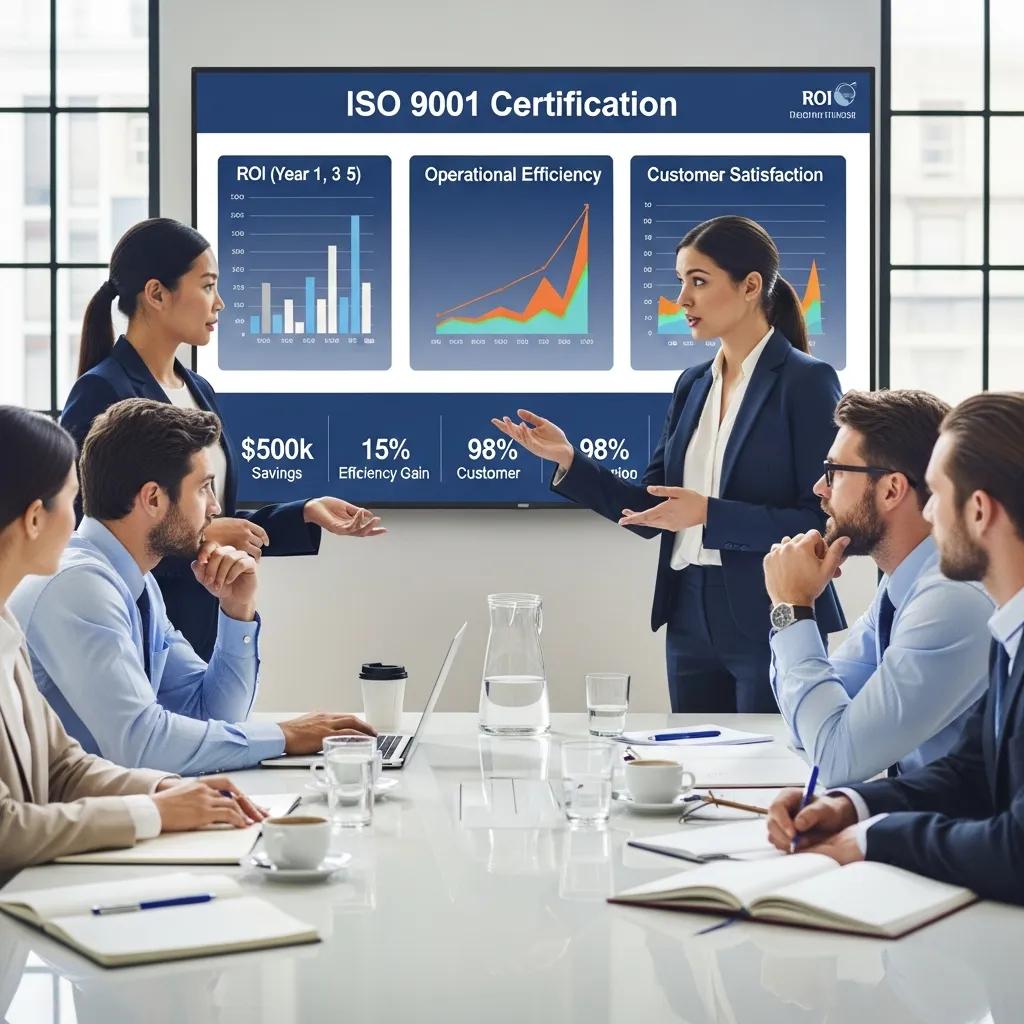
ROI for ISO 9001 is calculated by comparing incremental benefits (new contract revenue, reduced rework, lower defect-related costs) against total certification and ongoing compliance costs over a chosen period, typically three years. The mechanism is to quantify measurable KPIs—contract wins attributable to certification, percentage reduction in defects, change in customer complaints, and time-to-delivery improvements—and translate them into EUR where possible. Presenting a simple ROI formula helps stakeholders decide: ROI = (Net benefits over period − Certification & maintenance costs) / Certification & maintenance costs. The table below links common benefit types to practical metrics and example KPI improvements to support grant or board-level approval.
Intro to ROI table: This table maps benefit types to measurable metrics and sample values so teams can populate a three-year ROI model for ISO 9001 investments.
| Benefit type | Metric | Example KPI / percent improvement |
|---|---|---|
| New contract revenue | Win rate on tenders requiring ISO 9001 | +10–25% win rate |
| Reduced defects | Defect rate reduction | −20–50% |
| Efficiency gains | Lead time or throughput improvement | +10–30% |
| Cost of poor quality | Reduction in rework/warranty cost | −15–40% |
Summary paragraph: Translating improvements into monetary terms—such as the average contract value multiplied by improved bid success—creates a compelling financial case for certification. Use conservative and optimistic scenarios in a three-year cash-flow model to show payback periods and sensitivity to different KPIs. After establishing measurement, the next subsections list financial and operational KPIs and show how case-study formats can demonstrate real-world returns.
Welche finanziellen und operativen Vorteile resultieren aus der Zertifizierung?
Financial and operational benefits include increased contract eligibility and win rates, lower cost of poor quality through fewer defects and returns, and improved operational efficiency that shortens lead times. Quantifiable KPIs to track are tender win rate, average contract value, defect rate, rework cost as a percentage of revenue, and cycle time for core processes. Example improvements from conservative benchmarking could be a 10% increase in eligible tenders won and a 20% reduction in rework costs, which together can offset certification and maintenance fees within one to two years. Tracking these KPIs before and after certification creates the evidence base needed for ROI calculations and supports continuous improvement initiatives.
Research further supports these financial advantages, demonstrating how ISO 9001 certification can significantly improve a company’s profitability and financial health.
Financial Benefits of ISO 9001 Certification: Gross Profit, Sales, and Debt Ratios
The result of this research is that there is a significant positive difference between ISO 9001 certified companies in Iceland and companies without certification. The certified companies had a significant higher gross profit margins and return on sales ratio. There was also a difference in financial health of the certified companies from the non-certified companies where certified companies had lower debt ratio than companies that were not certified.
Financial benefits of an ISO 9001 certification, 2012
The following subsection explains how to structure case studies that clearly demonstrate these benefits.
Wie unterstützen Fallstudien die Bewertung des Nutzens?
Case studies should follow a simple, comparable blueprint: context and challenge, actions taken (including certification scope and timeline), costs (certification, consultancy, internal time), and measurable results (KPI changes and financial impact). Present before/after metrics—such as reduction in defect rate, increased tender win rate, and net revenue uplift—and compute a simple payback or ROI percentage over three years. Industry-relevant examples resonate most with procurement and finance stakeholders; anonymized metrics from similar sectors are particularly persuasive. A clean case-study template enables rapid evaluation of expected benefits for parallel projects, and it links the strategic procurement advantage of ISO 9001 to concrete financial outcomes.
Wie optimiert Stratlane Certification Deutschland Ihre Investition in die ISO 9001 Zertifizierung?
Stratlane Certification Deutschland is an innovative certification body based in Düsseldorf, Germany, that offers ISO certification services across Europe and the UK and uses AI-powered audit systems combined with experienced industry auditors to improve efficiency and reduce costs. Their approach focuses on accurate scoping, AI-assisted document review to shorten auditor preparation time, and transparent pricing models that limit surprises during registration and surveillance cycles. Accreditation and global acceptance of certificates ensure that certification meets buyer expectations and procurement requirements across international supply chains. For organizations seeking to optimize their ISO 9001 investment, working with an accredited registrar that leverages AI can reduce auditor days while preserving the contextual judgement provided by experienced auditors.
Welche Vorteile bieten KI-gestützte Audits und erfahrene Auditoren?
AI-assisted audits accelerate document analysis, evidence collection and cross-referencing, which reduces administrative audit time and focuses human auditors on contextual and risk-based judgement. The combined model uses AI to pre-process records and flag anomalies, while experienced auditors validate findings, assess process effectiveness, and interpret industry-specific risks—preserving audit quality. This hybrid approach typically reduces the number of on-site days and the cost associated with repetitive documentation review without compromising the registrar’s ability to assess compliance and continual improvement. Clients benefit from faster audit cycles, clearer audit reports, and fewer administrative interruptions during normal operations, which together lower the total cost of certification.
Emerging research highlights the potential of AI-powered expert systems to further streamline the audit process and significantly reduce associated costs.
Reducing ISO 9001 Audit Costs with AI-Powered QMS Expert Systems
Many organizations still face significant challenges in document audits, such as contract reviews, accounting audits, and compliance checks, which require substantial manpower and time. Current Artificial Intelligence solutions struggle with ambiguous requirements, unclear standards, and complex documents, limiting their scalability and effectiveness. To address these challenges, we propose a novel architecture, LLMES, designed to generate a concise and independent audit checklist. This approach allows Large Language Models to perform audits and produce results without prior fine-tuning.
LLMES: an LLMs-based expert system for quality management system audits, M Yang, 2025
Wie gewährleistet Stratlane eine kosteneffiziente und anerkannte Zertifizierung?
Stratlane emphasizes precise scoping during the pre-audit phase to avoid scope creep, offers remote preparation support to lower travel-related fees, and applies accredited procedures that ensure international acceptance of certificates. Their process includes transparent estimates tied to defined scope, so companies can compare quotes meaningfully and budget for surveillance and recertification. Experienced auditors provide industry-relevant judgement while AI tools handle repetitive evidence work, resulting in fewer auditor-days and a reduced chance of costly nonconformities due to administrative gaps. Organizations planning ISO 9001 certification can therefore optimize total cost of ownership by combining internal preparation, selective consultancy where needed, and a registrar that blends accreditation, audit expertise and automation to drive efficiency.
- Key takeaways for budgeting certification:Define scope precisely to get comparable registrar quotes.Invest in QMS maturity to reduce auditor days.Plan surveillance and recertification as recurring operating costs.
- Practical next steps for decision-makers:Map processes and sites to estimate audit days.Run an internal gap analysis focused on evidence and internal audits.Consider AI-enabled registrars and targeted consultancy to shorten timelines.