
Was ist ISO 50001? Der Standard für Energiemanagementsysteme
ISO 50001 is an international management standard that specifies requirements for establishing, implementing, maintaining and improving an Energy Management System (EnMS) to enable organisations to follow a systematic approach in achieving continual improvement of energy performance. This guide explains how ISO 50001 helps organisations reduce energy consumption, lower operating costs and meet regulatory and sustainability objectives through measurable energy performance indicators (EnPIs) and a defined energy baseline. Many organisations face rising energy costs, complex regulatory expectations and stakeholder pressure for verifiable emissions reduction; ISO 50001 provides a structured response that ties policy, planning and operational controls to measurable outcomes. Readers will learn what the standard covers, the PDCA cycle applied to energy management, tangible business benefits including typical savings, the implementation roadmap, integration with ISO 9001 and ISO 14001, and how AI and digital tools accelerate performance improvement. The article uses practical examples relevant to manufacturing, commercial buildings and IT operations, and includes tables and step lists to make planning actionable and ready for procurement or governance discussions.
What is ISO 50001? Defining the International Energy Management Standard
ISO 50001 defines a framework organisations use to set energy policy, carry out energy reviews, establish objectives, monitor energy performance and pursue continuous improvement through the PDCA cycle. The standard applies to any organisation, regardless of size or sector, that wishes to improve energy efficiency, reduce costs and demonstrate compliance with energy-related regulations and sustainability commitments. ISO 50001 focuses on energy performance rather than specifying particular technologies, which makes it suitable for industrial plants, commercial buildings and IT infrastructure alike. Understanding the standard’s scope and its emphasis on measurable EnPIs and a documented energy baseline prepares organisations to design targeted interventions that yield both short-term savings and longer-term resilience.
H3: What are the core principles and PDCA cycle in ISO 50001?
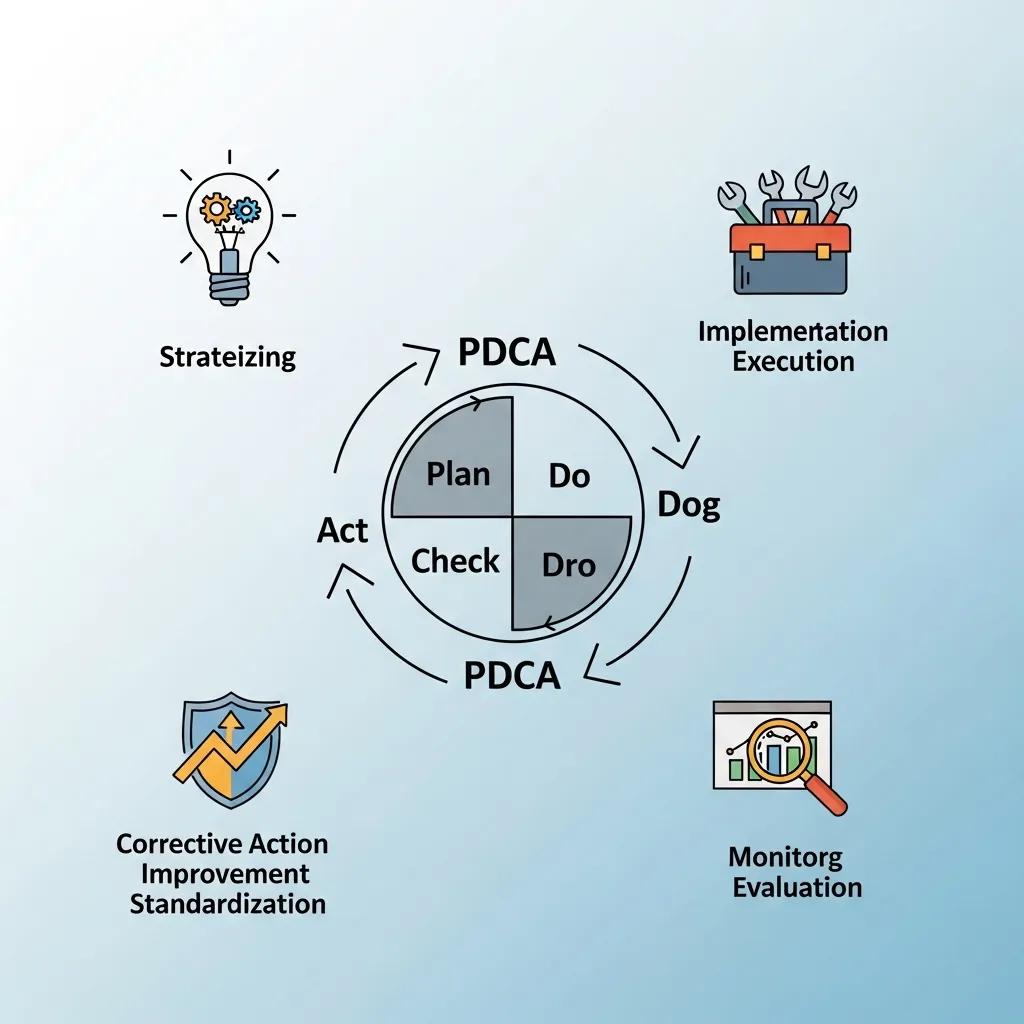
The PDCA (Plan–Do–Check–Act) cycle anchors ISO 50001 and organises energy management into repeatable stages that produce measurable improvement. Plan requires an energy policy, an energy review and identification of significant energy uses to set objectives and EnPIs; Do involves implementing operational controls, training and investment decisions; Check covers monitoring, measurement and internal audit against EnPIs and the energy baseline; Act requires management review and corrective actions to refine objectives. For example, an IT director might Plan by establishing a server-room energy baseline, Do by deploying efficient cooling setpoints, Check via continuous EnPI monitoring, and Act by adjusting procurement and maintenance schedules to sustain gains. Linking each PDCA stage to concrete EnMS activities ensures accountability and shorter feedback loops for performance gains.
H3: How has ISO 50001 evolved to meet modern energy challenges?
ISO 50001 has matured to prioritise performance measurement and continual improvement in response to rising digital demand and regulatory pressure, making the standard relevant to contemporary energy challenges. Recent revisions, including the 2018 update, emphasize clearer EnPI definitions, robust baselines and integration with corporate sustainability goals such as Net Zero commitments; this evolution helps organisations quantify emissions-related impacts of energy use. Digitalisation and AI-driven analytics are increasingly cited as drivers that enable more granular monitoring and faster PDCA cycles, which in turn make ISO 50001 more actionable across sectors. As energy markets and regulations tighten, the standard’s performance orientation allows organisations to demonstrate measurable progress to stakeholders, procurement partners and regulators.
What are the Key Benefits of ISO 50001 Certification for Businesses?

ISO 50001 certification delivers measurable energy savings, stronger compliance posture and market credibility by formalising an organisation’s approach to energy performance. Organisations typically see energy reductions through systematic measurement and operational changes, which translate into lower operating costs, improved risk management against regulatory changes, and clearer reporting for investors and customers. The standard also supports supply-chain requirements and procurement filters that favour certified suppliers with verifiable energy management practices. Implementing ISO 50001 aligns energy goals with business strategy and creates a governance framework for continual efficiency gains and resilience against price volatility.
H3: How does ISO 50001 drive energy efficiency and cost savings?
This subsection summarizes the mechanisms by which ISO 50001 produces savings and lists primary benefits to target quick understanding before implementation planning. The standard drives efficiency by requiring organisations to identify significant energy uses, set measurable EnPIs, and prioritise measures based on cost-benefit analysis, which typically produces sustained reductions in consumption.
ISO 50001 offers the following core benefits:
- Improved energy efficiency resulting from targeted operational changes and investment decisions.
- Documented cost savings through measurement and verification against a baseline.
- Reduced exposure to regulatory and market energy price risks via proactive management.
- Enhanced credibility with clients and investors through certified performance reporting.
These benefits compound over time as continuous improvement shortens PDCA cycles, making future savings easier to capture and justify.
Before examining sector comparisons, note how outcomes differ by context: manufacturing often captures process improvements, IT operations focus on server and cooling efficiency, and commercial buildings gain through HVAC and lighting optimisation. The next section presents a compact sector comparison to guide expected returns.
| Sector | Typical Savings | Strategic Benefit |
|---|---|---|
| Manufacturing | 8–18% energy reduction over several years | Lower production costs and improved competitiveness |
| IT operations | 5–15% reduction through cooling and workload optimisation | Improved uptime and lower hosting costs |
| Commercial buildings | 10–20% through HVAC and controls | Tenant satisfaction and lower operating expenses |
This comparison demonstrates how sector-specific EnMS measures deliver measurable financial and sustainability outcomes that feed directly into corporate strategy and procurement requirements.
For organisations that need certification and audit support, Stratlane Certification Deutschland is an accredited certification body offering ISO management system certification services and AI-enabled audit capabilities that can accelerate evidence collection and analysis. Stratlane Certification Deutschland works with professional auditors across more than 29 countries and issues certificates that are accepted by universities, companies and SMEs globally. If your procurement or clients require formal certification like ISO 9001 in addition to ISO 50001 evidence, engaging an accredited body helps close that requirement gap and aligns energy management with broader quality and compliance expectations.
What are the Essential Requirements and Steps for ISO 50001 Implementation?
ISO 50001 requires an energy policy, an energy review, documented objectives and targets, EnPIs, an energy baseline, operational controls, monitoring and measurement, internal audit and management review. Implementation typically begins with scoping and an energy review to identify significant energy uses and to establish baselines and EnPIs that will measure progress. From there, organisations develop an action plan with prioritized projects, assign responsibilities, install monitoring or metering where needed and conduct internal audits to verify results. A clear implementation roadmap helps align investments with expected payback and supports the certification audit when management demonstrates sustained performance and continual improvement.
H3: What are the core components of an effective Energy Management System?
An effective EnMS combines policy, planning, operational controls, competence-building, and performance measurement to create sustained improvement in energy performance. Core components include a documented energy policy that commits leadership support, an energy review to uncover significant energy uses and baseline data, EnPIs tied to objectives, documented operational controls for high-impact systems, and training to embed energy-aware behaviours. Measurement infrastructure—metering, data collection, and analytics—enables verification against the energy baseline and supports management review. These elements together create the control points auditors look for and provide a defensible basis for calculating savings and reporting to stakeholders.
The following table maps key requirement elements to typical outputs and EnPI examples for practical planning and risk management.
| Requirement Element | Typical Output | Example EnPI |
|---|---|---|
| Energy Review | List of significant energy uses | kWh per production unit |
| Energy Baseline | Reference period consumption profile | Annual kWh baseline |
| Objectives & Targets | Documented targets and timelines | % reduction in kWh/year |
| Monitoring & Measurement | Metering plan and logs | Cooling system kW demand |
| Internal Audit | Audit reports and corrective actions | Audit findings closed rate |
H3: How does the ISO 50001 certification process unfold?
Certification typically follows a staged sequence: preparation and gap analysis, system implementation, internal audits and management review, external certification audit, and ongoing surveillance audits. Preparation includes defining scope, conducting an energy review, and documenting the EnMS; implementation covers process changes, training and meter deployment; internal audits validate readiness and feed into management review before the external assessment. The external audit is performed by an accredited body that verifies conformance and the effectiveness of the EnMS; following certification, surveillance audits check sustained compliance, and recertification occurs on a three-year cycle. Planning realistic timelines—often several months to a year depending on scope—helps manage expectations and capture early wins to fund further measures.
How Does ISO 50001 Integrate with Other Management Systems like ISO 9001 and ISO 14001?
ISO 50001 shares the common high-level structure and PDCA approach used across ISO management system standards, which simplifies integration with ISO 9001 (quality) and ISO 14001 (environmental). Shared clauses such as leadership, planning, support, operation, performance evaluation and improvement enable joint audits, aligned management reviews and consolidated documentation. Practical integration reduces duplication of effort in objectives, internal audits and corrective actions, and presents a unified compliance posture to clients and regulators. This compatibility is particularly valuable when procurement requires both energy performance evidence and quality management certification from suppliers.
H3: What are the synergies between ISO 50001 and ISO 14001 environmental standards?
ISO 50001 and ISO 14001 complement each other by linking energy performance to environmental impacts and regulatory obligations, enabling organisations to address emissions and resource use in a coordinated way. Both standards require leadership commitment, lifecycle perspective in planning and performance evaluation—ISO 50001 provides precise EnPIs while ISO 14001 frames broader environmental aspects and impacts. Integrating the two allows a single environmental-energy policy, shared objectives (for example, reducing CO2 intensity per unit output), and combined audits, which improves efficiency and strengthens reporting for ESG and regulatory disclosures. This joint approach simplifies stakeholder communication and enhances the organisation’s sustainability credibility.
H3: How can ISO 50001 complement ISO 9001 quality management objectives?
ISO 50001 supports ISO 9001 by improving process consistency and reducing energy-related variability that can affect product or service quality; energy-efficient operations often produce more stable conditions for quality-critical processes. Shared PDCA cycles mean objectives for quality and energy can be aligned into integrated KPIs—such as cost-per-unit, defect rates and kWh-per-unit—so that efficiency measures reinforce quality outcomes. From a procurement perspective, many clients require ISO 9001-certified suppliers to ensure consistent delivery; demonstrating ISO 50001 alongside ISO 9001 provides a stronger business case by showing both quality and operational cost control. This procurement alignment often makes ISO 9001 an essential requirement when energy performance is a contract criterion.
- Clear demonstration of governance and risk management across quality and energy.
- Evidence of continuous improvement and reliable measurement systems.
- Reduced likelihood of operational disruptions due to energy-related failures.
- Cohesive documentation that eases supplier assessments and audits.
These synergies make integrated management systems more attractive to clients and simplify supplier qualification processes for complex contracts.
How Can AI and Digital Tools Enhance ISO 50001 Energy Management?
AI and digital tools accelerate measurement, analysis and control tasks that underpin ISO 50001’s measurement-driven approach, enabling faster detection of inefficiencies and more precise EnPI tracking. Advanced analytics transform meter and operational data into actionable insights, predictive maintenance signals and anomaly detection that shorten PDCA cycles and prioritise interventions with the highest return. Digital dashboards and automated reporting reduce audit preparation time and provide auditors with verifiable, time-series evidence to support certification claims. Combined, these tools turn raw energy data into governance-ready information that supports continual improvement.
H3: What role does AI-powered auditing play in energy performance improvement?
AI-powered auditing automates data validation, identifies outliers and trends in EnPIs, and surfaces opportunities that manual analysis might miss, enabling organisations to act faster on inefficiencies. For example, anomaly detection can flag abnormal cooling demand overnight, prompting investigation and corrective action that preserves savings and uptime. Predictive models can forecast energy demand and guide load-shifting or procurement strategies to capitalise on lower tariffs, improving cost outcomes. Organisations using AI-driven audit capabilities reduce the time auditors spend gathering evidence and increase the focus on value-creating actions, shortening the feedback loop between Check and Act phases of PDCA.
H3: How can digital transformation support continual energy efficiency?
Digital transformation equips an EnMS with IoT sensors, cloud analytics and visual dashboards that provide real-time EnPI monitoring, automated alerts and consolidated reporting for management review. IoT metering feeds granular data into models that segment consumption by system or process, enabling targeted measures rather than broad, costly initiatives. Governance is strengthened by role-based dashboards and audit trails that demonstrate data integrity and decision histories during external assessment. Visual assets such as trend charts and flow diagrams make management review sessions more effective and support evidence-based decisions that sustain improvements over time.
For organisations seeking accredited certification and AI-augmented auditing support, Stratlane Certification Deutschland offers certification services and leverages AI-powered audit tools to streamline evidence collection and analysis. As an accredited certification body with professional auditors operating in over 29 countries, Stratlane Certification Deutschland can help organisations align ISO 50001 with procurement and quality requirements such as ISO 9001, providing a practical route to satisfy client demands and regulatory expectations. Their services can be particularly useful for organisations that need efficient audit workflows and internationally recognised certificates accepted by universities, companies and SMEs.