

Grundlagen der ISO 45001: Das Managementsystem für Arbeitsschutz
ISO 45001 is the international standard for an Occupational Health and Safety Management System (OHSMS), published as ISO 45001:2018, that helps organisations proactively manage workplace risks and prevent work-related injury and ill health. This article explains what ISO 45001 requires, why it matters for compliance and business continuity, and how organisations can implement a risk-based, Plan-Do-Check-Act (PDCA) approach to protect people and operations. Readers will learn the standard’s scope, the core clauses and practical deliverables, the business benefits and cost drivers, the certification pathway from gap analysis to issuance, and how ISO 45001 interacts with ISO 9001 in integrated management systems. The guide also covers industry-specific adaptations for sectors such as construction, IT and manufacturing, and highlights how modern audit methods — including AI-assisted approaches used by some accredited bodies — can accelerate readiness. Start by understanding the standard’s definition and scope, then follow the implementation and certification steps to align safety with organisational objectives.
What is the ISO 45001 Standard and Its Scope?
ISO 45001 is a management-system standard that specifies requirements for an OHSMS to enable organisations to provide safe and healthy workplaces by preventing work-related injury and ill health and by proactively improving OH&S performance. The standard applies to organisations of any size or sector and uses the High-Level Structure (HLS) familiar from other ISO management standards to support integration with systems such as ISO 9001 and ISO 14001. ISO 45001 is risk-based and requires organisations to identify hazards, assess risks and determine controls that are proportionate to their context and activities. Understanding the standard’s scope clarifies which sites, processes and contractors fall under the OHSMS so that legal obligations and operational controls are consistently applied.
Definition of ISO 45001 and Occupational Health and Safety Management System
ISO 45001 defines an OHSMS as a set of interrelated elements enabling an organisation to establish OH&S policy, identify hazards, assess risks and implement controls to eliminate or minimise harm. An OHSMS typically includes an OH&S policy, documented procedures for risk assessment and operational control, incident investigation processes, and mechanisms for worker consultation and participation. For example, a lockout/tagout procedure for machinery is a practical control that flows from a risk assessment and becomes a documented operational control under ISO 45001. This structure ensures that risk identification, control selection and verification are managed systematically and feed into continual improvement processes.
Key Objectives and Purpose of ISO 45001
The principal objectives of ISO 45001 are to prevent work-related injury and ill health, ensure legal and regulatory compliance, and promote continual improvement of OH&S performance using a risk-based approach. By formalising responsibilities, competencies and performance evaluation, the standard enables organisations to set measurable targets such as reducing lost-time incidents, lowering incident rates, and improving near-miss reporting. ISO 45001 embeds the PDCA cycle—planning risk controls, implementing them, monitoring effectiveness, and acting on nonconformities—which drives structured improvement over time. These objectives support both worker well-being and operational resilience, linking safety outcomes to broader organisational performance.
Research further highlights how integrating the PDCA cycle is crucial for overcoming common barriers to effective ISO 45001 implementation.
Overcoming ISO 45001 Implementation Barriers with PDCA
the most important barriers to the effective application of ISO 45001:2018 in companies. In a solution by integrating ISO 45001:2018, based on the PDCA cycle, with quality circles.
A Theoretical Framework to ISO 45001: 2018
OHS Management System: The Improvement of Its Application Steps by Quality Circles, A Adem, 2018
What Are the Benefits of ISO 45001 Certification for Businesses?

ISO 45001 certification brings demonstrable business value by reducing workplace incidents, improving legal compliance, enhancing reputation, and supporting operational efficiency through systematic safety management. Certification signals to customers, regulators and insurers that an organisation follows recognised OH&S best practice, which can influence contract awards and insurance terms. The standard also promotes worker participation and training, which improves morale and retention while reducing absenteeism. Below we summarise the primary benefit areas and the mechanisms that create value, followed by a compact entity–attribute–value table to present scannable facts for decision makers.
Studies confirm that implementing ISO 45001, especially as part of an integrated management system, significantly boosts business performance and employee awareness.
ISO 45001 Impact on Business Performance & Employee Awareness
The purpose of this study was to determine the effect of the implementation of the Integrated Management System (IMAS) particularly the ISO 9001:2015 (Quality), ISO 14001:2015 (Environment), ISO 22000:2018 (Food Safety) and ISO 45001:2018 (Safety) on business Performance of Indonesian Food Industry. The results of the analyses showed that the implementation of IMAS has significantly influenced the business performance of the selected companies. Interestingly, it is also found that IMAS has contributed to the increase of employee awareness, improvement of the company’s image, improvement of quality and safety of the food products, the enlargement of new customers pool and facilitate access to new markets.
The effect of implementation integrated management system ISO 9001, ISO 14001, ISO 22000 and ISO 45001 on
Indonesian food industries performance, P Agus, 2015
How Does ISO 45001 Improve Workplace Safety and Employee Well-being?
ISO 45001 improves workplace safety by requiring structured hazard identification, risk assessment and implementation of proportionate controls, which reduce exposure to hazards across processes and sites. The standard emphasises worker participation, so employees provide input to risk assessments, which enhances hazard recognition and adoption of controls. Training, competence records and communication protocols required by the standard ensure that workers understand safe work procedures and emergency arrangements. These mechanisms translate into measurable outcomes such as fewer incidents, improved reporting culture and better employee morale, all of which support sustained productivity.
What Cost Savings and Legal Compliance Advantages Does ISO 45001 Provide?
ISO 45001 delivers direct and indirect cost savings through fewer incidents, reduced lost workdays, lower insurance-related costs and avoidance of fines due to non-compliance with OH&S laws. Organisations that systematically manage hazards also experience productivity gains and lower turnover, reducing recruitment and training costs. Compliance with legal and regulatory requirements is embedded in the planning and support clauses of the standard, helping organisations demonstrate due diligence in procurement and contract negotiations. Together, these financial and compliance benefits improve the business case for investing in an effective OHSMS.
Different benefit areas and the mechanisms that produce value are summarised below for quick reference.
| Benefit Area | Mechanism | Value |
|---|---|---|
| Incident reduction | Structured risk assessments and controls | Fewer injuries and lost-time incidents |
| Legal compliance | Legal register and monitoring | Reduced fines, improved regulatory standing |
| Financial savings | Lower claims and insurance exposure | Reduced direct and indirect costs |
| Reputation & contracts | External certification evidence | Better access to clients and tenders |
| Workforce performance | Training and worker participation | Higher morale, retention, and productivity |
This table clarifies how each benefit links to specific OHSMS mechanisms, helping leaders prioritise interventions that yield measurable return. Understanding these links supports targeted investment in risk controls and management processes.
Stratlane Certification Deutschland, an accredited certification body that combines experienced auditors with AI-assisted audit workflows, positions organisations to demonstrate compliance and readiness efficiently. For organisations seeking external certification, an accredited provider that applies consistent audit methodologies and sector expertise can shorten audit preparation time and increase confidence during external assessment. This practical advantage is particularly valuable where certification is a contractual requirement or a differentiator in competitive procurement.
What Are the Core Requirements and Clauses of ISO 45001?
ISO 45001 follows the ISO High-Level Structure with core clauses covering context, leadership, planning, support, operation, performance evaluation and improvement; each clause defines requirements that translate into tangible deliverables such as an OH&S policy, risk assessments, documented procedures and records. The standard mandates leadership commitment, a process for assessing legal requirements, documented information control, competence and communication arrangements, operational controls and incident management. Mapping clauses to pragmatic tasks helps teams allocate responsibilities and prepare evidence for internal and external audits. The table below links major clauses to practical examples to guide implementation planning.
How Does Leadership and Worker Participation Influence ISO 45001 Implementation?
Top management must demonstrate leadership and commitment by establishing an OH&S policy, assigning roles and ensuring resources for the OHSMS, which embeds safety into organisational governance and strategic decision-making. Worker participation is required through consultation, representation or joint committees, enabling frontline insights to inform risk assessment and control selection. Practical mechanisms include regular toolbox talks, safety committees with documented minutes, and worker-led hazard reporting systems, all of which create audit evidence of meaningful participation. Leadership visibility and structured worker engagement improve adoption of controls and accelerate corrective actions when nonconformities arise, which strengthens continuous improvement.
What Are the Planning, Support, Operation, and Improvement Clauses in ISO 45001?
Planning requires organisations to identify hazards, assess OH&S risks and opportunities, and set measurable objectives with action plans; support covers competence, awareness and documented information; operation demands implementation of risk controls and contractor management; improvement focuses on incident investigation, corrective action and continual enhancement. Practical tasks include maintaining a legal requirements register, performing documented risk assessments, ensuring staff competence records, and operating emergency plans and permits-to-work where needed. Evidence for these clauses takes the form of risk registers, training logs, operational procedures and corrective action records, which auditors review to confirm effective implementation and cycle-driven improvement.
Practical clause mapping is shown below to assist implementers in connecting requirements to actions.
| Clause | Requirement | Practical Example |
|---|---|---|
| Context of the organisation | Determine internal/external issues and interested parties | Scope statement and stakeholder map |
| Leadership | Policy, roles, and accountability | OH&S policy signed by top management |
| Planning | Hazard identification and objectives | Risk register with mitigation plans |
| Support | Competence, communication, documented info | Training matrix and controlled documents |
| Operation | Operational control and contractor management | Permits-to-work and contractor induction |
| Performance evaluation | Monitoring, internal audit, management review | KPI dashboard and audit reports |
| Improvement | Nonconformity and corrective action | CAPA records and trend analysis |
This clause-to-example mapping helps teams prepare tangible artefacts for audits and to align operational practices with ISO 45001 requirements.
How Is the ISO 45001 Certification Process Structured?
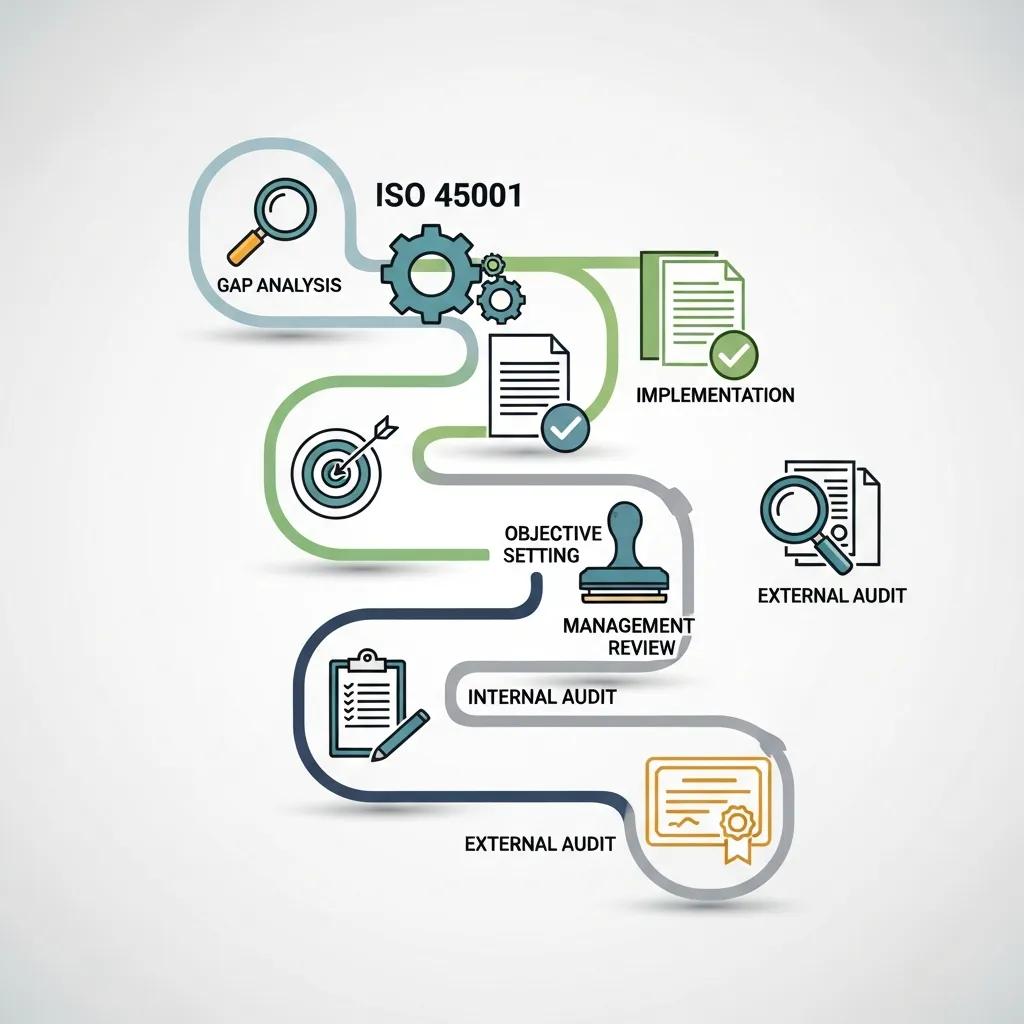
Certification to ISO 45001 follows a staged, auditable pathway: initial gap analysis and remediation planning, implementation and internal audit, then external certification assessment typically delivered as Stage 1 (documentation review) and Stage 2 (on-site/remote verification) leading to certificate issuance and periodic surveillance audits. Expected timelines vary with organisational complexity but a realistic programme includes 2–6 months for gap closure and implementation before external assessment. Each stage focuses on different evidence: Stage 1 confirms documented system readiness while Stage 2 verifies operational effectiveness and worker engagement. Clear timelines and stakeholder responsibilities help organisations align resources and demonstrate readiness to certifying bodies and customers.
What Are the Steps from Gap Analysis to Certificate Issuance?
A practical certification pathway includes these core steps, each with deliverables and typical timing estimates:
- Gap analysis and roadmap: identify nonconformities and create an implementation plan (2–6 weeks).
- System implementation: develop policy, procedures, controls and training (4–12 weeks).
- Internal audit and management review: verify effectiveness and close corrective actions (2–6 weeks).
- External Stage 1 audit: documentation and readiness review leading to Stage 2 scheduling (1–2 weeks).
- External Stage 2 audit and certification: on-site/remote verification and certificate issuance, followed by surveillance audits (1–4 weeks).
Each step produces checklistable outputs such as risk registers, training records, internal audit reports and corrective action logs that demonstrate progress toward certification. Preparing these deliverables in advance reduces the likelihood of nonconformities during external assessment.
How Does Stratlane’s AI-Powered Audit Enhance the Certification Process?
Stratlane Certification Deutschland combines experienced auditors with AI-enabled audit tools to improve efficiency and consistency during preparation and assessment. AI-assisted workflows can support predictive gap identification and streamline evidence collection by flagging missing documentation and recurring nonconformities, helping clients prioritise remediation. When experienced auditors interpret AI-generated findings, organisations gain actionable, sector-relevant recommendations that shorten pre-audit cycles and clarify corrective actions. The practical result is often faster readiness, fewer surprises in Stage 1/Stage 2 audits, and clearer pathways to maintain compliance during surveillance — an advantage for organisations seeking timely certification.
What Are the Differences and Synergies Between ISO 45001 and ISO 9001?
ISO 45001 focuses on occupational health and safety while ISO 9001 focuses on quality management and customer satisfaction; both share the ISO High-Level Structure which makes them integrable into a single integrated management system (IMS). Shared elements include context analysis, leadership, planning, documented information, internal audit and management review, which enable combined audits and unified processes such as document control and corrective action handling. The synergy reduces duplication, aligns objectives and clarifies responsibilities across safety and quality domains, while each standard retains unique requirements—safety-specific risk controls for ISO 45001 and product/service conformity metrics for ISO 9001. Many clients and formal procurement processes require ISO 9001 as a baseline, so combining both standards often meets contractual expectations and streamlines compliance.
How Do ISO 45001 and ISO 9001 Integrate in Management Systems?
Integration leverages shared clauses and common processes to create operational efficiencies: document control, internal audit, corrective action and management review can be unified under a single procedure and audit schedule. Practically, organisations map overlapping requirements—such as objectives, performance indicators and competence records—to avoid parallel systems and reduce audit fatigue. Integrated risk registers can capture quality and safety risks together, while training matrices reflect competence needs across disciplines. Implementation tips include harmonising terminology, using a single policy framework with cross-references, and scheduling combined internal audits to reduce disruption and create consolidated audit evidence.
| Standard | Focus Area | Overlap / Unique |
|---|---|---|
| ISO 45001 | Occupational health & safety | Emphasises hazard controls, worker participation |
| ISO 9001 | Quality management | Emphasises product/service conformity, customer focus |
| Overlap | Management system structure | Shared HLS clauses, document control, audits |
| Integration benefit | Efficiency and reduced duplication | Unified audits and harmonised objectives |
What Are the Key Differences in Focus Between Quality and Safety Standards?
ISO 9001 prioritises meeting customer requirements and managing processes to deliver consistent product/service quality, using metrics like defect rates and customer satisfaction; ISO 45001 prioritises preventing harm and ensuring worker well-being, using metrics like incident frequency and lost-time rates. Evidence in ISO 9001 audits often centres on process controls, product records and traceability, whereas ISO 45001 audits emphasise risk assessments, operational controls and worker consultation records. Clients and procurers commonly demand ISO 9001 as a prerequisite for supplier qualification because it demonstrates process reliability; pairing ISO 9001 with ISO 45001 communicates both operational quality and a commitment to employee safety, strengthening commercial credibility and contract eligibility.
How Does ISO 45001 Apply to Different Industries?
ISO 45001 is deliberately flexible so organisations can tailor controls to sector-specific hazards, legal frameworks and operational practices; this adaptability makes it applicable to construction, IT, manufacturing, healthcare and others. Each sector requires different risk controls and documented information: construction needs robust contractor management and site-based permits, manufacturing focuses on machine safety and maintenance regimes, while IT emphasises ergonomics and psychosocial risks. Tailoring involves selecting appropriate controls, training content and monitoring KPIs that reflect the real hazards of each activity. The guidance below identifies common sector hazards and offers practical tailoring examples and readiness checklists for three illustrative industries.
What Are Industry-Specific Occupational Health and Safety Challenges?
Different industries face distinct, predictable hazards and regulatory pressures that ISO 45001 helps address through targeted controls. Common sector hazards include:
- Construction: falls from height, moving plant, contractor coordination and site hazards.
- Manufacturing: machinery entanglement, hazardous energy, repetitive strain and maintenance risks.
- IT / Office: ergonomic strain, prolonged screen exposure and psychosocial stressors related to workload and remote work.
Mitigation strategies include engineering controls, safe work procedures, contractor induction systems, ergonomics programmes and mental health support measures; these controls must be documented, communicated and monitored as part of the OHSMS to be effective and auditable.
How Can ISO 45001 Be Tailored for Construction, IT, and Manufacturing?
Practical tailoring examples show how the standard translates into sector-specific controls: for construction, implement permit-to-work systems, site induction records and subcontractor management checklists; for IT, develop ergonomics assessments, hybrid/remote-work policies and psychosocial risk controls; for manufacturing, maintain lockout/tagout procedures, preventive maintenance schedules and machine guarding standards. A simple readiness checklist includes defined scope, legal register, risk register with sector-specific hazards, training records and evidence of worker consultation. These targeted adaptations ensure that the OHSMS addresses the most significant risks in each industry while remaining consistent with ISO 45001 requirements.
This adaptability is further demonstrated by research focusing on developing specific tools and methodologies to tailor ISO 45001 for unique industry challenges, such as those found in the construction sector.
ISO 45001:2018 Adaptation for OSH Performance & Worker Engagement
This study aims to develop and validate two innovative OSH assessment tools— the COSPL 1.0 Calculator and FLARE 1.0 Matrix—designed to enhance safety performance in Libya’s construction sector by adapting ISO 45001:2018 standards to local challenges. These tools integrate Libya-specific metrics with international standards to address critical gaps in leadership, planning, performance evaluation, and worker engagement.
ADAPTING ISO 45001: 2018 FOR OPTIMIZING SAFETY PERFORMANCE IN DEVELOPING COUNTRIES: A CASE STUDY ON LIBYA‘
S CONSTRUCTION SECTOR, AAA Elkaseh, 2018
- Construction checklist: scope mapped to sites, contractor vetting, toolbox talk schedule.
- IT checklist: ergonomics assessments, mental health resources, incident reporting for remote workers.
- Manufacturing checklist: maintenance logs, LOTO procedures, machine guarding audits.
These sector-focused measures make ISO 45001 practical and actionable across contexts, supporting compliance and operational safety in diverse environments.