

Optimierung der internen Auditfrequenz für ISO 9001 Compliance
Internal audit frequency defines how often an organization reviews its Quality Management System (QMS) to ensure conformity, effectiveness, and continual improvement. ISO 9001 requires audits at „planned intervals,“ which means frequency must be deliberate, risk-informed, and aligned with business impact rather than a fixed timetable. This article explains how to interpret Clause 9.2, which factors should determine audit cadence, and how a risk-based approach turns audit schedules into strategic instruments for compliance and operational resilience. Readers will learn practical steps to build a risk-mapped internal audit plan, examples for industry-tailored frequencies, and how digital tools and AI can make scheduling dynamic and evidence-driven. The guide covers regulatory expectations, auditor competence and independence, a risk-to-frequency matrix, technology use-cases, and sector-specific guidance for Automotive, Healthcare, and IT, delivering actionable advice for audit programme owners and quality managers.
This historical perspective underscores the evolution of audit planning from simple periodicity to a more strategic, risk-informed methodology.
Risk-Based Periodic Audit Scheduling
In recent years, assurance of quality has been derived via audit of the supplier or service provider and by using periodic audits, for example, annually or at least once every 5 years. In the past, companies may have used an audit only for what they considered to be “key” materials or services and used testing on receipt, for example, as their quality assurance measure for “less important”
A risk-based approach to scheduling audits, 2009
What Are the ISO 9001 Requirements for Internal Audit Frequency?
ISO 9001 requires that internal audits are performed at planned intervals to determine whether the QMS conforms to the organization’s own requirements and the standard, and whether it is effectively implemented and maintained. Planned intervals must reflect process importance, risk exposure, historical performance, and recent organizational changes so audit scheduling becomes a control in itself rather than a compliance checkbox. Audits should be carried out by competent, impartial auditors and the schedule must allow sufficient time for meaningful scope, evidence collection, and follow-up on corrective actions. Interpreting „planned intervals“ practically means establishing baseline cadences and adjusting them when risks or process criticality change, ensuring the audit programme supports management review and continual improvement.
ISO 9001 compliance often aligns with customer and sector expectations, where planned intervals are non-negotiable for key clients. For organizations seeking structured certification support, Stratlane Certification Deutschland offers ISO 9001 certification services that include planning and execution of internal audits to satisfy both standard requirements and client expectations. These services can serve as a resource when formalizing planned intervals and auditor arrangements.
How Does Clause 9.2 Define Planned Intervals for Internal Audits?
Clause 9.2 does not prescribe a fixed number of audits; instead, it requires that organizations establish planned intervals that ensure the audit programme evaluates conformity and effectiveness across the QMS. Practically, this is interpreted as: set an annual baseline for system-level review, schedule process-level audits based on criticality, and increase cadence for high-risk or customer-impacting processes. A common approach is annual system audits complemented by quarterly audits for high-risk areas, semi-annual audits for medium-risk, and annual audits for low-risk processes. This interpretation preserves flexibility while ensuring coverage and traceability for management review.
Translating Clause 9.2 into a schedule begins with process inventory and risk mapping, then documenting intervals in the audit programme. For example, a supplier qualification process with high customer impact might move from an annual to a quarterly audit after an adverse supplier event, demonstrating how planned intervals react to actual performance data. This practical translation helps internal audit frequency serve both compliance and risk mitigation goals.
What Are the Roles of Auditor Competence and Independence in Audit Scheduling?
Auditor competence and independence affect audit quality, scope, and scheduling because skilled, impartial auditors can cover complex processes more efficiently and deliver credible findings that management will act upon. Competence includes knowledge of ISO 9001 requirements, process-specific skills, and auditing techniques; independence reduces bias and may require auditor rotation or external participation for critical audits. Scheduling must therefore account for skill-matching—assigning auditors with the right technical background to high-complexity audits—and for maintaining impartiality, which can limit how often the same internal auditor assesses their own area.
Operationally, audit plans should reserve time for auditor training and external involvement where independence is essential, and they should stagger audits to avoid resource bottlenecks. Ensuring auditor competence and independence increases the trustworthiness of audit outcomes and supports more accurate risk-based adjustments to frequency and scope.
Which Factors Determine the Optimal Frequency of Internal Audits?
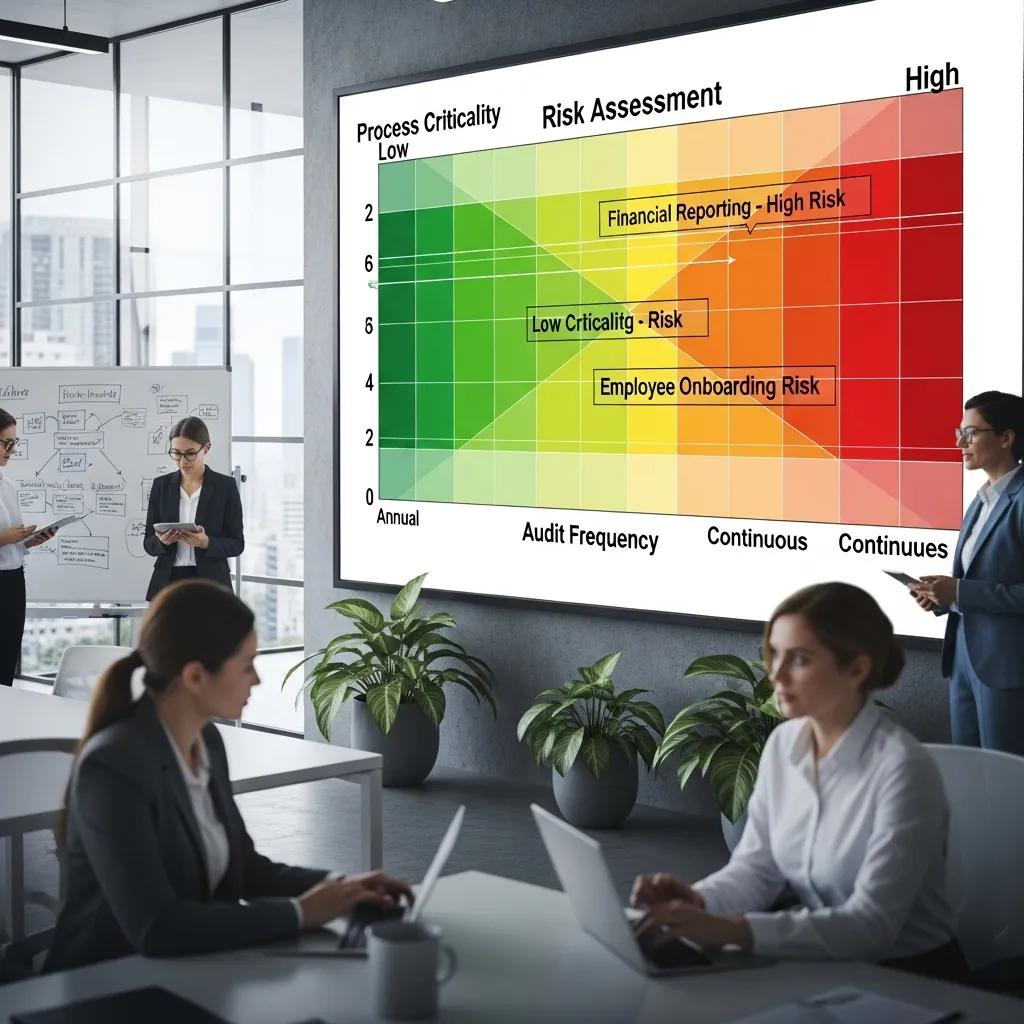
Optimal frequency is determined by a mix of process criticality, inherent and residual risk, past audit findings and trends, rate of organizational change, and available audit resources. These factors ensure audit activity focuses where non-conformities would have the greatest impact on customers, safety, or regulatory compliance rather than applying a uniform cadence. Balancing these attributes helps organizations allocate audit effort efficiently and maintain assurance across the QMS without over-auditing low-risk areas.
To operationalize this, use a checklist to capture the primary determinants before mapping them to frequencies.
- Key determinants for audit frequency include process criticality, historical non-conformities, regulatory exposure, rate of change, and supplier or third-party risk.
- Use a scoring approach to quantify determinants and translate scores into quarterly, semi-annual, or annual intervals.
- Review determinant scores after each audit cycle to update the schedule dynamically.
The following risk-to-frequency matrix provides a quick-reference mapping from process characteristics to recommended audit intervals.
Intro to the table: The table below maps typical process/area attributes to recommended audit frequencies, offering a practical starting point for converting risk assessments into scheduled audits.
| Process / Area | Risk Level / Complexity | Recommended Frequency |
|---|---|---|
| Safety-critical production process | High risk / High complexity | Quarterly |
| Customer service / order fulfilment | Medium risk / Moderate complexity | Semi-annual |
| Administrative support / internal finance | Low risk / Low complexity | Annual |
| New product introduction / pilot projects | Variable risk / Rapid change | Event-driven + quarterly until stable |
This matrix helps translate qualitative risk judgments into actionable intervals and can be adapted to specific organizational thresholds. Using such a matrix reduces guesswork and aligns audit effort to impact.
How Do Process Importance and Risk Influence Audit Frequency?
Process importance is defined by customer impact, safety implications, regulatory exposure, and financial or reputational consequences; risk captures likelihood and potential impact of failures within that process. Combining these dimensions yields a prioritization that directly maps to audit cadence: high-importance, high-risk processes require more frequent, deeper audits while low-importance, low-risk processes can be monitored less frequently. A simple scoring example assigns 1–5 points for importance and 1–5 for risk; combined scores of 8–10 indicate quarterly audits, 5–7 semi-annual, and 2–4 annual.
When process risk increases—such as after a supplier change or a spike in non-conformities—re-prioritization should trigger immediate follow-up audits and temporary increase in frequency until stability returns. This method ensures audit schedules remain responsive to real-world signals rather than static calendars, improving the audit programme’s relevance and efficiency.
What Impact Do Past Audit Results and Organizational Changes Have on Scheduling?
Past audit findings and trend analysis are essential inputs: persistent or recurring non-conformities should raise the cadence until corrective actions demonstrate sustained effectiveness, while clean trends may justify reduced audit frequency for that area. Likewise, organizational changes—new suppliers, process redesign, regulatory updates, or mergers—introduce fresh risk that requires targeted audits to verify controls and integration before reverting to baseline intervals. Using trend data to adjust frequency makes the audit programme proactive rather than reactive.
A typical operational rule is to require follow-up audits within three months for significant non-conformities and to schedule targeted audits after any major process change. By linking audit frequency to actual outcomes and structural changes, organizations preserve assurance where it matters most and avoid wasting resources on stable, low-risk areas.
How Can a Risk-Based Approach Improve Internal Audit Scheduling?
A risk-based approach aligns internal audit frequency to the likelihood and impact of potential failures, enabling audit resources to focus on areas with the greatest potential harm or non-conformity. This methodology replaces uniform schedules with evidence-driven cadences, increasing detection of systemic issues while reducing unnecessary checks in low-risk areas. The result is a more efficient audit programme that supports management decisions, improves corrective-action effectiveness, and strengthens the QMS over time.
Indeed, modern audit planning is increasingly viewed as a complex, multi-criteria decision-making process that seeks to optimize value beyond mere risk reduction.
Integrated Risk-Based Internal Audit Planning
Annual audit planning is a multi-criteria decision-making problem faced by internal audit departments of all organizations. Due to the constrained audit resources, the planning process primarily involves the analysis and evaluation of complex factors for selecting auditable units that maximize the full potential of internal audit. Previous research on internal audit planning only focused on the goal of risk minimization and applied ranking methods to prioritize alternatives. In order to enable internal audit activities to add more value to the organization, the integrated risk-based internal audit planning is proposed to assist audit department in achieving multiple objectives in addition to risk management.
A multi-objective optimization approach for integrated risk-based internal audit planning, X Wang, 2025
Key benefits of a risk-based schedule include improved prioritization, better management reporting, and tighter linkage between audit outcomes and business risk appetite. For organizations seeking expertise to operationalize this approach, Stratlane Certification Deutschland applies a combination of experienced auditors and AI-assisted risk scoring to develop practical, repeatable risk-based audit programmes that prioritize high-impact controls and maintain audit traceability.
What Steps Are Involved in Developing a Risk-Based Internal Audit Schedule?
A structured set of steps converts risk assessment into a living audit schedule: inventory processes, define risk criteria, score processes, map scores to frequencies, draft and approve the audit timetable, and monitor outcomes for adjustments. Each step requires stakeholder input—process owners, risk managers, and top management—to ensure the schedule reflects operational realities and strategic priorities. Practical tips include using standard scoring scales, documenting rationale for frequency choices, and scheduling periodic programme reviews to incorporate new risk intelligence.
- Inventory processes and identify stakeholders to ensure comprehensive coverage.
- Define risk criteria (likelihood, impact, regulatory exposure) and scoring methodology.
- Map combined scores to frequency bands, draft the schedule, and obtain management approval.
These steps produce a repeatable cycle: score, schedule, audit, review, and rescore, which embeds continual improvement into audit planning and supports transparent governance.
How Does Risk Assessment Guide Audit Frequency Decisions?
Risk assessment produces outputs—likelihood and impact scores—that can be combined into a risk rating and directly translated into audit intervals and scope adjustments. For example, combine likelihood (1–5) and impact (1–5) to form a 1–25 risk score; set thresholds such as 16–25 for quarterly audits, 8–15 for semi-annual, and 1–7 for annual. This quantitative mapping enables objective decisions and helps justify schedule choices to stakeholders and auditors. Furthermore, changes in the score should trigger automatic review of the audit interval, ensuring the timetable remains current.
Using such mappings also clarifies audit scope: higher-risk processes not only get audited more often but with expanded scope and deeper sampling, while lower-risk processes receive lighter, compliance-focused reviews. Tying frequency and scope to clear risk metrics strengthens the credibility and defensibility of the audit programme.
What Are the Benefits of Optimizing Internal Audit Frequency?
Optimizing audit frequency ensures assurance efforts are proportional to risk, improving compliance and reducing the probability of major non-conformities while avoiding resource waste. Right-sized auditing improves corrective-action effectiveness, shortens closure times, and provides management with timely insight into process performance. It also reduces auditor fatigue and administrative overhead by concentrating effort on high-value areas, which increases return on audit investment and enhances overall operational efficiency.
Quantified examples show that shifting from uniform to risk-based audits can reduce low-value audit hours by 20–40% while increasing detection rates in critical areas. These gains translate into better customer confidence, lower incident costs, and a stronger evidence base for continual improvement. Optimized cadence balances thoroughness and budget, ensuring sustainable audit programmes.
The section below highlights concrete ways optimized cadence benefits compliance and efficiency.
- Improved Compliance: Focused audits detect systemic issues earlier, reducing regulatory risk.
- Resource Efficiency: Audit effort is concentrated where it delivers most value, lowering overall costs.
- Enhanced Management Oversight: Timely, risk-aligned findings support strategic decision-making and corrective action prioritization.
These benefits illustrate why audit frequency is not just a scheduling task but a strategic component of quality and risk management, leading naturally to the role of regular auditing in risk mitigation.
How Does Regular Auditing Enhance Compliance and Risk Mitigation?
Regular, appropriately-timed audits detect control gaps early and provide evidence for corrective actions, which reduces escalation and limits the impact of non-conformities on customers and regulators. By tracking trends across cycles, auditors and management can identify systemic weaknesses and direct resources toward root-cause remediation rather than firefighting isolated incidents. This proactive posture improves control maturity and builds confidence with stakeholders who require documented assurance of QMS effectiveness.
Early detection also speeds corrective-action verification and closure, improving KPIs such as mean time to close non-conformities and repeat finding rates. Regular audits create a feedback loop that supports continuous improvement and helps organizations maintain compliance even as processes evolve.
In What Ways Does Audit Frequency Affect Operational Efficiency and Cost Savings?
Audit frequency directly influences audit overheads, staff time, and process disruption; too frequent audits can create unnecessary workload and distract process owners, while too infrequent audits leave latent risks undetected. Optimized schedules strike a balance, reallocating effort from low-value checks to high-risk areas and thereby improving ROI for auditing activity. Cost-benefit scenarios typically show initial investment in risk-based planning pays off through fewer redundant audits and faster problem resolution.
For example, replacing quarterly audits of several low-risk administrative processes with annual light-touch reviews can free hours for more in-depth examinations of high-risk production processes. This reallocation reduces audit fatigue, lowers external audit reliance, and improves the value delivered by each audit engagement.
How Can Technology and AI Support Efficient Internal Audit Planning?

Digital tools and AI can automate risk scoring, maintain dynamic schedules, surface trends from historical audit data, and generate prioritized audit lists, making internal audit programmes more agile and evidence-driven. Integration with the QMS and other business systems reduces manual data entry and ensures that audit triggers—such as supplier incidents or change requests—prompt schedule updates. These capabilities transform audit planning from a static calendar exercise into a responsive assurance mechanism that adapts as risk signals evolve.
The section below compares common tool types and their core benefits to help organisations select appropriate technology for frequency optimization.
Intro to the table: This table compares digital tool types, their capabilities, and the benefit each brings to audit frequency optimization.
| Tool Type | Capability | Benefit / Use Case |
|---|---|---|
| Risk registry / scoring tools | Centralize risk data and score processes | Enables objective mapping of risk to audit frequency |
| Audit management platforms | Scheduling, checklist automation, evidence repositories | Automates cadence, follow-ups, and reporting |
| Analytics & BI tools | Trend analysis and predictive indicators | Detects patterns that suggest schedule adjustments |
What Digital Tools Facilitate Automated Risk Scoring and Audit Scheduling?
Risk registers capture and normalize risk attributes across processes, audit management platforms schedule and assign audits, and analytics tools visualize trends and predict problem areas. Together, these tools enable automated triggers—for example, when a supplier non-conformity score exceeds a threshold the system can recommend a follow-up audit and adjust the cadence automatically. Integration with document control and incident management further streamlines evidence collection and corrective-action tracking.
When selecting tools, prioritize interoperability with existing QMS modules, configurable scoring criteria, and audit trail capabilities. These features ensure that automated scheduling remains transparent, adjustable, and auditable for stakeholders and external assessors.
How Does AI Optimize Internal Audit Frequency for Diverse Industries?
AI analyzes historical findings, incident data, production metrics, and change logs to detect patterns that human planners may miss, recommending frequency adjustments or expanded scope for areas showing emerging risk indicators. Predictive triggers—such as rising defect rates or supplier incidents—can prompt earlier audits, while stable trend signals may justify reduced cadence. However, AI models depend on quality data and require governance to prevent biased or opaque recommendations; human oversight remains essential to validate AI-driven schedule changes.
Industry-specific models improve relevance by weighting sector-critical risk indicators more heavily, but organizations should implement model validation, change management, and explainability practices to maintain trust in AI recommendations. Combined, AI and expert judgement create a scalable approach to dynamic scheduling that aligns audit frequency with evolving risk realities.
How Does Internal Audit Frequency Vary Across Different Industries?
Audit frequency differs across sectors based on regulatory intensity, safety implications, and customer expectations. High-risk sectors like Automotive and Healthcare typically require more frequent and deeper audits for safety-critical processes, while IT and SaaS firms may adopt change-driven and incident-driven cadences that emphasize control changes and security incidents. Tailoring frequency to industry norms, contractual obligations, and process risk ensures that audit programmes deliver relevant assurance without imposing unnecessary overhead.
The table below summarizes typical frequencies and rationale for three representative industries to guide benchmarking and planning.
Intro to the table: This comparative table gives typical audit frequency ranges by industry, highlighting primary risk areas that justify those cadences.
| Industry | Typical Risk Areas | Typical Audit Frequency Examples |
|---|---|---|
| Automotive | Supplier quality, product safety, component traceability | Quarterly to semi-annual for critical processes |
| Healthcare | Patient safety, regulatory compliance, sterilization controls | Quarterly for clinical processes; semi-annual for support services |
| IT / Software | Change management, information security, incident response | Event-driven and quarterly for high-change modules; semi-annual otherwise |
What Are Typical Audit Frequencies in Automotive, Healthcare, and IT Sectors?
Automotive firms often audit critical production and supplier-control processes quarterly or semi-annually because defects carry high safety and recall costs. Healthcare organizations prioritize patient-safety processes and regulatory controls with quarterly audits where risk is highest and semi-annual reviews for ancillary services. IT organizations emphasize change- and incident-driven audits; frequent releases or security incidents may trigger immediate audits, while stable systems move to a semi-annual cadence. These frequency ranges reflect the balance between assurance needs and operational disruption.
Benchmarking against industry norms helps justify cadence decisions to customers and regulators, but internal risk assessments should always refine these baselines to the organization’s specific context and customer commitments.
How Should Industry-Specific Risks Influence Audit Scheduling?
Industry-specific risks determine what to audit, how often, and with what depth: identify sector-critical controls—such as supplier traceability in Automotive or sterilization in Healthcare—and schedule them more frequently while aligning audits to regulatory reporting cycles and contractual obligations. Use industry-focused risk workshops with process owners to surface hidden dependencies and to align audit scope with external expectations. This stakeholder alignment ensures audit cadence supports both compliance calendars and operational readiness.
Incorporating industry risk intelligence into the audit schedule also helps demonstrate to customers and regulators that the organization’s assurance activities are targeted and evidence-based, strengthening external confidence in the QMS.
For tailored support in aligning audit cadence to sector requirements and certification pathways, consider consulting a certification body experienced in ISO 9001 internal audit planning and execution. Stratlane Certification Deutschland offers such support, combining industry-relevant audit planning with technical audit execution to help organizations match audit frequency to sector expectations and certification needs.
For a consultation to align your internal audit schedule with ISO 9001 requirements and industry risk, contact Stratlane Certification Deutschland to discuss tailored internal audit scheduling and ISO 9001 certification assistance.