

ISO 27001 Zertifizierung: So geht's – Your Complete Guide to Certification Process and Benefits
ISO 27001 Zertifizierung protects the confidentiality, integrity and availability of information by certifying an organisation’s Information Security Management System (ISMS), and it reduces risk while improving business continuity. This guide explains what ISO 27001 requires, how the certification process works, what documents auditors expect, the tangible benefits for procurement and compliance, and practical budgeting and maintenance advice for decision-makers. Readers will learn step-by-step preparation tactics, a checklist of mandatory artefacts such as the Statement of Applicability and risk treatment plans, and cost drivers with options to optimise expense. The article maps the certification stages from scoping through Stage 1 and Stage 2 audits to ongoing surveillance, and it outlines how ISO 27001 complements other management standards for contract eligibility. Throughout, semantic concepts like ISMS implementation, Annex A controls, and AI-assisted auditing appear in context to help IT directors, CISOs, and business leaders plan certification efficiently.
What is ISO 27001 and Why is Certification Important?
ISO 27001 is an international standard that specifies requirements for establishing, implementing, maintaining and continually improving an Information Security Management System (ISMS). The standard works by requiring organisations to identify information risks, select appropriate controls from Annex A, and demonstrate ongoing control effectiveness through monitoring and audits, which produces demonstrable risk reduction for stakeholders. Certification provides independent validation that an organisation’s ISMS meets ISO 27001:2013 requirements, creating trust with customers, partners and regulators. For procurement and competitive tenders, certification often serves as proof of disciplined security governance and predictable incident response.
ISO 27001 offers several core benefits:
- Improved risk management and reduced likelihood of breaches through systematic risk assessment and treatment.
- Stronger client trust and procurement standing because certification demonstrates third-party-validated controls.
- Regulatory alignment and clearer evidence for compliance activities that intersect with data protection laws.
These benefits lead naturally into understanding the standard’s structure and the ISMS lifecycle, which we cover next.
Understanding the ISO 27001 Standard and Information Security Management System
The ISO 27001 standard is structured around management system clauses and an Annex A catalogue of controls; it uses the Plan-Do-Check-Act (PDCA) cycle to drive continual improvement. Risk assessment and risk treatment are central mechanisms: organisations identify assets, threats and vulnerabilities, estimate risk levels, and select controls to reduce residual risk to acceptable levels. Annex A groups controls into thematic categories such as access control, cryptography, physical security and supplier relationships, which become meronyms—parts—of the ISMS. Practical control examples include multifactor authentication to protect access, encryption for data at rest and formal supplier security clauses for third-party risk management.
Understanding the standard’s structure helps teams map responsibilities: the ISMS owner defines scope and policies, IT implements technical controls, HR enforces awareness, and management carries out reviews. This role mapping sets up the certification journey described in the following section.
Who Needs ISO 27001 Certification and What Are Its Business Impacts?
ISO 27001 is relevant for organisations that process sensitive information, run critical IT services, or participate in regulated supply chains; typical adopters include tech firms, service providers, financial entities and healthcare-related organisations. For small and medium enterprises (SMEs), certification can unlock contracts by meeting customer due-diligence expectations, while for larger organisations it standardises security across multiple sites and vendors. Business impacts include clearer incident response, reduced risk exposure, and often improved commercial terms because customers prefer validated security practices.
Adopting ISO 27001 also affects operational behaviours: it formalises documentation, increases audit-readiness, and often requires cross-functional process changes that improve resilience. These operational shifts produce measurable outcomes when preparing for formal audits, which is the next topic.
How Does the ISO 27001 Certification Process Work?
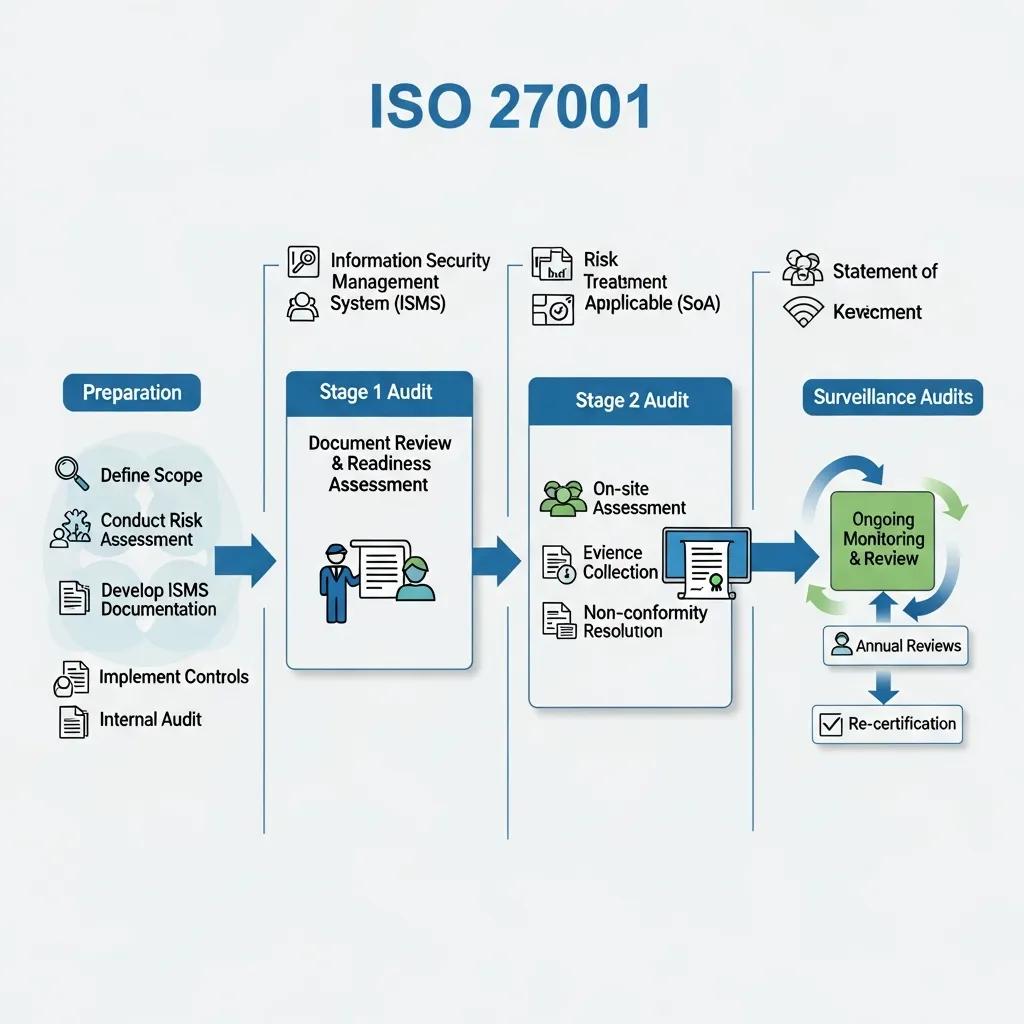
The ISO 27001 certification process is a staged journey: define scope and conduct readiness assessments, implement an ISMS aligned to selected controls, complete internal audits and management review, then undergo a two-stage external audit (Stage 1 documentation review and Stage 2 full audit), followed by regular surveillance audits to maintain certification. This staged approach ensures organisations progressively demonstrate capability and continual improvement over time. Practical planning reduces surprises during external assessment and speeds time to certificate issuance by clarifying responsibilities and evidence requirements early.
Below is a quick comparison of certification stages with typical activities and outcomes to guide planning and resource allocation.
The following table compares the certification stages, main activities, and what organisations should expect at each stage.
| Stage | Main Activities | Expected Outcome |
|---|---|---|
| Preparation (Scoping & Gap Analysis) | Define scope, perform gap analysis, plan controls | Clear project plan, prioritized gaps, scope statement |
| Stage 1 (Documentation Review) | Auditor reviews ISMS documentation and readiness | List of findings, go/no-go for Stage 2, audit agenda |
| Stage 2 (Full Audit) | Evidence review, control testing, interviews | Certificate issuance on successful results |
| Surveillance (Annual) | Periodic audits of selected controls and records | Continued certification, identification of improvement areas |
This staged breakdown shows what organisations must deliver at each point and how those deliverables move the project forward. With the stages clear, the next subsection outlines concrete steps and timelines.
What Are the Key Steps in the ISO 27001 Certification Journey?
The certification journey follows a predictable sequence that organisations can schedule and resource in advance. The typical steps are:
- Define scope and secure leadership buy-in.
- Conduct gap analysis and risk assessment.
- Implement controls, document the ISMS and perform training.
- Run internal audits and management review, then schedule external audit stages.
These steps typically span several months for most organisations; timelines compress when teams reuse existing management processes or adopt phased rollouts tailored to business priorities, which leads into audit preparation tactics covered next.
How to Prepare for the ISO 27001 Audit and What to Expect?
Audit readiness requires curated evidence, role-based preparedness, and realistic mock assessments. Start by ensuring policies are approved, the risk register is current, controls are implemented and logs/records are retained; auditors will expect traceable links between risks, chosen controls and evidence of operation. ISO 9001 certification is often a requirement for key clients and organisations should note this when defining procurement-driven scope and when planning integrated management systems, because many buyers expect maturity across quality and security together. Preparing staff for auditor interviews and running internal mock-audits reduces nonconformities and shortens the external audit timeline.
Practical tips include maintaining a document index, tagging evidence to control objectives, rehearsing responses to common auditor questions, and scheduling temporary access for assessors—these actions streamline Stage 1 and Stage 2 outcomes.
What Are the Essential ISO 27001 Requirements and Mandatory Documents?

ISO 27001 mandates several core documents that demonstrate a functioning ISMS: the scope statement, information security policy, risk assessment and risk treatment plan, Statement of Applicability (SoA), evidence of monitoring and measurement, internal audit reports and management review records. These documents form the meronomic parts of the ISMS and serve as primary auditor evidence. Clear version control, access to records and traceability between risks and selected controls are essential for a successful certification audit.
Below is a quick-reference table of essential documents, their purpose and typical contents to help teams assemble a compliant documentation set.
This table provides a checklist of mandatory documents and examples to use during preparation.
| Document/Requirement | Purpose | Typical Contents/Examples |
|---|---|---|
| Scope Statement | Defines boundaries of the ISMS | Included locations, assets, exclusions and interfaces |
| Information Security Policy | Sets management direction and objectives | Policy statements, roles, responsibilities |
| Risk Assessment & Treatment | Identifies and mitigates information risks | Asset inventory, threat/vulnerability analysis, treatment actions |
| Statement of Applicability (SoA) | Shows selected/declined Annex A controls | Control list, justification for inclusion/exclusion, implementation status |
Assembling these documents with clear ownership and version history makes the audit process more predictable and defensible. Next, practical implementation guidance helps teams apply these artefacts in operational settings.
How to Implement an Effective ISMS Aligned with ISO 27001 Controls
Implementing an ISMS requires translating selected controls into operational processes: define policy, assign control owners, update procedures, deploy technical measures, and run staff awareness programs. A phased approach—prioritising high-risk assets first—reduces upfront resource strain and creates early demonstrable wins for auditors. Mapping controls to business processes creates semantic triples such as „Access Control → protects → sensitive customer databases“ and clarifies auditing evidence paths. Examples of evidence include access logs, change control records, supplier contracts and training records.
Further research delves into the practicalities and challenges of implementing ISO 27001, particularly in specialized environments like software development, and the importance of focusing on actual content over mere process existence.
ISO 27001 Implementation: Guidelines, Documentation & Challenges
ABSTRACT: ISO 27001 information security management standard provides guidelines to organizations to evaluate and document their information security processes. However, information security management standards have been criticized to focus on the existence of the process but not its actual content. This Master’s Thesis aims to assess ISO 27001’s suitability to software development environment and its impact on employees’ practices and experiences in secure soft-ware development.
ISO 27001 information security management standard’s implementation in software development environment: A case study, 2020
Phased implementation should include measurable KPIs (incident closure time, control test pass rates) and regular reviews to confirm effectiveness, which feeds directly into the SoA and the next subsection describing the SoA’s role.
What is the Statement of Applicability and Its Role in Certification?
The Statement of Applicability (SoA) is the central document that records every Annex A control, whether it is implemented or excluded, and the justification for each decision; auditors use it to verify that control selection aligns with risk treatment choices. The SoA functions as both a mapping and a rationale: it links risks to controls and demonstrates management’s considered decisions about applicability. A simple SoA entry contains the control identifier, selection status, implementation description, and justification for any exclusions based on documented risk acceptance.
Maintaining an up-to-date SoA with versioning and sign-off provides a concise audit trail and reduces reviewer queries during Stage 1 and Stage 2 assessments.
What Benefits Does ISO 27001 Certification Offer to Your Business?
ISO 27001 certification delivers quantifiable business advantages: reduced probability and impact of incidents through structured risk treatment, improved customer confidence demonstrated by third-party validation, and clearer alignment with regulatory obligations that reduces legal risk. For procurement and tenders, certification becomes a differentiator and often a contractual expectation; this leads to faster vendor qualification and reduced due-diligence friction. Operationally, certification drives better process discipline, clearer responsibilities and evidence trails that simplify audits and internal controls.
The true value of ISO 27001 certification lies in its measurable effectiveness in achieving security objectives and actively preventing information security incidents.
ISO 27001 Effectiveness: Measuring Certification Impact & Risk Prevention
Effectiveness of ISO 27001 as an information security system is a measure of the expectation satisfaction level based on the organizational expectations prior to implementation of ISO 27001 and the actual results obtained after certification. Thus, effectiveness focuses on how well objectives have been achieved rather than how well processes have been followed. The effectiveness of ISO 27001 is in preventing or minimizing the exposure to information security incidents in the real world.
Effectiveness of ISO 27001, as an information security management system: an analytical study of financial aspects, NK Sharma, 2012
Key business benefits include:
- Risk Reduction: Systematic risk assessments and controls lower breach likelihood and operational disruption.
- Commercial Advantage: Certification streamlines procurement and enhances customer trust.
- Regulatory Alignment: Controls support compliance with data protection and sector-specific requirements.
ISO 9001 certification is often a requirement for key clients and ISO 27001 complements ISO 9001 by adding explicit information-security controls that support quality-driven supplier evaluations. Combining ISO 9001 and ISO 27001 in an integrated management system helps organisations meet client procurement requirements while reducing duplicated processes and audit fatigue.
This linkage between quality and security is particularly important for organisations that compete in regulated or enterprise markets and sets up the regulatory and competitive impacts discussed in the next two subsections.
How Does ISO 27001 Enhance Data Protection and Regulatory Compliance?
ISO 27001 improves data protection by enforcing documented controls that map to legal obligations such as data minimisation, access restrictions, encryption and incident response—measures that support GDPR and other privacy frameworks. The standard’s risk-based approach aligns control selection with specific legal requirements so organisations can demonstrate proportional measures during regulator reviews or litigation. Practical mapping involves documenting how controls such as access control and encryption reduce specific legal risks, and including those mappings in the SoA and compliance evidence set.
Recent studies and contemporary regulatory guidance emphasise evidence-based controls; ISO 27001’s structure provides a repeatable method to produce that evidence and to demonstrate ongoing compliance during audits.
What Competitive Advantages and Risk Reductions Result from Certification?
Certification often unlocks tender opportunities where buyers require audited security postures, improves negotiating leverage with partners, and can reduce the likelihood of costly incidents that harm revenue and reputation. Insurers and customers may view certified organisations as lower risk, which can translate into better terms or faster procurement decisions. Framing certification as an ROI decision, organisations can quantify avoided incident costs and incremental revenue from new contracts to justify certification investment.
These competitive effects compound over time: continued surveillance audits sustain buyer confidence and show prospective clients that security is an embedded business capability rather than a one-off project.
How Much Does ISO 27001 Certification Cost and How to Budget?
Certification cost depends on several drivers including scope size, organisational maturity, number of sites, complexity of technical infrastructure, and whether external consultancy or readiness support is used. Budget planning should separate internal implementation costs (staff time, technical controls, training) from external fees (auditor days, travel, certification body charges). Organisations can control costs by narrowing initial scope, reusing existing documented processes, and investing in readiness activities that reduce auditor days.
The table below breaks down typical cost factors, their relative impact and how providers or process choices can reduce expense.
This cost-factor table helps you estimate where budget will be spent and how to prioritise measures that reduce overall certification expenses.
| Cost Factor | Typical Range / Impact | How Stratlane (or providers) can reduce it |
|---|---|---|
| Scope size (users/sites) | Large scope increases audit days and cost | Limit initial scope or phase rollout to reduce auditor time |
| Maturity gap remediation | Significant technical fixes drive budget | Readiness assessments identify targeted fixes to avoid broad rebuilds |
| Number of sites | Multiple locations increase travel/audit effort | Combine remote evidence reviews and sampling to reduce days |
| Consultancy / readiness support | Adds cost but speeds certification | Expert guidance reduces rework and audit days through efficient evidence preparation |
What Factors Influence the Cost of ISO 27001 Certification?
Costs scale with complexity: a single-site SME with limited digital assets will face a smaller certification bill than a multinational with distributed infrastructure. Major drivers include the number of in-scope employees and systems, the extent of required technical controls, maturity of existing processes, and whether documentation and records already exist. A mini-calculation example: if auditor fee is calculated per audit day, reducing two auditor days through better readiness can materially lower certification fees; similarly, limiting scope to critical business functions reduces baseline audit effort.
Scoping carefully and investing in a focused gap remediation plan are practical levers to control spend while preserving meaningful security improvements.
How Can Stratlane’s AI-Powered Audit Tools Optimize Certification Expenses?
Stratlane Certification Deutschland is an accredited certification body specializing in ISO standards (ISO 9001, ISO 14001, ISO 27001, ISO 42001). They leverage AI-powered audit tools and experienced industry experts to provide certification services across various sectors in over 27 countries. Their certificates are recognized by universities, businesses, and SMEs globally. Using AI-powered audit tools can reduce manual evidence collection and automate control-mapping tasks, which shortens auditor preparation time and can reduce the number of onsite audit days required.
By combining automated audit coverage with skilled auditors, providers like Stratlane can often identify high-value evidence early, streamline sampling, and accelerate Stage 1 readiness—delivering cost savings through efficiency rather than by compromising audit rigor. Organisations seeking certification should evaluate providers’ methodologies for remote evidence review, AI-assisted control checks, and the experience of audit teams to estimate realistic cost savings.
How to Maintain ISO 27001 Certification and Ensure Continuous Compliance?
Maintaining certification requires planned surveillance audits, continual improvement cycles driven by management review, and ongoing monitoring of threat landscapes to ensure controls remain effective. Surveillance audits typically sample controls and records to confirm ongoing compliance; organisations must maintain evidence such as incident logs, audit trails, and recent management review minutes to demonstrate continuing conformity. A living ISMS uses metrics and continual assessment to keep residual risk within thresholds and to adapt controls as technology and threats evolve.
Embedding continuous monitoring and a cadence of reviews reduces the risk of nonconformities at surveillance and supports faster recertification at the three-year cycle end, which is the typical pattern for management system standards.
What Are Surveillance Audits and Recertification Requirements?
Surveillance audits occur periodically (commonly annually) after initial certification and focus on verifying selected controls and evidence of continual improvement. Auditors look for records that show corrective actions, incident handling, internal audit results, and management review outcomes; common findings include incomplete evidence linkage, outdated policies, or insufficient control operation proof. Recertification is a full-scope reassessment at the end of the certification cycle and requires refreshed documentation, evidence of sustained control effectiveness, and demonstration of corrective actions for previous findings.
Preparing a rolling evidence pack and tracking open actions reduces last-minute workload and improves surveillance outcomes.
How to Continuously Improve Your ISMS to Address Emerging Cyber Threats?
Continuous improvement uses KPIs, threat intelligence and planned update cycles to keep the ISMS responsive: suggested KPIs include time to detect incidents, time to close corrective actions, percentage of controls tested successfully, and staff awareness completion rates. Integrating threat intelligence into risk assessments ensures control selection remains relevant as adversary techniques evolve, while periodic tabletop exercises validate incident response. Leveraging AI tools for log analysis and anomaly detection can increase monitoring coverage and accelerate detection, while management review institutionalises the learning loop.
Regularly scheduled reviews that combine metric trends with external intelligence create a proactive posture that keeps the ISMS aligned to the organisation’s risk profile and audit expectations.