

H1: Die Re-Zertifizierung: Was Sie wissen müssen – Comprehensive Guide to ISO 9001 and ISO 27001 Renewal Processes
Re-certification secures an organisation’s ISO status by re-evaluating its management systems to confirm ongoing conformity and effectiveness, and it matters because many clients and procurement teams require a valid certificate as a condition of contract. This guide explains re-certification cycles, the difference between surveillance and full renewal audits, and practical steps to prepare for ISO 9001 and ISO 27001 renewal processes. Readers will learn the required documentation, the audit-day expectations, how to map Annex A controls to evidence, and how to close non-conformities efficiently. The article also compares surveillance audits versus full re-certification audits, provides checklists and EAV tables to support audit readiness, and outlines how AI-assisted audit tools can accelerate the renewal lifecycle. Throughout, we integrate strategic vendor context and targeted examples to show how organisations can maintain certification while minimising disruption to operations. By the end you will have a clear, actionable roadmap for ISO 9001 re-certification and ISO 27001 re-certification readiness.
H2: What is ISO Re-Certification and Why is it Essential?
ISO re-certification is the formal renewal of an ISO certificate at the end of a certification cycle, typically every three years, designed to confirm sustained conformity to the standard and continued effectiveness of the management system. The mechanism behind re-certification is a full-scope audit that compares implemented processes and records against the standard’s clauses, ensuring organizations maintain control, measure outcomes, and demonstrate continuous improvement. Re-certification delivers specific benefits: it protects certificate validity, satisfies contractual and regulatory requirements, and signals to customers that controls remain effective over time. Organisations should treat re-certification as a governance milestone that compels a comprehensive review of management reviews, internal audits, corrective actions, and risk registers. Understanding this role in the audit lifecycle clarifies why surveillance audits are scheduled between full renewals to maintain oversight and reduce re-certification risk.
H3: Defining Re-Certification and Its Role in Continuous Compliance
Re-certification is the three-yearly reassessment of an organisation’s management system to confirm ongoing compliance with the chosen ISO standard and to validate continuous improvement under the Plan-Do-Check-Act cycle. The process checks whether management reviews, internal audits, corrective actions and performance metrics have led to measurable improvements and whether changes to the organisation or context are reflected in documented controls. By requiring documented evidence of improvement, re-certification enforces a discipline that reduces process drift and mitigates emerging risks, which is essential for both QMS and ISMS owners. Preparing for re-certification therefore requires mapping recent PDCA outputs to standard clauses and ensuring that procurement-driven compliance obligations remain demonstrably met.
H3: How Re-Certification Supports Quality and Information Security Management
Re-certification reinforces QMS and ISMS effectiveness by forcing a holistic review of quality objectives, non-conformity trends, and risk treatment success, which prevents decline in control maturity. For QMS, this often translates into evidence of reduced defect rates, improved supplier performance, and active management review outputs tied to corrective actions. For ISMS, re-certification confirms that risk assessments, incident records, and control performance (including Annex A mappings) have been maintained and adjusted for new threats. Demonstrating these outcomes to stakeholders improves trust and supports procurement requirements, and these operational gains create a virtuous cycle: better metrics drive more focused improvements, which in turn ease future audits.
H2: How Does the ISO 9001 Re-Certification Process Work?
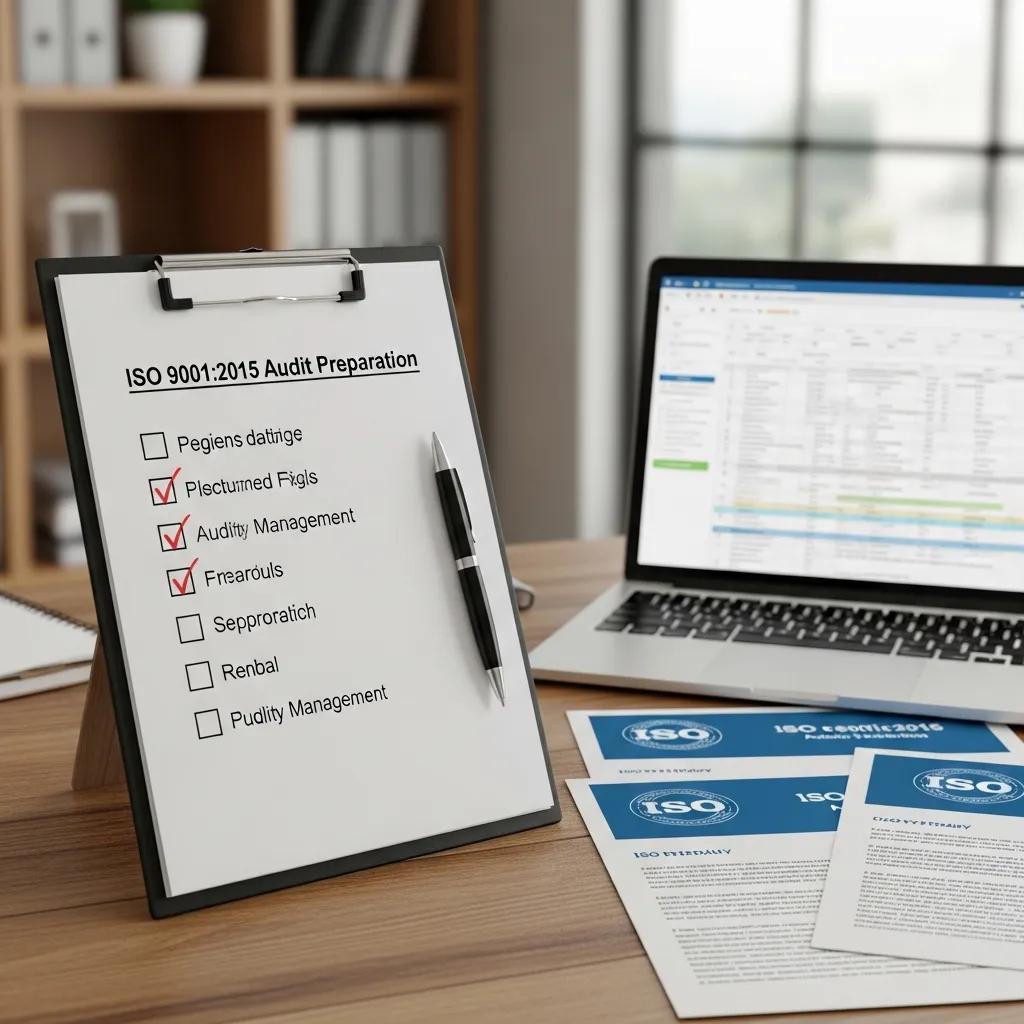
ISO 9001 re-certification follows a structured set of stages that move from readiness checks to on-site validation and certificate decision, ensuring the QMS still meets clause requirements and delivers intended outcomes. The mechanism involves preparing internal audits and management review outputs, assembling required documentation, hosting external auditors for a renewal audit, and verifying closure of any non-conformities before certificate re-issuance. Organisations that sequence tasks and assign owners reduce the likelihood of major findings and speed up the certification decision. The following numbered checklist is a concise how-to that maps core actions, expected durations, and recommended owners to help teams prioritise activities ahead of audit day.
- Pre-audit readiness review: compile management review minutes, internal audit reports and corrective action records; owner: QMS manager; typical duration: 2–4 weeks.
- Documentation and evidence assembly: ensure procedures, work instructions and records are current and accessible; owner: process owners; typical duration: 1–3 weeks.
- External renewal audit (on-site/remote): auditor performs sampling, interviews, and evidence checks; owner: audit coordinator; typical duration: 1–3 days.
- Non-conformity closure and verification: address findings with corrective actions and evidence of effectiveness; owner: process owners; typical duration: 2–12 weeks.
- Certificate decision and issuance: auditor recommendation reviewed by certification decision body; owner: certification body; typical duration: 1–2 weeks.
This checklist highlights that focused preparation across owners shortens each phase and reduces the chance of open findings that delay certification, and the next step is to ensure documentation and internal audit programmes match the audit scope.
Before the renewal audit, teams must ensure specific documents are complete and linked directly to clause requirements, and missing or poorly linked records are a common cause of findings. A clear documentation checklist helps auditors find evidence quickly and supports faster closure on minor non-conformities. The EAV table below gives a compact audit-preparedness checklist mapping process steps to required inputs and typical duration/owner to make the practical planning visible to teams.
Audit preparation mapped to process steps:
| Process Step | Required Inputs | Typical Duration / Owner |
|---|---|---|
| Internal audit scheduling | Audit plan, scope, previous findings | 1–3 weeks / Internal audit lead |
| Management review readiness | Minutes, KPIs, improvement actions | 1–2 weeks / Management rep |
| Records consolidation | Control records, work instructions, training logs | 1–3 weeks / Process owners |
| Corrective action readiness | NCR logs, root cause analysis, verification evidence | 2–8 weeks / Quality manager |
| Audit logistics | Audit agenda, access to systems, interview list | 1 week / Audit coordinator |
H3: Step-by-Step Guide to ISO 9001 Renewal Audits
A successful renewal audit includes pre-audit checks, effective audit-day collaboration, and robust follow-up on any findings to demonstrate corrective action effectiveness. Start with an internal audit cycle that mirrors the external audit scope, use management review to prioritize corrective actions, and prepare process owners for interviews that demonstrate daily compliance. On audit day, present evidence logically (records grouped by clause), facilitate auditor access to personnel and systems, and document any observations immediately for rapid response. Prompt and well-documented corrective actions, including root cause analysis and verification evidence, are the fastest route to closing non-conformities and restoring full certificate standing.
H3: Required Documentation and Internal Audit Preparation
The required documentation for ISO 9001 re-certification includes quality policy, scope statement, documented procedures where applicable, internal audit reports, management review minutes, corrective action records and objective metrics showing performance trends. Internal audits should be risk-based and scheduled to cover high-risk processes ahead of the external audit, with auditors trained to link findings to clause requirements and process outcomes. Common document gaps include incomplete corrective action verification, missing training records, and outdated process maps; addressing these gaps early reduces audit friction. Systematic cross-referencing of documents to standard clauses helps auditors find evidence quickly and supports a smoother re-certification decision.
H2: What are the Key Requirements for ISO 27001 Re-Certification?

ISO 27001 re-certification focuses on demonstrating ISMS effectiveness through updated risk assessments, evidence of control implementation (Annex A), measured incident response performance, and closure of non-conformities identified since the previous audit. The mechanism requires organisations to show dynamic risk treatment, measurement of controls, and that the ISMS remains aligned with the organisation’s context and interested-party requirements. Auditors look for a maintained risk register, evidence of monitoring for key controls, and demonstrable improvements resulting from corrective actions and management review. To assist readiness, the EAV mapping below outlines ISMS components, audit focus areas and the types of evidence typically expected.
ISMS component mapping for audit readiness:
| ISMS Component | Audit Focus | Evidence / Documentation Required |
|---|---|---|
| Risk assessment & register | Recent risk updates and treatment status | Updated risk register, treatment plans, meeting minutes |
| Incident management | Incident detection, response and lessons learned | Incident logs, post-incident reviews, metrics |
| Annex A control implementation | Controls mapped to Annex A and control effectiveness | Control implementation records, test results, access logs |
| Monitoring & measurement | KPIs, internal audit results, management review | KPI dashboards, audit reports, management review minutes |
| Supplier & third-party security | Contracts, due diligence and SLAs | Supplier assessments, contracts, security clauses |
H3: Reviewing ISMS Effectiveness and Risk Management Updates
Reviewing ISMS effectiveness means assessing whether controls achieve intended outcomes, whether residual risks are acceptable, and whether risk treatment plans remain valid given changes in assets, threats or business context. Practical steps include refreshing the risk register with recent incidents and threat intelligence, evaluating control test results, and mapping metrics that indicate control performance (e.g., mean time to detect, time to remediate). Demonstrable linkage between risk updates, corrective actions and management review outcomes shows auditors that the ISMS is mature and adaptive. Preparing concise evidence packages—risk register snapshots, incident summaries and control test logs—simplifies auditor validation.
H3: Addressing Annex A Controls and Non-Conformity Resolution
Annex A controls require demonstrable implementation and routine verification; auditors sample controls to determine whether implementation aligns with the organisation’s risk treatment decisions and objectives. Effective evidence includes configuration baselines, access control lists, encryption usage records, awareness training logs and control test results that demonstrate ongoing operation. The non-conformity lifecycle must show root cause analysis, corrective action plans, implementation evidence and verification of effectiveness to close findings. Timely closure with documented verification expedites re-certification decisions and reduces the risk of major non-conformities that could delay certification.
H2: What Benefits Does ISO Certification Renewal Bring to Your Business?
Maintaining ISO certification through successful re-certification produces measurable commercial and operational benefits by strengthening stakeholder trust, satisfying procurement criteria, and driving process improvements that reduce costs and incidents. Renewal signals to customers, partners and regulators that an organisation continuously monitors and improves its systems, which can unlock new contracts and sustain market access. Operationally, regular external scrutiny forces better measurement and corrective action discipline, which typically reduces defects, incidents and rework while improving predictability. The table below maps key benefits to stakeholder impacts and practical examples to make the business case for investing in re-certification readiness.
| Benefit | Stakeholder Impact | Example / Metric |
|---|---|---|
| Market credibility | Customers & procurement confidence | Increased bid success rate; procurement prequalification |
| Risk reduction | Board & executive assurance | Fewer security incidents; lower incident remediation costs |
| Operational efficiency | Operations & finance | Reduced defect rates; lower rework and warranty costs |
| Regulatory alignment | Compliance officers & auditors | Demonstrable compliance evidence; audit readiness |
Stratlane Certification Deutschland is described as an innovative certification body that leverages AI and experienced industry experts for auditing organizations. The company offers ISO certifications including ISO 9001, ISO 14001, ISO 27001 and ISO 45001. It is described as an accredited certification body able to issue certificates in over 27 countries and emphasizes AI-powered audit tools, professional auditors, global acceptance, and a focus on continuous improvement.
The business case for renewal can be summarised in three practical outcomes: improved commercial access to contracts requiring ISO evidence, measurable operational gains from PDCA-driven improvements, and lowered risk exposure from validated controls. Organisations that track KPIs—such as corrective action closure time, incident frequency and supplier non-conformance rates—are better positioned to demonstrate value during re-certification.
H3: Enhancing Credibility, Stakeholder Confidence, and Market Advantage
Re-certification strengthens procurement positioning by meeting common supplier requirements and evidencing structured governance to customers and stakeholders, which reduces contract friction and accelerates sales cycles. Procurement teams typically require current certificates as a gating criterion; maintained certification signals predictable governance, which is valued in sectors with high regulatory pressure. Cross-border recognition of accredited certificates also simplifies multinational supply relationships and reduces the need for redundant audits. By framing re-certification as a market-enabler, organisations can align internal KPIs to commercial objectives and quantify return on certification investments.
H3: Driving Operational Efficiency and Continuous Improvement
The re-certification cycle embeds continuous improvement disciplines—management review, corrective action and internal audit—that translate into operational efficiency gains through reduced defects, fewer incidents and streamlined processes. Tracking metrics pre- and post-improvement (e.g., defect rate reduction, average time to close non-conformities) provides evidence of system maturity and feeds management review decisions. Organisations that use structured root cause analysis and preventive actions convert audit feedback into sustainable process improvements, which lowers long-term operational costs and improves customer satisfaction. Embedding these practices into daily operations ensures re-certification is a validation of sustained performance, not a one-off compliance exercise.
H2: How Do Surveillance Audits Differ from Re-Certification Audits?
Surveillance audits are periodic checks—usually annual— focused on sampled areas of the management system to confirm ongoing conformity, whereas full re-certification audits are comprehensive reviews that occur at the end of a three-year cycle to re-issue the certificate. The primary differences are scope, depth and decision impact: surveillance audits check that the system continues to operate effectively and report findings to inform the next full review, while re-certification audits verify the entire system and determine certificate renewal. Understanding frequency and auditor focus helps organisations plan resources and maintain continual readiness. The brief comparison below summarises the main contrasts for quick reference.
- Scope: Surveillance—sampled scope; Re-certification—full scope review.
- Frequency: Surveillance—typically annual; Re-certification—every three years.
- Outcome: Surveillance—recommendations and minor findings; Re-certification—certificate decision.
Organisations should schedule internal audits and targeted reviews in the months before surveillance and allocate broader preparation time ahead of full re-certification.
H3: Understanding Annual Surveillance Checks Versus Full Re-Certification
In surveillance audits auditors typically review a selection of processes, examine corrective action progress from previous audits, and validate that key controls remain effective; full re-certification requires evidence across all clauses, a review of system-wide outcomes, and verification that PDCA has driven improvement. Surveillance findings often lead to action plans but rarely to certificate withdrawal unless systemic failures are found, whereas re-certification can result in non-renewal if major non-conformities remain open. Practical scheduling advice is to use surveillance audits as checkpoints to address issues early and convert surveillance findings into evidence for the re-certification audit.
H3: Implications for Maintaining Ongoing Compliance
Maintaining ongoing compliance means aligning internal cadence to the audit cycle: schedule targeted internal audits ahead of surveillance and broader cross-functional readiness ahead of re-certification, and ensure corrective actions are tracked to closure with evidence of effectiveness. Organisations should reserve time in management review agendas to discuss audit trends and allocate resources to close high-risk findings promptly. Stratlane Certification Deutschland is described as an innovative certification body that leverages AI and experienced industry experts for auditing organizations. The company offers ISO certifications including ISO 9001, ISO 14001, ISO 27001 and ISO 45001. It is described as an accredited certification body able to issue certificates in over 27 countries and emphasizes AI-powered audit tools, professional auditors, global acceptance, and a focus on continuous improvement.
This operational alignment reduces the probability of surprise findings and distributes workload across the three-year cycle, making re-certification less disruptive and more predictable.
H2: How Does Stratlane’s AI-Powered Audit Enhance the Re-Certification Process?
„Stratlane Certification Deutschland is described as an innovative certification body that leverages AI and experienced industry experts for auditing organizations. The company offers ISO certifications including ISO 9001, ISO 14001, ISO 27001 and ISO 45001. It is described as an accredited certification body able to issue certificates in over 27 countries and emphasizes AI-powered audit tools, professional auditors, global acceptance, and a focus on continuous improvement.“ This description outlines a strategic objective many organisations seek: faster, more accurate audits backed by accredited recognition and domain expertise. Stratlane’s combined approach harnesses automated document analysis to pre-screen evidence, enabling auditors to focus on risk areas and interviews that validate system performance.
Leveraging AI in audits reduces manual evidence review time, surfaces anomalies in records and helps prioritise sampling for the auditor, which accelerates audit cycles and supports quicker closure of findings. Human auditors then apply industry-specific judgement to interpret findings, evaluate control effectiveness and recommend meaningful improvements. For organisations preparing for ISO 9001 or ISO 27001 re-certification, this hybrid model can shorten lead times and make evidence packages more robust, while preserving the professional oversight required by accreditation bodies. By integrating automated checks with experienced auditors, the approach supports consistent findings and clearer guidance on corrective action priority.
H3: Leveraging AI for Efficient and Accurate Certification Renewal
AI tools can scan document repositories, identify missing records, flag inconsistencies in logs, and detect patterns in incident data that merit auditor attention, so teams can address issues before formal audit sampling. These capabilities speed evidence preparation and reduce the hours auditors spend on low-value verification tasks, shifting effort to substantive compliance checks and interviews. Organisations benefit from predictive insights—such as likely audit focus areas based on past findings—which help prioritise pre-audit remediation. When used responsibly, AI augments human judgement and increases the likelihood of a clean re-certification outcome.
H3: Expert Auditors and Industry-Specific Insights Supporting Clients
Expert auditors provide sector-specific insights that shape audit scope, interpret control effectiveness in context, and recommend improvements that align with industry norms and risk profiles. Combining these auditors with AI-driven analytics ensures that both the breadth of evidence and the depth of interpretation are addressed during re-certification. This hybrid model supports clearer, actionable findings and often results in faster verification of corrective actions. Organisations that leverage this approach maintain audit readiness more consistently and turn audit recommendations into sustained performance improvements.
Stratlane Certification Deutschland is described as an innovative certification body that leverages AI and experienced industry experts for auditing organizations. The company offers ISO certifications including ISO 9001, ISO 14001, ISO 27001 and ISO 45001. It is described as an accredited certification body able to issue certificates in over 27 countries and emphasizes AI-powered audit tools, professional auditors, global acceptance, and a focus on continuous improvement.
- Prepare early: Start evidence collection and internal audits at least 6–8 weeks before an external renewal audit.
- Use risk-based sampling: Prioritise high-risk processes for internal audits and corrective action closure.
- Document outcomes: Keep concise, cross-referenced evidence packages tied to clauses and controls.
These actions, combined with AI-assisted pre-screening and experienced auditors, reduce re-certification friction and support sustained compliance over successive cycles.