

ISO 9001: Mythen und Fakten für Unternehmen
Many organizations treat ISO 9001 as a box-checking exercise, but at its core ISO 9001 defines a Quality Management System (QMS) that helps organizations control risk, improve processes, and meet customer expectations. This article dispels the most common ISO Zertifizierung Missverständnisse, explains why those misconceptions persist, and shows how ISO 9001 functions as a strategic asset rather than a bureaucratic burden. Readers will learn which myths are most harmful to procurement and growth, how documentation and audits actually drive value, and why certification is often a prerequisite for winning contracts with universities, corporations, and large clients. The goal is practical: equip decision makers—especially in SMEs and IT firms—with rebuttals and actions to convert perceived costs into measurable benefits. Near the end, we briefly note how Stratlane Certification Deutschland approaches ISO 9001 certification with AI-supported audits and industry-specific auditors to help companies meet client requirements efficiently.
Welche Mythen gibt es über ISO 9001 Zertifizierung für Unternehmen?
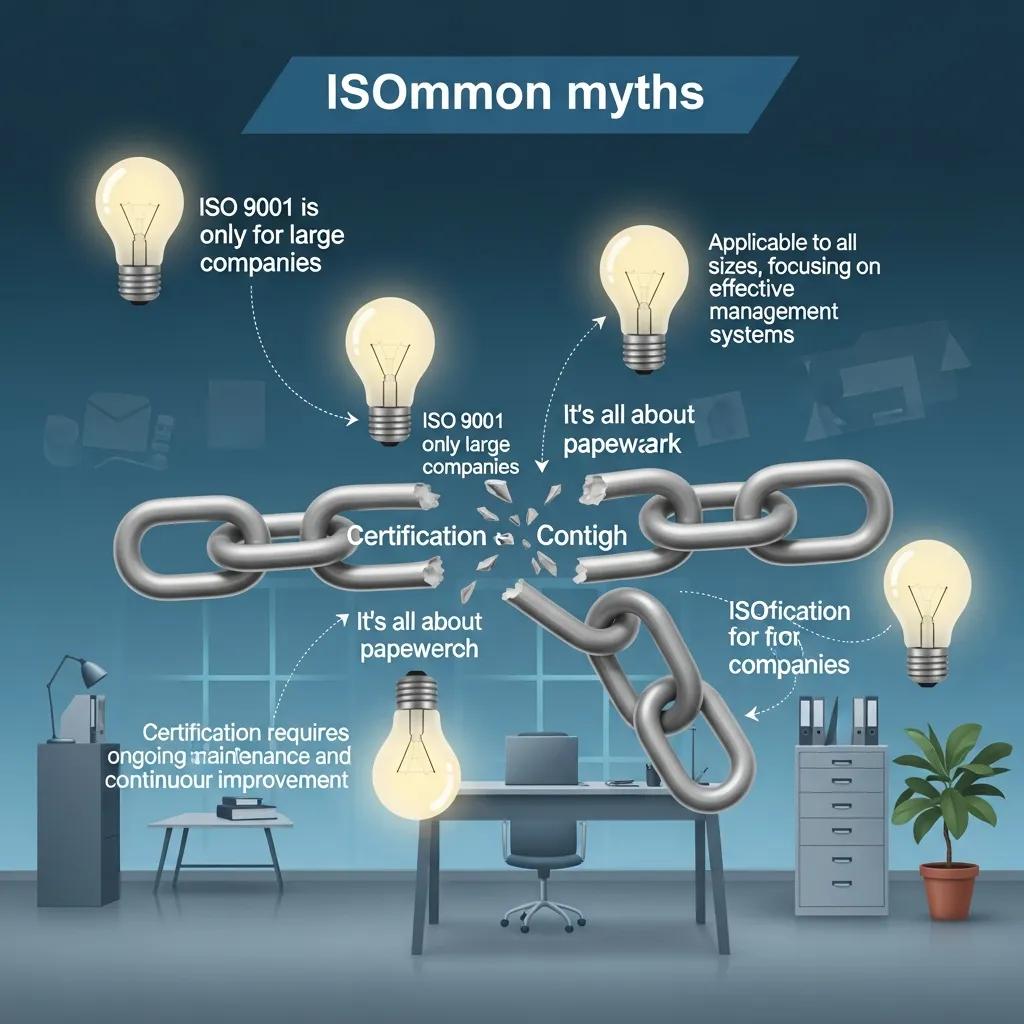
ISO 9001 often attracts myths because its language is normative and its outcomes depend on implementation; the reality is that ISO 9001 defines principles for process control, risk-based thinking, and continuous improvement that scale across sectors. By understanding the mechanism—QMS processes, management review, and surveillance audits—companies can see how compliance creates measurable operational value rather than mere paperwork. Below we list the most common myths and concise realities so procurement and leadership can refute objections during supplier qualification or internal planning. This section prepares readers to evaluate ISO 9001 not by stereotypes but by the system’s tangible impacts on delivery, risk, and market access.
Common myths about ISO 9001 with their realities:
- Myth — ISO 9001 is only for manufacturers: ISO 9001 applies to any organization that delivers products or services and focuses on managing processes to meet customer requirements.
- Myth — Certification is prohibitively expensive for SMEs: Initial costs can be managed with scaled implementation and modern audit methods, and long-term ROI often exceeds upfront investment.
- Myth — ISO 9001 is just bureaucracy: Required documentation exists to ensure traceability, accountability, and measurable improvement, not to create busywork.
These myth-to-reality points show why procurement teams often treat ISO evidence as a risk filter; the next section examines specific applicability for SMEs and service firms.
| Myth | Typical belief | Reality / Impact |
|---|---|---|
| ISO 9001 is only for manufacturers | Quality standards target production environments | ISO 9001 is sector-agnostic; service and IT firms use process controls to reduce delivery risk and meet procurement thresholds |
| Certification is too expensive for SMEs | High audit and implementation fees outweigh benefits | Scaled QMS and AI-assisted audits reduce cost; certification opens tender eligibility and can shorten onboarding |
| ISO 9001 creates bureaucracy | Large binders of procedures with little value | Documentation supports traceability and continual improvement, reducing rework and vendor risk |
This comparison highlights how each myth, when corrected, maps to procurement or operational impacts that matter to buyers and internal sponsors. The next subsection addresses whether ISO 9001 is really only for large companies and manufacturers.
Ist ISO 9001 nur für große Unternehmen und Hersteller relevant?
ISO 9001 is deliberately written to be scalable: clauses describe outcomes and expectations rather than prescriptive processes, which allows small and medium enterprises to adapt requirements to their context. A QMS for an IT service provider, for example, focuses on service delivery processes, incident handling, change control, and supplier management rather than factory floor checklists. This scalability means that small vendors can adopt proportional documentation and controls that satisfy both internal needs and external procurement checks. Many procurement teams accept evidence of a process-based QMS even from SMEs when policies, risk assessments, and a recent audit report demonstrate consistent delivery, making certification a practical route to cross eligibility thresholds in competitive tenders.
Ist die ISO 9001 Zertifizierung zu teuer für kleine und mittlere Unternehmen?
Cost concerns often center on audit fees, consultant support, and internal implementation time, but a structured cost-vs-return analysis typically shows multiple ROI channels for SMEs and IT firms. Short-term costs include gap analysis, initial certification audit, and minor process updates; long-term benefits capture reduced defects, faster onboarding, and access to contracts that require certification. Practical options such as phased implementation, in-house project ownership, and AI-assisted audit preparation can lower expenses and duration while preserving audit rigor. The table below summarizes common cost components and the long-term returns that justify the investment for smaller organisations.
| Cost Component | Short-term Cost | Long-term Benefit (ROI) |
|---|---|---|
| Initial gap analysis & documentation | Moderate consultancy or staff time | Faster audit readiness and fewer nonconformities in first audit |
| Certification audit fees | Paid to accredited body | Eligibility for tenders and reduced procurement screening |
| Internal process changes | Staff time for training and implementation | Lower defect rates, reduced rework, improved delivery times |
Understanding the financial logic behind certification helps teams present ISO 9001 as an investment in market access and operational reliability. The next H2 addresses the “bureaucracy” myth directly by showing how documentation and process measures drive efficiency and learning.
Wie entkräften wir das Missverständnis, dass ISO 9001 nur aus Bürokratie besteht?
ISO 9001 requires documented information to provide evidence of process effectiveness and decision making; the purpose of these records is to create traceability, enable root-cause analysis, and demonstrate continuous improvement rather than to impose unnecessary forms. Well-implemented QMS documentation is lean and risk-focused: it captures what is needed to prove consistent delivery, monitor KPIs, and support corrective actions. Recent studies and audit practice emphasize that documentation used correctly accelerates problem resolution and reduces operational variability, which translates directly into customer satisfaction and lower cost of poor quality. The next paragraphs explain how ISO mechanisms produce efficiency and how organizations can keep documentation purposeful and minimal.
The importance of robust data management and audit-ready processes, particularly in regulated industries, is further underscored by recent research.
ISO 9001: Data Management for Regulated Manufacturing
The increasingly complicated nature of the regulated manufacturing environment demands strong data management architectures on the basis of international standards management. In particular, the defense and aerospace sectors, where the International Traffic in Arms Regulations (ITAR) and the ISO 9001 quality management standards apply, face big issues related to the provision of secure, traceable, and audit-ready data streams within the enterprise systems. The possibility of non-compliance, inefficiency, and slow audits exists with paper-based processes and system design fragmentation.
AUTOMATING COMPLIANCE-READY DATA FLOWS IN ITAR AND ISO 9001 CERTIFIED MANUFACTURING SYSTEMS, 2025
ISO 9001 promotes process improvement and operational efficiency through structured activities like process mapping, KPI monitoring, and corrective action workflows. These mechanisms force organizations to define inputs, outputs, responsibility, and acceptance criteria—clarity that removes ambiguity and speeds daily work. Regular internal audits and management review create feedback loops where nonconformities are turned into targeted improvements, reducing defects and lead times. In practice, teams that apply these mechanisms report measurable decreases in repeat errors and faster cycle times, demonstrating that the QMS is a tool for operational excellence rather than paperwork.
ISO 9001 treats documentation as evidence of control and learning, distinguishing between required documented information and useful supporting material. Essential documents commonly include a quality policy, scope statement, process descriptions, records of training, audit reports, and corrective actions; anything beyond that should be lean and justified by risk or regulatory need. Teams can adopt templates, version control, and electronic records to keep documentation accessible and meaningful, avoiding bulky manuals that no one reads. By focusing documentation on decisions, measurement, and outcomes, companies maintain audit readiness while preserving agility and staff time for value-adding work.
- ISO 9001’s required documentation primarily ensures traceability, not bureaucracy.
- Essential records include policy, scope, process outcomes, and audit evidence.
- Lean documentation practices emphasize templates, risk focus, and electronic records.
These points show how documentation supports performance and set up the next section, which explores specific mechanisms—like PDCA and audits—that embed continual improvement into daily operations.
Beeinträchtigt ISO 9001 Innovation und Flexibilität in Unternehmen?

The misconception that ISO 9001 stifles innovation arises when organizations conflate control with rigidity; in fact, ISO 9001’s emphasis on risk-based thinking and PDCA fosters structured experiments and managed change that protect quality while enabling innovation. By requiring defined acceptance criteria, risk assessments, and change control, the standard creates guardrails that let teams test new approaches without exposing customers to undue risk. Well-applied, ISO 9001 integrates with agile and iterative methods by documenting hypotheses, test results, and lessons learned, thereby converting experiments into institutional knowledge. The following subsections explain how ISO enables controlled innovation and provide IT-specific examples to illustrate flexibility in practice.
ISO 9001 enables controlled innovation through Plan-Do-Check-Act cycles, formalized risk assessment, and documented change control that together allow iterative development without compromising delivery. Teams plan experiments with success criteria, perform changes in controlled environments, and use monitoring to check outcomes; unfavorable results trigger corrective actions while successful changes are standardized into the QMS. This approach reduces the chance that a new feature or process will introduce regressions, while still supporting frequent releases and continuous improvement. The controlled experimentation model aligns with software development lifecycles and product management practices, making ISO a framework for disciplined innovation rather than an obstacle.
Examples from the IT sector show ISO 9001’s adaptability to modern development and service operations. Continuous Integration / Continuous Deployment (CI/CD) pipelines can be governed by documented change control and rollback procedures that meet clause requirements without slowing delivery. Incident management systems map to nonconformity and corrective action processes, enabling measured improvements after each incident. Managed services can define service level processes that combine contractual obligations with continual improvement cycles, demonstrating that ISO clauses directly map to typical IT practices and can enhance, not hinder, responsiveness.
- CI/CD can be paired with ISO change control to allow rapid but safe deployments.
- Incident and problem management under ISO produce systematic lessons learned.
- Service definitions and SLAs integrate with QMS processes to align delivery with customer expectations.
These examples illustrate that ISO 9001 supports innovation at scale; the following H2 explains why certification is an ongoing commitment rather than a one-time achievement.
Warum ist ISO 9001 Zertifizierung eine dauerhafte Verpflichtung und kein einmaliger Erfolg?
Certification is not a single milestone because ISO 9001 requires evidence of an effective, maintained QMS over time; certification bodies perform an initial certification audit followed by periodic surveillance audits and full recertification cycles to confirm continued conformity. Surveillance audits typically focus on the effectiveness of corrective actions, management review outcomes, and sustained process performance rather than redoing implementation work. The ongoing obligation ensures that the organization’s PDCA activities continuously produce improvement and that the QMS evolves with changing risks and customer requirements. Understanding this timeline helps organizations budget for sustained improvement and treat certification as a governance mechanism for quality and resilience.
Surveillance and ongoing audits serve purposes beyond compliance: they surface systemic weaknesses, validate corrective measures, and provide external assurance to customers and procurement teams that processes remain effective. Auditors look for evidence of monitoring, trend analysis, corrective action closure, and management commitment—items that show the QMS is producing intended results. The cadence of oversight varies by certification body and risk profile, but the semantic effect is consistent: regular external review drives internal discipline, reducing surprises and building trust with stakeholders over time. The next subsection explains the PDCA cycle’s role in making improvement measurable and auditable.
The PDCA (Plan-Do-Check-Act) cycle underpins continual improvement by converting observations into planned actions, measuring their effects, and institutionalizing successful changes. In practice, PDCA means setting improvement objectives, implementing changes on a controlled scale, checking results with KPIs and audits, and acting to standardize effective solutions or revise plans. This creates a repeatable evidence trail that auditors and management can review, linking operational metrics to strategic objectives. Through PDCA, organizations demonstrate that certification reflects active management of quality and not a static certificate on a wall.
- Surveillance audits validate that corrective actions and improvements are sustained.
- Auditors seek trend analysis, effectiveness of measurements, and management review evidence.
- PDCA converts problems into measured improvements and audit evidence.
These mechanisms make certification a living governance process; the next H2 argues why many clients explicitly require ISO 9001 when selecting suppliers.
Warum ist ISO 9001 für Unternehmen ein unverzichtbares Kundenanfforderungskriterium?
ISO 9001 frequently functions as a procurement trigger because it signals to buyers that a supplier has defined processes, risk controls, and third-party verification—attributes that reduce onboarding work and delivery risk. Procurement teams use certification as a binary filter in many tenders and vendor assessments to manage regulatory, operational, and reputational risk. Recent procurement guidance and market surveys indicate that certification shortens qualification timelines and can be a minimum eligibility criterion for projects involving complex deliverables or institutional buyers. The table below maps client types to procurement triggers and shows how ISO 9001 specifically addresses each trigger, supporting the argument that certification is often required rather than optional.
The critical role of ISO 9001 in ensuring supplier quality within procurement systems has been recognized for decades, as early research indicates.
ISO 9001 for Supplier Quality & Procurement
ISO 9001 conformance of suppliers and the quality of products they provide, within a procurement system. The original ISO 9000 standard was issued in 1979 that provided guidelines for quality management systems.
ISO 9000 impact on product quality in a defense procurement environment, TA Mazzuchi, 1979
| Client Type | Procurement Trigger | How ISO 9001 Addresses It |
|---|---|---|
| Universities / Research institutions | Consistent quality and traceability | ISO 9001 documents processes and records, aiding reproducibility and audit trails |
| Corporations | Supplier risk mitigation and contractual reliability | Certification indicates third-party assurance of process controls and continuous improvement |
| Public sector / Large tenders | Mandatory supplier qualification criteria | ISO 9001 often appears as a minimum eligibility or evaluation factor in RFPs |
These mappings show that ISO 9001 reduces the due diligence burden for buyers and increases supplier credibility, which leads to faster onboarding and higher trust. The H3 subsections below expand on trust and competitive advantage.
Wie stärkt ISO 9001 das Vertrauen und die Glaubwürdigkeit bei Kunden?
Certification strengthens customer trust by providing external validation that processes are defined, monitored, and improved based on objective evidence. For procurement teams, a certificate and accompanying audit report reduce the need for extensive documentation requests and on-site audits during vendor selection, speeding the qualification process. The perception of lower delivery and compliance risk increases the willingness of larger clients to engage with certified suppliers, and this effect is especially pronounced when dealing with complex projects or regulated environments. Demonstrating that corrective actions are effective and that management reviews occur regularly converts certification into a tangible trust asset during contract negotiations.
Inwiefern verschafft ISO 9001 einen Wettbewerbsvorteil im Markt?
ISO 9001 can act as a differentiator in bids where many suppliers present similar technical capabilities; certification becomes a tiebreaker that signals maturity and reliability. Certified suppliers often qualify for tenders they otherwise would be excluded from, and some clients weight certification in evaluation criteria, improving the chance of award. Additionally, consistent processes enable more predictable pricing and delivery performance, which can be positioned as a value proposition for premium contracts. In sum, ISO 9001 helps suppliers win business through eligibility, perceived risk reduction, and demonstrated operational competence.
- Certification reduces vendor assessment workload for buyers.
- ISO 9001 often functions as an eligibility or scoring criterion in tenders.
- Demonstrable process control enables suppliers to claim higher reliability and win preference.
With procurement logic established, the final section explains how Stratlane Certification Deutschland positions its services to help organizations meet these client expectations efficiently.
Wie unterscheidet sich Stratlane Certification Deutschland bei der ISO 9001 Zertifizierung?
Stratlane Certification Deutschland combines accredited certification services with modern audit approaches and industry-focused auditors to help organizations achieve ISO 9001 in a way that aligns with procurement requirements. The company offers ISO certifications including ISO 9001, ISO 14001, ISO 27001, and ISO 45001, and emphasizes AI-powered audit tools that streamline evidence collection and sampling without sacrificing audit rigor. Stratlane’s accredited status and ability to issue certificates across multiple countries—reported across more than 27 countries—mean clients receive internationally recognized proof of conformity that universities, corporations, and SMEs commonly trust. This practical approach targets the common objections covered earlier by reducing administrative load, shortening audit cycles, and delivering industry-relevant findings.
An important part of Stratlane’s proposition is AI-assisted auditing, which accelerates preparatory work, improves sampling, and produces consistent, data-backed findings that auditors can verify. AI tools can surface relevant records, detect trends in process metrics, and prepare audit trails that save client time during on-site activities. The result is often a shorter, more focused audit that concentrates on risk areas and verifiable outcomes rather than exhaustive manual checks. This efficiency addresses the „cost“ and „bureaucracy“ myths by reducing administrative overhead while preserving the external assurance buyers expect.
This firm also emphasizes experienced, sector-specific auditors who understand domain practices and can translate audit findings into actionable recommendations tailored to the client’s market. Industry knowledge shortens the time auditors need to understand processes, increases the relevance of corrective actions, and enhances acceptance of findings by procurement teams. For organizations aiming to secure contracts that list certification as a trigger, Stratlane’s combination of accredited issuance, AI-assisted evidence collection, and auditor expertise offers a pragmatic path to certification with measurable efficiency gains.
- Stratlane provides accredited certification services for multiple ISO standards.
- AI-supported audits reduce preparation time and improve evidence consistency.
- Industry-specific auditors deliver actionable, procurement-relevant findings.
If you want to explore a quote or an audit roadmap tailored to procurement requirements and sector context, Stratlane Certification Deutschland can assess readiness and propose a focused path to certification that aligns with customer expectations and risk controls.
Welche Vorteile bieten KI-gestützte Audits von Stratlane?
KI-gestützte audits accelerate evidence collection by identifying relevant documents, highlighting trends, and suggesting sampling areas that merit auditor attention, which shortens on-site activity and reduces client preparation time. Machine-assisted analysis increases consistency in findings by applying repeatable selection criteria and surfacing anomalies that merit investigation, improving the objectivity of audit outcomes. For SMEs and IT firms, these tools reduce administrative overhead and cost while preserving the depth of audit evidence required by accredited certification processes. The practical effect is a more efficient certification journey that directly addresses concerns about expense and bureaucracy raised earlier.
Wie profitieren Unternehmen von erfahrenen und branchenspezifischen Auditoren?
Experienced, sector-specific auditors bring immediate contextual understanding to an audit, which reduces time spent explaining business models and allows auditors to focus on real process risks and improvement opportunities. Their recommendations tend to be actionable and aligned with industry best practice, making corrective actions more effective and easier to implement. This relevance also increases procurement confidence because audit reports reflect an auditor’s understanding of domain-specific controls, not generic checklists. As a result, organizations benefit from faster audit cycles, more targeted improvements, and stronger evidence for buyer due diligence.
- Sector knowledge shortens audit time and improves recommendation relevance.
- Actionable, industry-aligned findings accelerate corrective action and compliance.
- Procurement teams value audit reports that reflect domain realities rather than generic templates.
This completes the article’s practical guidance and company integration; the final sentences above point to next steps for organisations ready to align certification with business and procurement goals.