
How to Create a Quality Management Manual for ISO 9001 Certification
The Quality Management Manual (QMM) is a concise, structured document that defines how an organization implements its Quality Management System (QMS) to meet ISO 9001 requirements and demonstrate audit-readiness and client assurance. This article teaches practical steps to create a QMM that maps clauses to processes, captures responsibilities, and provides clear evidence for auditors and procurement teams. Many organizations struggle to translate high-level policy into auditable, process-level documentation; a well-crafted QMM bridges strategy and operation while reducing time spent collecting evidence during supplier assessments. You will learn what a QMM is, the essential sections to include, detailed drafting steps and role assignments, and how to present the manual to clients and auditors. The guide also contains EAV-style tables, actionable lists, and best practices for maintainability so you can produce a QMM that supports ISO 9001 certification and commercial requirements. Read on for templates, step-by-step procedures, and practical examples you can adapt to IT, manufacturing, and service contexts.
What is a Quality Management Manual and Why is it Important?
A Quality Management Manual is documented information that explains an organization’s QMS scope, quality policy, process overview, and key responsibilities, serving as a single-source reference for auditors and stakeholders. It works by translating ISO 9001 clauses into organizational commitments and mapped processes, which helps auditors verify compliance and helps teams understand their role in meeting customer requirements. The manual promotes audit-readiness, consistent process execution, and faster supplier onboarding, and it reduces evidence collection time during audits. Below are the core functions the QMM serves and how each function produces operational value.
Research further emphasizes the critical role of QMS audit readiness in achieving high-performance quality outcomes.
QMS Audit Readiness for High-Performance Quality
This study investigates a comprehensive quality management system (QMS) and its influence on multiple work-related outcomes. It examines certified quality systems used in the automotive industry to test whether QMS audit readiness mediates the relationship between quality factors and outcomes. Audit readiness did not emerge as a mediating variable, but rather as a significant process outcome.
High performance quality management systems and work-related outcomes: Exploring the role of audit readiness and documented procedures effectiveness, SP Goffnett, 2007
What Functions Does a Quality Management Manual Serve in a QMS?
A QMM performs governance, alignment, and evidential functions that support the QMS and certification cycle. First, it communicates the quality policy and objectives so leadership direction becomes auditable evidence tied to clause requirements, which streamlines executive-level interviews during audits. Second, it maps processes and responsibilities to show who owns inputs, outputs, and controls; this mapping reduces ambiguity and accelerates corrective action implementation. Third, the manual links procedures and records so auditors can trace clause fulfilment to specific documents and records, lowering the time needed to gather evidence. Fourth, it provides a formal basis for internal audits and continual improvement plans, enabling measurable follow-ups that close nonconformities more quickly and improve client confidence. These functions together make the QMM a practical tool for both daily management and external validation, leading naturally to how ISO 9001 treats the manual itself.
Is a Quality Management Manual Required for ISO 9001 Certification?
No — ISO 9001:2015 does not explicitly require a separate „manual,“ but it does require documented information sufficient to ensure effective QMS operation; a QMM remains a practical way to meet that requirement. Organizations may choose to embed required documented information across procedures and process records, but a consolidated manual simplifies audits and supplier assessments by presenting scope, policy, and process maps in one place. For procurement and large clients, a QMM often functions as the primary artifact used to validate supplier capability and contractual compliance, so many firms maintain one even when not strictly mandatory. Therefore, while the standard treats the manual as optional, keeping a QMM is a low-friction approach to satisfying auditors and clients who expect a coherent description of your QMS, and that expectation leads into the next section on recommended structure.
This perspective is supported by studies highlighting how a well-structured QMS manual, aligned with ISO 9001:2015, effectively documents quality policy and goals.
ISO 9001:2015 QMS Manual Documentation & Policy
The documentation structure developed in this paper aims to guarantee an efficient QMS, based on the requirements of ISO 9001:2015. In this manual the quality policy and goals are
Quality management system based on the ISO 9001: 2015: Study case of a coachwork company, EE Tubón-Núñez, 2015
What are the Key Elements and Structure of an ISO 9001 Quality Management Manual?
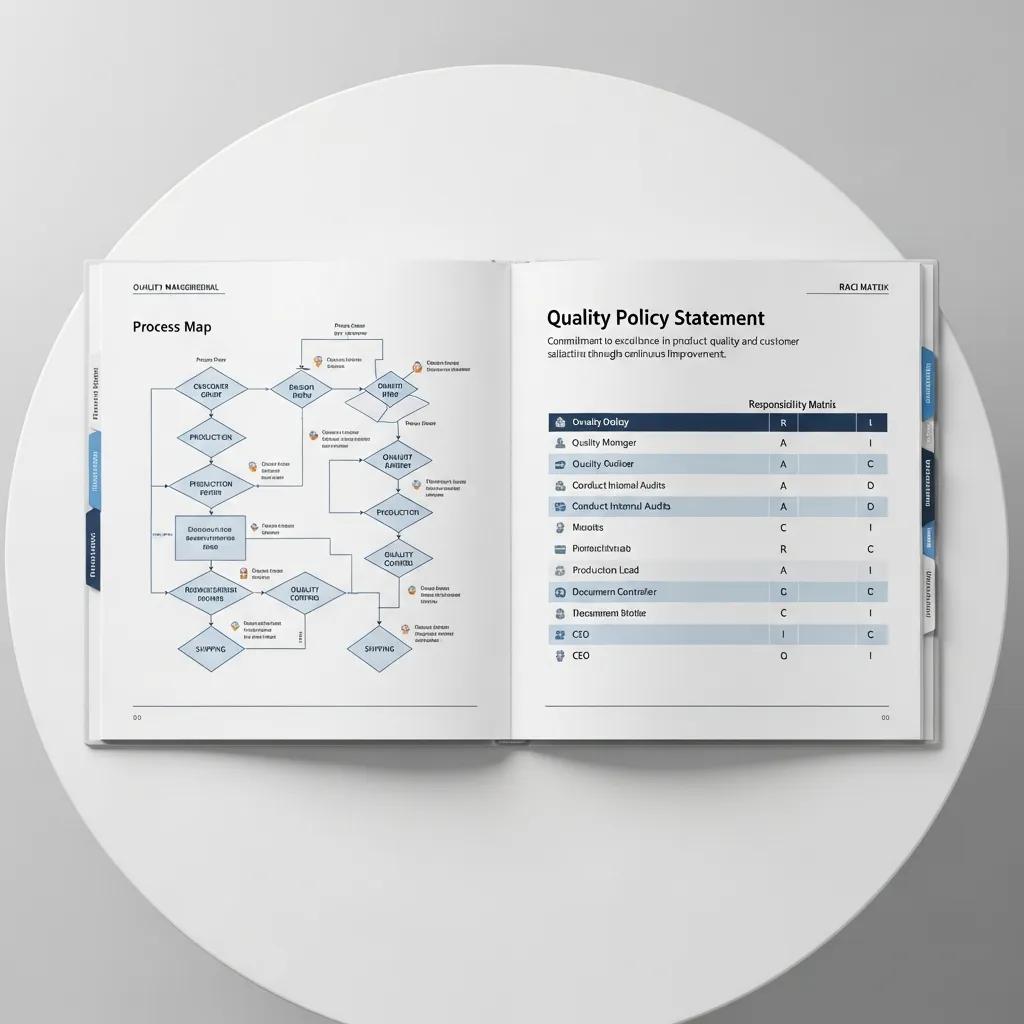
A practical QMM organizes content so each section links to ISO 9001 clauses and shows evidence paths to procedures and records. Begin with scope and context, include a clear quality policy and objectives, provide a process overview and responsibility matrix, and reference core procedures and records. Layout and maintainability matter: use version control, include change history, and prefer live document links or cross-references to procedures to keep the manual current. The table below compares typical QMM sections with their function and an example entry or recommended format to guide your drafting.
Intro paragraph: The following table maps essential QMM sections to their purpose and a brief example of how to present each entry so auditors and clients can quickly verify conformity.
| QMM Section | Purpose | Example Entry / Format |
|---|---|---|
| Scope & Context | Defines boundaries and interested parties (ISO 4) | „Scope: Design and delivery of IT services to EU clients; excludes subcontracted manufacturing.“ |
| Quality Policy & Objectives | States leadership commitment and measurable objectives | „Policy: Commit to customer satisfaction; Objective: Reduce defects by 15% year-over-year.“ |
| Process Overview | Shows process map and interactions | „Process map diagram + inputs/outputs summary per process.“ |
| Roles & Responsibilities | Assigns ownership and authority | „QMS Manager: maintains QMM; Process Owner: monitors KPIs.“ |
| Documented Procedures & Records | References procedural documents and retention | „Change control procedure ref; Test records retained 5 years.“ |
Summary paragraph: Structuring the manual to map each section to an ISO clause and an evidence location helps auditors find corroborating records quickly and makes the QMM a living index for your QMS.
Before drafting the specific sections such as scope and policies, consider templates and phrasing that satisfy clause requirements and client expectations; the next subsections explain scope wording and which policies and responsibilities to include.
How to Define the Scope and Context of the Organization in the QMM?
Define scope by stating what products, services, and processes are included and explicitly note exclusions with rationale tied to clause 4 (Context of the organization). Start with a concise sentence listing activities covered, then describe external and internal issues and interested parties that affect your QMS. Provide boundaries for locations, suppliers, and outsourced processes where relevant, and include a brief rationale for any exclusions that could otherwise appear as gaps during audit. A clear scope reduces ambiguity during certification audits and frames which processes require documented controls, setting up the responsibilities and procedure references that follow.
Which Policies, Procedures, and Responsibilities Must be Included?
Include at minimum a quality policy, measurable quality objectives, procedures for control of documented information, nonconformity and corrective action, internal audit, and management review; add process-specific procedures where risk or regulatory needs demand. Assign responsibilities using a RACI pattern so each activity has a Responsible, Accountable, Consulted, and Informed owner; this RACI approach is particularly useful for cross-functional processes like change control and release to customers. For IT organizations, explicitly include change management and incident handling procedures and identify the IT director or process owner as accountable for those controls. Clear assignment of authorities and documented procedures reduces audit findings and improves operational consistency, which supports practical development steps described next.
The effectiveness of assigning responsibilities through a RACI matrix is a recognized best practice in resource management.
Responsibility Assignment Matrix (RACI) for QMM
assigned to a person there is one specific type of tool that combines all the required aspects. Responsibility assignment matrix, RAM, is a tool to assign
Resource management, accountabilities, and responsibilities in an engineering services company, 2022
How to Develop Your Quality Management Manual Step-by-Step?
A stepwise approach reduces rework and engages stakeholders so the QMM becomes useful rather than bureaucratic. Start with planning and stakeholder mapping, perform a gap analysis against ISO 9001 clauses, draft the manual with mapped process diagrams and references, run reviews with process owners and top management, finalize approval and version control, and launch training and internal audits to validate effectiveness. The numbered list below presents a reproducible sequence suitable for HowTo schema and quick adoption.
Intro paragraph: Use the sequence below as a checklist for project management, assigning roles and deliverables for each step.
- Plan & Scope the QMM Project: Identify stakeholders, determine scope, and set milestones.
- Perform Gap Analysis: Compare existing documentation to ISO 9001 requirements and list missing items.
- Draft Sections & Process Maps: Write scope, policy, process overviews, and responsibility matrices.
- Review & Validate with Owners: Circulate drafts to process owners and gather evidence links.
- Approve & Control Versions: Obtain management approval and establish version control and change history.
- Implement, Train & Audit: Train staff, perform internal audits, and collect improvement actions.
Summary paragraph: Following these steps produces a QMM that is auditable, aligns with business processes, and is ready for certification review; the next table maps development steps to roles and expected deliverables for clarity.
Intro to table: The following EAV-style mapping links each development phase with the responsible role and an expected deliverable so teams can track accountability and outcomes.
| Phase | Responsible Role | Expected Deliverable |
|---|---|---|
| Planning & Scoping | Project Sponsor / QMS Manager | Project plan, stakeholder list, timeline |
| Gap Analysis | QMS Manager / Internal Auditor | Gap report with prioritized actions |
| Drafting | Process Owners | Draft QMM sections, process maps, RACI |
| Review & Approval | Top Management | Signed approval, version-controlled QMM |
| Implementation & Audit | QMS Manager / Internal Auditors | Training records, internal audit report |
Summary paragraph: Assigning clear roles and tangible deliverables at each phase prevents stalls and produces audit-ready documentation more quickly, which connects to responsibilities and best practices covered in the next subsections.
What Roles and Responsibilities are Involved in QMM Development?
Key roles include the executive sponsor who provides direction and approval, the QMS manager who coordinates drafting and version control, process owners who supply procedural detail, and internal auditors who verify compliance and readiness. Each role typically commits a defined portion of time—executive sponsor for approval and strategy alignment, QMS manager for day-to-day project management, process owners for content input, and auditors for gap validation and pre-audit checks. Use a simple RACI table during drafting to show who is Responsible, Accountable, Consulted, and Informed for each section; this reduces review cycles and clarifies where to collect records for audit evidence. Clear role definitions help sustain the manual as a living document and set expectations for maintenance cycles.
What Best Practices Ensure an Effective and Auditable QMM?
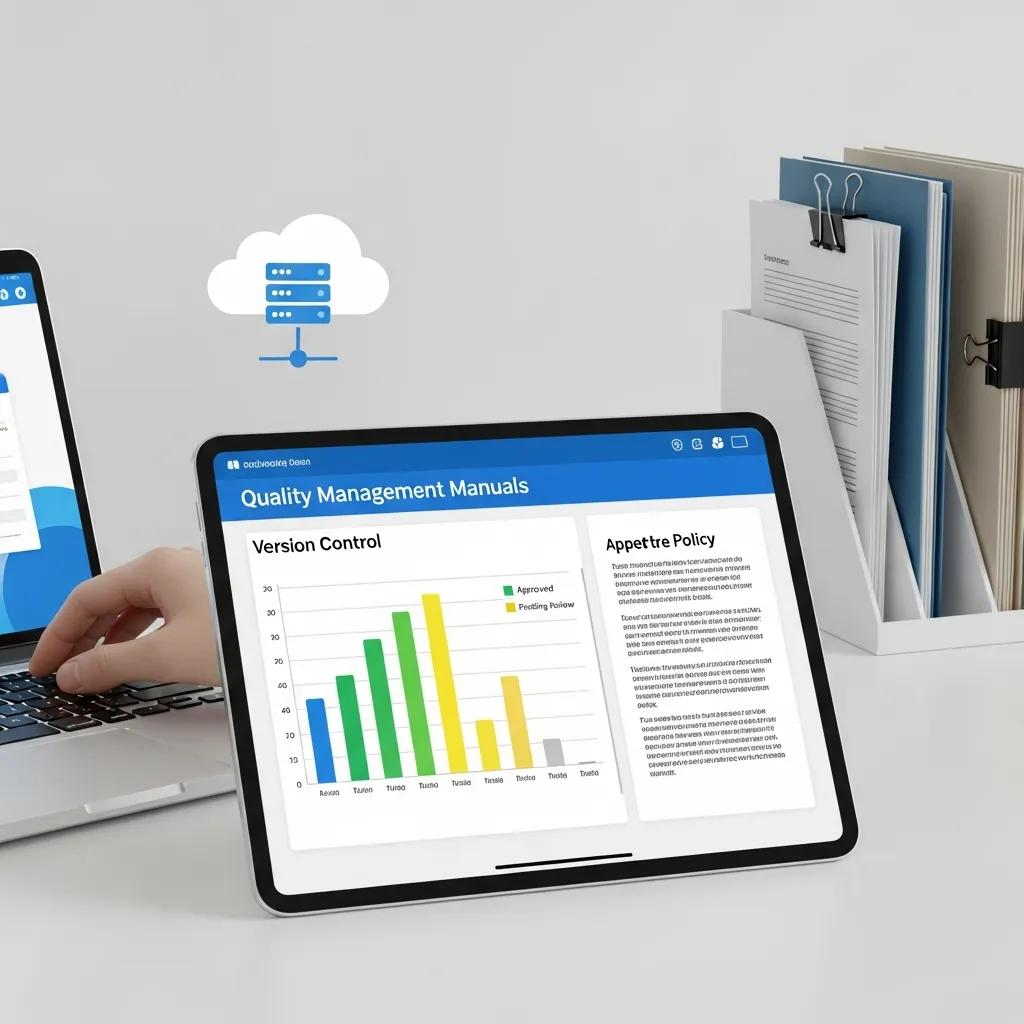
Adopt version control, link the manual to actual procedures and records, and include a change-log to provide an audit trail for revisions. Keep content concise and process-focused, using diagrams and tables to show interactions and responsibilities, and reference retained records with location and retention period. Use digital documentation tools that preserve timestamps and access logs to support evidence of control and change, and apply risk-based thinking to highlight controls for high-risk processes. These practices reduce nonconformities and speed up certification audits; they naturally lead into how a QMM supports commercial requirements and client assessments.
Wesentliche Elemente und Aufbau eines ISO 9001-Handbuchs
A QMM demonstrates to clients and procurement teams that your organization has defined controls, measurable objectives, and documented procedures that reduce delivery risk and ensure consistent quality. By presenting scope, policy, and process maps, the manual shortens supplier assessments, satisfies RFP evidence requests, and increases trust during onboarding. The EAV table below compares common procurement requirements with how a QMM demonstrates compliance and the specific evidence to present during supplier evaluations.
Intro paragraph: The table illustrates typical buyer demands and the concrete QMM evidence that meets each demand to make supplier vetting faster and more transparent.
| Client Requirement | How QMM Demonstrates Compliance | Evidence to Present |
|---|---|---|
| Demonstrated QMS | QMM maps policy to processes and clauses | QMM sections + internal audit summary |
| Consistent Service Delivery | Process maps and control points | KPI reports, nonconformity logs |
| Risk Management | Risk-based thinking embedded in procedures | Risk register entries, corrective actions |
| Data & Records Control | Document control section with retention | Documented procedure, version history |
Summary paragraph: Showing these linkages during procurement response or supplier audits reduces evidence requests and can shorten time-to-contract, which is critical when major clients use ISO 9001 as a qualification in tenders.
How Does a QMM Convince Key Clients and Facilitate Certification?
A QMM convinces clients by making governance visible: clients and auditors can quickly verify commitment, controls, and evidence paths rather than piecing together disparate documents. In procurement scenarios, clauses that require ISO 9001 or equivalent assurance are often satisfied by presenting a manual that maps processes to objectives and records; this reduces back-and-forth during vendor assessments and can lower the time to contract award. Examples include supplier pre-qualification where a QMM replaces lengthy document submissions, vendor audits where process maps reduce on-site time, and tender evaluations where a clear scope and policy demonstrate compliance with contractual quality clauses. Metrics to track impact include reduction in audit evidence requests, decreased time to contract, and fewer repeat nonconformities—these KPIs show the QMM’s commercial value and set the stage for selecting supporting certification services.
What Industry-Specific Considerations Should be Reflected in the QMM?
Tailor the QMM for sector-specific risks: IT manuals should highlight change management, incident response, and data protection; manufacturing QMMs must detail product traceability, production controls, and equipment maintenance; service organizations should focus on service delivery processes and customer feedback loops. For regulated sectors, include references to statutory and regulatory requirements and integrate compliance checks into process controls. Balance generic structure with targeted appendices or annexes that contain industry-specific procedures and records; this modular approach keeps the manual usable across multiple clients and audit types and feeds directly into options for external certification support discussed next.
How Can Stratlane Certification Deutschland Assist in Your QMM Creation and ISO 9001 Certification?
Stratlane Certification Deutschland provides certification services focused on ISO 9001, offering support that bridges QMM development and the certification audit. Their approach combines AI-assisted audit tools with experienced, accredited auditors to accelerate gap analysis and draft validation, reducing the administrative burden on your team while ensuring audit readiness. Engaging a certification partner like Stratlane can shorten the time between drafting a QMM and achieving certification by providing targeted pre-audit checks, consistency reviews, and an external perspective that aligns documentation with auditor expectations. This support is particularly valuable when clients require evidence quickly during procurement or when organizations need a credible third-party to validate their QMS before formal audit.
Intro paragraph to services list: Below are typical ways a certification body can support your QMM and certification journey.
- Gap analysis and pre-audit review: External assessment of missing documented information and recommended corrective actions.
- AI-enhanced consistency checks: Automated tools to find inconsistencies and missing cross-references in your draft manual.
- Accredited auditor validation: Independent audit-readiness checks that align documentation with certification criteria.
Summary paragraph: By combining technological tools and accredited human auditors, a certification partner helps organizations produce a QMM that satisfies both audit rigor and client expectations, allowing you to focus on operations while proficiency in documentation and evidence is established.
What is Stratlane’s AI-Enhanced Approach to QMM Development?
Stratlane uses AI-powered audit tools to accelerate QMM drafting, consistency checking, and gap analysis, helping teams identify missing clause mappings, inconsistent terminology, and absent evidence links more quickly than manual review alone. The AI complements human judgment by surfacing patterns and potential nonconformities, enabling more focused corrections before formal audits. Practical use-cases include automated cross-reference checks between procedures and records, risk identification based on process descriptions, and draft suggestions that harmonize terminology across sections. This combination reduces time spent on repetitive review tasks and helps produce a more coherent, auditable manual that aligns with certification expectations.
How Do Accredited Auditors Support Your Certification Journey?
Accredited auditors validate that your QMM and supporting records meet certification criteria and provide the external credibility clients and procurement teams expect for ISO 9001 certification. Auditors perform pre-audit checks, structured certification audits, and follow-up assessments that verify the effectiveness of documented controls and corrective actions. Working with accredited auditors helps ensure that certifications are accepted by universities, corporations, and SMEs worldwide, and that audit findings are actionable and aligned with certification scope. Preparing specific evidence—such as process maps, records of internal audits, and management review minutes—before auditor visits speeds up the certification process and improves the likelihood of a successful outcome.