

Was ist ISO 27001? Eine Einführung in die Informationssicherheitszertifizierung
ISO 27001 is the international standard that specifies requirements for establishing, implementing, maintaining and continually improving an Information Security Management System (ISMS), and it helps organisations protect the confidentiality, integrity and availability of information. This introduction explains what ISO 27001 covers, why it matters for businesses of every size, and how adopting the standard reduces information risk while supporting regulatory compliance and customer trust. Decision-makers will learn the standard’s scope, core requirements, the role of Annex A controls, and how certification typically proceeds — including readiness reviews, formal audits and ongoing surveillance. The article maps the certification lifecycle, practical risk-assessment steps, measurable business benefits, and industry-specific implementation considerations in Germany. Readers seeking pragmatic next steps will also find how certification bodies that combine AI tools with experienced auditors can streamline audits and support integrated ISO 27001 / ISO 9001 paths. The next section defines the standard precisely and highlights top-level benefits for organisations.
Was ist der ISO 27001 Standard und welche Bedeutung hat er für Unternehmen?
ISO 27001 is a management-system standard designed to ensure systematic protection of information assets through risk-based processes, documented policies and defined responsibilities. It works by requiring organisations to identify information assets, evaluate threats and vulnerabilities, and select proportionate controls to treat identified risks under a documented Statement of Applicability. The specific benefit is that an ISMS aligns security activities with business objectives so confidentiality, integrity and availability become demonstrable outcomes rather than ad hoc measures. Understanding these mechanisms clarifies why ISO 27001 supports regulatory compliance, reduces breach costs and strengthens supplier and customer confidence. The following subsections examine the standard’s objectives and the ISMS concept in practical terms.
Academic research underscores the critical role of ISO 27001 in safeguarding information assets and systematically managing security risks.
ISO 27001: Protecting Information Assets & Managing Security Risks
Information is a fundamental asset within any organization and the protection of this asset, through a process of information security is of equal importance. COBIT and ISO27001 are as reference frameworks for information security management to help organizations assess their security risks and implement appropriate security controls. One of the most important sections of IT within the COBIT framework is information security management that cover confidentiality, integrity and availability of resources.
Effectiveness of ISO 27001, as an information security management system: an analytical study of financial aspects, NK Sharma, 2012
Welche Ziele verfolgt ISO 27001 im Bereich Informationssicherheit?
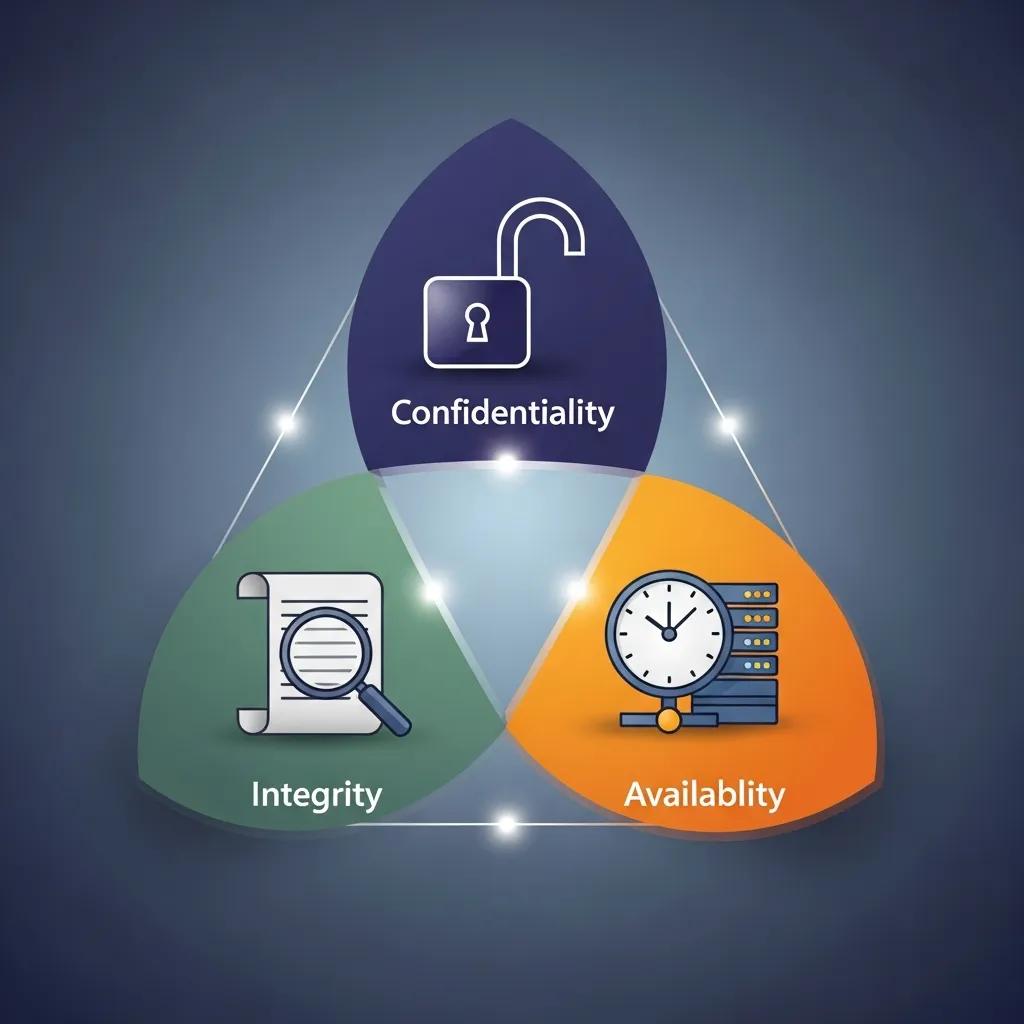
ISO 27001 pursues three core objectives: protect confidentiality, maintain integrity and ensure availability of information assets, commonly known as the CIA triad. The standard requires organisations to reduce risk through formal assessment and treatment, improving resilience against incidents and supporting business continuity planning. Continuous improvement is embedded via the PDCA (Plan-Do-Check-Act) cycle so controls are monitored, audited and adjusted over time to reflect changing threats. These objectives translate into reduced incident frequency, faster recovery and clearer accountability for information risk, which in turn lowers operational disruption and potential regulatory penalties.
Wie definiert ISO 27001 das Informationssicherheits-Managementsystem?
An ISMS under ISO 27001 is a structured set of policies, procedures, processes and roles that collectively manage information risk across an organisation. It begins with scope definition and asset inventory, proceeds through risk assessment and treatment selections, and requires documented policies, roles, training and monitoring to operate effectively. The PDCA cycle governs continual improvement: plan the ISMS, implement controls, check performance via monitoring and audits, and act on findings to close gaps. This systemic approach ensures information security is integrated into business processes rather than being a siloed IT activity, which facilitates consistent governance and measurable performance.
Welche Anforderungen und Kontrollen umfasst ISO 27001?
ISO 27001’s structure includes high-level clauses covering context, leadership, planning, support, operation, performance evaluation and improvement, and it requires risk-based selection of controls from Annex A. Organisations must maintain documented risk assessments, a Statement of Applicability (SoA), procedures for incident response and evidence of monitoring and internal audit activities. Annex A provides control families that organisations use as a catalogue for treatment options; applying those controls depends on the risk assessment and documented justifications. The next subsections explain the risk assessment workflow and summarise Annex A control families with practical examples for IT, infrastructure and processes.
Wie funktioniert die Risikobewertung und das Risikomanagement nach ISO 27001?
Risk assessment under ISO 27001 follows a clear sequence: identify assets and owners, list threats and vulnerabilities, analyse and evaluate risk likelihood and impact, then select risk treatment options and record them in a risk register. Typical analysis methods include qualitative scoring (e.g., low/medium/high) or quantitative approaches (financial impact estimates), combined with likelihood estimates to prioritise treatment. Risk treatment includes implementing controls, accepting residual risk with justification in the SoA, transferring risk through contracts or insurance, or avoiding risk by changing business processes. Regular monitoring, review and updates to the risk register ensure the ISMS remains aligned with evolving threats and organisational changes.
Was beinhaltet Annex A und welche Sicherheitskontrollen sind relevant?
Annex A groups controls into families such as access control, cryptography, operations security, communications security and supplier relationships, offering practical control options to address identified risks. Organisations reference Annex A when preparing the SoA to show which controls were selected, why they were chosen and how they are implemented. For SMEs, relevant examples often include access management, patching and backup procedures, secure configuration and basic encryption; larger enterprises will extend this with network segregation, advanced monitoring and supplier security programs.
The following table maps Annex A control families to the assets they protect and typical implementations.
| Control family | Protects | Typical implementation |
|---|---|---|
| Access control | User accounts, systems, sensitive data | Role-based access, MFA, periodic entitlement reviews |
| Cryptography | Confidential data in transit and at rest | TLS for communications, disk encryption, key management |
| Operations security | Servers, processes, backups | Patch management, secure baselines, scheduled backups |
| Supplier relationships | Outsourced services and data exchange | Contracts with security clauses, third-party assessments |
This mapping helps teams link Annex A options to business assets and decide which controls yield the best risk reduction given their context.
Welche Vorteile bietet die ISO 27001 Zertifizierung für Unternehmen?
ISO 27001 certification delivers strategic and measurable benefits: it provides third-party assurance of security practices, supports regulatory compliance such as GDPR, reduces the likelihood and impact of incidents, and improves procurement standing with customers and partners. Certification creates a documented governance framework that boards and regulators can rely on, turning security from a technical cost center into a managed business capability. Organisations can measure benefits via KPIs such as reduced incident rates, faster recovery time, fewer supplier security failures and improved win rates in tenders. The subsections below explain trust and compliance impacts and include an EAV table that links benefits to business impact and example KPIs.
Wie stärkt ISO 27001 das Vertrauen von Kunden und Partnern?
Certification acts as third-party assurance that an organisation manages information risk systematically, which buyers and partners often require as part of procurement and contractual processes. Presenting ISO 27001 certification reduces due-diligence friction, shortens supplier on-boarding and can be a decisive factor in competitive tenders that demand demonstrable security governance. For operational teams, certification clarifies responsibilities and improves incident response coordination, which further strengthens vendor reputation. Given procurement practices, many organisations also expect suppliers to hold complementary management standards such as ISO 9001, which reinforces expectations for structured processes and consistent quality.
The benefits of ISO 27001 can be summarised in measurable terms:
- Third-party assurance: Certification demonstrates independent verification of controls.
- Procurement advantage: Certified suppliers face fewer documentation hurdles in RFPs.
- Operational clarity: Defined roles and procedures reduce incident response time.
These advantages convert into tangible procurement and reputational gains that support business growth and risk reduction.
The following table aligns common certification benefits with business impact and example KPIs.
| Benefit | Business impact | Example KPI or ROI |
|---|---|---|
| Third-party assurance | Faster procurement decisions | Reduction in due-diligence hours per bid |
| Regulatory support | Lower compliance risk and fines | Number of compliance incidents per year |
| Incident reduction | Lower breach-related costs | Average breach cost saved annually |
This comparison shows how certification outcomes translate into measurable business metrics that executives can track and optimize.
Inwiefern unterstützt ISO 27001 die Einhaltung von Datenschutzgesetzen wie GDPR und BDSG?
The standard’s utility extends to global privacy compliance, effectively addressing common challenges in data protection.
ISO 27001 for Global Privacy Compliance
ISO 27001 in privacy compliance, its effectiveness in addressing the shortcomings in privacy compliance, and the advantages of ISO 27001
ISO 27001 and Global Privacy Compliance, 2025
ISO 27001 supports GDPR and the German BDSG by establishing documented controls for data processing, access rights, data minimisation and incident response, enabling organisations to demonstrate appropriate technical and organisational measures. Specific Annex A controls—such as access control, cryptography and logging—map directly to GDPR principles like integrity, confidentiality and accountability, aiding data protection impact assessments and vendor management. The ISMS also enforces documentation, retention policies and breach notification procedures that align with legal reporting timelines. For German organisations, combining ISO 27001 evidence with legal records simplifies cross-functional compliance efforts and vendor oversight.
Research further emphasizes how ISO 27001 helps embed compliance deeply within an organization’s operational framework.
ISO 27001: Anchoring Compliance in Information Security
This also includes compliance as part ofinformation security management systems in order to better anchor compliance in the overall organization, especially at the operational level.
Creation of a distinct culture for the overall system “Compliance, IT security and Data protection” in municipalities in
Germany, C Schachtner, 2022
Wie läuft der Zertifizierungsprozess für ISO 27001 ab?
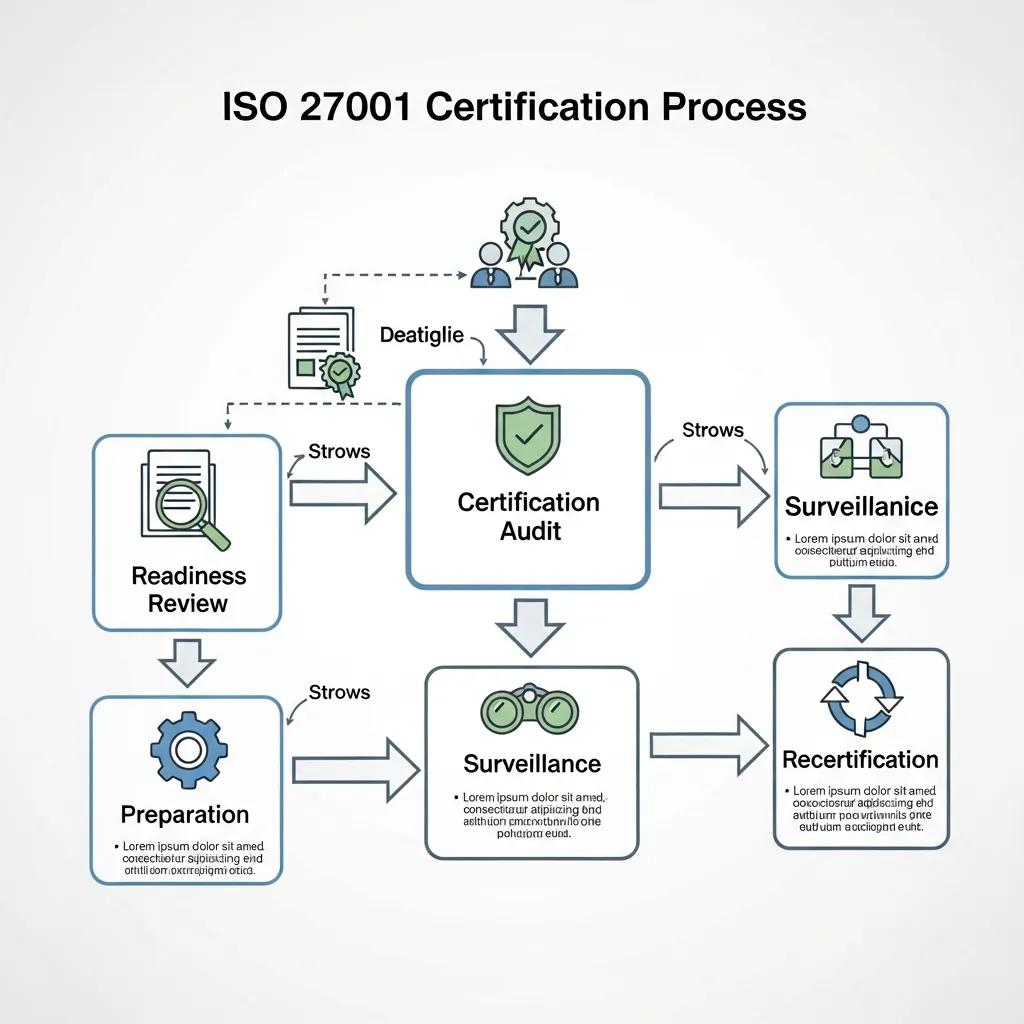
The ISO 27001 certification lifecycle typically follows preparation, a Stage 1 readiness review, a Stage 2 certification audit, regular surveillance audits and eventual recertification, all driven by documented evidence and an operational ISMS. Preparation includes scoping, conducting an initial risk assessment, developing policies and compiling the Statement of Applicability; Stage 1 assesses readiness and documentation, while Stage 2 verifies implementation and effectiveness through sampling and interviews. Surveillance audits, usually annual, check continued conformity and the effectiveness of continual improvement activities, while recertification occurs on a three-year cycle to renew the certificate. Below is a numbered checklist summarising the core audit stages and what organisations should prepare to present to auditors.
The certification process can be outlined in steps:
- Preparation: Define scope, assets, policies and conduct initial risk assessment.
- Stage 1 (readiness): Auditor reviews documentation and readiness for full audit.
- Stage 2 (certification): Auditor verifies implementation and evidence of effectiveness.
- Surveillance: Periodic checks to ensure ongoing conformity and improvements.
- Recertification: Comprehensive re-evaluation to renew the certificate.
These steps clarify expected deliverables and timelines, helping teams sequence tasks and resource the audit effectively.
Welche Schritte umfasst das Audit und die Zertifizierung durch Stratlane?
Stratlane Certification Deutschland operates as an innovative certification body that leverages AI and experienced industry experts for auditing organisations, offering ISO certifications including ISO 9001, ISO 14001, ISO 27001 and ISO 42001. Their approach includes a readiness review followed by a formal certification audit and subsequent surveillance audits, with auditors combining automated evidence checks with professional judgement to verify control effectiveness. Stratlane’s positioning emphasises professional, reliable services and global acceptance of certifications by universities, companies and SMEs, supported by accreditation in over 27 countries and auditors in over 29 countries. After the audit steps, organisations receive findings and a remediation plan where necessary to achieve certification.
Stratlane’s blend of AI-assisted review and experienced auditors helps speed evidence review while ensuring consistent application of audit criteria, and their global accreditation supports recognition across markets.
Wie trägt der Einsatz von KI bei Stratlane zur Effizienz des Audits bei?
AI-assisted auditing at Stratlane aids efficiency by automating routine evidence collection, flagging inconsistencies and enabling auditors to focus on judgment-intensive activities such as contextual interviews and control effectiveness assessments. Automated tools can rapidly compare documented controls against evidence, detect missing artefacts and prioritise areas for human review, reducing time spent on manual checks without replacing auditor expertise. This combination of AI with experienced auditors yields faster throughput and consistent audit scopes, while human auditors apply nuanced judgement to complex risk scenarios. As a result, organisations can expect a more streamlined audit experience that balances speed with rigorous evaluation.
As many procurement functions demand both quality and information security assurance, pursuing integrated certification paths can further reduce duplicate effort and audit overhead.
Warum ist die Kombination von ISO 27001 und ISO 9001 für Schlüsselklienten wichtig?
Many key clients require ISO 9001 in addition to ISO 27001 because quality management and information security intersect across processes, supplier management and continual improvement, creating stronger contractual assurances. ISO 9001 focuses on consistent delivery, customer satisfaction and process control, while ISO 27001 focuses on protecting information assets and managing risk; together they present a comprehensive governance package that procurement teams commonly expect from suppliers. Integrating both systems reduces audit duplication, harmonises documentation and demonstrates both process maturity and security rigor — attributes crucial for contracts with universities, corporate clients and regulated sectors. The table below compares the two standards across purpose, client requirement likelihood and implementation overlap to illustrate why many buyers ask for both.
The following table compares ISO 27001 and ISO 9001 across practical attributes.
| Standard | Purpose | Client requirement likelihood / Overlap |
|---|---|---|
| ISO 27001 | Protect information confidentiality, integrity, availability | High for data-sensitive suppliers; overlaps in supplier controls |
| ISO 9001 | Ensure consistent product/service quality and customer satisfaction | Very common in procurement; overlaps in process control |
| Integrated IMS | Combine QMS + ISMS governance | Preferred by many key clients to reduce vendor risk and audit fatigue |
This comparison shows why dual certification strengthens a supplier’s profile and simplifies client assessments.
(For organisations preparing certification, pursuing integrated paths that address both ISO 27001 and ISO 9001 concurrently is a practical recommendation to meet client expectations and streamline audits.)
Wie ergänzen sich Informationssicherheits- und Qualitätsmanagementsysteme?
Information security and quality management systems complement each other through shared process-control mechanisms such as change management, document control and supplier oversight, which reduce both quality defects and security vulnerabilities. Both standards use PDCA for continual improvement, enabling unified management reviews, combined internal audits and consolidated corrective actions that save time and clarify responsibilities. For example, document control procedures required by ISO 9001 support consistent policy distribution for ISMS controls, while incident handling processes from ISO 27001 can be integrated into quality non-conformance workflows. Integrating systems eliminates duplicated records, aligns objectives and strengthens cross-functional accountability.
Welche Vorteile ergeben sich durch die Integration beider Standards für Unternehmen?
Integrated certification delivers multiple operational advantages: lower audit costs through combined assessments, reduced administrative overhead from unified documentation, and a stronger procurement position when responding to tender requirements. Organisations can measure integration benefits via fewer audit days, reduced man-hours managing separate systems and improved tender success rates where clients value holistic governance. Combined systems also enhance resilience by aligning quality-driven process controls with security controls that protect those processes and their outputs. This integrated approach supports strategic risk management and presents a single, coherent governance posture to customers and regulators.
Wie wird ISO 27001 in verschiedenen Branchen in Deutschland umgesetzt?
Implementation of ISO 27001 varies by sector: finance, healthcare, public sector and manufacturing each impose distinct regulatory and operational constraints that shape controls and evidence requirements. Finance demands strong encryption, segregation of duties and transaction logging; healthcare emphasises patient-data protections, consent and strict access controls; public sector projects often require transparency, audit trails and compliance with national security policies; manufacturing focuses on OT/IT convergence controls and supplier integrity. Tailoring an ISMS to sector specifics ensures controls are both practical and auditable, while aligning with national laws like GDPR and German BDSG. The subsections below list sector-specific considerations and best-practice steps for implementation.
Welche branchenspezifischen Anforderungen sind zu beachten?
Different sectors require tailored control emphases: finance needs robust transaction monitoring and encryption, healthcare mandates strict access controls and consent management, public sector entities must address transparency and record-keeping, and manufacturing must secure industrial control systems and vendor chains. Each environment also introduces unique vendor and supplier expectations, meaning organisations must map contractual obligations into Annex A selections and the SoA. Regulatory crosswalks tying ISO 27001 controls to sector rules simplify audits and reduce rework. Teams should prioritise controls that directly mitigate the highest sectoral risks and document mapping for auditors.
- Finance: Prioritise strong logging, segregation of duties and cryptography.
- Healthcare: Focus on strict access controls, consent processes and breach response.
- Public sector: Emphasise auditability, transparency and legal record-keeping.
- Manufacturing: Secure OT/IT interfaces and vendor security controls.
These focus areas guide control selection and justify SoA choices during audits.
Welche Best Practices und Fallstudien gibt es zur ISO 27001 Implementierung?
Effective ISO 27001 implementation follows an incremental approach: define scope realistically, secure top-management commitment, build an asset inventory, run a pragmatic risk assessment and implement high-impact controls first. Engaging leadership and embedding PDCA cycles ensures continuous improvement, while external auditors and accredited certification bodies provide validation and objective feedback. Best practices include using templates sparingly, prioritising training and awareness, automating evidence collection where feasible and aligning ISMS metrics with business KPIs. Organisations that adopt these practices tend to achieve certification faster and sustain improvements through routine surveillance.
Below is a concise best-practice checklist to guide implementation efforts.
- Secure leadership buy-in and assign clear roles.
- Start with a focused scope and realistic asset inventory.
- Prioritise controls that reduce the highest business risks first.
- Automate evidence collection and maintain a living risk register.
These steps reduce project risk, improve audit readiness and create a resilient ISMS that adapts as the organisation evolves.