

ISO 9001 Re-Certification: What You Need to Know for Successful Renewal
ISO 9001 re-certification confirms that an organization’s Quality Management System (QMS) continues to meet international requirements and supports ongoing customer confidence and procurement eligibility. This guide explains the re-certification audit lifecycle, core renewal requirements, the role of surveillance audits, and practical preparation steps so you can plan a smooth renewal. Many organizations struggle with evidence readiness, unresolved nonconformities, and aligning management review outputs to ISO 9001:2015 clauses; addressing those gaps proactively reduces audit risk. The article maps the re-certification timeline, details documentation and internal-audit expectations, describes surveillance rhythms, and offers checklists and comparison tools for choosing an accredited certification body. Readers will also find pragmatic lists and EAV tables that translate auditor expectations into concrete evidence examples and selection criteria, enabling teams to prepare with confidence for their next ISO 9001 renewal.
Academic research further explores the intricacies of ISO 9001 QMS recertification, examining various aspects from methodology to key findings.
ISO 9001 QMS Recertification: A Systematic Literature Review
study purpose or objective, theory supporting the research, research method adopted, main findings of the study and directions for further research on ISO 9001 QMS recertification.
ISO 9001 maintenance, decertification and recertification: a systematic literature review, C Camango, 2023
What Is the ISO 9001 Re-Certification Process?
The ISO 9001 re-certification process is the triennial external audit that verifies sustained conformity of your QMS and renews the certificate, typically following periodic surveillance audits that check ongoing compliance. The mechanism relies on documented evidence of continual improvement, closure or management of prior nonconformities, and demonstrated process performance; auditors evaluate whether controls remain effective and aligned to ISO 9001:2015 clauses such as context, leadership, and performance evaluation. Successful re-certification yields a renewed certificate accepted by clients and procurement bodies, while a failed outcome typically triggers corrective actions and follow-up assessment. Below is a concise numbered overview of the common re-certification flow to use as a planning checklist.
- Planning and scope confirmation: confirm sites, processes, and standards covered.
- Internal audits and management review: address findings and demonstrate improvement.
- External re-certification audit: on-site or remote evidence verification and interviews.
- Nonconformity resolution and decision: corrective actions reviewed, certification decision issued.
- Certificate renewal: successful decision leads to certificate re-issuance valid for the next cycle.
This stepwise view clarifies the timeline and responsibilities for each phase, and it leads naturally into understanding how re-certification contrasts with initial certification requirements.
How Does Re-Certification Differ from Initial Certification?
Re-certification differs from initial certification because auditors focus on evidence of sustained effectiveness and continual improvement rather than initial implementation of a QMS. During an initial certification audit the emphasis is on whether processes are established and deployed; during re-certification the auditor evaluates trends, corrective action effectiveness, and whether the organization has embedded risk-based thinking into operations. Evidence expectations shift from demonstrating that procedures exist to proving they work over time through metrics, internal-audit cycles, and management-review outcomes. Auditors also review how previous nonconformities were handled; well-documented corrective actions and verification reduce the likelihood of major findings during re-certification. Understanding this difference helps teams prioritize longitudinal data and corrective-action closure in preparation for the re-certification audit.
What Are the Key Steps in the Re-Certification Audit?
The re-certification audit itself follows a predictable sequence: opening meeting, document and record review, process sampling with interviews, identification of nonconformities, and a closing meeting with findings and timelines. Auditors plan sampling based on risk, process criticality, and previous findings, and they will interview process owners to confirm consistent implementation and performance. Reports typically include observations, minor and major nonconformities, and required corrective-action deadlines, with major issues potentially delaying certification. Preparing teams to present concise evidence packages and to make process owners available for interviews significantly reduces audit duration and clarifies any findings. The flow from audit activities to corrective action and decision explains why regular internal audits and timely management review are essential prior steps.
Stratlane Certification Deutschland illustrates a streamlined re-certification workflow by combining accredited auditors with AI-supported audit tools to accelerate evidence capture and reporting while maintaining global acceptance standards. This contextual example shows how a provider can support planning, surveillance, and re-certification phases without changing the fundamental audit requirements.
What Are the Essential Requirements for ISO 9001 Renewal?
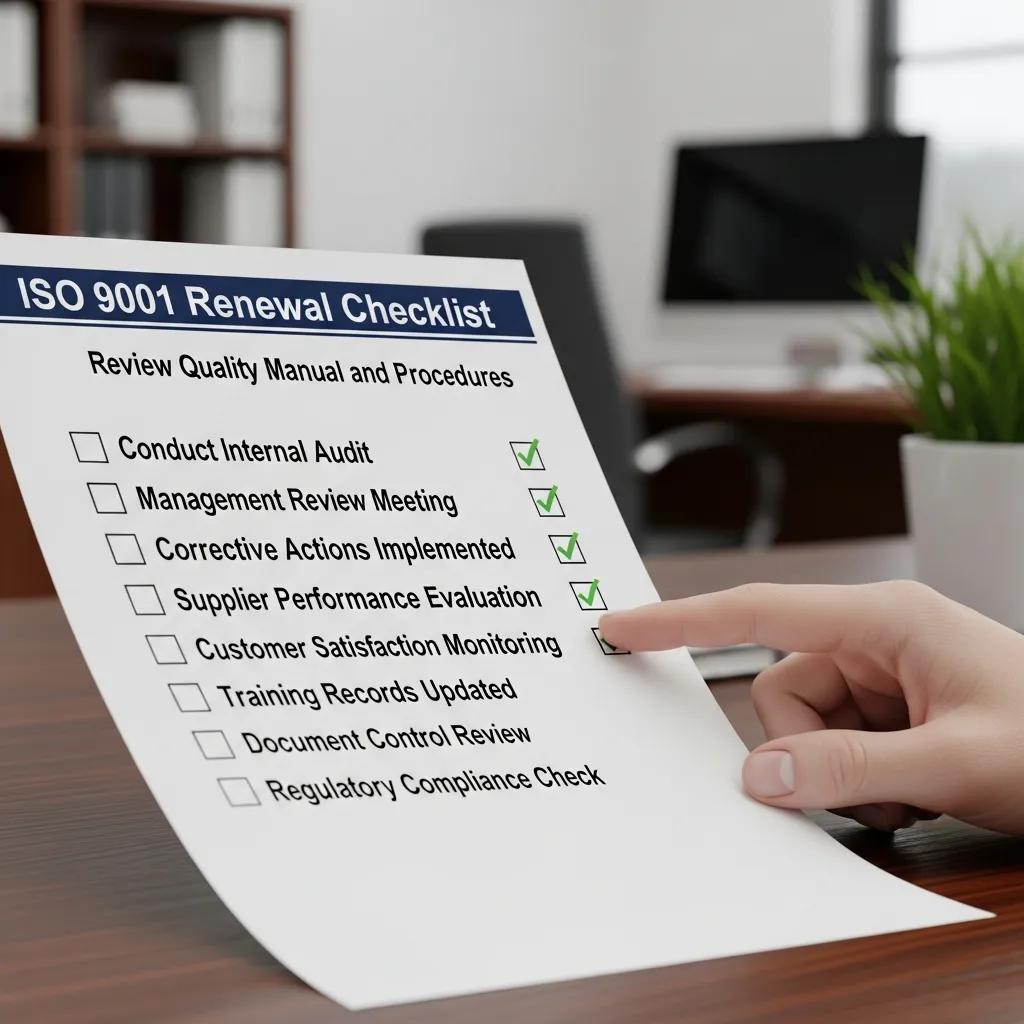
ISO 9001 renewal requires up-to-date QMS documentation, evidence of internal audits and management reviews, handling of nonconformities and corrective actions, and performance monitoring tied to objectives. Auditors verify that the documented scope, process controls, and document-control records are current and accessible, that internal-audit schedules and reports exist and show follow-up, and that management reviews address strategic issues with outputs allocated to owners. Performance metrics and customer-satisfaction data are crucial to demonstrate effectiveness and improvement over the certification cycle. The table below maps core requirements to what auditors typically look for and provides concrete evidence examples teams should prepare.
| Requirement | What the Auditor Looks For | Evidence Examples |
|---|---|---|
| Document control | Current procedures and version control | Updated procedures, change logs, authorized revisions |
| Internal audits | Scheduled audits, findings, and follow-up | Audit schedule, reports, corrective-action verification |
| Management review | Agenda, inputs, outputs, and decisions | Management-review minutes, action lists, assigned owners |
| Corrective actions | Root cause, actions, verification | CAR records, implementation evidence, effectiveness checks |
| Performance metrics | Objective alignment and trend data | KPI dashboards, trend reports, customer feedback records |
This mapping gives teams a practical checklist to prioritize evidence collection and aligns internal activities to auditor expectations. Preparing these artifacts and linking them to ISO 9001 clauses reduces ambiguity during the external assessment and leads into specific document types auditors expect to see.
Which Documentation and Records Must Be Updated?
Auditors expect a set of core documentation to be current: the QMS scope statement, key procedures or process descriptions, work instructions for critical operations, internal-audit records, management-review minutes, and corrective-action records. Each document must show revision control and appropriate approvals, while records should demonstrate recent activity and follow-up; for example, internal-audit reports with evidence of closure and verification are stronger than open-ended findings. Teams should assemble document control indexes and quick-reference evidence packages that map records to clause requirements to speed auditor review. A practical approach is to create a cross-reference matrix linking each clause to sample records, which simplifies auditor sampling and highlights compliance. Ensuring these documents are current transitions naturally to how internal audits and management reviews underpin renewal readiness.
How Do Internal Audits and Management Reviews Support Renewal?
Internal audits identify gaps and produce corrective-action plans that management reviews use to allocate resources and validate effectiveness, thereby forming the backbone of re-certification evidence. Internal-audit outputs should include nonconformity classification, root-cause analysis, action deadlines, and verification steps; auditors will sample these to confirm closure and effectiveness over time. Management review demonstrates top management’s oversight through meeting minutes that capture strategic risks, opportunities, resource needs, and decisions tied to QMS objectives. When management reviews explicitly reference audit findings and performance trends, auditors see documented leadership engagement and continual improvement. These functions together establish a narrative of sustained compliance that auditors expect during the re-certification assessment.
How Do Surveillance Audits Support Continuous ISO 9001 Compliance?
Surveillance audits are interim checks—usually annual—conducted between full re-certification audits to confirm ongoing conformity and to identify issues early before the triennial re-certification. The mechanism focuses on sampled processes, follow-up of previous findings, and confirmation that the QMS remains effective; surveillance audits are narrower in scope than re-certification audits but essential to maintain certification status. Regular surveillance reduces the risk of surprises at re-certification by ensuring trends and corrective actions are monitored and by keeping documentation current. Preparing for surveillance requires maintaining current records and having clear evidence of action on prior nonconformities, which also strengthens the organization’s readiness for the full re-certification audit.
What Is the Purpose and Frequency of Surveillance Audits?
The primary purpose of surveillance audits is to monitor continued conformity and improvement between certification cycles, typically conducted annually with the full re-certification audit every three years. Surveillance auditors confirm that corrective actions remain effective, that internal audits are performed, and that management still reviews performance; they may also sample key processes for on-site verification. The frequency—often once per year—creates a rhythm of compliance that keeps organizations focused on continual improvement rather than last-minute remediation. This annual cadence helps organizations build audit habits and preserves institutional memory of QMS practices ahead of the re-certification audit. Understanding surveillance frequency clarifies how routine activities feed into long-term certification health.
How Should Organizations Prepare for Surveillance Audits?
Preparation for surveillance audits requires up-to-date metrics, evidence of corrective-action progress, accessible process records, and availability of process owners for interviews during the audit. Teams should compile recent KPI trends, internal-audit summaries, management-review highlights, and a list of open and closed corrective actions with verification notes. Quick evidence packages—organized by process and clause—reduce audit time and help auditors validate conformity efficiently. Scheduling briefings for interviewed staff and ensuring remote-access documents or local file organization also prevent delays. These preparation steps not only ease surveillance audits but also improve the organization’s overall readiness for the subsequent re-certification assessment.
An AI-supported surveillance approach can reduce audit downtime and improve evidence collection by automating document indexing and highlighting high-risk areas for auditor attention; for organizations working with providers that combine accredited auditors and AI tools, this results in faster reporting and clearer evidence trails. This operational example shows how technology can be leveraged to make surveillance outputs more actionable and to shorten the time between finding and verification.
What Are the Benefits of Maintaining ISO 9001 Certification?
Maintaining ISO 9001 certification delivers clear business benefits: it improves client trust and supplier qualification, increases access to procurement opportunities that mandate certification, and drives operational improvements through disciplined process controls. The mechanism of benefits arises from documented processes, performance monitoring, and a culture of corrective action that collectively reduce defects, improve delivery, and mitigate compliance risks. For leaders, certificate continuity supports contract eligibility and can reduce the frequency of client-led supplier audits by providing trusted third-party validation. The table below summarizes primary benefits, the business impact, and metrics or examples organizations can use to quantify value.
| Benefit | Business Impact | Metric or Example |
|---|---|---|
| Client trust | Easier pre-qualification for tenders | Reduced supplier audits, increased contract wins |
| Process consistency | Fewer defects and rework | Defect rate, first-pass yield improvements |
| Risk mitigation | Lower compliance incidents | Incident rate, corrective-action closure time |
| Continuous improvement | Efficiency gains and cost savings | Cycle time reduction, cost per unit savings |
This benefits table helps decision-makers translate certification into measurable outcomes and connects improvement activities to business metrics that stakeholders recognize. Demonstrating these metrics in management reviews strengthens the case for continued investment in QMS activities.
How Does Re-Certification Enhance Client Trust and Competitive Advantage?
Active ISO 9001 certification signals to clients and procurement teams that a supplier follows internationally recognized quality practices, which simplifies supplier qualification and builds credibility during tender evaluations. Organizations can quantify trust by tracking reduced frequency of client inspections, higher bid success rates, or shortened onboarding timelines when certification is part of the contractual criteria. During audits, presenting customer-feedback trends and corrective-action results demonstrates a commitment to customer satisfaction, which further strengthens competitive positioning. Using these data points in proposals and client discussions converts certification into a tangible market differentiator. The role of re-certification in procurement contexts thus links QMS practices directly to commercial advantage and contract eligibility.
What Operational Efficiencies and Risk Mitigation Are Gained?
ISO 9001 practices reduce variability, improve process control, and formalize nonconformity management, which together yield tangible efficiency gains and lower operational risk. Metrics such as defect rate, on-time delivery, and corrective-action closure time provide a view of operational health; improvements in these areas often lead to cost reductions and higher customer satisfaction. Risk mitigation arises from documented controls and management oversight, which reduce the likelihood and impact of incidents through preventive actions and timely corrective measures. Tracking these KPIs within the QMS enables teams to prioritize improvement projects that deliver measurable returns. Understanding these operational outcomes closes the loop between certification activities and organizational performance.
How to Choose the Right Certification Body for Your ISO 9001 Re-Certification?

Selecting the right certification body requires evaluating accreditation, auditor expertise and sector experience, geographic acceptance of the certificate, and the provider’s audit approach and technology options. Accreditation ensures the certificate will be recognized by clients and regulators, while experienced auditors bring sector-specific insight that reduces rework and increases audit efficiency. Technology such as remote-audit capabilities and AI-supported evidence capture can improve scheduling flexibility and speed reporting, but these features should complement, not replace, auditor competence. The following table provides a structured comparison to help procurement and quality leaders evaluate providers against practical checklist questions.
| Provider Attribute | Why It Matters | Checklist Question |
|---|---|---|
| Accreditation | Ensures certificate recognition | Is the provider accredited by a recognized body for ISO 9001 scope? |
| Auditor expertise | Reduces audit rework and adds practical insight | Do auditors have sector experience and relevant qualifications? |
| Geographic acceptance | Certificate usability across markets | Will the certificate be accepted in key operating regions? |
| Technology and approach | Improves efficiency and evidence handling | Does the provider use secure remote audits or AI-assisted tools? |
This comparison table helps teams ask precise questions during provider selection and frames responses in decision-ready terms. Evaluating providers against these attributes leads into more detailed checks on accreditation documentation and auditor CVs.
Why Is Accreditation and Auditor Expertise Important?
Accreditation is the formal recognition that a certification body meets standards to issue ISO certificates that will be accepted by clients and regulators; auditor expertise ensures the assessment is practical, efficient, and relevant to your sector. Checking accreditation scope verifies that the provider is authorized to certify within your industry and gives confidence that certificates will be recognized internationally. Auditor sector experience shortens audit time by focusing sampling on high-risk processes and offering value-added observations that support improvement. Requesting evidence of accreditation and asking about auditor track records are practical checklist items during provider evaluation. Understanding these verification steps guides organizations to providers who combine credibility with actionable audit feedback.
How Does AI-Powered Auditing Improve the Re-Certification Experience?
AI-powered auditing improves the re-certification experience by automating document indexing, identifying high-risk evidence gaps, prioritizing sampling, and accelerating report generation, which in turn shortens assessment cycles and clarifies nonconformity root causes. These tools do not replace auditor judgment but augment it by surfacing trends, correlating records to clause requirements, and producing structured findings faster than manual methods. Faster reporting enables quicker corrective-action assignment and verification, reducing the window between finding and closure and lowering re-certification risk. When evaluating providers, consider whether AI capabilities are used to enhance efficiency while preserving auditor accreditation and sector expertise. This combination of technology and human judgment helps organizations achieve timely re-certification while gaining deeper insight into system performance.
Stratlane Certification Deutschland’s stated strengths—AI-powered audit systems, experienced accredited auditors, global acceptance, and a focus on continuous improvement—represent the sort of provider attributes teams should prioritize when selecting a certification partner. Use these UVPs as evaluation criteria without allowing technology claims to overshadow verification of accreditation and auditor competence.
How to Prepare Effectively for Your ISO 9001 Re-Certification Audit?
Effective preparation begins with an audit-readiness checklist, clear assignment of roles, and polished evidence packages that map records directly to ISO 9001 clauses and audit criteria. Preparation activities should include completing internal audits with verified closures, compiling KPI trends and customer-satisfaction data, updating document-control registers, and rehearsing process-owner interviews. Teams should create a concise evidence index and ensure that responsible personnel are briefed and available during the audit window. Below is an actionable checklist to guide readiness activities and reduce last-minute remedial work.
- Update documents and records: Ensure procedures, work instructions, and version control are current.
- Close internal-audit findings: Verify corrective actions with evidence of effectiveness.
- Compile performance data: Prepare KPI trends, customer feedback, and objective progress reports.
- Schedule staff availability: Confirm process owners and records custodians will be reachable during the audit.
- Prepare evidence packages: Organize documents by process and clause for quick auditor sampling.
Following this checklist reduces friction during the audit and ensures auditors can verify conformity efficiently, which leads into practical team-level behaviors that support successful outcomes.
What Are the Key Checklist Items for Audit Readiness?
Key checklist items include updated document-control records, recent internal-audit reports with closed findings, management-review minutes showing decisions and resource allocation, and demonstrable corrective-action verification. Additionally, teams should prepare KPI dashboards that show trend analysis, customer-satisfaction summaries, and risk-treatment plans that tie to strategic objectives. Having a cross-reference matrix that maps each clause to representative records accelerates auditor sampling and demonstrates intentional organization of evidence. Run a short internal “mock interview” for process owners to ensure consistent, concise responses during auditor interviews. These readiness steps create the operational rhythm that supports both surveillance and re-certification audits.
How Can Teams Ensure Successful Audit Outcomes?
Teams ensure successful outcomes by assigning clear roles for audit day, preparing concise evidence packages, rehearsing interviewer responses, and establishing rapid follow-up mechanisms for any findings. Assign an audit-day coordinator, designate process owners for interviews, and prepare a single point of access to evidence—physical or digital—to avoid delays. Use brief, factual statements during interviews and reference documented records promptly; auditors value verifiable links between statements and evidence. After the audit, prioritize timely corrective-action submission and verification to close findings within required timeframes. Implementing these behaviors institutionalizes audit readiness and reduces the likelihood of disruptive findings at re-certification.
For organizations ready to discuss re-certification support, Stratlane Certification Deutschland offers consultation on combining accredited auditor expertise with AI-assisted audit tools to streamline evidence capture and reporting. Contacting a provider for a pre-audit readiness discussion can clarify scope and timelines ahead of the formal assessment.
Stratlane Certification Deutschland can provide a consultation or quote to help plan your re-certification pathway with AI-supported audit tools and accredited auditors. If you would like assistance in preparing for renewal, reach out to Stratlane Certification Deutschland to request a consultation or quote.