

Risikomanagement nach ISO 27001: Eine Einführung und umfassender Leitfaden zum Informationssicherheitsrisiko
Information security risk management under ISO 27001 defines a structured approach to identify, analyse and treat risks to information assets, ensuring confidentiality, integrity and availability are maintained. This article explains how an ISMS applies a risk-based approach, why it matters for IT directors and business leaders, and how practical steps from asset inventory to residual risk measurement produce measurable protection.
Readers will learn core concepts such as assets, threats, vulnerabilities and risk owners, follow a step-by-step ISO 27001 risk assessment process, compare risk treatment strategies, understand the Statement of Applicability, and see business benefits and integration with ISO 9001. Practical lists, EAV tables and examples illustrate scoring methods, risk treatment plan components, and how to justify Annex A control selections. Current research and best practice thinking inform recommendations so you can design an auditable, proportionate ISMS risk program aligned with compliance and procurement needs.
Was ist Risikomanagement nach ISO 27001 und warum ist es wichtig?
ISO 27001 Risikomanagement is the systematic process by which an organization identifies information assets, assesses threats and vulnerabilities against them, and chooses controls to manage residual risk in line with risk acceptance criteria. The mechanism relies on an ISMS framework that links risk assessment outputs to the Statement of Applicability and a Risk Treatment Plan, producing traceable decisions and continuous improvement. The result is reduced incident likelihood and impact, clearer compliance posture, and stronger contractual assurance to customers and regulators. This section defines the approach and highlights three direct business benefits that explain why organizations invest in ISO 27001.
ISO 27001 risk management delivers clear operational advantages:
- Increased resilience: Better detection and faster response reduce business disruption.
- Demonstrable compliance: A documented ISMS aligns with GDPR and other regulations.
- Market trust: Certification signals controlled handling of sensitive data to customers.
These benefits create a practical rationale for adopting a risk-based ISMS and lead directly into the core concepts that underpin any ISO 27001 risk program.
Welche Kernkonzepte umfasst das ISO 27001 Risikomanagement?
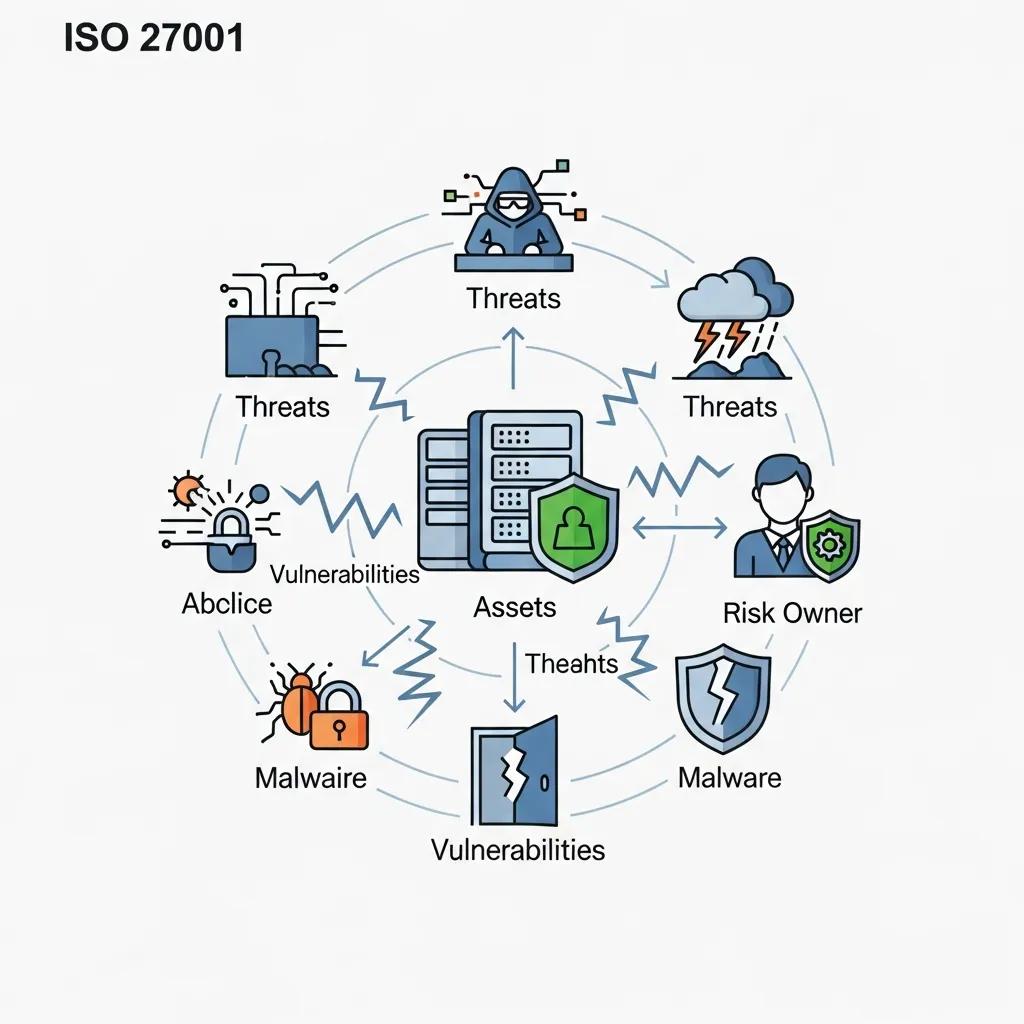
Core ISO 27001 concepts include asset, threat, vulnerability, risk, risk owner, residual risk and risk acceptance; each term has a practical role in assessment and treatment. An asset is any item of value—data, system or process—that requires protection; threats are potential events that could harm assets; vulnerabilities are weaknesses that threats exploit. Risk is commonly quantified as likelihood × impact, producing a score that informs prioritization; residual risk remains after controls are applied and must be acceptable to stakeholders. Risk owners are accountable for treatment actions and monitoring, ensuring that decisions are implemented and reviewed in management meetings.
Understanding these definitions enables consistent application of methods such as asset-based or scenario-based risk assessment, and prepares teams to document findings in the risk register and link outcomes to Annex A controls in the SoA. This glossary-level clarity prepares practitioners for the stepwise assessment process described next.
Wie schützt ein Informationssicherheits-Managementsystem Ihre Daten?
An ISMS protects data by establishing policies, processes and controls that align with identified risks and organizational objectives, thereby operationalizing the CIA triad across people, process and technology. Typical controls include access management, encryption, logging and incident response; each control maps to confidentiality, integrity or availability objectives and reduces likelihood or impact of specific threats. Continuous monitoring, internal audit and management review create feedback loops that refine controls and close gaps, enabling a cycle of continual improvement. These mechanisms work together to ensure that implemented controls remain proportionate and effective as the threat landscape and business context evolve.
This functional view of protection bridges directly into the procedural risk assessment steps that ISO 27001 prescribes and which organizations must follow to produce auditable evidence of decision-making.
Wie funktioniert der ISO 27001 Risikobewertungsprozess?
The ISO 27001 risk assessment process is a sequence of steps: establish context and criteria, identify assets, identify threats and vulnerabilities, analyze and evaluate risks, prioritize and assign owners, then document and report findings. This mechanism ensures that risk decisions are repeatable and defensible, producing outputs such as a risk register and inputs to the Statement of Applicability. The benefit is transparent, auditable prioritization that ties control selection to assessed risk. Below is a concise step-by-step breakdown to serve as an operational checklist.
The importance of a structured approach to risk management, especially in critical sectors, is underscored by real-world scenarios where the absence of such frameworks can lead to significant vulnerabilities and losses.
ISO 27001 Controls for Information System Risk Assessment
PMI Main Clinic has never implemented information system risk management before. If a risk occurs at the PMI Main Clinic, the PMI Main Clinic can suffer huge losses and hamper the health service process. To find out the possible risks that can occur at PMI, the ISO 31000: 2018 method is used and the control standard uses ISO 27001: 2022.
Risk Management in Information Systems: Applying ISO 31000: 2018 and ISO/IEC 27001: 2022 Controls at PMI’s Central Clinic, 2018
Follow these core steps when conducting an ISMS risk assessment:
- Define context and criteria: Establish scope, risk appetite and acceptance thresholds.
- Identify assets: Create an asset inventory and assign values for CIA impact.
- Identify threats & vulnerabilities: Use threat modelling, logs and stakeholder interviews.
- Analyze risks: Apply qualitative or quantitative scoring (impact × likelihood).
- Evaluate & prioritize: Compare scores to acceptance criteria and rank actions.
- Assign owners & treat risks: Appoint risk owners, select controls and document RTP.
- Monitor & review: Track metrics, review incidents and update the register.
These steps provide a workflow for teams to follow; the next subsection describes practical techniques for identification and initial analysis.
Welche Schritte umfasst die Risikoidentifikation und -bewertung?
Risk identification combines asset inventories, interviews, automated discovery and scenario workshops to produce a validated register of assets, associated threats and exploitable vulnerabilities. Techniques such as data-flow mapping, configuration scans and user interviews reveal both technical and organisational vulnerabilities that matter to business-critical processes. Initial valuation uses CIA impact ratings and contextual factors like legal requirements and third-party dependencies to set impact scores. Clear documentation at this stage establishes the baseline for subsequent analysis and ensures traceability from observations to risk entries.
Good identification practices also inform scope refinement and ensure that subsequent analysis reflects realistic threat scenarios rather than theoretical possibilities, which helps avoid over-control and supports proportionate treatment planning.
Wie werden Risiken analysiert, bewertet und Risikoeigentümer bestimmt?
Risk analysis converts identified issues into scored entries using qualitative matrices or quantitative models; a common formula multiplies likelihood by impact to derive a priority score that supports decisions. Qualitative methods use categories (low/medium/high) and stakeholder judgement, while quantitative approaches assign numeric probabilities and monetary impact values for cost–benefit analysis. Assigning risk owners relies on clear accountability: owners are typically process or system managers with authority over controls and resources. Owners are responsible for drafting the Risk Treatment Plan actions, securing resources, and reporting progress in management review cycles.
A short example scoring table clarifies the approach and helps teams set acceptance thresholds that inform whether to avoid, reduce, share or accept each risk in the treatment phase.
| Asset Type | Impact Dimension | Sample Impact Rating (1–5) |
|---|---|---|
| Customer personal data | Confidentiality | 5 |
| Financial ledger system | Integrity | 5 |
| Public website | Availability | 3 |
| Backup storage | Confidentiality/Availability | 4 |
Welche Optionen und Strategien gibt es für die Risikobehandlung nach ISO 27001?
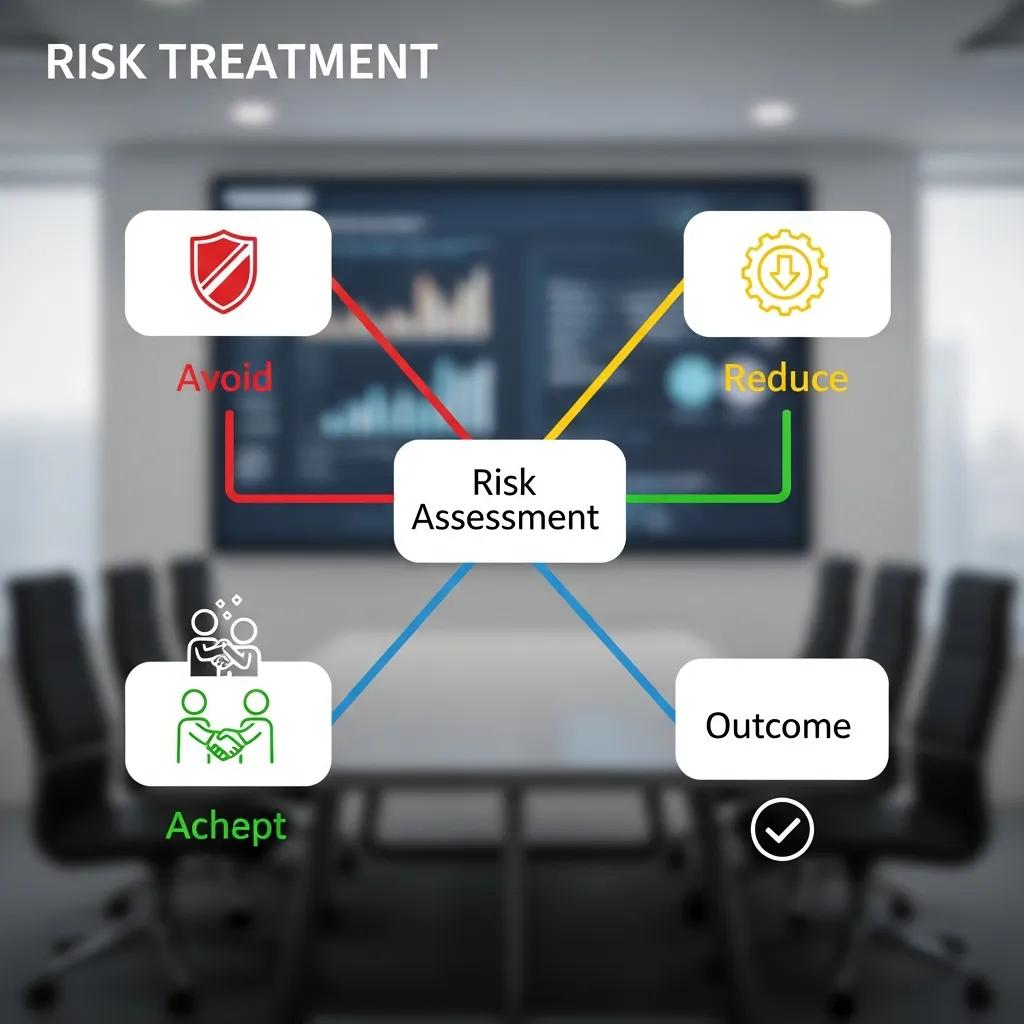
ISO 27001 defines four principal risk treatment strategies—avoid, reduce, share and accept—and requires organizations to document selected controls in a Risk Treatment Plan linked to the Statement of Applicability. The mechanism for selecting a strategy combines risk appetite, cost–benefit analysis and operational constraints; the result is a prioritized set of controls with owners, timelines and success metrics. Practically, choosing between strategies reduces wasted controls, aligns security investments with business value, and creates measurable outcomes. The following list summarizes each strategy with a one-line explanation to support quick decision-making.
The four treatment strategies and when to use them:
- Avoid: Stop the activity that creates the risk (e.g., discontinue a non-essential service).
- Reduce: Implement controls to lower likelihood or impact (e.g., patching, encryption).
- Share: Transfer risk via insurance or contractual controls with third parties.
- Accept: Retain residual risk when cost of control outweighs benefit and it is within appetite.
These options feed directly into an RTP that assigns actions, owners and tracking metrics; the next subsection compares the strategies with examples and control outcomes.
Was sind die vier Risikobehandlungsstrategien: Vermeiden, Reduzieren, Teilen, Akzeptieren?
Each strategy addresses risk differently and suits different contexts: avoidance eliminates the exposure, reduction lowers probability or impact, sharing transfers responsibility, and acceptance documents conscious retention of risk. Practical examples illustrate choices: avoid by decommissioning legacy services that cannot be secured; reduce by applying multi-factor authentication and network segmentation; share by requiring strong security SLAs with cloud providers; accept small, low-impact risks where mitigation costs exceed value. Decision factors include residual risk level, implementation cost, legal obligations and strategic importance. Controls selected should be proportional and justified in the SoA to demonstrate auditability.
Linking these strategies to actionable controls ensures the RTP is a living plan rather than a one-off document, which leads naturally to the mechanics of creating and maintaining an effective RTP.
| Strategy | When to use | Example control / outcome |
|---|---|---|
| Avoid | Non-essential, high-risk activity | Decommission feature; outcome: risk eliminated |
| Reduce | Critical service with modifiable exposure | Apply encryption/MFA; outcome: reduced likelihood |
| Share | External dependency with transferable risk | Contractual SLAs/insurance; outcome: third-party accountability |
| Accept | Low-impact, low-cost risks | Documented acceptance; outcome: monitored residual risk |
Wie wird ein effektiver Risikobehandlungsplan erstellt?
An effective Risk Treatment Plan contains clear actions, owners, timelines, resource estimates and success metrics, and it integrates with change management to ensure controls are implemented and tested. The RTP should reference the originating risk ID, map to Annex A controls where relevant, and include acceptance criteria for closure. Monitoring metrics such as control implementation percentage, time-to-complete actions and residual risk trend enable management to track progress and make resourcing decisions. Regular review cycles—driven by incidents, changes, or scheduled management review—ensure the RTP remains current and effective.
Practical RTP snippets include columns for action description, priority, owner, start and end dates, required budget and verification evidence; treating the RTP as an auditable artifact improves transparency and supports both internal governance and external certification.
Was ist die Bedeutung der Statement of Applicability im ISO 27001 Rahmen?
The Statement of Applicability (SoA) is the definitive document that lists Annex A controls, indicates whether each control is applied, and provides a justification and implementation status; it connects risk assessment outputs to selected controls. The SoA mechanism ensures auditors and stakeholders can see why particular controls were chosen, how they mitigate assessed risks, and whether alternative controls were considered. Mandatory SoA elements include control ID, inclusion (yes/no), justification, implementation status and references to evidence. This clear mapping supports both certification audits and internal governance by making control selection and rationale explicit.
Because the SoA is central to certification, good practice includes version control, traceable evidence links and a clear link from each SoA entry back to the corresponding risk or RTP action.
Welche Elemente muss die SoA enthalten und wie dokumentiert sie Annex A Kontrollen?
A robust SoA contains at minimum: Annex A control identifier, decision to include or exclude the control, a concise justification aligned to risk assessment outputs, current implementation status and references to evidence such as procedures or test results. Documentation best practices include unique IDs for SoA rows, links to risk register entries, and versioned records of changes with management approval. Mapping Annex A controls to local policies and procedures clarifies how each control is realised in practice and ensures auditors can follow the implementation trail. Regular updates after risk reassessments and control tests maintain SoA accuracy.
This disciplined approach to SoA content strengthens audit readiness and ensures control choices remain proportionate to assessed risks.
Wie rechtfertigt die SoA die Auswahl und Umsetzung von Sicherheitskontrollen?
Justification in the SoA should explicitly link each control to an assessed risk or legal/commercial requirement, explaining how the control reduces likelihood or impact and any residual risk remaining after implementation. Typical justification statements reference risk scores, business impact, legal obligations (e.g., data protection) or cost–benefit conclusions that led to selecting or excluding a control. Auditable evidence such as test results, configuration records and incident metrics substantiates implementation claims. Demonstrating proportionality—why lighter controls suffice or why stronger measures are necessary—improves stakeholder confidence and supports certification decisions.
Clear justifications also enable management to prioritise actions in the RTP and maintain a defensible security posture when facing procurement or regulatory scrutiny.
| Control (Annex A) | Included in SoA (Y/N) | Justification / Implementation status |
|---|---|---|
| A.9.2 (User access) | Y | MFA and role-based access implemented; evidence: access review logs |
| A.12.3 (Backups) | Y | Encrypted off-site backups retained; evidence: backup reports |
| A.14.2 (Development security) | N | No in-house software development; justification: outsourced with SLAs |
| A.18.1 (Legal/regulatory) | Y | GDPR data processing controls mapped; evidence: DPIA and contracts |
Welche Vorteile bietet die ISO 27001 Zertifizierung für Unternehmen?
ISO 27001 certification delivers measurable improvements in security posture, regulatory alignment and commercial credibility by institutionalising a risk-based ISMS that is regularly audited and improved. The mechanism produces operational benefits such as fewer incidents, streamlined vendor assessments and clearer responsibility for security, while the result is increased trust from customers and better positioning in tenders. Certification also reduces duplication in supplier security checks and can lower insurance costs through demonstrable controls. The list below summarizes primary corporate benefits and transitions into commercial implications that influence procurement and client requirements.
Key certification benefits include:
- Improved security posture: Structured controls reduce incidence and impact of breaches.
- Regulatory and contractual alignment: An ISMS supports GDPR obligations and contractual evidence.
- Commercial advantage: Certification shortens procurement due diligence and increases client confidence.
Wie verbessert ISO 27001 die Informationssicherheit und Compliance?
ISO 27001 improves information security by enforcing control selection based on assessed risks, which increases detection capabilities, reduces exposure windows, and clarifies response responsibilities. Compliance improvements arise because the ISMS requires mapping legal and contractual obligations into controls and evidence, producing artifacts such as DPIAs, retention policies and audit trails that demonstrate alignment. Tangible outcomes often include faster incident resolution, clearer reporting to regulators and fewer recurring control failures. Recent industry practice shows that integrating monitoring and automated evidence collection accelerates compliance workflows and decision-making.
These security and compliance gains reduce friction with customers and regulators and feed into stronger business continuity and reputation resilience, which are described in the next subsection on procurement and efficiency gains.
Welche Wettbewerbsvorteile und Effizienzsteigerungen resultieren aus der Zertifizierung?
Certification yields procurement advantages by providing a single, accepted source of assurance for many clients, reducing repetitive questionnaires and enabling faster onboarding. Operational efficiencies appear as standardised processes for incident handling, access reviews and supplier management, which lower operational overhead and error rates. Certified organisations often present clearer SLAs and evidence packages during tenders, improving win rates for security-sensitive contracts. Internally, certifiable processes drive continual improvement cycles that decrease manual work and enable better measurement of security performance.
(Integration note) Stratlane Certification Deutschland offers ISO 27001 Certification service and specialises in ISO certifications across Europe and the UK. Stratlane Certification Deutschland is an innovative certification body based in Düsseldorf, Germany, specializing in ISO certifications (ISO 9001, ISO 14001, ISO 27001, ISO 42001). They leverage AI-powered audit tools and experienced auditors across Europe and the UK to provide professional and reliable certification services, emphasizing efficiency, effectiveness, and cost reduction. Accredited status across multiple countries supports global acceptance of certificates and can help organisations meet procurement requirements where certification is a threshold criterion.
This operational and commercial bridge clarifies why many buyers require both technical assurance (ISO 27001) and process reliability signals such as those provided by additional management system standards.
Wie ergänzen sich ISO 27001 und ISO 9001 für eine ganzheitliche Unternehmenssicherheit?
ISO 27001 (ISMS) and ISO 9001 (QMS) complement each other by aligning risk-based thinking, documented processes and continual improvement across quality and security objectives, creating synergies in governance and management review. While ISO 27001 focuses on protecting information assets from threats, ISO 9001 concentrates on meeting customer requirements and process effectiveness; together they standardise documentation, internal audit and corrective action workflows. The combined mechanism reduces duplication—shared procedures for document control, audits and management review—and results in more efficient resource use. The comparison below outlines overlap and distinct focus areas and supports decisions on integrated management systems.
A side-by-side comparison clarifies integration points:
- ISO 27001: Protects confidentiality, integrity, availability; emphasises risk treatment and technical controls.
- ISO 9001: Ensures product/service quality and customer satisfaction; emphasises process performance and continuous improvement.
- Shared processes: Document control, internal audit, competence management, management review.
These shared elements make it practical to integrate systems and leverage certification to meet broader client assurance needs; the next subsection explains why ISO 9001 is often required by key clients.
Was sind die Hauptunterschiede und Synergien zwischen ISO 27001 und ISO 9001?
The main difference is scope: ISO 27001 targets information risks and controls related to security, whereas ISO 9001 targets consistent product/service quality and customer satisfaction. Synergies appear in governance clauses—both standards require leadership commitment, risk-based thinking and documented processes—so organisations can share internal audit programs, change control and continual improvement mechanisms. Integration reduces audit fatigue as evidence for one standard often satisfies the other’s requirements where processes overlap, improving efficiency. Practically, combining the standards reduces administrative overhead and strengthens cross-functional accountability for both quality and security outcomes.
These operational synergies lead many organisations to pursue dual certification to meet comprehensive assurance demands from large customers and regulated markets.
Warum ist ISO 9001 für Schlüsselkunden oft eine notwendige Ergänzung zur ISO 27001?
Key clients frequently request ISO 9001 alongside ISO 27001 because quality management demonstrates reliable delivery processes and controls that underpin secure services, creating end-to-end assurance for both security and service quality. Procurement teams view ISO 9001 as evidence of consistent processes, predictable outcomes and supplier maturity—attributes that reduce vendor risk and contractual disputes. Stating this plainly: ISO 9001 complements ISO 27001 by ensuring that the processes which implement security controls are themselves reliable and consistently executed. For organisations pursuing tenders or contracts with stringent supplier requirements, holding both certifications often increases eligibility and reduces follow-up audits.
Stratlane Certification Deutschland provides ISO certification services across multiple standards and can advise organisations on combined certification strategies that align with procurement expectations and international acceptance, supporting efficient auditing through experienced auditors and AI-assisted evidence collection.
Stratlane Certification Deutschland is an innovative certification body based in Düsseldorf, Germany, specializing in ISO certifications (ISO 9001, ISO 14001, ISO 27001, ISO 42001). They leverage AI-powered audit tools and experienced auditors across Europe and the UK to provide professional and reliable certification services, emphasizing efficiency, effectiveness, and cost reduction. Accredited status in over 27 countries supports global acceptance of certificates and offers a pragmatic route for organisations seeking internationally recognised assurance.
This closing endorsement ties the practical guidance above to an available certification option that helps translate ISMS readiness into recognised external assurance and contractual credibility.