
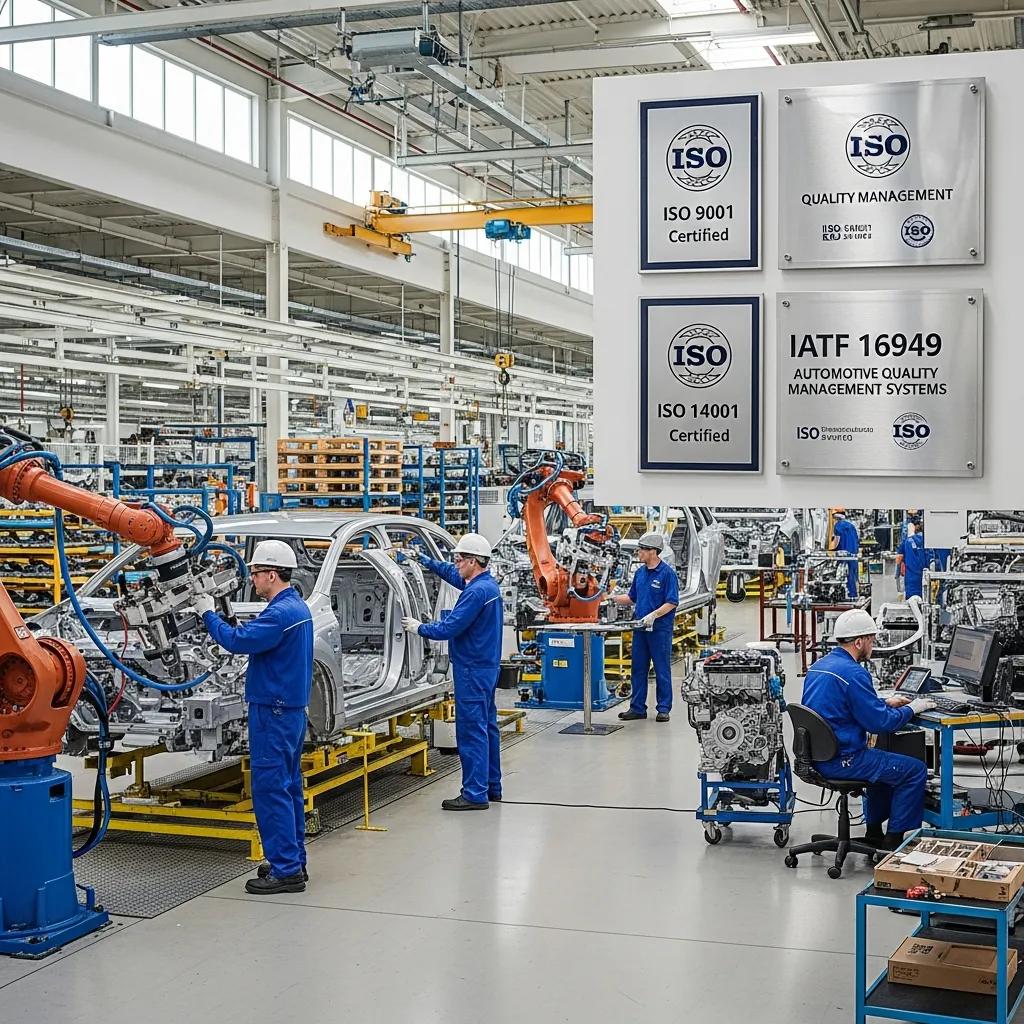
ISO Zertifizierung für die Automobilindustrie: Essential Standards and Certification Processes for Automotive Suppliers
ISO certification for the automotive industry defines the set of quality, environmental, safety, and information-security standards that suppliers must demonstrate to participate in modern vehicle supply chains. This article explains which standards matter—primarily ISO 9001 and IATF 16949—how they interact with OEM procurement expectations, and how supporting standards such as ISO 14001, ISO 45001 and ISO 27001 reduce risk across manufacturing, workforce safety, and data handling. Readers will learn the core requirements that OEMs expect during supplier selection, the practical steps suppliers follow to achieve certification, and how AI-assisted auditing can shorten timelines while improving audit quality. The guide maps certification stages, compares ISO 9001 and IATF 16949, summarizes complementary standards, and provides an actionable how-to pathway tailored to automotive suppliers. Throughout, the article uses semantic concepts (entities and relationships like ) and practical lists and tables to help procurement teams, quality managers, and supplier development specialists make informed certification decisions in the context of the ISO Automobilindustrie.
Why is ISO 9001 Certification Crucial for Automotive Suppliers?
ISO 9001 is the international quality management system (QMS) standard that defines consistent processes for document control, corrective action, and continual improvement, and it functions as the baseline credential many OEMs require for supplier qualification. The mechanism is simple: ISO 9001 specifies process controls and performance metrics that reduce variation and demonstrate repeatable product and service quality, which directly supports buyer confidence and supply chain stability. For many buyers, ISO 9001 serves as a contractual gate—proof of a functioning QMS that satisfies traceability, supplier monitoring, and corrective-action expectations. This foundational role makes ISO 9001 a practical prerequisite for supplier onboarding, enabling suppliers to meet supplier scorecards and procurement checklists efficiently.
Indeed, the importance of a robust quality management system is consistently highlighted by OEMs as a fundamental requirement for their suppliers.
OEM Expectations for Supplier Quality Management Systems
many Original Equipment Manufacturers (OEMs) focus their suppliers most often concern the latter’s implementation of a quality management system based on the guidelines
The role of the requirements of quality, environmental and safety management systems in the relationship with suppliers, M Urbaniak, 2018
OEMs and large clients typically treat ISO 9001 as a minimum requirement with explicit procurement implications:
- Suppliers without ISO 9001 may be excluded from RFQs and supplier databases.
- Certification streamlines audits by proving baseline processes such as document control and nonconformance management.
- ISO 9001 status often improves supplier scoring in performance evaluations and reduces onboarding time.
Understanding the clause-level mapping below clarifies how ISO 9001 maps to OEM needs and leads naturally to why automotive-specific standards like IATF 16949 add further requirements.
How Does ISO 9001 Meet OEM and Client Requirements?
ISO 9001 meets OEM and client requirements by defining clauses for process control, traceability, supplier evaluation, and corrective action that align directly with procurement expectations in the automotive supply chain. Clause-to-requirement mapping shows that document control supports part traceability, while nonconformance control and corrective action processes satisfy warranty and field-failure investigation needs. In practice, suppliers present documented procedures for production control, incoming inspection, and supplier management during onboarding audits, which reduces the number of ad-hoc checks OEMs perform. A procurement checklist typically includes evidence of internal audits, management review minutes, and a documented corrective-action system, all of which are core ISO 9001 outputs. Mapping these clauses to buyer requirements makes ISO 9001 an operational bridge between internal quality practices and external supplier acceptance.
ISO 9001’s clause structure also supports scalable audits and supplier scorecards, which is why achieving certification often shortens the overall supplier qualification timeline and reduces repeated documentation requests from OEMs.
What Are the Core Principles of ISO 9001 in Automotive Quality Management?
The core principles of ISO 9001—customer focus, leadership, process approach, improvement, evidence-based decision making, and relationship management—translate into automotive practices that prioritize defect prevention, traceability, and continuous reduction of variation. Customer focus drives requirements engineering and control plans; the process approach ensures consistent work instructions and measurable KPIs for each production stage. Continuous improvement and risk-based thinking promote FMEA-style analysis, preventive actions, and data-driven corrective cycles that reduce field failures and warranty costs. In an automotive context, these principles are realized through control plans, SPC (statistical process control), and documented measurement systems that capture defect rates and process capability.
These principles form the conceptual foundation that IATF 16949 builds upon, introducing automotive-specific expectations for product safety and supply chain controls that OEMs often mandate.
What is IATF 16949 Certification and Why is it Mandatory in Automotive?
IATF 16949 is the automotive-specific QMS requirement that builds on ISO 9001 with added emphasis on defect prevention, product safety, and supply chain controls; many OEMs require IATF 16949 for suppliers in critical tiers. The standard integrates automotive-specific methods such as advanced product quality planning (APQP), failure mode and effects analysis (FMEA), and warranty management into a QMS framework, raising expectations for measurement, traceability, and supplier development. OEMs mandate IATF 16949 because it reduces variation, strengthens supplier oversight, and aligns supplier processes with vehicle-level safety and reliability requirements. For suppliers, IATF 16949 demonstrates alignment with automotive risk controls and often determines eligibility for higher-tier contracts.
The evolution of IATF 16949 reflects a long-standing industry effort to standardize quality management across the global automotive supply chain.
IATF 16949: Harmonizing Automotive Supply Chain Certification
ISO/TS 16949 was launched in 1999 by the International Automotive Task Force (IATF) with the aim of harmonizing the diverse assessment and certification systems worldwide in the supply chain for the automotive sector. ISO/TS 16949 aimed to eliminate the need of the automotive suppliers for multiple sectoral certifications such as QS9000, VDA6 and EAQF. The fourth version of the standard—published in October 2016—has been renamed IATF 16949. The research focuses on four case studies, one Original Equipment Manufacturer of the automotive sector and one manufacturer from each of Tier 1, Tier 2 and Tier 3 of the automotive sector. The perspectives of other main stakeholders, such as auditors and consultants directly involved in the implementation and certification of ISO/TS 16949 and IATF 16949 were also considered.
Adopting ISO/TS 16949 and IATF 16949 standards:
An exploratory and preliminary study, I Laskurain, 2017
The following table compares the base ISO 9001 framework with the automotive-focused IATF 16949 to clarify differences important to procurement and compliance teams.
| Requirement Area | ISO 9001 (Base Standard) | IATF 16949 (Automotive Additions) |
|---|---|---|
| Base scope | Generic QMS requirements for any industry | Automotive QMS with product-safety and supply-chain focus |
| Key process additions | Document control, corrective action, management review | APQP, FMEA, warranty management, product safety controls |
| OEM expectation impact | Baseline supplier acceptance | Mandatory for many OEMs and higher-tier supplier qualification |
| Measurement emphasis | Process effectiveness and customer satisfaction | Robust measurement for defect prevention and traceability |
This comparison shows how IATF 16949 adds automotive-specific controls on top of ISO 9001, making it the standard many OEMs list as a contractual requirement.
How Does IATF 16949 Build Upon ISO 9001 for Automotive Suppliers?
IATF 16949 builds upon ISO 9001 by retaining the base clause structure while mandating automotive-specific processes such as APQP, advanced measurement systems, and defined supplier development programs that prioritize product safety and continuous reduction of defects. Technically, the relationship is: with sector-specific requirements; this ensures that suppliers implement both general quality practices and automotive-focused controls. For suppliers this means integrating cross-functional teams for APQP, documenting FMEA outputs into control plans, and maintaining warranty and field-return analysis procedures. These added processes create a tighter loop between design, production, and after-sales performance, directly addressing OEM concerns about safety and reliability.
Adopting IATF 16949 therefore often requires suppliers to augment existing QMS artifacts with product-safety controls and supplier performance programs, which supports OEM risk mitigation strategies.
What Are the Key IATF 16949 Requirements for Automotive Suppliers?

Key IATF 16949 requirements prioritize risk management, traceability, product safety, and supplier development through specified practices that suppliers must operationalize. Important clauses include requirements for APQP and control plans, structured FMEA usage, defined measurement and monitoring for special characteristics, and formal supplier performance management with escalation paths for nonconformances. Practical compliance tips include maintaining clear traceability records, documenting control plans tied to process parameters, and running regular cross-functional reviews that feed into management review and corrective actions. Supplier readiness is judged on both the existence of procedures and measurable outcomes such as reduced defect rates and timely corrective action closure.
A short prioritized checklist helps suppliers focus efforts before an IATF audit:
- Establish APQP documentation and control plans.
- Implement FMEA and link outputs to process controls.
- Maintain traceability and field-failure reporting mechanisms.
These priorities align directly with OEM expectations and reduce the risk of disqualification during supplier selection.
Which Additional ISO Standards Support Automotive Industry Compliance?
Beyond ISO 9001 and IATF 16949, complementary ISO standards address environmental performance, workforce safety, and information security—areas that increasingly influence OEM procurement decisions and regulatory compliance. ISO 14001 helps manufacturers manage environmental risks and sustainability targets; ISO 45001 governs occupational health and safety controls; and ISO 27001 secures data and connected-vehicle information flows. These standards function as meronyms of a broader compliance framework: management system audits, nonconformance reporting, and corrective action processes are shared components across standards that together strengthen supplier resilience. Suppliers that combine these standards demonstrate holistic risk management across operations, people, and information.
Below is a concise reference table summarizing each supporting standard’s scope and why it matters to automotive suppliers.
| Standard | Scope | Why it matters for automotive suppliers |
|---|---|---|
| ISO 14001 | Environmental management systems | Demonstrates regulatory compliance, resource efficiency, and OEM sustainability alignment |
| ISO 45001 | Occupational health and safety | Reduces workplace incidents, supports continuity of supply and worker welfare |
| ISO 27001 | Information security management | Protects design data, telematics, and supplier-customer information exchanges |
Adopting these standards helps suppliers respond to OEM sustainability scoring, protect intellectual property, and secure manufacturing continuity, which increasingly factor into procurement decisions.
How Does ISO 14001 Enhance Environmental Management in Automotive Manufacturing?
ISO 14001 enhances environmental management by requiring a structured approach to identifying environmental aspects, setting objectives, and implementing controls that reduce emissions, waste, and resource consumption. For automotive plants, this translates into documented procedures for chemical handling, energy management, and supplier material compliance that OEMs often evaluate during sustainability assessments. Implementing ISO 14001 can improve resource efficiency metrics and reduce regulatory risk, which improves supplier standing in sustainability-focused procurement. Environmental performance improvements also support reputation and long-term cost reductions through waste minimization and energy optimization.
Improvements under ISO 14001 frequently lead procurement teams to prefer suppliers that can demonstrate measurable reductions in environmental impact and transparent reporting practices.
Why Are ISO 45001 and ISO 27001 Important for Automotive Companies?
ISO 45001 and ISO 27001 address two critical non-product risks: worker safety and information security, both of which can disrupt production or expose OEMs to liability. ISO 45001 establishes processes for hazard identification, incident investigation, and preventive actions that reduce workplace injuries and support operational continuity. ISO 27001 requires a risk-based information-security management system that protects design files, telematics data, and supplier communications against breach and unauthorized access. Together, these standards lower the probability of production stoppages and data incidents that can cascade into safety recalls or intellectual property exposure.
Manufacturers that adopt ISO 45001 and ISO 27001 therefore present lower operational and reputational risk to OEMs, strengthening long-term supplier relationships.
How Does Stratlane’s AI-Driven Audit Process Improve ISO Certification for Automotive?

Stratlane Certification Deutschland combines human auditor expertise with AI-driven analysis to streamline audits, improve documentation review, and detect systemic quality trends across supplier data. The AI component accelerates the review of procedures, records, and corrective-action histories, while experienced auditors provide contextual judgment on automotive-specific requirements such as APQP and product-safety controls. This hybrid approach improves audit accuracy by surfacing patterns and anomalies quickly, reduces administrative time spent on document validation, and supports localized audits across multiple European locations. For suppliers, the value is faster readiness checks and focused remediation actions that align with OEM expectations.
The human + AI model produces three practical benefits for automotive clients:
- Faster document and records analysis that reduces pre-audit preparation time.
- Improved trend detection that informs preventive actions and continuous improvement.
- Localized auditing capabilities that combine language and sector knowledge with automated checks.
These advantages make certification audits more precise and efficient, which eases the pathway to compliance and supports sustained QMS performance.
What Are the Benefits of Combining Human Expertise with AI in Audits?
Combining human expertise with AI in audits creates a complementary system in which AI handles large-scale data pattern recognition and humans interpret context, stakeholder expectations, and regulatory nuance. AI algorithms rapidly scan records, flagging inconsistencies in traceability, corrective-action timelines, and measurement data, while auditors assess the significance of those flags against automotive requirements and supplier realities. This division of labor increases reproducibility across audits and reduces subjective variation in findings, while saving time on routine evidence gathering. Auditors then focus on higher-value activities such as interviewing process owners and validating control effectiveness, which improves both audit depth and supplier engagement.
The resulting audit process enhances credibility with OEMs because it pairs systematic data analysis with sector-experienced judgment, improving both speed and acceptance of audit outcomes.
How Does Stratlane’s Automotive Industry Knowledge Enhance Certification Outcomes?
Stratlane’s automotive industry knowledge ensures audits prioritize OEM-relevant controls, focusing on product-safety characteristics, supplier management, and measurement systems that affect vehicle reliability. Sector experience enables auditors to evaluate APQP artifacts, FMEA outputs, and warranty-handling processes with attention to OEM scoring criteria, increasing the likelihood that audit findings map to buyer expectations. Localized language capabilities and familiarity with regional regulatory contexts mean recommendations are practical and actionable for suppliers operating across German and European markets. This domain alignment reduces back-and-forth between supplier and certifier and accelerates acceptance by OEM supplier development teams.
By focusing audits on OEM-relevant evidence and operational realities, sector-aware certification improves supplier readiness and shortens the route to qualification.
What Are the Steps to Achieve ISO Certification for Automotive Suppliers with Stratlane?
Achieving ISO certification for automotive suppliers typically follows a structured pathway: initial gap analysis, QMS development and documentation, internal audits and management review, then certification audit and surveillance. Stratlane supports suppliers at each stage, offering AI-enhanced gap analysis to prioritize remediation, expert auditors to validate automotive-specific artifacts, and localized services that align with OEM contractual expectations. The process-to-outcome mapping below shows typical steps, expected outputs, and business impact to help procurement and quality teams plan timelines and resources effectively.
The table below maps each certification step to typical duration/output and expected business impact.
| Phase | Typical Output / Duration | Business Impact |
|---|---|---|
| Gap analysis | Prioritized nonconformance list (1–3 weeks) | Focuses remediation on OEM-critical gaps |
| QMS documentation | Control plans, procedures (4–12 weeks) | Enables supplier onboarding and audits |
| Internal audit + management review | Audit reports, corrective actions (2–4 weeks) | Demonstrates readiness for certification audit |
| Certification audit + issuance | Certificate award (audit timeline varies) | Enables contract eligibility and supplier ranking |
What Is the Step-by-Step Certification Process for Automotive Companies?
The step-by-step certification process begins with a diagnostic gap analysis that identifies differences between current practices and the target standard, followed by remediation planning and QMS documentation to address prioritized gaps. Next, the supplier conducts internal audits to verify process effectiveness and holds management review to approve release for certification, after which a certification body performs the formal audit. Stratlane’s AI-assisted gap analysis can accelerate the diagnosis phase by quickly identifying documentation and process gaps, while human auditors validate corrective actions during certification. Typical timelines are qualitative—ranging from a few weeks for small-scope implementations to several months for complex production systems—depending on supplier readiness and resource allocation.
This clear progression from gap analysis to certification audit creates predictable milestones that procurement and quality teams can coordinate with OEM timelines.
How Does Stratlane Ensure Ongoing Compliance and Quality Improvement?
Stratlane ensures ongoing compliance through scheduled surveillance audits, data-driven trend analysis, and support for corrective and preventive actions that close the loop on audit findings. Surveillance audits verify that the QMS maintains effectiveness after certification, while AI-derived trend reports identify recurring issues before they escalate into nonconformances. Stratlane’s approach blends periodic human oversight with continuous analysis to recommend preventive measures, update control plans, and focus supplier development efforts where they yield the greatest reduction in defects. This continuous improvement cycle helps suppliers maintain the performance metrics OEMs expect and supports long-term contract stability.
Sustained monitoring and targeted improvement actions therefore maintain supplier eligibility and reduce the risk of supply interruptions tied to quality or safety incidents.
What Are the Benefits of ISO Certification for Automotive OEMs and Suppliers?
ISO certification delivers commercial, operational, and reputational benefits for OEMs and suppliers by establishing verifiable controls that reduce defects, protect data, and demonstrate environmental and safety stewardship. For suppliers, certification often translates into enhanced market access, higher placement on supplier shortlists, and measurable procurement advantages such as faster onboarding and better supplier-scorecard results. OEMs benefit from working with certified suppliers because certification reduces oversight costs, shortens qualification cycles, and improves supply-chain resilience through standardized processes and clearer escalation paths. Together, these advantages improve total cost of ownership and long-term reliability across the vehicle lifecycle.
Key benefits of certification include:
- Increased eligibility for OEM contracts and RFQs.
- Reduced defect rates and warranty exposure through improved controls.
- Stronger supplier ranking and procurement trust that shorten onboarding.
These outcomes support both commercial growth for suppliers and operational certainty for OEMs, making certification a strategic investment rather than an administrative checkbox.
How Does ISO Certification Enhance Market Competitiveness and Client Trust?
ISO certification enhances market competitiveness by serving as a credible signal of process maturity and risk management, which buyers interpret as lower procurement risk and faster integration into supply chains. Certified suppliers routinely appear higher on supplier shortlists, receive fewer contingency audits, and are more likely to be included in multi-sourcing strategies by OEMs. Client trust increases when suppliers can demonstrate objective evidence—certificates, audit reports, and trend metrics—that they manage quality, safety, and information security systematically. These factors together increase the probability of contract awards and long-term collaborative relationships with OEMs.
Consequently, certification functions as both a risk-control mechanism and a market-differentiation tool that supports growth in competitive tendering environments.
What Case Studies Demonstrate Stratlane’s Success in Automotive Certification?
Case study teasers show a common pattern: suppliers facing complex APQP and traceability gaps leveraged AI-assisted diagnostics and sector-focused audits to prioritize remediation and achieve certification acceptance by OEMs. In these examples, Stratlane’s combined human and AI services pinpointed documentation shortfalls, guided corrective actions, and validated controls during certification audits, which accelerated supplier qualification. Measurable outcomes included shorter pre-audit preparation periods and improved readiness metrics prior to formal audits, easing the path to supplier acceptance. While specific client details are confidential, these typical outcomes illustrate how targeted, data-driven support aligns supplier practices with OEM expectations.
These case teasers underscore that strategic investment in certification support—combining automation and industry expertise—can materially reduce time-to-qualification and improve procurement outcomes for automotive suppliers.