
ISO Zertifizierung für das Gesundheitswesen in Germany: Comprehensive Guide to Quality, Safety, and Compliance
ISO certification in healthcare establishes formal management systems that link quality, safety and regulatory expectations to everyday clinical and administrative workflows. This guide explains how ISO standards such as ISO 9001, ISO 13485 and ISO 27001 apply specifically to German hospitals, clinics and medical device manufacturers, highlighting practical benefits for patient safety, procurement and market access. Readers will learn what each standard requires, how controls and processes translate into measurable outcomes, and the step-by-step route to certification in the German healthcare context. The article maps the role of quality management systems (QMS), information security management systems (ISMS), and device-specific requirements into operational improvements and regulatory alignment. Each major section includes actionable lists, EAV-style comparison tables and practical examples to support implementation planning for healthcare leaders, clinical managers and medical device teams.
Why is ISO 9001 Certification Essential for Healthcare Organizations in Germany?
ISO 9001 defines a process-based quality management system that helps healthcare organizations structure processes, document responsibilities and measure outcomes to improve patient safety and operational reliability. The mechanism centers on the Plan-Do-Check-Act cycle and risk-based thinking, which forces organizations to identify clinical and administrative risks, implement controls and review effectiveness through management review and internal audits. In Germany, many large purchasers and partnering organizations expect demonstrable QMS performance, making ISO 9001 not only a quality tool but often a procurement differentiator. The following table compares core ISO 9001 attributes to concrete healthcare values so readers can see how clauses map to clinical benefits and contracting requirements.
This EAV table shows how ISO 9001 attributes translate into healthcare outcomes.
| QMS Attribute | Process / Control | Healthcare Value |
|---|---|---|
| Process control | Standardized SOPs and workflow mapping | Reduced variability in clinical tasks; consistent patient care |
| Documentation | Documented procedures and records | Traceability for incidents and audits; procurement acceptability |
| Management review | Regular performance review and corrective planning | Continuous improvement and measurable KPI gains |
This mapping demonstrates that ISO 9001 delivers both clinical safety benefits and the documented evidence many payers and partners require. Understanding these links clarifies why ISO 9001 is often treated as effectively required by major clients and procurement processes; organizations that lack demonstrable QMS practices may be excluded from contracts or collaborations.
ISO 9001 improves service quality through specific mechanisms and measurable outcomes, which the next subsection explores with concrete clinical examples.
How does ISO 9001 improve healthcare quality management systems?
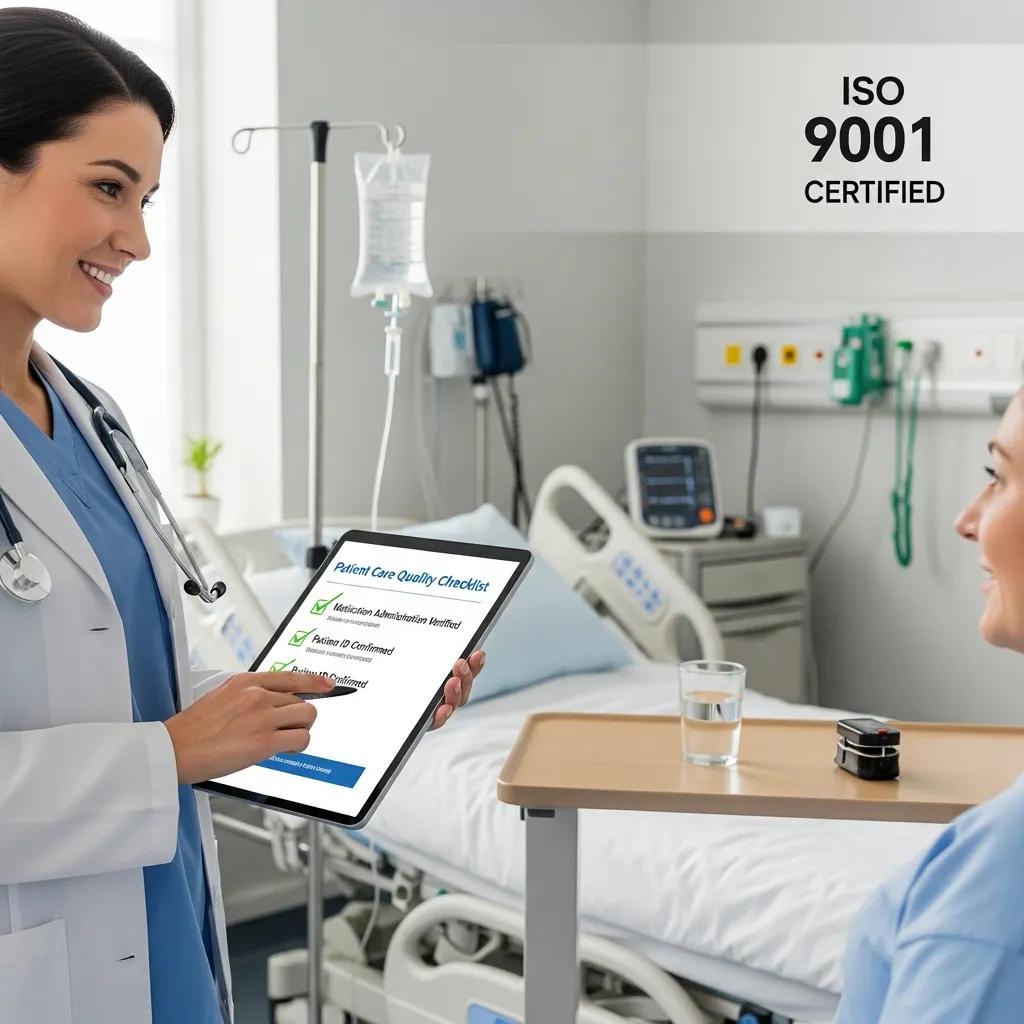
ISO 9001 improves healthcare quality management systems by formalizing process mapping, introducing risk-based assessments, and enforcing continual improvement cycles tied to measurable KPIs. In practice this means medication reconciliation processes are standardized, incident reporting becomes systematic, and root-cause analyses feed documented corrective actions that are tracked over time. The mechanism creates clear ownership for tasks, documented acceptance criteria and a feedback loop through internal audits and management review that reduces recurrence of errors. For example, a standardized handover checklist can reduce medication discrepancies and shorten patient transfer times, demonstrating how process controls convert to clinical outcomes. These systemic changes reduce variability and create objective metrics for procurement and quality benchmarking.
What are the benefits of ISO 9001 for hospitals and clinics?
ISO 9001 delivers measurable benefits across patient outcomes, operational efficiency and market credibility, translating quality practices into competitive advantage for hospitals and clinics. Benefits include improved patient safety through standardized procedures, faster incident resolution through documented corrective actions, and stronger procurement positioning because suppliers and partners can verify a managed QMS. The following list summarizes primary benefits and their impact on healthcare operations.
ISO 9001 provides these practical benefits:
- Improved patient safety: standardized procedures reduce clinical variability and errors.
- Operational efficiency: process measurement lowers cycle times and waste.
- Procurement eligibility: documented QMS increases trust with payers and partners.
These advantages reinforce one another: better processes yield measurable outcomes that procurement teams can verify, improving access to partnerships and contracts. The next section explains how device-focused ISO 13485 complements ISO 9001 for manufacturers.
How Does ISO 13485 Certification Support Medical Device Manufacturers in Germany?
ISO 13485 is the internationally recognized standard for medical device quality management systems and focuses specifically on product lifecycle, traceability and regulatory alignment with European Medical Device Regulation (MDR). Its mechanism centers on design control, traceability, supplier control and post-market surveillance to ensure devices meet safety and performance requirements consistently. For German manufacturers, ISO 13485 maps closely to MDR expectations and supports conformity assessment by demonstrating structured design history files, risk management and change control processes that regulators and notified bodies review. The table below maps key ISO 13485 requirements to compliance outcomes and market access benefits for clarity.
| Requirement | Key Action | Benefit / Compliance Outcome |
|---|---|---|
| Design control | Documented design inputs, verification and validation | Demonstrable evidence for MDR conformity and product safety |
| Traceability | Batch records and UDI-ready traceability | Faster recalls and enhanced regulator confidence |
| Post-market surveillance | Complaint handling and vigilance reporting | Ongoing safety monitoring and regulatory responsiveness |
By translating specific clauses into compliance outcomes, manufacturers can target system changes that directly affect market access and notified body reviews. The following subsection summarizes critical clauses and practical manufacturer actions.
What are the key requirements of ISO 13485 for medical device quality assurance?
Key ISO 13485 requirements include documented design and development controls, rigorous traceability from input materials to finished devices, supplier qualification and clear post-market surveillance procedures. These clauses require manufacturers to maintain design files, run verification and validation activities, and ensure that each production batch can be traced and recalled if necessary. Risk management per ISO 14971 principles is embedded into design control, and change control processes must be auditable and linked to product risk assessments. In practical terms, maintaining a design history file and supplier performance metrics reduces regulatory friction and shortens time to market by providing ready evidence for conformity assessment. This structured approach helps manufacturers integrate quality assurance into daily production and regulatory reporting.
Further research and case studies highlight the critical role of robust design and development procedures in achieving both ISO 13485 compliance and CE certification for medical devices.
ISO 13485 & MDR Compliance for Medical Device Design
The ability to innovate and optimize internal design processes is crucial for companies operating in the medical device sector, where regulatory compliance is essential. This thesis, conducted in collaboration with INTRAUMA S.p.A., presents the improvement of Design and Development Procedure applied to a new series of Osteotomy Plates. The aim is to enhance the effectiveness of the internal design process, focusing on both the technical phases of design and the regulatory compliance pathway, in accordance with the Medical Device Regulation (MDR). Throughout the thesis, an original procedure for preparing the technical documentation is presented, necessary for submitting the device to the certification body, with the aim of obtaining the CE certification. This approach is fundamental to ensure that every medical device placed on the European market is safe, effective and meets high-quality standards.
Procedure improvement for designing and developing medical devices in compliance with MDR and ISO 13485: case study on osteotomy plates series., 2024
How does ISO 13485 ensure regulatory compliance and market access?
ISO 13485 supports regulatory compliance by creating auditable, repeatable processes that match the evidence expectations of MDR conformity assessments and notified bodies. Manufacturers with a certified QMS can show documented controls over design, supplier management and post-market surveillance, which reduces the scope of regulator queries and speeds review cycles. Certification signals to distributors and healthcare partners that products meet recognized quality benchmarks, easing commercial negotiations and procurement approvals. The practical consequence is improved market access and increased confidence from healthcare purchasers and clinical partners, which can drive adoption in hospitals and clinics. These benefits complement internal process improvements and feed into overall device reliability.
What Role Does ISO 27001 Play in Protecting Healthcare Data in Germany?

ISO 27001 establishes an Information Security Management System (ISMS) that systematically assesses information risks, implements security controls and maintains continuous monitoring to protect patient data and health IT systems. The ISMS mechanism requires documented risk assessments, control selection, incident response planning and ongoing audits, aligning directly with GDPR expectations for accountability and data protection by design. For healthcare providers in Germany, ISO 27001 reduces breach risk, strengthens patient trust and simplifies procurement evaluations where data security is a vendor requirement. The following table maps specific ISMS controls to GDPR and healthcare impacts to make the linkage explicit for technical and compliance teams.
| Security Control | Control Action | GDPR / Healthcare Impact |
|---|---|---|
| Access control | Role-based access and authentication | Limits data exposure and supports data minimization |
| Encryption & backup | Encrypted storage and secure backups | Protects data integrity and assists breach containment |
| Incident response | Documented playbooks and notification timelines | Enables timely breach reporting and GDPR compliance |
Mapping controls to GDPR outcomes clarifies how an ISMS not only protects systems but also provides documented proof of compliance and accountability. The next subsections examine ISMS lifecycle and GDPR-specific benefits in practical terms.
How does ISO 27001 establish effective information security management systems?
ISO 27001 establishes an ISMS through a lifecycle of risk assessment, control selection, implementation, monitoring and continual improvement. The process starts with identifying assets such as EHR systems and connected medical devices, assessing threats and vulnerabilities, and selecting controls from Annex A that mitigate identified risks. Implementation includes policies, access controls, encryption, network segmentation and incident response procedures, followed by regular internal audits and management review to verify effectiveness. For healthcare, controls applied to EHRs and medical devices reduce lateral attack surfaces and improve detection and response times, which in turn strengthens clinical continuity and patient data safety. Continuous monitoring ensures controls adapt to evolving threats and operational changes.
What are the GDPR compliance benefits of ISO 27001 for healthcare providers?
ISO 27001 supports GDPR compliance by providing structured evidence of data protection measures, a documented risk-based approach and processes for breach detection and reporting. Specific GDPR-relevant controls include data protection by design, maintaining records of processing activities, encryption, and timely breach notification procedures that demonstrate accountability. For healthcare providers, these controls reduce regulatory exposure by showing proactive protection of patient data and robust incident handling that meets notification timelines. The practical benefits include improved patient trust, reduced likelihood of enforcement action and a clearer position in procurement evaluations where data protection is a determinative criterion. These outcomes tie security practice to business and clinical resilience.
How Do ISO Standards Enhance Operational Efficiency and Patient Safety in German Hospitals?
When implemented in an integrated fashion, ISO standards such as ISO 9001, ISO 27001, ISO 14001 and ISO 45001 create an aligned management system that eliminates duplicated effort, standardizes controls and focuses leadership on measurable outcomes. The mechanism relies on shared elements—document control, internal audits, management review and corrective action—that, when consolidated, reduce bureaucracy and sharpen operational KPIs. Hospitals that integrate standards report improvements in resource utilization, error reduction and environmental performance, which together improve patient experience and long-term sustainability. The list below identifies cross-standard benefits that hospital leaders can expect from coordinated certification strategies.
- Standardized governance: unified documentation and review processes reduce administrative overhead.
- Measurable KPIs: aligned metrics allow faster decision-making and targeted improvement.
- Risk reduction: coordinated risk registers reduce clinical and operational exposures.
These integrated benefits support a culture of continuous improvement and operational resilience that feeds directly into patient safety programs. The following subsections give concrete examples of patient safety outcomes and process improvements.
What improvements in patient safety result from ISO-certified quality management?
ISO-certified QMS improves patient safety through enforced standard operating procedures, systematic incident reporting and structured root-cause analysis processes that prevent recurrence. The mechanism turns ad-hoc corrections into tracked corrective actions with measurable effectiveness criteria, which reduces repeat incidents such as medication errors or procedural lapses. For example, a standardized surgical checklist and associated audit schedule can reduce perioperative complications and enable reproducible training measures. These procedural controls also feed into staff competency frameworks and supplier quality controls, creating a layered approach to patient safety that is verifiable during external audits and procurement reviews. Over time, these practices translate into measurable improvements in outcome indicators.
How do ISO standards streamline hospital processes and reduce inefficiencies?
ISO standards streamline hospital processes by forcing process mapping, waste identification and performance measurement that reveal bottlenecks and unnecessary variation. Process standardization reduces cycle times for admissions, diagnostics and discharge planning, while supplier management controls improve inventory accuracy and reduce stockouts of critical supplies. Implementing key performance indicators tied to management review enables targeted process improvements and resource reallocation to high-impact areas. Practical examples include reduced patient wait times through streamlined triage workflows and lower equipment downtime through preventive maintenance schedules aligned to ISO procedures. Together, these process refinements reduce costs while improving clinical throughput and patient satisfaction.
What is the Process for Achieving ISO Certification in the German Healthcare Sector?
Achieving ISO certification in healthcare follows a clear sequence of steps: scoping and gap analysis, implementation of documented systems, internal audits, and external certification audits followed by surveillance. The mechanism begins with a pre-audit gap analysis to identify missing processes and evidence, followed by prioritized implementation and staff training to close gaps. After internal audits verify readiness, certification bodies conduct Stage 1 documentation reviews and Stage 2 on-site audits to validate system effectiveness; corrective actions are tracked until certification is granted. The numbered list below summarizes the standard certification pathway as a concise roadmap for healthcare organizations pursuing ISO certification.
- Conduct a gap analysis and define scope: identify processes and regulatory intersections.
- Implement controls and documentation: create SOPs, records and training programs.
- Run internal audits and management review: verify effectiveness and readiness.
- Undergo external Stage 1 and Stage 2 audits: address findings and obtain certification.
This stepwise approach helps teams plan timelines, allocate responsibilities and prepare evidence for auditors. The next subsections expand on audit stages and how a certification partner can support the journey.What are the key steps in the ISO certification audit and approval process?
The audit and approval process normally includes a Stage 1 documentation review, a Stage 2 on-site audit to verify implementation, corrective action cycles to address nonconformities, and ongoing surveillance audits to maintain certification. Stage 1 focuses on scope, documented procedures and evidence availability, while Stage 2 examines operational practice, staff interviews and sampled records. Nonconformities are categorized and require documented corrective actions with root-cause analysis; the certifier then verifies closure before issuing certification. Surveillance audits, typically annual, ensure the QMS remains effective and improvements continue, while re-certification cycles occur on a fixed multi-year schedule. Proper internal auditing and management review prior to external assessment significantly increase the chance of first-time certification success.
How does Stratlane Certification Deutschland support healthcare providers through certification?
Stratlane Certification Deutschland is a certification body that utilizes experienced industry experts to audit and certify organizations across various sectors, including healthcare. The organization provides ISO certification audits and services covering healthcare-relevant standards such as ISO 9001, ISO 13485 and ISO 27001, combining expert judgment for efficient assessments. Their approach typically includes scoping support, documentation review, on-site auditing by qualified auditors and multi-language documentation review capability to accommodate international manufacturers and providers. Working with an accredited certification partner that blends domain expertise can shorten audit cycles and help teams focus on prioritized corrective actions that align with regulatory and procurement expectations.
For teams planning certification, Stratlane’s model offers a blend of technical automation and auditor experience that supports faster evidence collection and clearer audit outcomes. The next section outlines emerging standards and trends that should shape longer-term planning for healthcare systems.
What Are the Emerging ISO Standards and Trends Impacting Healthcare in Germany?
Emerging trends in ISO adoption for healthcare include stronger emphasis on sustainability, occupational health and integrated management systems that combine quality, security and environmental controls. ISO 14001 and ISO 45001 are becoming more relevant as hospitals face regulatory and reputational pressure to reduce environmental impact and protect staff health and safety. Additionally, the increasing role of cybersecurity and data protection in procurement means ISO 27001 adoption often accompanies device and IT contracts. These trends push providers toward holistic management approaches that balance clinical quality with environmental and workplace safety objectives. The following subsections introduce ISO 14001 and ISO 45001 and practical measures hospitals can adopt.
How does ISO 14001 promote sustainable healthcare practices and environmental management?
ISO 14001 provides a framework for environmental management that helps hospitals identify impacts, set reduction targets and implement operational controls for waste, energy and procurement. Typical measures include waste segregation programs, energy-efficiency audits and sustainable purchasing criteria that reduce both environmental footprint and operating costs. The mechanism emphasizes continuous monitoring, legal compliance and management review, ensuring improvements are measurable and defensible during audits or regulatory inquiries. For healthcare organizations, ISO 14001 can improve community trust, reduce disposal liabilities and realize cost savings from energy and waste reductions, aligning environmental responsibility with fiscal stewardship.
What benefits does ISO 45001 offer for occupational health and safety in healthcare?
ISO 45001 focuses on occupational health and safety systems that identify workplace hazards, implement risk controls and promote a safety culture that protects staff and patients alike. Controls include hazard identification, PPE protocols, incident reporting and wellbeing programs that reduce injuries and infection transmission risks. By integrating OHS processes with clinical QMS activities, hospitals can reduce staff absenteeism, improve morale and ensure safer patient care environments. The combined effect of ISO 45001 and QMS measures strengthens overall resilience and helps organizations meet both worker protection obligations and patient safety goals.