
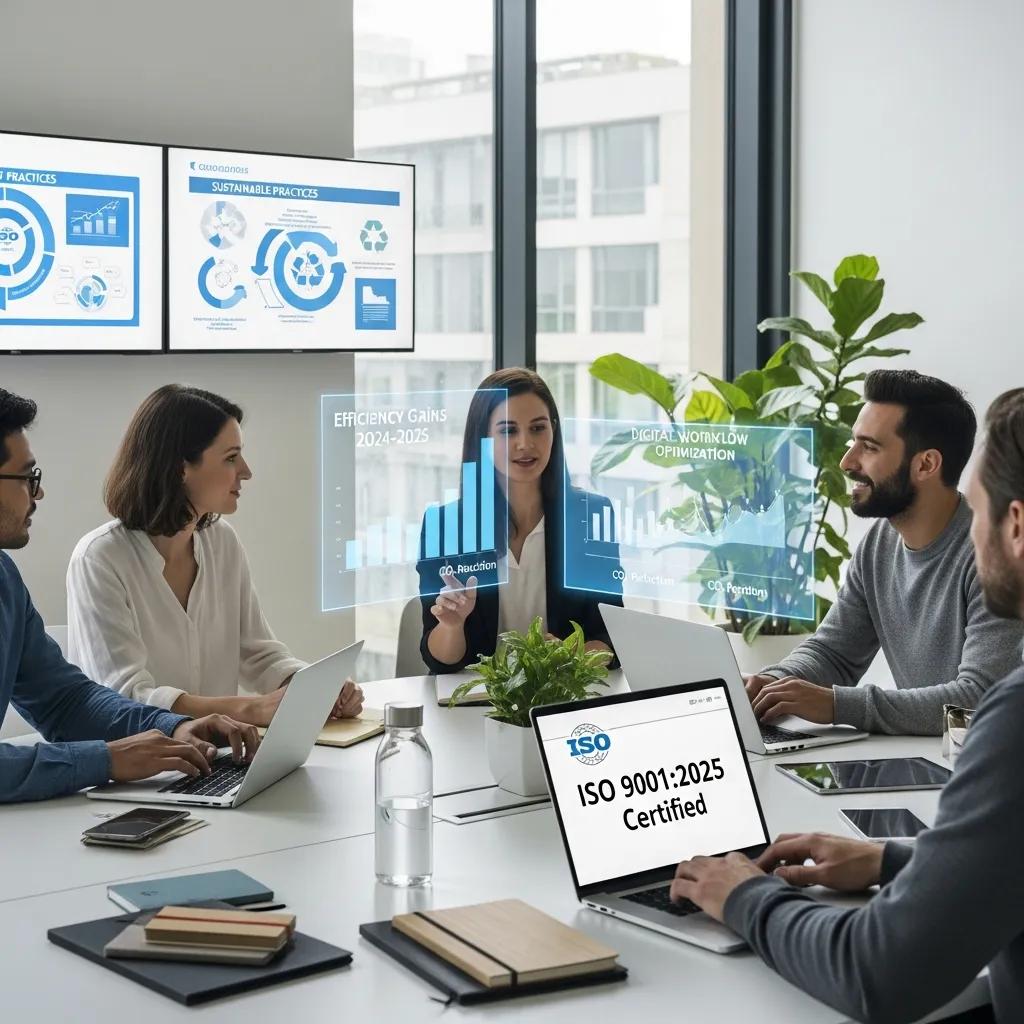
Die neuesten Trends in der ISO Zertifizierung 2025: Strategien für nachhaltigen Geschäftserfolg
The ISO certification landscape in 2025 is defined by three converging forces: digital transformation, heightened sustainability expectations, and evolving cyber and AI risks. This article explains how those forces reshape certification scope, audit methods, and buyer requirements, and why organizations must adapt management systems to remain competitive and resilient. Readers will learn which technologies—AI, blockchain, cloud QMS and remote audits—directly change how audits are performed, how ISO 9001 functions as a procurement gatekeeper, and how ISO 14001, ISO 27001, ISO 42001 and ISO 56001 integrate into strategic risk and innovation programs. The piece also outlines practical steps for preparing for the ISO 9001:2026 revision, integrating ESG into management systems, and hardening information security against AI and quantum-era threats. Finally, the article highlights how modern certification providers use AI plus sector expertise to accelerate and clarify certification outcomes for buyers and suppliers alike. Throughout, readers will find actionable checklists, comparison tables, and concise lists designed for procurement, compliance and leadership teams.
Wie prägt die digitale Transformation die ISO Zertifizierung?
Digital transformation is altering ISO certification by changing what auditors inspect and how evidence is gathered; technologies enable continuous monitoring, automated sampling and tamper-evident records that increase audit reach and reduce manual overhead. The mechanism is straightforward: data-driven systems and secure ledgers provide richer, machine-readable evidence, which shortens assessment cycles and supports real-time compliance claims. The main business benefit is faster, more defensible certification outcomes that buyers can verify during vendor selection. Organizations that adopt cloud-based QMS, IoT telemetry and structured data practices make certification audits more efficient and create a clearer trace of compliance for stakeholders.
Different technologies produce distinct certification impacts; the following table summarizes key comparisons and how each technology affects audit scope, traceability and efficiency.
| Technology | Attribute | Impact on Certification |
|---|---|---|
| Artificial Intelligence (AI) | Automated evidence analysis and anomaly detection | Speeds document review, highlights risk patterns, reduces sampling error |
| Blockchain | Immutable transaction records and timestamps | Strengthens traceability and tamper evidence for critical records |
| Cloud-based QMS | Centralized, versioned management system | Enables continuous compliance, easier evidence retrieval for auditors |
This table shows how combining these technologies raises the bar for reliable, auditable evidence and forces auditors to adapt sampling and verification approaches. The next sections examine AI and blockchain in audits, then remote audits and cloud QMS in practice.
Welche Rolle spielen KI und Blockchain in modernen ISO Audits?

AI assists auditors by automating document classification, performing intelligent sampling, and detecting anomalies that indicate nonconformities. In practice, AI models scan vast operational logs and production records to flag deviations that warrant human review, reducing time spent on repetitive checks while preserving auditor judgment for complex issues. Blockchain complements AI by anchoring critical records—such as versioned procedures, change logs and supplier attestations—in tamper-evident ledgers to improve traceability during dispute resolution. Together, AI and blockchain shift audits from point-in-time evidence collection toward continuous assurance models where algorithmic triage surfaces the highest-value audit targets and immutable records shorten verification workflows.
Research further supports the transformative potential of AI in auditing, highlighting systems that leverage large language models to generate comprehensive audit checklists and enhance efficiency.
LLMES: AI-Powered Audits for Quality Management Systems
To address these challenges, we propose a novel architecture, LLMES, designed to generate a concise and independent audit checklist. This approach allows Large Language Models to perform audits and produce results without prior fine-tuning. LLMES effectively integrates complex legal documents, expert knowledge, and mandatory regulatory guidelines with large language modeling to enhance artificial intelligence-assisted auditing.
LLMES: an LLMs-based expert system for quality management system audits, M Yang, 2025
Wie verbessern Remote Audits und Cloud-basierte QMS die Zertifizierungsprozesse?
Remote audits and cloud-based QMS platforms streamline scheduling, evidence submission and collaboration between auditors and client teams, cutting travel costs and accelerating timelines without sacrificing rigor. Secure evidence exchange, role-based access controls and recorded review sessions create an auditable trail that supports remote decision-making and reduces latency in corrective action verification. Limitations persist—network reliability, data residency and real-time observation of physical processes—so remote methods are often blended with targeted on-site checks for physical controls. Auditors and clients must agree on acceptance criteria for remote evidence and ensure cloud QMS configurations provide the metadata auditors require to validate document authenticity and change history.
Indeed, studies confirm that organizations perceive remote and on-site audits as equally beneficial, underscoring the effectiveness of digital transformation in auditing.
Digital Transformation: Remote vs. On-site Audit Benefits
The purpose of the study was to verify whether different methods of management systems auditing are perceived by the audited organizations as equally beneficial. On-site audits were compared with remote audits, as well as audits related to voluntary management systems with audits related to mandatory management systems.The survey on organizations from the food sector with the use of CATI/CAWI mix methodology was carried out. The analysis carried out has shown that remote and on-site audits are perceived as equally beneficial. The degree of credibility,) usefulness in improving the organization and financial usefulness of these two audits methods were assessed at the same level.
Auditing management systems in digital transformation era, P Kafel, 2022
- The top advantages of cloud QMS and remote audits include faster cycle times, reduced cost, and improved documentation consistency.
- Remote audits require explicit evidence-handling procedures, secure sharing practices, and clear audiovisual standards for live inspections.
- Combining remote and on-site methods yields the most resilient certification approach, aligning efficiency with verification needs.
These operational improvements form the foundation for procurement teams to request more timely and robust evidence during supplier qualification, which is explored next.
Warum ist ISO 9001 2025 unverzichtbar für die Anforderungen wichtiger Kunden?
ISO 9001 continues to function as a core procurement signal because it documents process consistency, risk-based thinking and customer-focused controls that buyers use to reduce supplier selection risk. Mechanically, ISO 9001 aligns organizational processes with measurable quality objectives and documented controls, which reduces variability, supports contractual performance and simplifies supplier audits for purchasing teams. For procurement, the result is lower onboarding friction, clearer KPIs in contracts and demonstrable traceability when service levels or product quality are questioned. Organizations without ISO 9001 increasingly face longer vetting cycles, conditional contract awards or exclusion from certified supply chains where buyers treat the standard as a mandatory prequalification.
Below is a comparative mapping that clarifies how ISO 9001 maps to procurement needs and the practical consequences for suppliers.
| Procurement Factor | ISO 9001 Attribute | Value for Buyers |
|---|---|---|
| Trust & Predictability | Documented quality processes and metrics | Lower supplier risk, consistent product/service delivery |
| Contractual Readiness | Established nonconformity and corrective action routines | Faster contract mobilization, fewer performance disputes |
| Supplier Selection | External certification as third-party evidence | Objective vendor screening reducing audit scope |
This table demonstrates why certification is often requested during vendor selection and how it shortens procurement cycles. Companies preparing for tenders should therefore treat ISO 9001 as a strategic asset.
For procurement readiness, use this checklist to prepare for buyer scrutiny and the upcoming ISO 9001:2026 revision.
- Conduct a gap analysis against expected clauses and buyer requirements.
- Implement measurable quality objectives and automated data collection in QMS.
- Document supplier controls, escalation paths and corrective action timelines.
After adopting these steps, organizations typically reduce RFP friction and shorten contracting timelines. For companies seeking external support, certification providers that combine AI-enabled audit workflows with experienced auditors—such as those applying AI-assisted review plus sector knowledge—can accelerate readiness and offer clearer evidence for procurement teams. Stratlane Certification Deutschland, for example, positions AI-powered audits alongside experienced industry auditors to deliver efficient ISO 9001 assessments and help clients meet procurement prerequisites without unnecessary delay.
Welche Vorteile bietet ISO 9001 für Kundenvertrauen und Wettbewerbsfähigkeit?
ISO 9001 provides buyers with documented evidence that a supplier manages quality through repeatable processes, controls for nonconforming outputs, and measurable improvement cycles. This mechanism builds customer confidence by making performance predictable and auditable, which in turn supports longer-term contracts and referenceability in competitive bids. Measurable outcomes include fewer defects, clearer complaint handling and improved on-time delivery—metrics buyers often track before and after supplier onboarding. The combination of documented controls and continuous improvement practices directly supports a supplier’s ability to compete for larger contracts where procurement teams prioritize risk mitigation.
Wie bereiten sich Unternehmen auf die ISO 9001:2026 Revision vor?
Preparing for the ISO 9001:2026 revision begins with a phased readiness program: perform a gap analysis, prioritize high-impact changes, pilot revised processes, and roll out staff training supported by digital tracking. Adopt cloud-based QMS tools that store change history and metrics so auditors can verify transition controls and objective evidence quickly. Organizations should also refine supplier management clauses and integrate data-driven KPIs into routine reporting to demonstrate compliance with revised expectation areas. Small, iterative pilots help surface implementation challenges early and build the documented audit trail auditors will expect during transition assessments.
Wie integriert Nachhaltigkeit die ISO Standards für zukunftsfähige Unternehmen?

Sustainability is being woven into ISO standards through requirements for environmental objectives, life-cycle thinking, and supplier due diligence that align corporate ESG commitments with operational controls. The mechanism is integration: environmental management, supply chain auditing and ESG disclosures become inputs to management system controls and audit scopes, forcing companies to demonstrate measurable reductions and circularity actions. Businesses obtain benefits such as lower regulatory risk, improved investor signaling and operational efficiencies from waste reduction and energy optimization. Practical adoption means linking ISO 14001 objectives with procurement clauses, carbon accounting and documented circular-economy initiatives.
Use the following mapping to relate ISO 14001 and ESG attributes to tangible business outcomes.
| ISO/ESG Attribute | Operational Action | Business Benefit |
|---|---|---|
| Environmental Objectives | Measured emission and waste targets | Reduced costs, regulatory compliance, investor confidence |
| Supplier Environmental Due Diligence | Audit protocols and evidence collection | Lower supply-chain disruption risk, brand protection |
| Life-cycle Assessment | Product-design and end-of-life planning | New circular revenue opportunities and material savings |
This table clarifies how operationalizing sustainability within management systems produces measurable outcomes that matter to customers and stakeholders. The next subsections explain ISO 14001’s role in climate goals and how ESG criteria reshape certification expectations.
Welche Bedeutung hat ISO 14001 für Klimaneutralität und Kreislaufwirtschaft?
ISO 14001 establishes a framework for setting environmental objectives, measuring performance and implementing controls that directly support climate-neutral strategies and circularity initiatives. The mechanism requires organizations to assess environmental aspects across value chains, set quantified targets and monitor progress with documented evidence—exactly the artifacts auditors look for when validating climate claims. Examples include energy-efficiency projects with monitored KPIs and material-recovery programs that reduce landfill waste while documenting closed-loop flows. By embedding these practices into a certified EMS, companies signal credible progress to buyers and investors focused on decarbonization and resource efficiency.
Wie beeinflussen ESG-Kriterien die ISO Zertifizierungsanforderungen?
ESG expectations increase the scope of audits by requiring evidence of social and governance practices alongside environmental controls, particularly in supplier networks and material sourcing. The practical effect is that certification audits now often request supplier assessments, human-rights due diligence records, and governance evidence such as decision-making trails and accountability roles. Auditors evaluate these artifacts to determine whether ESG commitments are operationalized rather than aspirational. Companies that align ISO clauses with ESG reporting frameworks reduce duplication of effort and provide buyers with consolidated documentary proof during supplier qualification.
- ESG-driven documentation requirements commonly include supplier audits, traceability records, and governance matrices.
- Aligning ISO management system records with ESG disclosures creates operational efficiencies and auditor-ready evidence.
- Firms that prepare supplier evidence in advance reduce the time auditors spend on verification and improve procurement outcomes.
Welche Innovationen bringt ISO 56001 für das Management von Innovationsprozessen?
ISO 56001 introduces structure to innovation management by specifying processes for idea conception, evaluation, portfolio governance and measurement, enabling organizations to treat innovation like any other audited management system. The mechanism standardizes roles, criteria for idea selection, and performance metrics, which makes innovation activities auditable and repeatable across projects. Benefits include clearer governance for R&D investment, measurable innovation KPIs and reduced waste on low-value initiatives. Integrating ISO 56001 with existing QMS and digital tools allows leaders to prioritize initiatives based on data and to demonstrate innovation capability to partners and buyers.
The following list outlines practical steps to adopt ISO 56001 effectively.
- Define an innovation governance structure with accountable roles and decision gates.
- Establish measurable KPIs and portfolio reviews that feed into management reviews.
- Use digital tools to capture idea pipelines, evaluation criteria and outcomes.
Adopting these practices helps organizations demonstrate systematic innovation to stakeholders and auditors, which enhances access to collaboration opportunities and innovation-focused procurement.
Wie unterstützt ISO 56001 die systematische Förderung von Innovationsfähigkeiten?
ISO 56001 codifies processes for capturing ideas, assessing market and technical viability, and governing project portfolios so that innovation becomes a predictable, measurable capability. The mechanism formalizes evaluation criteria, stage-gate reviews and cross-functional governance to ensure that resources focus on initiatives with validated value propositions. Examples include standardized templates for business cases, periodic portfolio health metrics, and management review inputs that convert innovation outcomes into strategic decisions. This systemization reduces rework, improves resource allocation, and makes innovation outcomes transparent to auditors and external partners.
Welche Vorteile bietet die Integration von ISO 42001 für KI-Managementsysteme?
ISO 42001 provides controls specific to AI governance—risk assessment, model lifecycle management, transparency and ethical oversight—that complement ISO 56001 and QMS controls when AI is used in products or processes. By integrating ISO 42001 elements, organizations can demonstrate controls for data quality, bias mitigation, and explainability, reducing legal and ethical risks associated with deployed AI systems. For buyers, certified AI governance is a procurement differentiator that signals responsible AI practices and traceable decision-making. A short example: combining model documentation, validation records and post-deployment monitoring into a single auditable stream improves buyer confidence and supplier accountability.
Wie reagiert ISO 27001 auf die wachsenden Herausforderungen der Cybersicherheit?
ISO 27001 evolves by emphasizing risk-based controls for new threat vectors such as AI-driven attacks and emerging cryptographic risks associated with quantum computing, while also strengthening supply-chain security requirements. The mechanism combines traditional information security controls with continuous monitoring, threat intelligence integration and supplier assurance workflows that auditors review for effectiveness. The main business outcome is improved resilience against data breaches, clearer contractual security expectations for suppliers, and a demonstrable baseline of cyber hygiene that matters to customers and regulators. Practical preparation includes updating risk assessments for AI-specific threats and reviewing cryptographic strategies with an eye to future-proofing.
Welche neuen Bedrohungen adressiert ISO 27001 im Zeitalter von Quantencomputing und KI?
Contemporary threats include AI-enabled model poisoning, automated phishing at scale, and future risks to public-key cryptography posed by quantum advances, requiring updated controls and cryptographic agility. Organizations should implement adversarial testing, robust model validation, and inventory of cryptographic assets to assess exposure and plan migration to quantum-resistant algorithms when appropriate. Example mitigations include stronger key-management practices, phased replacement plans for vulnerable algorithms, and monitoring for anomalous model behavior that indicates poisoning or misuse. These steps help auditors verify that organizations actively manage emergent risks rather than relying on historical controls alone.
Wie stärken Unternehmen ihre Lieferkettensicherheit durch ISO 27001?
Supply-chain security under ISO 27001 emphasizes supplier assessments, contractual security clauses, and continuous monitoring of third-party controls to ensure vendors meet agreed security baselines. Companies should gather evidence such as supplier security policies, penetration test summaries, and proof of breach-response capabilities, integrating them into supplier onboarding and periodic reassessment workflows. Practical tools include centralized vendor registries, automated attestations and periodic audits focused on high-risk suppliers. Buyers commonly require these artifacts during procurement, and having them organized within a certified ISMS reduces verification time and strengthens contractual risk allocation.
- Key supplier security measures include baseline assessments, contractual SLAs for incident response, and continuous monitoring.
- Centralizing supplier evidence into a searchable registry improves audit readiness and reduces procurement friction.
- Including proof of supplier certification or assessment in procurement packages accelerates vendor qualification.
Wie nutzt Stratlane Certification Deutschland KI für effiziente und transparente Zertifizierungen?
Stratlane Certification Deutschland combines AI-assisted audit workflows with experienced industry auditors to speed evidence review, improve anomaly detection, and enhance traceability of certification decisions. The mechanism pairs automated data processing—such as intelligent sampling and document classification—with auditor judgment to focus human effort where it adds most value, reducing administrative time while maintaining rigorous oversight. For clients, this hybrid approach delivers faster audit cycles, clearer audit trails and sector-specific audit scopes aligned to industries like Automotive, Aviation, Banking and IT. The result is a more transparent certification experience that helps suppliers demonstrate readiness to procurement teams and reduce time-to-contract.
The AI-assisted process at Stratlane yields concrete operational benefits for organizations pursuing ISO certification.
- Reduced audit preparation time through prioritized evidence requests and automated checks.
- Higher accuracy in identifying nonconformities via AI anomaly detection paired with auditor review.
- Improved traceability through structured, machine-readable evidence logs that auditors and clients can reference.
Welche Vorteile bietet der AI-gestützte Auditprozess für Unternehmen?
An AI-supported audit process reduces manual review effort, highlights high-risk areas, and provides reproducible sampling, which together shorten audit durations and reduce surprises during assessments. The mechanism automates evidence triage and flags inconsistencies for auditor follow-up, enabling a more focused on-site or remote review and reducing administrative burden on client teams. Quantifiable benefits include lower internal resource hours spent on auditor requests and faster closure of corrective actions due to clearer, prioritized findings. This approach supports procurement needs by producing succinct, auditable evidence packages that contracting teams can assess quickly.
Wie gewährleistet branchenspezifische Expertise maßgeschneiderte Zertifizierungslösungen?
Sector knowledge shapes audit scope, evidence expectations and practical controls so that certification outcomes are relevant and actionable for specific industries such as Automotive, Aviation, Banking and IT. The mechanism involves tailoring checklists, sampling strategies and control expectations to industry norms and regulatory overlays, reducing unnecessary remediation and focusing improvement efforts where they matter for buyer confidence. Examples include traceability controls in Automotive, avionics configuration management in Aviation, and encryption and access controls in Banking and IT. Tailored audits reduce friction during procurement by ensuring that certification evidence aligns with buyer-specific technical and regulatory requirements.
- Industry-specific audits reduce rework by aligning auditor focus with sector risk profiles.
- Tailoring evidence requirements ensures procurement teams receive the most relevant artifacts for vendor qualification.
- Combining AI tooling with sector expertise offers both efficiency and domain accuracy.
This article has outlined practical strategies, EAV mappings and operational steps organizations can adopt to align certification programs with 2025 trends in digitalization, sustainability, innovation and security.