
ISO Zertifizierung für die Lebensmittelindustrie: Warum ISO 9001 und ISO 22000 für Ihren Erfolg unverzichtbar sind
ISO 9001 and ISO 22000 are internationally recognised management system standards: ISO 9001 defines requirements for a quality management system (QMS) while ISO 22000 defines a food safety management system (FSMS). Together they create a structured framework that binds process control, risk management and supplier oversight to measurable outcomes, directly addressing procurement and retailer expectations in the food sector. Many food companies face contractual pressure from major customers and regulators to demonstrate consistent quality and traceable safety controls; certification delivers auditable proof of those capabilities. This article explains how ISO 9001 and ISO 22000 work in practice, how HACCP and PRPs fit into an FSMS, and why an integrated management approach reduces risk, improves efficiency and opens market access. You will find practical implementation guidance, comparisons of certification impacts, and a description of how a certification partner can support gap analysis, audits and ongoing surveillance. The sections that follow cover why ISO 9001 is a strategic procurement requirement, how ISO 22000 secures farm-to-fork safety, market and trust benefits, service support models, integration strategies for QMS and FSMS, and current regulatory trends shaping certification needs.
Warum ist ISO 9001 für Lebensmittelhersteller eine strategische Anforderung?

ISO 9001 is a management standard that specifies a process-based approach to consistently deliver products that meet customer and regulatory requirements; it works by requiring documented controls, performance measurement and continuous improvement. The mechanism—process standardization plus management review—reduces variability in production and strengthens supplier qualification, which is why many procurement teams treat ISO 9001 as a baseline requirement. For food manufacturers this translates into traceable batch records, defined control points for critical processes, and a formal corrective action system that limits recurrence of defects and supports supplier audits. Organizations that implement ISO 9001 reduce supplier risk exposure and position themselves more favorably during commercial evaluations and tender processes. Understanding these procurement drivers leads naturally to tactical steps you can take to map processes and evidence for buyers.
The following list summarises common procurement drivers that make ISO 9001 strategically important for food suppliers:
- Major customers and retailers require documented management systems to qualify suppliers for supply contracts.
- ISO 9001 supports supplier performance metrics and reduces the need for repetitive buyer audits.
- Compliance with ISO 9001 lowers perceived supply-chain risk during supplier selection and contract negotiation.
These procurement drivers explain why certification often converts directly into commercial access and reduces onboarding time for new customers.
Stratlane Certification Deutschland positions ISO 9001 as a strategic requirement for key clients, emphasising industry-specific expertise and accredited certification to facilitate market access and supplier acceptance. This business perspective clarifies why buyers prioritise certified suppliers and what auditors will seek during supplier qualification.
Wie verbessert ISO 9001 die Qualitätsmanagementprozesse in der Lebensmittelindustrie?
ISO 9001 improves QMS processes by enforcing a lifecycle view of activities from incoming materials to finished goods release, using defined procedures, records and KPIs. Process mapping under ISO 9001 creates explicit inputs, outputs and control points—examples include standardized batch record templates, incoming goods inspection criteria and documented change controls for formulations. Measured KPIs such as nonconforming rate, on-time delivery and corrective action response time give procurement teams quantifiable evidence of performance. Continuous improvement cycles (plan-do-check-act) ensure systemic problems are addressed rather than merely patched, which strengthens traceability and reduces audit findings over time. These mechanics lead directly into the customer-facing benefits of improved satisfaction and operational efficiency.
Welche Vorteile bietet ISO 9001 für Kundenzufriedenheit und betriebliche Effizienz?
ISO 9001 drives customer satisfaction by reducing variability in product quality and increasing on-time delivery through standardized processes and robust supplier controls. Operationally, the standard encourages waste reduction, clearer roles and responsibilities, and preventive actions that lower defect rates and rework costs. Example pre/post metrics include reduced complaint rates, improved fill-rate percentages and lower scrap—each metric strengthens your negotiating position with buyers and shortens time to listing with retailers. Improved internal communication and management review cycles also speed decision-making and resource allocation, which enhances responsiveness during peak demand or recalls. The efficiency gains from ISO 9001 therefore produce measurable financial and commercial advantages for food manufacturers.
Wie gewährleistet ISO 22000 die Lebensmittelsicherheit entlang der gesamten Lieferkette?
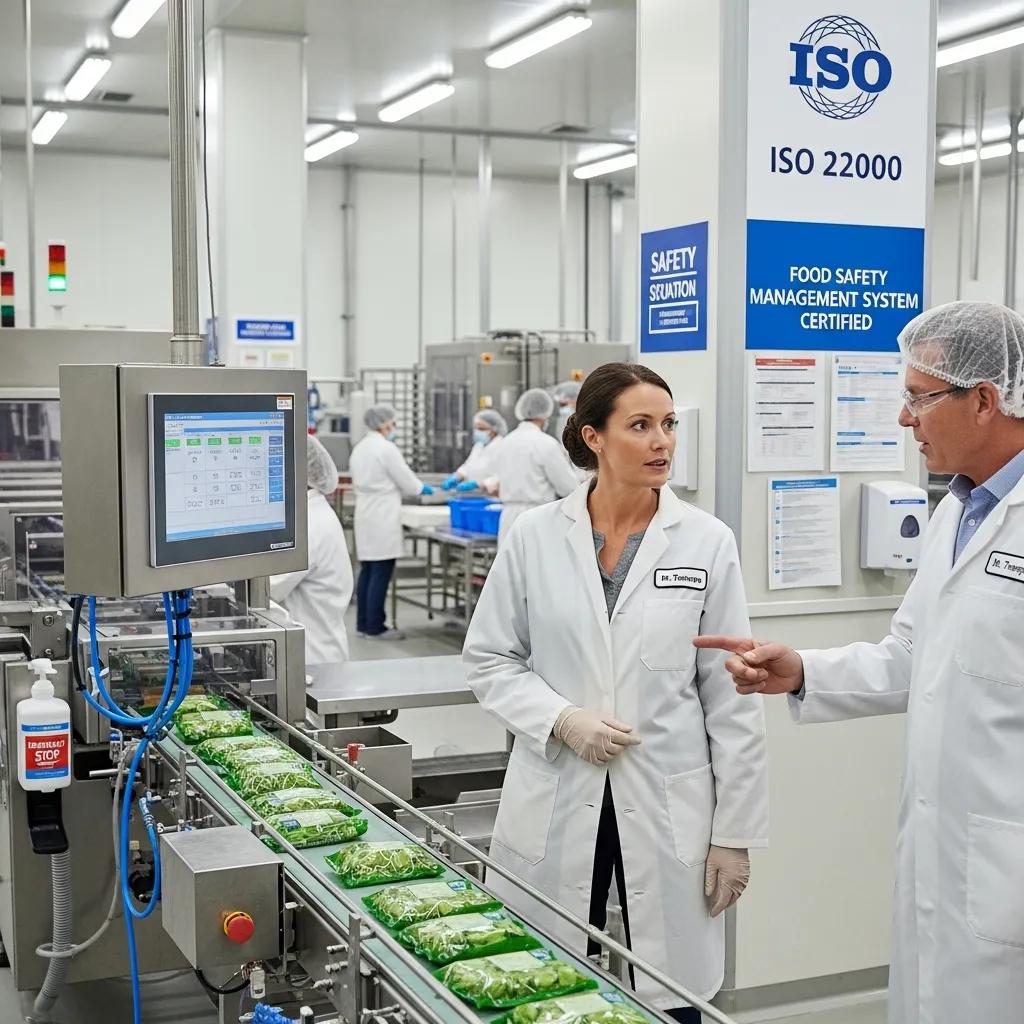
ISO 22000 defines requirements for a Food Safety Management System that integrates HACCP principles, prerequisite programs (PRPs) and risk-based management to control hazards from raw material sourcing through finished product distribution. The mechanism is a layered control model: PRPs establish the hygienic and operational baseline, HACCP identifies critical control points, and FSMS management processes ensure communication, verification and continual improvement. This structure supports farm-to-fork safety by tying supplier assurance, process monitoring and batch traceability into one auditable system. The next paragraphs examine how HACCP principles are embedded in ISO 22000 and how PRPs and risk assessments operationalise safety across the supply chain.
ISO 22000 achieves farm-to-fork assurance through three core components:
- Prerequisite Programs (PRPs): foundational sanitation, personnel hygiene, and facility controls.
- HACCP-based hazard analysis and identification of Critical Control Points (CCPs).
- Management requirements: communication, verification, validation and continual improvement.
These components work together to create an auditable chain of responsibility from incoming ingredients to delivery of finished goods.
Welche Rolle spielen HACCP-Prinzipien im ISO 22000 Food Safety Management System?
HACCP provides the preventive backbone of ISO 22000 by requiring systematic hazard analysis and control measures aimed at biological, chemical and physical hazards. The seven HACCP principles—hazard analysis, CCP identification, critical limits, monitoring, corrective actions, verification and documentation—map directly into FSMS procedures; for example, a pasteurisation step will be documented as a CCP with temperature limits, continuous monitoring logs and defined corrective actions for excursions. This approach emphasises prevention rather than inspection after the fact, and it produces clear records that regulators and customers can review. Proper implementation of HACCP within ISO 22000 therefore shortens root-cause analyses and supports faster, evidence-based corrective actions.
Wie integrieren Prerequisite Programs und Risikomanagement die Lebensmittelsicherheit?
Prerequisite Programs (PRPs) such as cleaning schedules, pest control, supplier approval and equipment maintenance create the stable operational environment in which HACCP controls can be effective. Risk assessments prioritise hazards and help allocate verification activities proportionally—suppliers with higher inherent risk receive more frequent testing and tighter contractual controls. Supplier assurance measures (audits, certificates of analysis, traceability requirements) are typical PRP elements that extend safety upstream into raw material sourcing. Documented verification—environmental monitoring, calibration and internal audits—closes the loop and ensures PRPs remain effective over time. These operational layers together ensure that hazard controls are both preventive and verifiable.
Welche Vorteile bringt die ISO-Zertifizierung für Lebensmittelunternehmen in Bezug auf Marktzugang und Vertrauen?
Accredited ISO certification provides objective proof of management capability, directly influencing market access, retailer acceptance and buyer confidence. Certification demonstrates that a company operates under repeatable, auditable controls, which reduces perceived supplier risk and can be a mandatory condition for listing with major retailers or entering export markets. Beyond market entry, certification often reduces the frequency of buyer audits, shortens onboarding time and enhances brand reputation among trade partners. The following EAV table compares the practical effects of different certification approaches on market access attributes relevant to procurement and sales.
The table below compares ISO 9001, ISO 22000 and HACCP on attributes that matter for market access and buyer trust:
| Certification | Market Access | Client Requirement | Audit Frequency |
|---|---|---|---|
| ISO 9001 (QMS) | High — supports supplier qualification | Frequently requested by large buyers | Lower frequency for certified suppliers |
| ISO 22000 (FSMS) | High — required for food safety listings | Often required for retailer listings and exports | Moderate; includes surveillance and verification |
| HACCP (Principles) | Essential operational control | Mandatory as part of FSMS and regulatory compliance | Operational monitoring plus audits |
This comparison shows that combining ISO 9001 and ISO 22000 typically delivers the strongest commercial signal to buyers and regulators.
Following this comparative evidence, companies should prioritise certification pathways that align with target customers and export requirements. Achieving accredited certification therefore becomes a strategic commercial tool that reduces friction with buyers and can materially reduce time to contract or listing.
After establishing the market case for certification, companies often ask how certification affects credibility and cost outcomes, which the next subsections explore.
Wie steigert ISO-Zertifizierung die Glaubwürdigkeit bei wichtigen Kunden und Handelspartnern?
Third-party certification functions as independent proof that management controls are in place and effective, which buyers treat as lower-risk evidence compared with self-declared practices. Certified suppliers typically experience faster onboarding, reduced scope for buyer audits, and a clearer path to retailer lists because certification standardises the documentation buyers request—management reviews, audit reports and corrective action records. Certification also supports better contract negotiation because it signals institutional control over quality and safety processes rather than dependence on individual staff knowledge. These credibility effects make certification a practical asset in commercial negotiations and long-term buyer relationships.
Welche Auswirkungen hat die Zertifizierung auf Risikominderung und Kosteneffizienz?
Certification reduces operational risk by enforcing preventive controls and a culture of continuous improvement that lowers incident rates, recalls and product withdrawals. Quantifiable cost impacts include fewer corrective actions, reduced waste, improved yields and potentially lower insurance premiums due to demonstrable risk management. Suggested KPIs to track ROI include incident frequency, recall cost per year, percentage of on-time deliveries, and cost of nonconformities; improvements in these metrics translate directly into lower total cost of quality. A disciplined FSMS and QMS therefore convert risk mitigation into measurable financial benefits over time.
Indeed, studies confirm that an integrated management system combining ISO 9001 and ISO 22000 significantly boosts quality performance and reduces costs.
ISO 9001 & 22000 Boost Quality Performance
The results showed that the application of Integration Management System ISO 9001: 2015 and ISO 22000: 2018 a significant influence to quality performance such as increased customer satisfaction index, customer complaint reduction, reduction of defects, decrease product returns and reduced cost of quality.
Effect of integrated management system of ISO 9001: 2015 and ISO 22000: 2018 implementation to packaging industries quality performance at
Banten Indonesia, A Purwanto, 2015
Wie unterstützt Stratlane Certification Deutschland Lebensmittelunternehmen bei der ISO-Zertifizierung?
Stratlane Certification Deutschland provides accredited certification services for ISO 9001 and ISO 22000 tailored to the food industry, combining industry-specific expertise, experienced multilingual auditors and AI-enhanced audit processes. Their service model supports companies from initial gap analysis through certification, surveillance and recertification, focusing on aligning management system scope with market and regulatory requirements. AI tools accelerate document review and pattern detection while experienced auditors apply contextual judgment on industry risks and supplier expectations; together these elements shorten audit cycles and improve evidence quality. Below is a concise EAV table that outlines service features and expected outcomes.
Intro: The table describes key service elements and their outcomes to help procurement and quality teams assess certification partners.
| Service | Feature | Outcome |
|---|---|---|
| Accredited certification | ISO 9001 and ISO 22000 scope | Enables market access and buyer acceptance |
| AI-enhanced audit tools | Document pattern detection and review automation | Faster audit cycles and improved evidence accuracy |
| Experienced multilingual auditors | Industry-specific judgement and regulatory knowledge | Better contextual findings and smoother audits |
This service mapping clarifies how technical features translate into commercial outcomes that matter to food companies.
The practical support model from a certification body should emphasise transparent scopes, clear audit criteria and a collaborative approach to corrective actions. For many clients, these capabilities reduce audit disruption and help meet procurement demands more quickly.
Welche Vorteile bieten KI-gestützte Audits und erfahrene Auditoren für den Zertifizierungsprozess?
AI-assisted audits speed up document analysis by highlighting patterns, anomalies and missing records, enabling auditors to focus on high-risk areas rather than routine checks. This efficiency lowers time on site, accelerates evidence collection and can reduce overall audit duration while preserving thoroughness. Experienced auditors contribute industry context, regulatory interpretation and supplier negotiation knowledge that AI alone cannot provide, ensuring findings are actionable and relevant. The combined approach—AI for volume, human experts for judgement—improves audit precision and reduces disruption to operations, which helps companies meet client and regulatory expectations more reliably.
Wie werden maßgeschneiderte Lösungen für den deutschen Lebensmittelmarkt umgesetzt?
Tailored implementations begin with regulatory mapping to German and EU food laws to ensure that PRPs and HACCP plans meet local enforcement expectations. Localised documentation, multilingual audit teams and alignment with retailer requirements are typical elements of a German market solution, along with supplier assurance measures adapted to regional supply-chain structures. Scoping is adjusted by product type, process complexity and export targets to avoid unnecessary controls while covering critical risks. These steps produce a certification scope and control set that is both auditable and commercially aligned with buyer expectations.
Wie lassen sich ISO 9001, ISO 22000 und HACCP zu einem integrierten Managementsystem verbinden?
An integrated management system (IMS) merges QMS and FSMS clauses and operational controls to eliminate duplication and create unified documentation, audits and management reviews. The mechanism is clause and process mapping: map ISO 9001 clauses (document control, management review, corrective action) to ISO 22000/HACCP processes to create shared procedures and single sets of records. This consolidation reduces administrative overhead, aligns KPIs and produces a single evidence set for buyers and regulators. The following table maps example components and illustrates integration benefits to support practical implementation decisions.
Academic research further highlights the comprehensive positive impact of integrated management systems on various aspects of business performance within the food industry.
ISO 9001 & 22000 Impact on Food Industry Performance
The results of the analyses showed that the implementation of IMAS has significantly influenced the business performance of the selected companies. Interestingly, it is also found that IMAS has contributed to the increase of employee awareness, improvement of the company’s image, improvement of quality and safety of the food products, the enlargement of new customers pool and facilitate access to new markets. Moreover, IMAS also has proven an important system that managed to increased customer satisfaction, contributed to the improvement of internal organizational, improve communication culture in the co
The effect of implementation integrated management system ISO 9001, ISO 14001, ISO 22000 and ISO 45001 on
Indonesian food industries performance, P Agus, 2015
Intro: The table maps ISO 9001 components to ISO 22000/HACCP counterparts and shows integration advantages for operations and compliance.
| Component | ISO 9001 counterpart | Integration Benefit |
|---|---|---|
| Document control | Controlled procedures and batch records | Single source of truth, reduced duplication |
| Management review | FSMS management review with safety focus | Unified strategic oversight and combined KPIs |
| Corrective actions | CAPA linked to CCP deviations | Coordinated root-cause remediation and verification |
This mapping demonstrates how integration streamlines audits and clarifies responsibilities across quality and food safety functions.
A practical checklist for integration includes harmonising document templates, creating combined audit schedules and consolidating training and supplier performance metrics. These steps ensure traceability and compliance while avoiding administrative burden.
Welche Synergien entstehen durch die Kombination von Qualitäts- und Lebensmittelsicherheitsstandards?
Combining QMS and FSMS reduces duplicated controls by enabling a single corrective action process, unified training programs and one set of audit records for overlapping clauses. Shared KPI dashboards (e.g., nonconformities, supplier performance, on-time delivery) give management a holistic view linking quality and safety outcomes. Consolidated supplier performance management reduces audit fatigue for suppliers and shortens evidence requests from buyers. Practical tips include aligning document identifiers across systems, scheduling joint internal audits and creating cross-functional teams to oversee integrated objectives.
Wie unterstützt ein integriertes System die Einhaltung gesetzlicher Vorschriften in Deutschland und der EU?
An IMS simplifies compliance by providing harmonised documentation that maps directly to regulatory obligations such as traceability, hygiene and recordkeeping. During inspections, integrated records allow teams to present a coherent evidence package that demonstrates due diligence across both quality and safety domains. When legal updates occur, a single change control process propagates updates consistently across QMS and FSMS documents, reducing the risk of conflicting procedures. Assigning clear responsibilities within an IMS also speeds response to enforcement queries and supports export certification requirements.
Welche aktuellen regulatorischen Anforderungen und Trends beeinflussen die ISO-Zertifizierung in der Lebensmittelindustrie?
Current regulatory drivers in Germany and the EU emphasise traceability, auditable hygiene controls and supplier transparency, and these requirements shape FSMS scope and verification activities. Market trends such as digital traceability, supplier visibility, sustainability and convergence of retailer schemes (including GFSI recognition) are raising buyer expectations for data-rich evidence and faster verification. Regular updates to standards and evolving market expectations mean companies must plan for proactive recertification cycles and digital readiness. The final subsections map specific regulatory effects and emerging developments that merit near-term action by food companies.
Key trends impacting certification and compliance include:
- Increased demand for digital records and traceability across the supply chain.
- Convergence of retailer requirements with international schemes driving harmonisation.
- Growing buyer emphasis on sustainability and ESG-linked supplier evaluation.
These trends require operational adjustments and inform certification scope decisions.
Wie wirken sich deutsche und EU-Lebensmittelgesetze auf Zertifizierungsanforderungen aus?
German and EU food regulations often align with PRPs and HACCP requirements—traceability, hygiene and labelling obligations translate directly into FSMS controls and documentation expectations. National enforcement agencies and EU bodies expect auditable evidence of hazard analysis and supplier controls, so certification scopes should explicitly cover statutory requirements to avoid gaps during inspections. Export markets may require recognition of specific schemes or additional attestations, which can be incorporated into the FSMS scope during gap analysis. Mapping regulations to FSMS elements ensures certification supports legal compliance, not just buyer expectations.
Welche neuen Entwicklungen und Marktanforderungen sollten Lebensmittelunternehmen beachten?
Emerging developments include AI-enabled traceability tools, digital audit platforms, stronger ESG expectations from buyers, and greater alignment between retailer schemes and GFSI standards. Short-term actions for companies include investing in digital recordkeeping for batch traceability, performing supplier risk segmentation, and integrating sustainability indicators into supplier assessments. These steps both strengthen compliance posture and enhance commercial attractiveness to buyers who increasingly demand transparent, data-driven supply chains. Preparing now reduces future audit friction and supports continued market access.