

Six Sigma: Optimize Processes and Reduce Errors for Business Excellence
Six Sigma is a data-driven methodology that reduces variability and defects in business processes by applying statistical analysis and disciplined project management to deliver measurable improvements in quality and cost. This article explains how Six Sigma’s structured DMAIC framework and Lean integration drive process optimization, error reduction, and measurable ROI for operations, IT, and service functions. Readers will learn core principles, the five DMAIC phases, practical tools and EAV mappings, certification pathways from Yellow through Master Black Belt, and how AI and digital tools accelerate modern implementations. Practical comparisons will show how Six Sigma techniques map directly to ISO 9001 requirements, why certification matters for client procurement, and where industry-specific deployments (IT, finance, healthcare) produce clear KPI improvements. Throughout the guide you’ll find tactical lists, EAV tables for quick practitioner reference, and brief, strategic references to relevant certification services such as those offered by Stratlane Certification Deutschland to help organizations align process excellence with formal QMS certification.
What is Six Sigma and How Does It Enhance Process Optimization?
Six Sigma is a disciplined approach to process improvement that combines statistical tools, process mapping, and project governance to reduce defects and variation, improving customer satisfaction and operational metrics. It works by defining measurable goals, using data to baseline performance, analyzing root causes with statistical and qualitative techniques, and implementing controlled improvements that sustain gains. The method’s core value lies in converting vague quality goals into quantifiable targets such as defect-per-million-opportunities (DPMO) reductions and shorter cycle times, which directly improve profitability and reliability. Below we outline core principles and emphatic benefits that show how Six Sigma turns quality objectives into measurable outcomes, and then explain how Lean complements these capabilities.
Six Sigma rests on several guiding principles that practitioners use to structure improvement efforts and measure success. These principles ensure the approach remains customer-focused, data-driven, and process-oriented while promoting cross-functional collaboration and continual improvement.
- Customer focus: Align process metrics with customer requirements and voice of the customer.
- Data-driven decision-making: Use statistical evidence, not opinion, to prioritize solutions.
- Process orientation: Treat activities as systems of inputs and outputs to control variation.
These principles lead into practical benefits for organizations, which we explore next to show why Lean integration is frequently combined with Six Sigma.
What are the core principles and benefits of Six Sigma methodology?
Six Sigma’s core principles emphasize customer focus, rigorous measurement, and problem-solving discipline, producing tangible operational benefits in cost, quality, and speed. The methodology translates customer requirements into critical-to-quality (CTQ) metrics, uses statistical methods to reveal variation sources, and prioritizes countermeasures with measurable targets. Organizations commonly see benefits such as defect rate reductions, improved first-pass yield, and lower rework costs, which in turn improve customer satisfaction and supplier performance. Recent studies and practitioner reports indicate typical improvements include double-digit percentage reductions in defects and measurable time-to-market acceleration, making Six Sigma particularly attractive where reliability and compliance matter most.
These measurable benefits suggest natural synergy with Lean principles that focus on eliminating waste, which we discuss in the next subsection.
How does Lean Six Sigma integrate with traditional Six Sigma approaches?
Lean Six Sigma integrates Lean’s focus on waste elimination with Six Sigma’s statistical rigor to both streamline flow and control variation, producing faster and more consistent outcomes. Lean tools (value stream mapping, 5S, takt time) remove non-value activities and shorten cycle times, while Six Sigma tools (SPC, DOE, hypothesis testing) reduce variability in the remaining process steps. Practically, teams use Lean to simplify processes and then deploy DMAIC to stabilize and improve key steps, often achieving faster ROI than either approach alone. Hybrid deployments are particularly effective in environments like IT/DevOps, where removing handoffs and controlling defect variance together reduce deployment defects and shorten recovery times.
Research further supports the combined application of DMAIC and Lean tools like Value Stream Mapping for identifying and eliminating waste, particularly in service-oriented processes.
DMAIC Tools & Lean VSM for Service Process Improvement
The work proposes the application of the DMAIC tools, contained in the context of the six sigma, and Value Stream Mapping (VSM) under the lean philosophy perspective in order to identify the focus of waste that can be improved, corroborating with lean thinking. Unlike the common application of VSM, used in manufacturing processes, this study has its application in a service chain.
Proposal the application of DMAIC tools and value stream mapping under the perspective of the lean philosophy for process improvement: a case study, 2017
This combination sets the stage for the DMAIC framework, which operationalizes continuous improvement through five concrete phases.
How Does the DMAIC Methodology Drive Continuous Improvement?
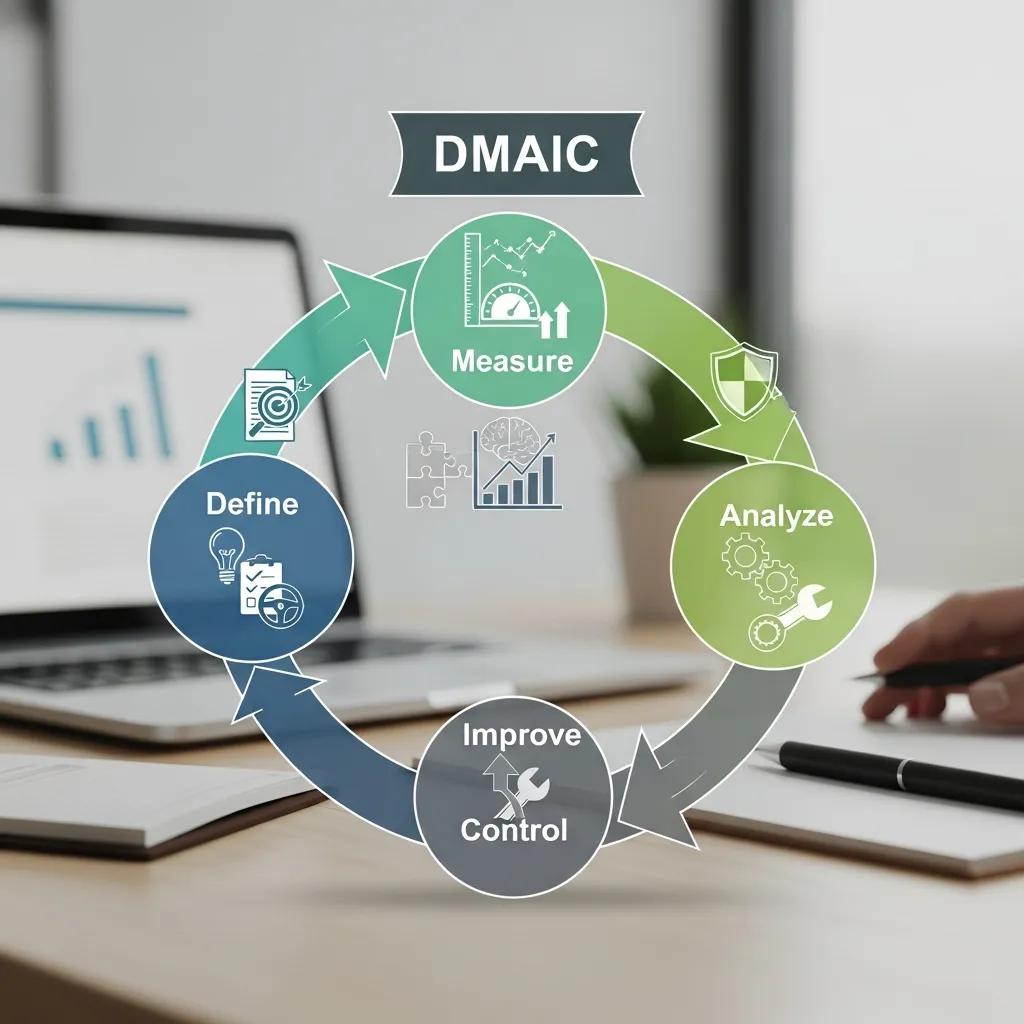
DMAIC (Define, Measure, Analyze, Improve, Control) is the operational backbone of Six Sigma, turning strategic improvement goals into stepwise projects that deliver sustained results through measurement and control. Each phase has a clear purpose: Define the problem and scope, Measure baseline performance and variation, Analyze root causes, Improve with validated solutions, and Control using documentation and monitoring to sustain gains. By enforcing a structured flow from problem definition to control plans, DMAIC reduces wasted effort and focuses resources on interventions with proven impact. Below is a concise phase-by-phase summary and a practitioner-ready EAV table mapping objectives, deliverables, and example tools.
DMAIC summarized with phase roles:
- Define: Establish project charter, scope, and CTQs to focus improvement efforts.
- Measure: Collect data to quantify current performance and validate measurement systems.
- Analyze: Use root-cause analysis and statistical techniques to identify key drivers of variation.
- Improve: Design and pilot solutions using DOE, FMEA, or Poka-Yoke to reduce defects.
- Control: Implement control plans, SPC charts, and documentation to lock in gains.
The phase descriptions above lead naturally into a compact EAV table that maps each DMAIC phase to common objectives and tools for practical application.
| Phase | Primary Objective | Typical Deliverables |
|---|---|---|
| Define | Set project scope and customer requirements | Project charter, SIPOC, CTQ tree |
| Measure | Quantify current performance and measurement capability | Baseline metrics, data collection plan, MSA |
| Analyze | Identify root causes and key inputs | Cause-and-effect, Pareto, hypothesis tests |
| Improve | Develop and validate solutions to reduce defects | DOE, process maps, pilot results, FMEA |
| Control | Sustain improvements with monitoring and governance | Control plan, SPC charts, standard work |
This mapping helps teams select tools intentionally during each phase and prepares the organization for the control mechanisms described next.
What are the five phases of DMAIC and their roles in process improvement?
The five DMAIC phases provide a sequential roadmap that converts a business problem into a controlled process improvement with measurable outcomes. Define creates alignment on scope and customer needs with artifacts like SIPOC and the project charter. Measure establishes baseline metrics and ensures measurement system accuracy, enabling reliable data-driven decisions. Analyze identifies root causes using statistical tests, Pareto analysis, and root-cause tools to focus improvements. Improve develops countermeasures and validates them via pilot tests and Design of Experiments (DOE). Control institutionalizes changes with control plans, SPC, and documented procedures that prevent regression. Each phase produces artifacts that hand off to the next phase, ensuring traceability and accountability.
These roles are reinforced by specific tools and techniques, which we map in the following subsection to guide tool selection.
Which tools and techniques support each DMAIC phase effectively?
Selecting the right tools accelerates DMAIC projects and improves the robustness of outcomes; tools range from simple qualitative methods to advanced statistical analysis. In Define, use SIPOC and VOC mapping to align on customer requirements. Measure requires data collection plans and measurement system analysis to ensure accuracy. Analyze benefits from Pareto charts, Ishikawa diagrams, regression, and ANOVA to isolate significant factors. Improve often uses DOE, FMEA, and Poka-Yoke to design robust countermeasures. Control uses SPC, control plans, and documented standard work to sustain performance. Digital tools and AI can augment many of these techniques by automating data collection, anomaly detection, and predictive analysis, shortening cycle times and improving confidence in decisions.
To make tool selection practical for teams, the next H2 demonstrates how these methods align directly with ISO 9001 requirements and audit-readiness.
How Does Six Sigma Complement ISO 9001 for Quality Management?
Six Sigma provides concrete, methodical techniques that fulfill ISO 9001’s QMS requirements by translating “what” the standard asks for into “how” operational teams achieve and demonstrate compliance. ISO 9001 defines a process approach, risk-based thinking, performance evaluation, and continual improvement; Six Sigma supplies project governance, measurement systems, root-cause analysis, and control mechanisms that satisfy those clauses with measurable evidence. Integrating Six Sigma with ISO 9001 strengthens audit readiness, provides quantifiable performance improvement, and positions suppliers more favorably in procurement. Below is a practical table mapping ISO requirements to Six Sigma methods and expected deliverables to help teams prepare for certification and internal audits.
The table below maps ISO 9001 requirements to Six Sigma techniques and example deliverables that demonstrate compliance.
| ISO 9001 Focus | Six Sigma Method to Meet Requirement | Example Deliverable |
|---|---|---|
| Process approach | SIPOC, process mapping, CTQ trees | Process maps, documented procedures |
| Performance evaluation | Data collection, control charts | KPI dashboards, SPC charts |
| Risk-based thinking | FMEA, root-cause analysis | Risk register, mitigation plans |
| Continual improvement | DMAIC projects | Project charters, before/after metrics |
This mapping clarifies how Six Sigma acts as the “how” for ISO 9001’s “what,” making it easier to prepare evidence for audits and to embed continual improvement in the QMS.
Integrating these approaches also creates a competitive advantage because many key clients require demonstrable QMS compliance; organizations that combine ISO 9001 certification with Six Sigma capabilities present stronger procurement cases. Stratlane Certification Deutschland positions itself to support this alignment: the organization utilizes AI and experienced industry experts to audit organizations and focuses on ISO certification services including ISO 9001, complemented by Six Sigma training and consulting to help clients meet procurement expectations. This combination helps firms demonstrate both compliance and process capability when engaging with demanding customers.
After understanding how Six Sigma helps achieve ISO requirements, it is useful to review the specific business benefits that come from integration and certification.
In what ways does Six Sigma provide practical methods to achieve ISO 9001 compliance?
Six Sigma tools operationalize ISO 9001 clauses by converting general QMS requirements into project-level actions with measurable evidence for audits. For process approach and documented information, teams use SIPOC and standard work; for performance evaluation they implement SPC and dashboards; for risks they apply FMEA and mitigation tracking. These methods produce artifacts—control plans, capability studies, and before/after metrics—that auditors can verify, which streamlines certification readiness. Implementing Six Sigma also improves measurement maturity, ensuring that key QMS indicators are reliable and actionable.
These practical mappings inform the strategic benefits organizations gain when integrating Six Sigma with their certified QMS, discussed next.
What are the benefits of integrating Six Sigma with ISO 9001 standards?
Integrating Six Sigma with ISO 9001 delivers strategic benefits that extend beyond compliance to measurable operational excellence. Chief benefits include improved audit outcomes due to objective evidence, reduced defect and rework rates through targeted projects, and stronger supplier positioning during procurement because performance metrics are demonstrable. Organizations typically observe faster corrective action closure, better KPI alignment to business goals, and a clearer linkage between customer requirements and operational processes. Taken together, these benefits reduce cost, enhance reputation, and increase the likelihood of winning contracts where ISO 9001 certification is a prerequisite.
These advantages naturally intersect with professional development and certification pathways in Six Sigma, which we cover next to show how belts translate into capability.
What Are the Different Six Sigma Certification Levels and Their Significance?

Six Sigma certification comes in belt levels—Yellow, Green, Black, and Master Black Belt—each representing increasing depth in statistical tools, project leadership, and strategic deployment capability. Yellow Belts typically support projects with basic process and data understanding; Green Belts lead smaller DMAIC projects and apply statistical analysis; Black Belts direct large projects, coach teams, and perform advanced analytics; Master Black Belts focus on enterprise deployment, strategy, and training. Each level delivers distinct business outcomes: quicker local fixes from Yellow, cross-functional cost reductions from Green, breakthrough process changes from Black, and sustained capability-building from Master Black Belt. Below is a comparative EAV table that maps typical skills to expected business ROI to help decision-makers choose appropriate training investments.
The Master Black Belt certification, as detailed in various handbooks, signifies a deep understanding of Six Sigma deployment and leadership within an organization.
Six Sigma Master Black Belt Certification & Deployment
A Lean Six Sigma deployment team structure. to sit for the Six Sigma Master Black Belt certification examination.
The certified Six Sigma master black belt handbook, 2010
Use the table below to compare belt levels by core skills and typical business outcomes.
| Belt Level | Typical Skills | Business Outcomes / ROI |
|---|---|---|
| Yellow Belt | Process basics, SIPOC, basic data interpretation | Faster problem identification, team engagement |
| Green Belt | Project leadership, intermediate statistics | Local process improvements, measurable cost savings |
| Black Belt | Advanced statistics, coaching, ROI analysis | Major defect reduction, cross-functional savings |
| Master Black Belt | Strategy, deployment, training | Enterprise capability, sustained continuous improvement |
Understanding these roles supports decisions about internal training pathways and external certification requirements.
What skills and knowledge are gained at Yellow, Green, Black, and Master Black Belt levels?
Each belt builds competencies progressively: Yellow Belts acquire process mapping and basic problem-solving, Green Belts develop statistical analysis and project management, Black Belts master DOE, regression, and team leadership, while Master Black Belts align Six Sigma with business strategy and coach other belts. Training timeframes vary by provider and depth, but typical programs combine classroom work, hands-on projects, and project verification for credentialing. The business impact scales accordingly—from quicker fixes and improved team problem-solving with Yellow Belts to enterprise-level cost avoidance and strategic process deployment with Master Black Belts.
These career and organizational benefits make certification attractive not only for practitioners but also for clients and procurement teams, which we highlight next with a brief strategic note on certification expectations.
How can Six Sigma certification advance careers in process optimization and quality management?
Six Sigma certification advances careers by validating technical skills, demonstrating project results, and positioning practitioners for leadership roles in quality, operations, and transformation programs. Certified professionals often move into roles such as process improvement lead, quality manager, or operational excellence director, supported by documented project successes that resonate with procurement and clients. Organizations that develop internal certification pathways increase retention and create a pipeline of trained practitioners who can scale improvements across departments, reinforcing the strategic value of aligning Six Sigma capability with formal QMS certification such as ISO 9001.
This professional capability is increasingly amplified when teams use AI and digital tools to accelerate analysis and control, which is the focus of the next H2.
How Can Businesses Leverage AI and Digital Tools to Enhance Six Sigma Implementation?
AI and modern analytics accelerate Six Sigma by automating data ingestion, detecting anomalies, and generating predictive insights that shorten DMAIC timelines and improve decision confidence. Machine learning models can surface leading indicators of process degradation, cluster root causes from high-dimensional data, and suggest optimal parameter settings via automated DOE. Digital dashboards and real-time SPC enable continuous monitoring, while low-code platforms speed deployment of control logic and alerts. These technologies reduce manual analytics time and allow teams to focus on high-value interpretation and corrective action design.
Recent research highlights how integrating AI, especially machine learning and predictive analytics, can significantly enhance the Six Sigma DMAIC model for greater economic impact and real-time problem detection.
AI-Enhanced Six Sigma DMAIC for Process Optimization
The focus of this research is to explore how AI can enhance the Six Sigma DMAIC (Define, Measure, Analyze, Improve, Control) model to transform the existing continuous process improvement and develop a greater economic impact for various industries. AI’s strengths of data analytics and, in particular, machine learning enable business to detect problematic areas in manufacturing processes with high accuracy in real time, thus preventing such issues from exacerbating into crisis. It also saves on resources which have to be spent in case of manual intervention while at the same ensuring maximum operational efficiency. The combination of the predictive analysis of AI with the rigor of Six Sigma promotes productivity in diverse organizations, implementing strict standards of quality to support constant improvement in performance.
Leveraging Artificial Intelligence To Revolutionize Six Sigma: Enhancing Process Optimization And Predictive Quality Control, R Akhtar, 2024
Below are practical AI and digital tool use-cases that show how technology complements traditional Six Sigma work.
- Predictive maintenance: AI models forecast failures from telemetry to reduce downtime.
- Automated anomaly detection: ML flags unusual patterns in process data for faster root cause analysis.
- Real-time SPC dashboards: Streaming metrics trigger alerts and support control plans.
Adopting these tools requires attention to data quality, governance, and model validation to ensure trustworthy results and regulatory compliance. The next subsection describes specific AI roles within Six Sigma projects and integration considerations.
What role does AI play in data analysis and decision-making within Six Sigma projects?
AI supports Six Sigma by automating pattern detection, prioritizing likely root causes, and enabling predictive control that prevents defects before they occur. For example, anomaly detection algorithms can surface outliers faster than manual review, while predictive models estimate process drift enabling proactive interventions. These capabilities shorten the Analyze and Improve phases by providing statistically robust insights at scale. However, AI integration demands high-quality data, transparent models for auditability, and processes for validating model outputs against domain expertise to preserve accountability.
After considering AI’s role, it’s important to explore broader technology trends that reshape traditional Six Sigma practices.
How are emerging technologies transforming traditional Six Sigma methodologies?
Emerging technologies—IoT telemetry, cloud analytics, and automation—convert episodic Six Sigma projects into continuous improvement ecosystems with streaming data and automated controls. IoT provides finer-grained inputs for SPC and predictive models, cloud platforms enable scalable analytics, and automation enforces control plans directly in production or service workflows. As a result, organizations can move from periodic improvement projects to near-real-time process governance, reducing the time between detection and remediation. Process owners and auditors must adapt by updating control plans, validating data sources, and ensuring that automated interventions remain transparent and reversible.
The technology-enabled capabilities discussed here are particularly persuasive when demonstrating Six Sigma’s impact in specific industries, which we examine next.
Which Industry-Specific Applications Demonstrate Six Sigma’s Impact on Process Excellence?
Six Sigma’s principles adapt across sectors, producing measurable gains in IT, finance, and healthcare by reducing errors, shortening cycle times, and strengthening compliance. In IT, DMAIC paired with CI/CD tooling reduces post-deployment defects and accelerates mean-time-to-repair. In finance, process mapping and statistical control shorten loan and transaction processing with fewer errors. In healthcare, rigorous root-cause analysis and control plans reduce medication and operational errors, improving patient safety and regulatory compliance. Below we highlight practical examples and anonymized case summaries that illustrate typical before/after metrics and the role ISO-aligned QMS plus Six Sigma play in procurement decisions.
The examples below show typical sector applications and expected KPI improvements.
- IT: Use DMAIC to reduce post-release defects by combining automated test telemetry with SPC.
- Finance: Apply process mapping and FMEA to reduce transaction cycle time and approval errors.
- Healthcare: Implement standardized checklists, FMEA, and SPC to lower medication errors and readmissions.
These industry-specific deployments often hinge on certification and audit-readiness because key clients and regulators demand documented quality systems; integrating ISO 9001 certification with Six Sigma projects can be decisive during vendor selection. Stratlane Certification Deutschland provides ISO certification services and complementary Six Sigma training/consulting to help organizations demonstrate compliance and operational capability, particularly when clients require certified suppliers in procurement processes.
How is Six Sigma applied in IT, finance, and healthcare sectors to reduce errors?
In IT, teams use DMAIC together with telemetry and automated testing to identify deployment bottlenecks, reducing post-deployment bug rates and rollback incidents. In finance, process mapping, Lean waste elimination, and statistical monitoring reduce processing times and transaction errors, improving throughput and customer satisfaction. In healthcare, structured problem-solving, FMEA, and control charts target clinical and administrative error sources to reduce adverse events and readmissions. Each sector customizes tools and KPIs—DPMO for IT, cycle time for finance, and patient-safety metrics for healthcare—while maintaining the same data-driven discipline for verifying improvements.
These practical use-cases are reinforced by anonymized case studies that demonstrate measurable ROI and how QMS certification supported procurement wins.
What case studies highlight measurable improvements through Six Sigma adoption?
Two anonymized case summaries illustrate typical outcomes: a financial services team reduced loan processing time by 35% through process mapping and DMAIC-driven automation pilots, and a hospital reduced medication errors by 40% using FMEA, standardized protocols, and SPC monitoring. In both cases, combining Six Sigma methods with documented QMS artifacts made audit evidence stronger and helped secure contracts where ISO-like quality assurance was a prerequisite. These outcomes show that measurable process improvement paired with certification offers both operational and commercial advantages that decision-makers can quantify.
This article has provided practical frameworks, tools, and mappings to help organizations adopt Six Sigma, integrate it with ISO 9001, and leverage modern analytics to sustain gains.