

Dauer einer ISO Zertifizierung: Understanding ISO Certification Timelines and Processes
Understanding the duration of an ISO certification requires separating certificate validity from the practical timeline needed to design, implement and audit a management system. This article explains how long ISO certifications typically last, what stages determine the calendar from gap analysis to certificate issuance, and which elements most influence time-to-certify for standards such as ISO 9001 and ISO 27001. Many organizations face uncertainty about timelines and client requirements; Stratlane Certification Deutschland is an innovative certification body that utilizes AI and experienced industry experts to audit organizations. Offers ISO certifications including ISO 9001, ISO 14001, ISO 27001, ISO 42001; provides industry-specific services, tailored certification services across sectors such as Automotive, Aviation, Banking, Healthcare, and IT; emphasizes efficiency, trust-building, and comprehensive support (FAQs, case studies, consultant finder). The guide below maps the typical 3-year certification cycle, provides phase-by-phase timelines, gives sector-specific acceleration tips, and explains why ISO 9001 is often a contractually required credential for key clients. Throughout, readers will find practical checklists, comparison tables, and concrete mitigation strategies to estimate a realistic schedule for certification.
What Is the Typical Duration of an ISO Certification Cycle?
An ISO certification cycle typically refers to the period a certificate remains valid and the recurring audit cadence that maintains it; the standard cycle is three years with annual surveillance audits and a recertification audit at the end of the third year. This structure balances system maturity verification and continual improvement by requiring an initial certification audit (often split into Stage 1 and Stage 2), followed by surveillance audits that check ongoing conformity and effectiveness. Organizations should plan for the full three-year window as the baseline, but account for time before initial certification for implementation, which varies by scope and complexity. The following table compares common ISO standards on validity, surveillance frequency, and recertification intervals to clarify expectations across management-system types.
The table below summarizes typical cycle rules for ISO 9001, ISO 27001, and ISO 14001:
| Standard | Typical Certificate Validity | Surveillance Frequency | Recertification Interval |
|---|---|---|---|
| ISO 9001 | 3 years (certificate cycle) | Annual surveillance audits | Full recertification at year 3 |
| ISO 27001 | 3 years (certificate cycle) | Annual surveillance audits | Full recertification at year 3 |
| ISO 14001 | 3 years (certificate cycle) | Annual surveillance audits | Full recertification at year 3 |
This comparison clarifies that while validity and cadence are consistent across many ISO management standards, implementation time before initial audit varies widely. Understanding these baseline intervals helps procurement teams and operations plan training, internal audits, and evidence collection before external assessment.
How Long Is an ISO Certificate Valid For?
An ISO certificate is typically valid for three years from the date of issuance, provided annual surveillance audits confirm continued compliance and no major non-conformities force suspension. Validity reflects the certification body’s confidence that the management system meets the standard over a multi-year period, while surveillance audits verify that processes and corrective actions remain effective between full audits. Exceptions to the three-year pattern can occur when scope changes, major non-conformities are found, or the organization requests a scope extension; these events can require additional audits and affect the certificate timeline. Planning for continuous evidence collection and timely corrective action reduces the risk of shortened validity or additional audit work.
What Are the Key Stages in the ISO Certification Timeline?
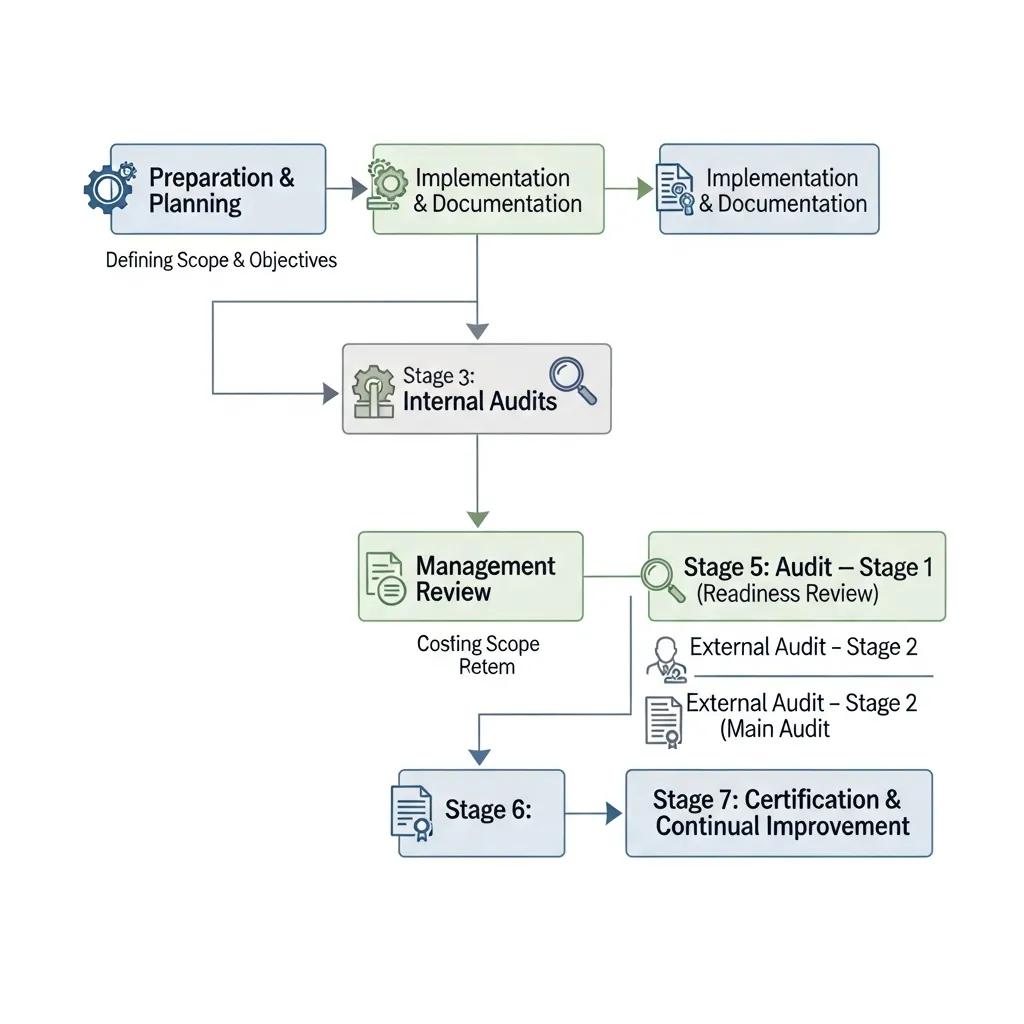
Certification proceeds through a predictable set of stages: preparation and gap analysis, implementation and documentation, internal audits and management review, Stage 1 (readiness) and Stage 2 (certification) external audits, followed by surveillance and recertification cycles. Each stage serves a distinct verification role: gap analysis identifies weaknesses, implementation builds controls and records, internal audit validates operational conformity, and external audits provide independent assurance. Typical durations per stage depend on organization size and process maturity, but teams should expect weeks to months for implementation and scheduling buffers for audit availability. Clear role assignments and a documented project plan shorten delays and improve the predictability of the overall timeline.
The main stages are:
- Preparation and gap analysis to define scope and identify gaps.
- Implementation and documentation of processes and controls with evidence.
- Internal audits and management review leading into external Stage 1 and Stage 2 audits.
- Ongoing surveillance audits and a three-year recertification audit.
These steps create a continuous improvement loop and directly inform scheduling, resource allocation, and readiness checks.
How Long Does ISO 9001 Certification Take? A Detailed Timeline
ISO 9001 certification timelines vary by company size, existing process maturity, and resource allocation, but a typical initial certification project takes between three to nine months from formal project start to certificate issuance for many organizations. The timeline compresses when an organization already has documented processes, trained personnel, and recent internal audits; conversely, greenfield implementations or complex multi-site scopes lengthen the schedule. A compact project plan breaks work into parallel tracks—documentation, training, evidence collection and internal audit—to reduce idle time between tasks. The EAV table below shows typical durations by company size across common phases to help estimate realistic calendars and identify bottlenecks.
The following table helps estimate time by company size and phase:
| Company Size | Preparation & Gap Analysis | Implementation & Documentation | Internal Audit → External Audit |
|---|---|---|---|
| SME (1–50) | 1–2 weeks | 4–8 weeks | 3–6 weeks |
| Mid-size (51–500) | 2–4 weeks | 8–16 weeks | 4–8 weeks |
| Enterprise (500+) | 4–8 weeks | 16–32 weeks | 6–12 weeks |
This breakdown shows that SMEs can often achieve certification in a shorter window when focused resources are allocated, while enterprises require longer implementation and evidence-collection phases due to process complexity and coordination across sites. Use these estimates as a baseline, then add contingency for corrective-action cycles and scheduling.
What Are the Steps in the ISO 9001 Certification Process?
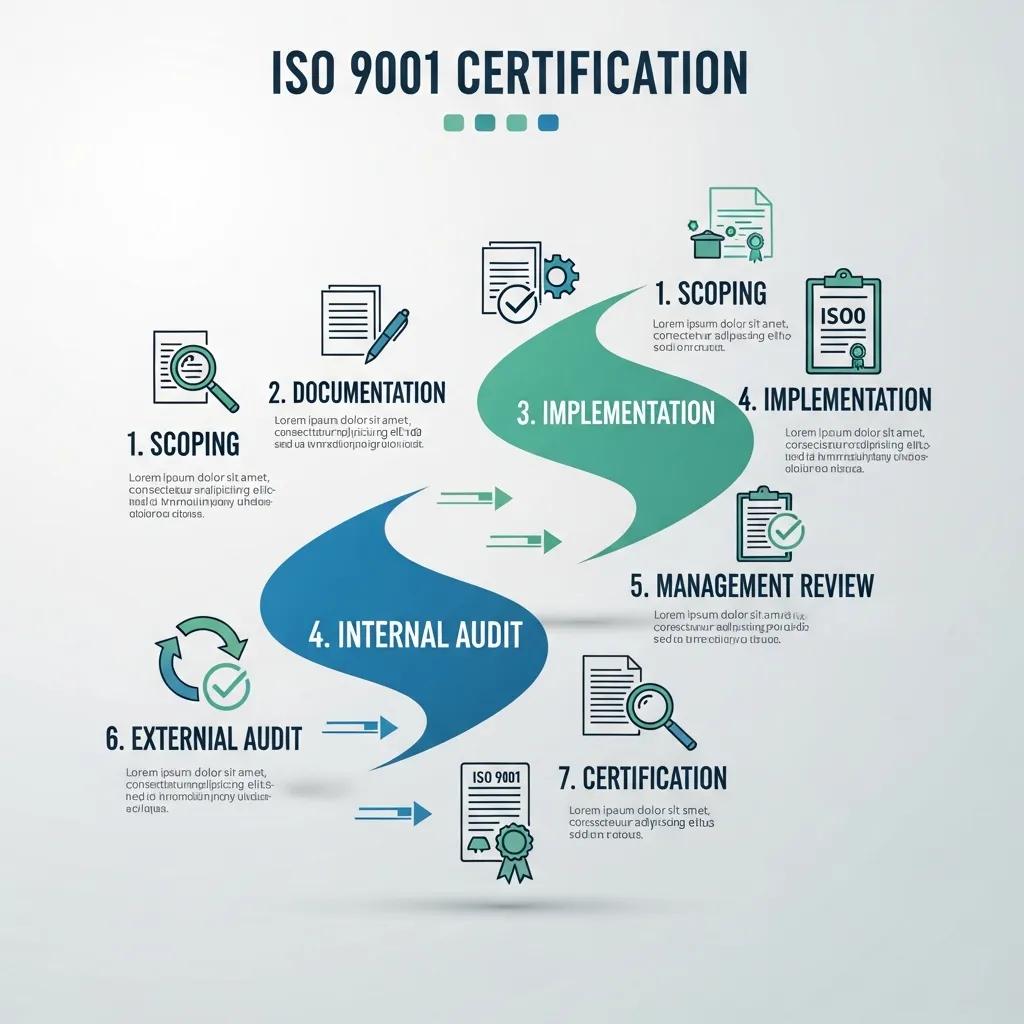
The ISO 9001 process follows a sequence from scoping to certification decision, each delivering concrete outputs such as a scope statement, documented procedures, and audit reports. Scoping and gap analysis define what parts of the organization are in-scope and identify documentation and process gaps to address; this phase clarifies boundaries and measurable objectives. Implementation creates documented processes, work instructions, and records while the internal-audit phase identifies non-conformities and triggers corrective actions; management review validates effectiveness prior to external assessment. The external certification audit typically includes Stage 1 (document review/readiness) and Stage 2 (on-site verification) and culminates in a certification decision and issuance of the ISO 9001 certificate.
The major steps are:
- Scoping and gap analysis to define the management-system boundaries.
- QMS documentation, process changes and evidence collection.
- Internal audits and corrective actions leading to management review.
- Stage 1 readiness review followed by Stage 2 certification audit and certificate issuance.
Preparing deliverables for each step shortens the audit window and reduces the probability of major non-conformities during external assessment.
Which Factors Influence the Duration of ISO 9001 Certification?
Several variables materially influence how long ISO 9001 takes: company size and process complexity, availability and competence of internal resources, prior documentation and certification experience, and external factors like audit scheduling and scope changes. For example, an SME with well-documented procedures and a committed project sponsor can achieve certification in 2–4 months, whereas a large multi-site manufacturer may need 6–12 months to integrate processes and collect sufficient evidence. Common blockers include incomplete records, lack of internal audit capability, and insufficient top-management engagement; mitigation tactics include hiring experienced consultants, running pre-audit readiness checks, and using templates to accelerate documentation. Quantifying these factors early helps create a realistic timeline and resource plan.
What Is the Duration of ISO 27001 Certification? Planning Your Information Security Journey
ISO 27001 certification timelines often run longer than ISO 9001 because of ISMS-specific tasks like scoping IT assets, performing thorough risk assessments, and implementing technical controls that require coordination with IT operations. Typical projects range from four to twelve months depending on the complexity of the IT landscape, existing security posture, and the amount of technical evidence needed to demonstrate control effectiveness. Risk assessment, Statement of Applicability creation, and control implementation are front-loaded activities that drive both effort and schedule, and organizations should plan parallel streams for policy documentation, technical deployment, and evidence collection to accelerate delivery. Early involvement of IT, security, and executive stakeholders shortens decision timelines and helps manage dependencies on tooling or system changes.
What Are the Specific Phases of ISO 27001 Certification?
ISO 27001 phases include scoping and asset identification, risk assessment and Statement of Applicability (SoA) development, control implementation and evidence collection, internal audit, and external certification audits; each phase has IT-dependent tasks that can extend timelines. Scoping identifies assets, owners and boundaries and determines the appropriate depth of controls; risk assessment quantifies threats, vulnerabilities and impact and informs the SoA. Implementing technical controls—patching, access controls, logging and monitoring—often requires operational change management and testing, which can add weeks or months. Internal audit and remediation close gaps prior to the external Stage 1 and Stage 2 audits; treating technical deployment and evidence collection as priority tracks helps prevent late-stage delays.
How Does ISMS Implementation Affect Certification Timeline?
ISMS implementation affects timeline through technical complexity, required integrations, and testing cycles; cloud-native startups with modern, automated environments can often implement controls faster than legacy enterprises with fragmented systems. Common blockers include unmanaged assets, insufficient logging, and complex change-management processes that delay control verification. To accelerate timelines, organizations can prioritise a minimal control set that addresses highest risks first, leverage templates and automation for evidence collection, and run focused pilot audits to validate controls before full external assessment. Clear ownership, a prioritized roadmap and automation for evidence capture reduce manual effort and shorten the path to certification.
How Often Are Surveillance and Recertification Audits Required in ISO Certification?
Yes — surveillance audits are required and are typically conducted annually to verify ongoing conformity, while recertification is conducted at the end of a three-year cycle to renew the certificate. Surveillance audits focus on key processes and corrective action follow-up rather than the full scope examined during initial certification, and they are designed to validate continual improvement and management-system stability. Recertification audits are broader, effectively re-assessing the system to confirm it still meets the standard across the full scope, and organizations should plan documentation refreshes and a comprehensive internal audit prior to recertification. The table below provides a concise process-oriented checklist for audit frequency and purpose.
Surveillance and recertification key points:
- Annual surveillance audits confirm ongoing compliance and monitor corrective-action effectiveness.
- Recertification at year three re-assesses the full scope and verifies overall system maturity.
- Surveillance findings can trigger extra audits or corrective actions that affect timelines.
These audit cadences create predictable checkpoints that both buyers and suppliers can use to maintain trust and operational continuity.
What Is the Purpose of Annual Surveillance Audits?
Annual surveillance audits exist to ensure a certified management system remains effective and that corrective actions from earlier audits are implemented and maintained. Surveillance auditors sample processes and records, evaluate performance trends, and confirm that non-conformities have been addressed; they do not usually repeat exhaustive checks of every clause but focus on risk areas and previous findings. Preparing for surveillance involves maintaining internal audit schedules, ensuring records are up-to-date, and verifying that management review actions have been tracked and closed. Regular surveillance reduces the likelihood of surprise findings at recertification and supports continuous improvement by highlighting areas for incremental enhancement.
When and How Is Recertification Conducted?
Recertification is conducted at the end of the three-year certificate cycle and typically involves a comprehensive audit that covers the full scope of the management system; it mirrors aspects of the initial Stage 2 audit but focuses on system maturity and the effectiveness of continual improvement. The recertification schedule should be arranged well in advance to allow time for internal audits, evidence consolidation and corrective-action closure. A short readiness checklist for recertification includes updated scope and objectives, recent internal-audit reports, evidence of corrective-action closure, and recent management reviews. Proper planning for recertification minimizes administrative delays and ensures the certification body can complete the assessment within the expected window.
A short readiness checklist for recertification includes:
- Updated scope and objectives
- Recent internal-audit reports
- Evidence of corrective-action closure
- Recent management reviews
Proper planning for recertification minimizes administrative delays and ensures the certification body can complete the assessment within the expected window.
Why Is ISO 9001 Certification a Requirement for Key Clients?
ISO 9001 often becomes a procurement requirement because it provides objective, auditable evidence that a supplier operates documented processes, manages quality risks, and demonstrates continual improvement—attributes that reduce buyer risk and simplify supplier evaluation. Buyers use ISO 9001 as a trust signal in tender processes and supplier scorecards because certification demonstrates consistent outputs, traceability, and an audit trail for corrective actions. For organizations bidding into regulated markets or complex supply chains, ISO 9001 short-circuits many qualification steps by providing an internationally recognised baseline for quality management.
How ISO 9001 aligns with procurement requirements:
- Process Consistency: Demonstrates standardized processes and reduced variation in deliverables.
- Traceability: Provides documented records and audit trails for critical activities and outputs.
- Risk Management: Shows structured handling of quality risks and corrective-action systems.
Stratlane Certification Deutschland is an innovative certification body that utilizes AI and experienced industry experts to audit organizations. Offers ISO certifications including ISO 9001, ISO 14001, ISO 27001, ISO 42001; provides industry-specific, tailored certification services across sectors such as Automotive, Aviation, Banking, Healthcare, and IT; emphasizes efficiency, trust-building, and comprehensive support (FAQs, case studies, consultant finder). This integration of clarity, auditability and external assurance explains why many procurement teams list ISO 9001 as a minimum supplier criterion.
How Does ISO 9001 Build Trust and Meet Client Procurement Requirements?
ISO 9001 builds trust by requiring documented processes, objective evidence, and regular audits that together produce reliable, verifiable results for buyers; the standard’s clauses directly map to typical supplier evaluation criteria used in procurement. Documented procedures reduce ambiguity about responsibilities and outputs, audit trails provide demonstrable evidence for regulatory or contractual checks, and management review ensures top-level oversight—elements procurement teams value when assessing supplier risk. Buyers therefore treat ISO 9001 certification as a proxy for governance, stability and continuous improvement, which simplifies contractual approvals and reduces the need for extensive supplier audits. In practice, vendors with ISO 9001 certification typically move faster through supplier qualification and onboarding.
What Competitive Advantages Does ISO 9001 Provide to Certified Companies?
ISO 9001 delivers several commercial benefits that translate into measurable competitive advantages: access to tenders that require certified suppliers, improved internal efficiency and defect reduction, and stronger supplier scorecard ratings during procurement evaluations.
Certification can increase win rates for bids where quality management is an explicit requirement and reduce the time buyers spend on supplier due diligence.
Operationally, documented processes and internal audits drive reductions in rework and improve customer satisfaction metrics, which in turn become sales differentiators.
These advantages combine to create both top-line access to new opportunities and bottom-line improvements from more predictable operations.
How Does Stratlane Certification Deutschland Streamline the ISO Certification Duration?
Stratlane Certification Deutschland reduces time-to-certify by combining AI-assisted audit preparation and document pre-checks with experienced industry auditors who focus human attention where judgment is needed, thereby trimming avoidable admin time and accelerating evidence collection cycles. Using tooling to pre-analyze documentation and map evidence to standard clauses allows auditors to prioritise high-risk areas and shorten on-site audit durations, while industry-specific auditor experience reduces clarification cycles and rework. The table below compares conventional approaches with the Stratlane approach across key attributes to show the expected impact on time-to-certify and audit efficiency.
| Approach | Time-to-Certify | Use of AI | Industry Tailoring | Support Services |
|---|---|---|---|---|
| Conventional approach | Longer; variable scheduling | Minimal or none | Generic, one-size-fits-all | Basic audit reporting |
| Stratlane approach | Shorter; focused audits and faster closure | AI-assisted evidence pre-checks | Tailored pathways for industries like Automotive, Healthcare, IT | Enhanced support: FAQs, case studies, consultant finder |
This comparison shows that combining automation for routine tasks with expert human auditors yields measurable efficiency gains by reducing report generation time, clarifying evidence expectations, and cutting audit durations without sacrificing rigour. These benefits translate into faster certificate decisions and fewer follow-up audits.
What Role Does AI and Expert Auditing Play in Efficient Certification?
AI accelerates certification by automating document mapping to standard clauses, flagging missing evidence, and generating draft audit checklists and reports, which saves auditors and client teams hours of repetitive work; expert auditors then concentrate on judgement-heavy areas such as contextual risk and control effectiveness. This entity → relationship → entity pattern—documentation → maps to → clause—permits rapid identification of gaps and prioritisation of remedial tasks. Conservative estimates place time savings in preparation and reporting cycles at a material level, especially when organizations provide structured digital records; experts focus on interpretation, stakeholder interviews and verification, producing faster closure of non-conformities. This hybrid approach preserves audit quality while compressing timelines through repeatable automation and domain expertise.
How Are Industry-Specific Solutions Tailored to Optimize Certification Timelines?
Tailored industry solutions work by aligning scope, control expectations and evidence templates to sector norms so auditors and audited teams spend less time resolving generic ambiguities and more time validating context-specific risks and controls. For example, healthcare and aviation sectors often require specific documentation and traceability that pre-built templates can address, while IT-focused engagements prioritise logging, access control and encryption evidence. Pre-built control mappings, industry templates and dedicated auditor expertise reduce rework, lower clarification cycles, and accelerate acceptance of evidence during Stage 2 audits. Stratlane Certification Deutschland is an innovative certification body that utilizes AI and experienced industry experts to audit organizations. Offers ISO certifications including ISO 9001, ISO 14001, ISO 27001, ISO 42001; provides industry-specific, tailored certification services across sectors such as Automotive, Aviation, Banking, Healthcare, and IT; emphasizes efficiency, trust-building, and comprehensive support (FAQs, case studies, consultant finder).
Stratlane’s combined approach provides a practical pathway for organisations to meet client procurement expectations within compressed timelines while preserving the impartiality and rigour expected from reputable certification bodies.