

Tipps und Tricks für die ISO Zertifizierung: Ihr umfassender Leitfaden zum erfolgreichen Zertifizierungsprozess
ISO certification formalizes a management system that consistently delivers defined outcomes; for many organisations, it is the difference between being eligible for major contracts and being excluded at the RFP stage. This guide shows IT directors and business leaders how ISO 9001 — a Quality Management System (QMS) certification — works, why it matters to key customers, and how to move from gap analysis to maintained certification with practical tips and measurable ROI. You will learn the core benefits for customer satisfaction and compliance, a step-by-step roadmap for certification, tactical implementation advice to avoid common pitfalls, and ways to leverage certification as a competitive advantage in procurement and sales. Practical sections include a numbered process checklist, EAV tables for expected durations and deliverables, lists of common mistakes and remediation, and a maintenance schedule that aligns surveillance audits with continual improvement. Throughout we reference contemporary developments such as AI-assisted auditing and accreditation considerations so you can evaluate providers and design a pragmatic project plan that meets tender requirements and operational goals.
Warum major clients demand ISO 9001 stems from its role as a recognised indicator of consistent process control, documented governance and measurable quality outcomes. This foundation leads directly into the specific client-facing benefits and compliance mechanisms that make certification a procurement prerequisite for many sectors.
Warum ist die ISO 9001 Zertifizierung für Ihre wichtigsten Kunden unverzichtbar?
ISO 9001 is a standard for a Quality Management System that defines process controls, documentation and continual improvement mechanisms which ensure consistent product or service delivery. Because it embeds risk-based thinking and measurable KPIs, many large customers treat ISO 9001 certification as a procurement requirement to reduce supplier risk and to ensure traceability across contractual obligations. Certification therefore increases vendor eligibility for tenders, reduces onboarding friction, and signals an auditable commitment to quality — outcomes that directly affect commercial opportunity and client trust.
ISO 9001 delivers three primary client-focused benefits:
- Quality consistency: Standardised processes reduce variance in deliverables and service levels.
- Risk reduction: Documented controls and risk registers lower the chance of contract failures.
- Procurement prerequisite: Many RFPs list ISO 9001 as a minimum supplier requirement, making certification essential for eligibility.
These advantages shape vendor selection policies and explain why procurement teams prioritise certified suppliers; understanding these benefits prepares leadership to allocate resources for certification and to map compliance to commercial objectives.
Welche Vorteile bietet ISO 9001 für Kundenzufriedenheit und Vertrauen?

ISO 9001 strengthens customer satisfaction by enforcing documented processes for requirements capture, delivery verification and handling of nonconformities, which produces measurable improvements in on-time delivery and complaint resolution. By mandating customer feedback loops and management review of quality metrics, the standard creates a culture of responsiveness that clients recognise as lower operational risk. Recent industry analyses indicate that organisations applying QMS metrics see faster closure of corrective actions and improved net promoter scores, which buyers interpret as stronger partnership reliability. These operational changes increase client trust during supplier evaluations and can shorten procurement due-diligence cycles.
Improved customer outcomes also create marketing and tendering advantages, and the mechanisms that produce these outcomes — documented procedures, KPI tracking and corrective action systems — directly support a business case for certification. The next section explains how ISO 9001 supports compliance and risk management in practical terms.
Wie sichert ISO 9001 die Einhaltung von Compliance und Risikomanagement?
ISO 9001 embeds risk-based thinking across processes by requiring organisations to identify, assess and mitigate risks that affect conformity of services or products, which creates traceable evidence for regulators and clients. The standard’s emphasis on documented procedures, responsibility matrices and internal audits produces artifacts (risk registers, control matrices, audit reports) that simplify compliance checks. For example, linking a risk register entry to a process control and its monitoring KPI demonstrates how an identified risk is managed operationally and measured over time. This traceability not only reduces audit friction but also limits supplier and operational risk for customers, reinforcing contractual reliability.
Because compliance evidence is central to certification audits, preparing clear mappings between regulatory requirements, contractual clauses and QMS processes reduces surprises during external audits and accelerates corrective action closure — a practical bridge to the certification phases described next.
Wie gestaltet sich der ISO Zertifizierungsprozess Schritt für Schritt?
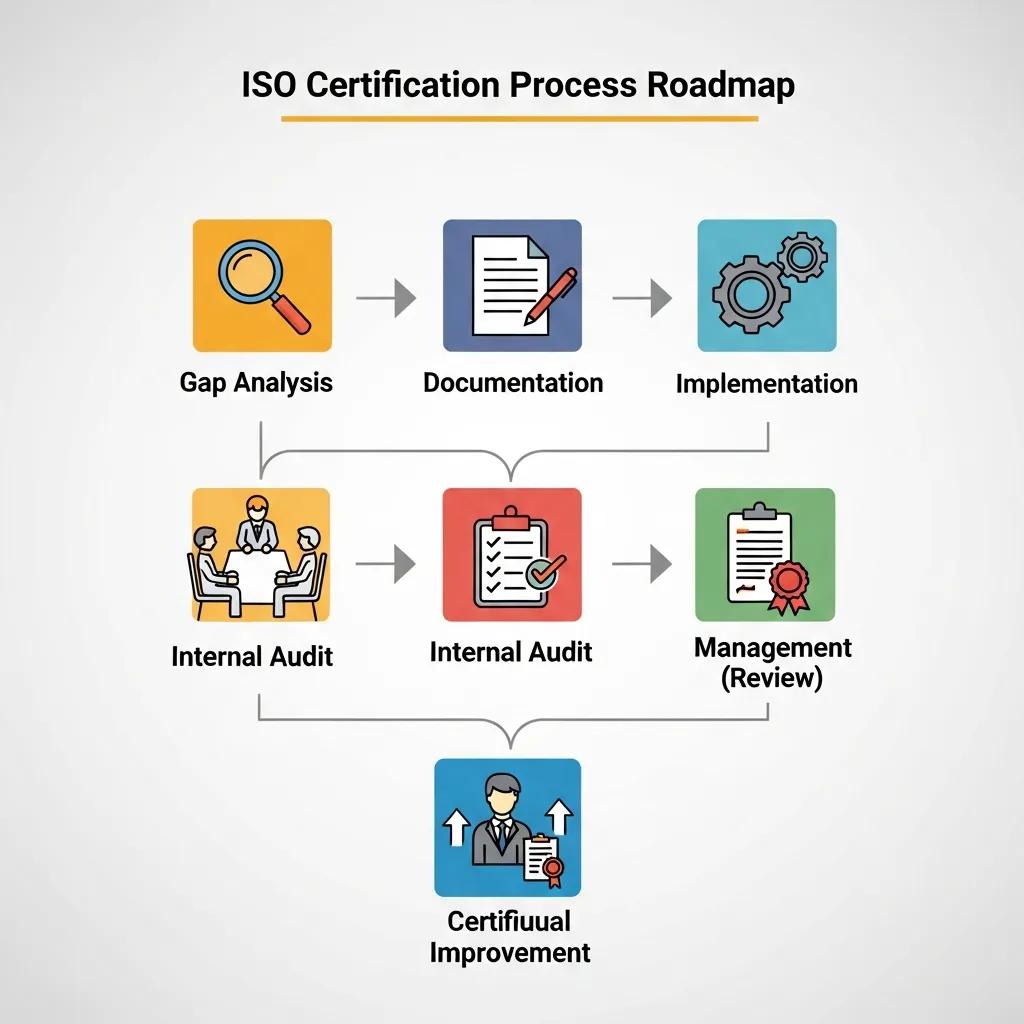
The ISO certification process follows a clear sequence: gap analysis, documentation, implementation, internal audit, external audit, certification decision, and surveillance — each phase delivers specific outputs and typically takes between a few weeks and several months depending on organisational complexity. A successful programme assigns accountable roles, defines deliverables for each phase, and uses objective evidence to demonstrate conformity; this structured approach shortens certification timelines and reduces rework. Typical projects for medium-sized organisations aim for certification within 6–12 months when resourcing and leadership engagement are aligned.
The following numbered steps outline the practical progression and expected outputs for featured-snippet clarity:
- Gap analysis (2–4 weeks): Identify differences between current processes and ISO 9001 requirements; produce a remediation plan.
- Documentation (4–8 weeks): Create QMS manuals, procedures and process maps; assign responsibilities.
- Implementation (6–16 weeks): Execute process changes, train staff, and collect baseline metrics.
- Internal audit & corrective actions (2–6 weeks): Validate process effectiveness, close findings.
- External audit (Stage 1 and Stage 2, 1–3 weeks): Certification body assesses conformity and issues nonconformities if any.
- Certification decision: Accredited body reviews evidence and issues certificate.
- Surveillance (annual): Ongoing audits to maintain certification across the cycle.
A practical schedule with expected durations and outputs is shown below to help planning and stakeholder alignment.
Introductory table: expected phase durations, roles and tangible outputs.
| Phase | Typical duration | Key outputs |
|---|---|---|
| Gap analysis | 2–4 weeks | Gap report, project plan, prioritized corrective actions |
| Documentation | 4–8 weeks | QMS manual, procedures, process maps, role descriptions |
| Implementation | 6–16 weeks | Trained staff, KPI baselines, implemented controls |
| Internal audit | 2–6 weeks | Audit reports, nonconformity records, corrective actions |
| External audit & certification | 1–3 weeks (audit) | Audit report, certificate (if compliant) |
| Surveillance | Annual | Surveillance reports, continual improvement evidence |
This EAV-style table clarifies phase expectations and helps teams set realistic milestones before the external audit. The next subsection highlights how AI can be used in audits to increase efficiency.
Was sind die wesentlichen Phasen von der Gap-Analyse bis zur Zertifizierung?
The gap analysis identifies where current processes fall short of ISO 9001 and produces a prioritized plan that drives documentation and implementation workstreams. This diagnostic phase typically outputs a gap register, mapped process responsibilities and a remediation timeline that ties to business KPIs such as defect rate or on-time delivery. Following gap closure, documentation and implementation convert corrective plans into standard operating procedures and supporting evidence, while internal audits validate readiness for external assessment. Assigning accountable process owners and tracking progress against the gap register speeds closure of nonconformities and reduces risk during the certification audit.
Clear role assignments and a tightly managed corrective action workflow ensure that the internal audit phase produces a small, manageable set of findings rather than extensive rework, which shortens the time needed for external assessment and moves the organisation toward certification.
Wie unterstützt KI den Auditprozess bei Stratlane?
AI-assisted auditing tools can accelerate evidence collection by automating data sampling, identifying anomalies and highlighting trends that warrant auditor attention, which reduces manual effort and improves consistency across audits. In practice, AI helps auditors focus on high-risk areas by flagging statistical outliers in KPIs, automating checklist completion and aggregating documentary evidence for review; these capabilities shorten audit time while preserving rigour. As an example of provider practice, Stratlane Certification Deutschland uses AI-powered auditing tools alongside experienced auditors to streamline sampling and reporting, combining automated analysis with professional judgement to maintain accreditation standards and audit quality.
Further research underscores the critical role of robust data management and automation in achieving audit readiness and ensuring compliance, particularly in complex regulatory environments.
Automating ISO 9001 Compliance: Data Management for Audit Readiness
The increasingly complicated nature of the regulated manufacturing environment demands strong data management architectures on the basis of international standards management. In particular, the defense and aerospace sectors, where the International Traffic in Arms Regulations (ITAR) and the ISO 9001 quality management standards apply, face big issues related to the provision of secure, traceable, and audit-ready data streams within the enterprise systems. The possibility of non-compliance, inefficiency, and slow audits exists with paper-based processes and system design fragmentation.
AUTOMATING COMPLIANCE-READY DATA FLOWS IN ITAR AND ISO 9001 CERTIFIED MANUFACTURING SYSTEMS, 2025
Used conservatively, AI complements auditor expertise rather than replacing it: automation handles routine evidence collation and trend detection, allowing auditors to concentrate on context, interviews and judgemental sampling that require human insight.
Welche Tipps und Tricks erleichtern die erfolgreiche Umsetzung von ISO 9001?
Implementing ISO 9001 successfully begins with realistic scoping, senior leadership engagement and a project plan that sequences documentation, training and metric baselining. Practical tools include standardised templates for procedures, a central evidence repository, and a phased rollout where high-risk processes are stabilised first. Early establishment of a management review cadence and a small set of leading KPIs focused on defect rate, on-time delivery and corrective action closure provides measurable signals for improvement. These tactical choices reduce documentation burden and embed continual improvement into daily operations.
Key tactical actions to prioritise during implementation:
- Scope carefully: Limit initial scope to core processes to control complexity and prove value quickly.
- Engage leadership: Obtain clear process ownership and resource commitment from executives.
- Use templates and a repository: Standard templates and a central evidence store reduce the administrative load.
- Train process owners early: Equip owners with audit interview skills and evidence management techniques.
These measures speed adoption and create measurable progress; the next subsection lists common mistakes to avoid when implementing ISO 9001.
Welche häufigen Fehler sollten Sie bei der Implementierung vermeiden?
Many organisations stumble by scoping the QMS too broadly, underestimating the documentation and training effort, or treating certification as a one-off project instead of an ongoing programme. Common errors include weak leadership sponsorship, skipped internal audits, and inadequate recording of evidence for key processes, each of which leads to last-minute firefighting before the external audit. Remediation focuses on re-scoping where necessary, enforcing a documented corrective action workflow, and scheduling mock audits to identify weaknesses early. Addressing these items proactively reduces the chance of persistent nonconformities and shortens the certification timeline.
Top five implementation mistakes and quick remediations:
- Inadequate scoping: Reassess scope and start with core processes to limit complexity.
- Underestimating documentation: Use templates and assign clear documentation owners.
- Neglecting staff training: Run role-specific training sessions and practical mock interviews.
- Skipping internal audits: Schedule regular internal audits and follow up promptly on findings.
- Poor evidence management: Centralise evidence in a searchable repository and enforce version control.
These remediation steps convert common pitfalls into controlled actions that support a smooth certification journey.
Wie bereiten Sie Ihr Team optimal auf interne und externe Audits vor?
Preparation combines classroom training, mock audits and a single place for evidence retrieval so that process owners can respond consistently during interviews. Begin with role-specific briefings on audit objectives and typical interviewer questions, then conduct mock internal audits that simulate the external audit environment and generate corrective actions to close before the real assessment. Maintain an audit day checklist — including document access, system credentials and evidence references — and rehearse interview scenarios to build confidence. Continuous rehearsal and closure of internal findings demonstrate maturity and reduce auditor time spent on follow-up queries.
A disciplined rehearsal and evidence management routine not only improves audit performance but also embeds the behaviours auditors expect, smoothing the transition from internal review to successful certification.
Wie maximieren Sie den Nutzen Ihrer ISO Zertifizierung über die reine Compliance hinaus?
To extract business value from ISO 9001, translate QMS metrics into financial and operational KPIs that influence tender outcomes, customer retention and process costs. Use certification as a sales and procurement signal, include QMS achievements in tender responses, and connect improvements (reduced defects, faster onboarding, higher first-pass yield) to measurable savings or revenue opportunities. Quantifying wins lets IT leaders and executives compare certification costs to avoided costs and potential new contract revenue. A clear ROI framework includes baseline costs, expected savings from reduced rework, and estimated revenue uplift from meeting procurement prerequisites.
Below is an EAV table mapping benefits to business metrics and estimated impact to help leaders prioritise which QMS improvements to target first.
| Benefit | Business metric | Estimated impact |
|---|---|---|
| Operational efficiency | Defect rate reduction (%) | Lower rework costs; improved throughput |
| Tender success | Increase in eligible bids (%) | Greater addressable market and potential revenue |
| Customer trust | Complaint resolution time (days) | Higher retention and contract renewals |
| Onboarding speed | Time to onboard new clients (days) | Faster revenue recognition and lower resource cost |
This mapping helps decision-makers focus on process improvements that produce measurable ROI and supports a business case for investment in QMS activities. The following subsections explain operational efficiency gains and ROI aspects relevant to IT and executive teams.
Wie steigert ISO 9001 die operative Effizienz und Wettbewerbsfähigkeit?
ISO 9001 drives operational efficiency by standardising workflows, reducing variance and enabling root-cause analysis that targets the largest cost drivers. Standard operating procedures and KPI monitoring reduce defects and handover errors, improving throughput and predictability across IT and service processes. For example, process standardisation in incident management reduces mean time to resolution and limits repeated failures, which in turn reduces workload and operational expense. Improving supplier management through defined supplier evaluation criteria and performance metrics also accelerates onboarding and reduces supplier-related disruptions.
These efficiency gains translate into competitive advantages: lower total cost of delivery, more predictable SLAs, and demonstrable evidence for procurement teams assessing supplier risk. The next subsection provides an ROI framework for executives.
Welche ROI-Aspekte sind für IT-Leiter und Geschäftsführung relevant?
Executives should quantify ROI by combining direct savings (reduced rework, fewer incidents) with revenue uplifts from new contracts enabled by certification and indirect benefits such as lower insurance or compliance costs. An ROI framework begins with baseline costs (current defect rates and incident response costs), projects improvements attributable to QMS changes (percentage reduction in defects), and estimates revenue gains from additional tenders won due to certification. Suggested KPIs include cost per incident, defect rate, bid win rate and time to onboard new clients; tracking these over time demonstrates tangible returns from certification investments.
Indeed, empirical studies consistently demonstrate the tangible financial advantages of ISO 9001 certification, impacting key performance indicators such as profitability and financial stability.
Financial Benefits of ISO 9001 Certification: Profit, Sales, and Debt
The result of this research is that there is a significant positive difference between ISO 9001 certified companies in Iceland and companies without certification. The certified companies had a significant higher gross profit margins and return on sales ratio. There was also a difference in financial health of the certified companies from the non-certified companies where certified companies had lower debt ratio than companies that were not certified.
Financial benefits of an ISO 9001 certification, 2012
By converting QMS improvements into dollar-value estimates, IT leaders can prioritise initiatives with the highest ROI, justify certification expenses, and present a measurable business case to stakeholders considering the certification investment.
Wie erhalten und pflegen Sie Ihre ISO Zertifizierung langfristig?
Maintaining ISO certification requires an active surveillance and continual improvement programme: annual surveillance audits, timely corrective action closure, regular management reviews and ongoing internal audits across the three-year cycle. Governance should assign responsibility for evidence collection, corrective action tracking and KPI review to named owners, while maintaining an audit calendar that anticipates surveillance scope. Treating maintenance as business-as-usual rather than a project reduces audit preparation time and limits disruptive, last-minute compliance efforts. The following table clarifies audit types, frequencies and key requirements to prevent misunderstandings about maintenance responsibilities.
| Audit type | Frequency | Key requirements |
|---|---|---|
| Internal audit | Quarterly / semi-annual | Audit reports, closed corrective actions, evidence traceability |
| Surveillance audit | Annual | Demonstrated continual improvement, KPI trends, sampled process evidence |
| Recertification audit | Every 3 years | Full system review, evidence of sustained conformity, management review records |
This schedule helps teams plan evidence collection and corrective action workflows so surveillance audits validate genuine improvement rather than reactive fixes. The next subsection describes the specific evidence auditors expect.
Was sind die Anforderungen an Überwachungsaudits und kontinuierliche Verbesserung?
Surveillance audits typically sample processes to verify the QMS remains effective; auditors expect evidence of management reviews, KPI trend analysis, completed corrective actions and examples of process improvements. Demonstrable continual improvement can include reduced defect rates, completed improvement projects with measurable outcomes, and updated process documentation reflecting lessons learned. Auditors also review how nonconformities were handled, whether root causes were addressed, and whether preventive actions were implemented. Regularly compiling these artifacts — audit reports, KPI dashboards, corrective action records — makes surveillance audits routine and predictable.
Maintaining a continuous improvement log and linking improvements to measurable business outcomes strengthens audit evidence and demonstrates the QMS is delivering ongoing value beyond initial certification.
Wie vermeiden Sie typische Stolpersteine bei der Zertifikatserhaltung?
Common maintenance failures arise from poor record-keeping, slow corrective action closure and failure to update processes as the organisation evolves; these issues create audit findings and risk certificate suspension. Mitigation includes a documented evidence retention policy, a centralised corrective action tracker with SLA targets for closure, and periodic process reviews to ensure documentation reflects current practice. Establish ownership for each corrective action and enforce management review reminders to avoid lapses in governance. A monitoring cadence that ties internal audits to management review dates prevents accumulation of unresolved findings.
By institutionalising simple controls — central evidence repository, tracked corrective actions, scheduled internal audits — organisations avoid the most frequent pitfalls and keep certification in good standing.
Für Organisationen assessing providers or seeking certification partners, consider accreditation status, geographic coverage and audit methodology when selecting a certification body. Stratlane Certification Deutschland is an accredited certification body operating across Europe and the UK that issues certificates in multiple countries and combines experienced auditors with AI-supported auditing tools; these features can shorten audit cycles and provide consistent audit quality for organisations operating internationally. If you require a provider who offers multi-country coverage, accredited decisions and AI-assisted efficiency, Stratlane Certification Deutschland positions ISO certification as a strategic advantage for tender eligibility and supplier credibility.
Contact details and local presence for providers should be verified directly with the organisation; combine the selection criteria above with references and evidence of accreditation to make an informed choice.