

Die Informationssicherheitsleitlinie: Ein umfassender Leitfaden zur ISO 27001 Policy und ISMS-Implementierung
An information security policy (Informationssicherheitsleitlinie) is a concise, high-level statement from top management that defines an organisation’s commitment to protecting information assets, sets measurable objectives, and directs the Information Security Management System (ISMS). This guide explains what an ISO 27001 Leitlinie must contain, how it differs from procedures and controls, and how it becomes the governance backbone that drives risk assessment, control selection, and audit readiness. Organisations frequently face pressure from clients and regulators to demonstrate consistent policy governance; a well-crafted policy both reduces implementation friction and signals trustworthiness to stakeholders. In the sections that follow we define the policy in the ISO 27001 context, outline key components and practical examples, present step-by-step drafting and approval guidance, show how ISO 9001 integration strengthens the ISMS, and explain review cycles and audit roles required for continual improvement. Practical checklists, EAV tables, and actionable lists are included to help practitioners create, implement and maintain an ISO 27001 information security policy that aligns with contemporary best practice and recent research.
Navigating the broader landscape of information security standards, including ISO 27001, often presents challenges in consistently applying and comparing control measures.
ISO 27001 Control Measures & Implementation
In the realm of IoT information security and other domains, various information security standards exist, such as the IEC 62443 series standards published by the International Electrotechnical Commission and ISO/IEC 27001 by the International Organization for Standardization. Business organizations are striving to improve and protect their operations through the implementation and study of these information security standards. However, comparing or pinpointing applicable control measures is becoming increasingly labor-intensive and prone to errors or deviations, especially given the plethora of information standards available.
Multi-language IoT information security standard item matching based on deep learning, WC Wu, 2024
Was ist eine Informationssicherheitsleitlinie und warum ist sie für ISO 27001 wichtig?
An information security policy is a top-level document that states management’s intentions and direction for information security, providing the framework for objectives, responsibilities, and the ISMS scope. Its mechanism is governance: the policy translates strategic risk appetite into measurable objectives and control requirements, enabling consistent decision making across processes. The practical benefit is clear — without a formal policy, auditors cannot verify direction and commitment from top management, which jeopardises ISO 27001 certification and operational consistency. Below we clarify the definition in ISO terms and show how the policy functions within the ISMS structure to link risk assessment, Annex A controls, and monitoring activities.
The policy differs from procedures and controls in being purposefully high level; procedures implement policy requirements, while controls enforce them, and the policy sets the “why” and the acceptance criteria. This separation avoids operational drift and ensures that audits evaluate alignment to management intent rather than implementation minutiae. Understanding this distinction leads naturally to concrete components you should include when drafting your policy.
- The policy defines management commitment and objectives that shape the ISMS.
- The policy maps to ISO 27001 clauses and Annex A controls to show traceability.
- The policy signals to customers and regulators that the organisation manages information risk.
These points clarify why a policy is a mandatory element of certification and why its structure matters for implementation and audit readiness.
Wie definiert sich die Informationssicherheitsleitlinie im Kontext von ISO 27001?
In ISO 27001 terms, the information security policy is a documented statement from top management that specifies direction and constraints for information security and supports the ISMS objectives. It functions as a governance artifact that references scope, applicable regulatory requirements, risk management approach, and commitment to continual improvement. Typical policy wording includes scope statements, roles and responsibilities for information security, high-level objectives (e.g., acceptable residual risk), and references to supporting processes such as incident management and supplier assurance. Concrete examples of short policy statements are useful: for instance, “Top management commits to preserve confidentiality, integrity and availability of information supporting critical business processes,” which demonstrates alignment to the CIA triad and ISO clauses. These normative elements establish a direct trace to ISO 27001 requirements and help auditors confirm that strategic intent guides control selection.
Welche Rolle spielt die Leitlinie im Informationssicherheitsmanagementsystem?
The policy’s functional role is to provide governance, set priorities and allocate responsibilities so the ISMS can translate risk treatment decisions into operational controls that protect information assets. It acts as the top layer in a chain: policy → objectives → risk assessment → controls → monitoring and improvement, ensuring that each control choice is justified by management direction. Practically, the policy enables consistent risk acceptance decisions and serves as the baseline for internal audits and management reviews. When teams map controls to the policy, they create evidence that management intent influenced the risk criteria and chosen safeguards. This governance linkage is essential; auditors look for direct evidence that objectives and controls are traceable to a signed policy.
Welche Schlüsselkomponenten umfasst eine effektive ISO 27001 Informationssicherheitsleitlinie?
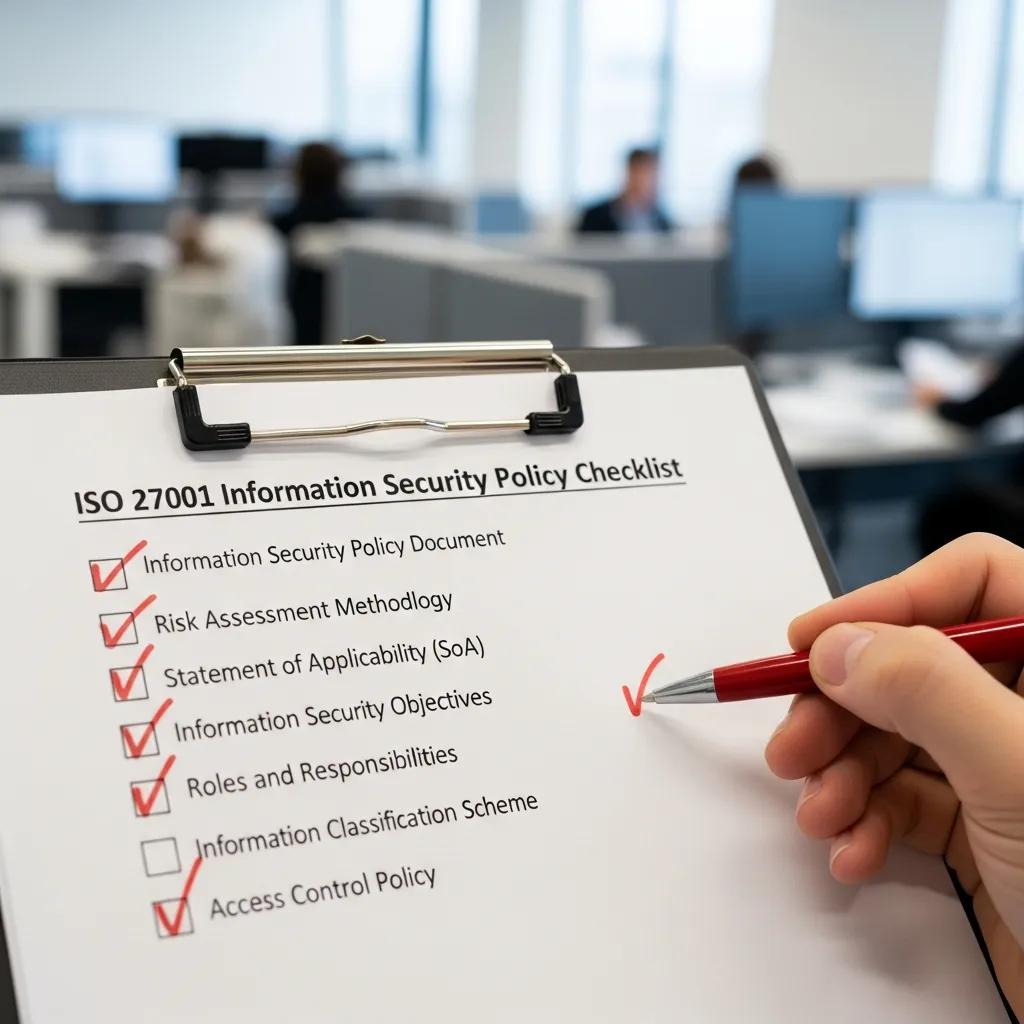
An effective ISO 27001 information security policy contains a clear scope statement, measurable objectives, defined roles and responsibilities, commitment from top management, a risk-based approach description, and references to supporting processes and Annex A control categories. The mechanism is alignment: these components ensure the ISMS operates under consistent rules and measurable targets. The immediate value is auditability and organisational clarity, reducing ambiguity during implementation and external assessment.
Below is a table that compares common policy components, what they cover, and practical examples to support scoping choices and content.
| Component | Description | Example |
|---|---|---|
| Scope statement | Defines organisational, physical and technical boundaries | „Applies to all IT systems and personnel delivering cloud services to EU clients“ |
| Objectives | Measurable security goals aligned to business needs | „Reduce critical incident rate by 30% within 12 months“ |
| Roles & responsibilities | Assignment of authority and accountability | „CISO accountable for ISMS performance; process owners manage controls“ |
| Risk approach | High-level description of risk assessment and treatment | „Risk-based approach per ISO 27005 with annual reviews“ |
| Approval & review | Version control and top-management sign-off clauses | „Approved by CEO; reviewed annually or after major incidents“ |
This table helps teams decide what to include and how to phrase policy elements so they remain concise and auditable. The next step is practical guidance for setting scope, objectives and responsibilities.
Wie werden Umfang, Ziele und Verantwortlichkeiten in der Leitlinie festgelegt?
Scoping should reflect business services, legal obligations and third-party relationships; choose between company-wide policies or service-specific statements depending on organisational complexity. Objectives must be SMART — specific, measurable, achievable, relevant, and time-bound — for auditors to evaluate performance and for teams to operationalise controls. Responsibilities are best allocated using a RACI pattern: assign who is Responsible for execution, Accountable for decisions, Consulted for expertise, and Informed for awareness. For example, scope could specify “customer data processed in Europe,” an objective could be “99.9% availability for critical customer portals,” and a RACI note would name the service owner accountable for uptime. Clear assignment of responsibilities reduces audit findings and accelerates corrective action.
Welche Bedeutung haben die Prinzipien Vertraulichkeit, Integrität und Verfügbarkeit?
The CIA triad — confidentiality, integrity and availability — is the foundational principle set that informs policy objectives and control selection. Confidentiality requires measures such as access control and encryption; integrity focuses on change control, hashing and versioning; availability concerns redundancy, backups and continuity planning. Policy statements should explicitly reference these principles and give examples of required outcomes, such as “protect customer PII from unauthorised disclosure” for confidentiality, or “ensure timely recovery of operational systems within defined RTOs” for availability. Mapping specific Annex A controls to each CIA principle aids traceability during audits and ensures the ISMS addresses each dimension of risk. Recognising these principles sets the stage for translating policy into concrete risk treatments and monitoring metrics.
Wie entwickelt und implementiert man eine Informationssicherheitsleitlinie nach ISO 27001?
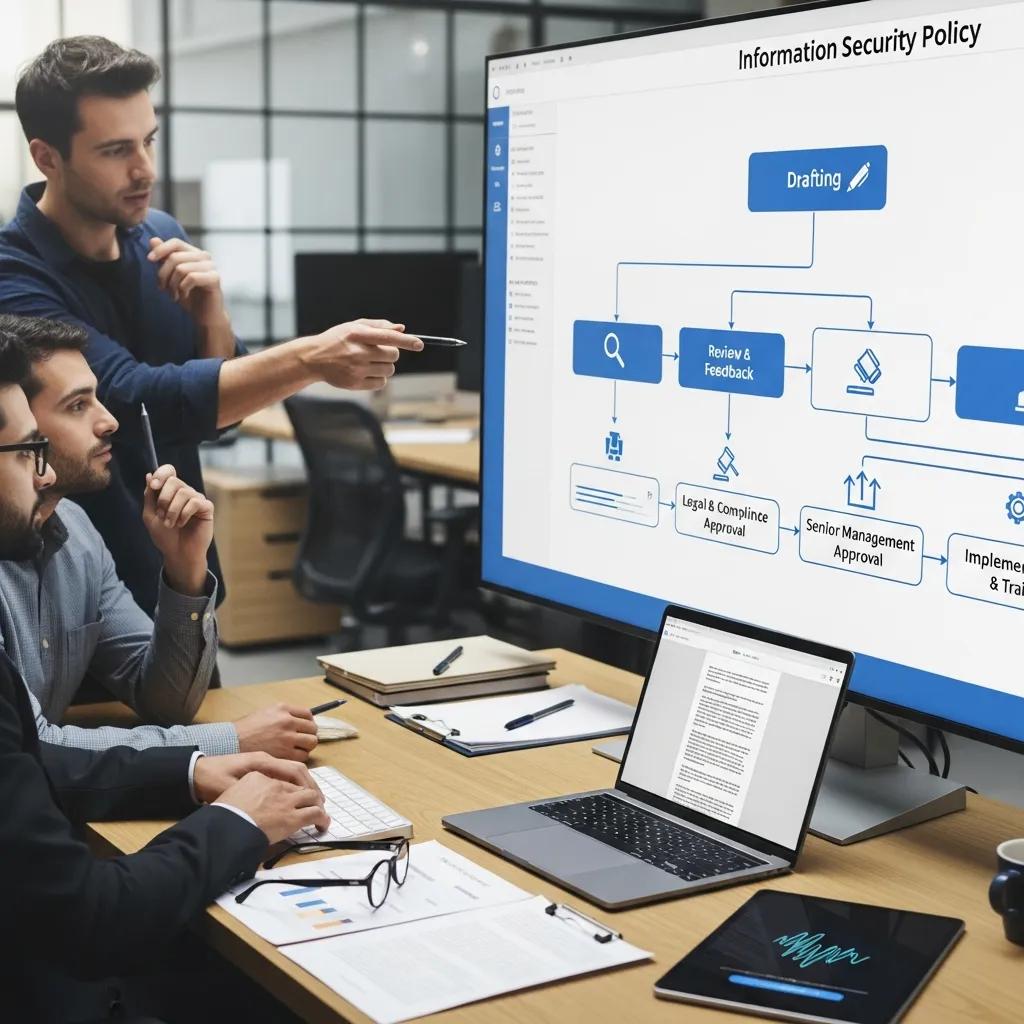
Developing and implementing a policy follows a structured process: stakeholder mapping and risk input, drafting, management approval, communication and training, and embedding the policy into procedures and the ISMS cycle. The mechanism is iterative: initial drafts incorporate risk assessment findings, approval secures resources and authority, and communication ensures consistent implementation across functions. The benefit is a defensible, auditable policy that directs control selection and supports certification.
Follow this numbered checklist to structure the development and approval process.
- Identify stakeholders and scope inputs: collect legal, contractual and business requirements.
- Draft policy aligning to risk criteria and ISO 27001 clauses, keeping statements high level.
- Circulate for technical and legal review and update based on feedback.
- Obtain top-management approval and publish with version control and effective date.
- Communicate policy to staff, run role-based training, and integrate into procedure documentation.
This sequence gives a practical timetable and clarifies responsibilities, which leads to document control and integration with existing quality processes.
Below is an implementation mapping table that links steps to roles and deliverables to support project planning.
| Phase | Responsible Role | Deliverable |
|---|---|---|
| Stakeholder analysis | Security lead | Requirements & scope report |
| Drafting | ISMS team | Draft policy document |
| Review & approval | Top management | Signed policy with version control |
| Communication | HR & comms | Training materials & acknowledgment records |
| Embedding | Process owners | Updated procedures and control evidence |
This EAV table provides a clear checklist for teams to assign tasks and confirm outputs, enabling a controlled approval path and measurable progress. The next subsection explains practical drafting and approval details.
Welche Schritte sind bei der Erstellung und Genehmigung der Leitlinie zu beachten?
Start with stakeholder mapping to capture legal, contractual and business needs that define scope and risk acceptance. Draft concise policy language that expresses management intent, reference compliance obligations, and include measurable objectives; avoid procedural detail in the policy itself. Use controlled review cycles with technical, legal and operational reviewers, then secure formal sign-off from top management with versioning metadata. After approval, publish the policy through formal channels and require role-based acknowledgment to create evidence for audits. Maintaining a lightweight but disciplined approval process avoids endless iterations and ensures the policy can be audited against objectives and controls.
Wie können Vorlagen und Best Practices die Entwicklung erleichtern?
Templates accelerate drafting by providing standard clauses for scope, objectives, roles and review cycles while leaving space for organisation-specific statements. Best practices include keeping policy language clear and actionable, mapping policy clauses to Annex A control families, and embedding continuous improvement clauses to reflect annual review cycles. Templates should be adapted, not copied verbatim, to preserve contextual relevance and avoid superficial compliance. Using templates and checklists reduces drafting time and supports consistent audit evidence, which makes the policy easier to maintain as the ISMS matures.
Wie unterstützt die Integration von ISO 9001 die Informationssicherheitsleitlinie und das ISMS?
Integrating ISO 9001 process controls with ISO 27001 governance reduces duplication and creates a single management system framework where quality and security objectives align. ISO 9001 provides robust process documentation, change control and supplier management mechanisms that facilitate consistent control implementation required by an ISMS. The practical value is operational stability: when quality processes are mature, security controls can be embedded into existing workflows, shortening implementation timelines and improving audit evidence consistency. The section below contrasts how each standard contributes and lists the key integration benefits.
From SERP report: expertise across diverse ISO standards (ISO 9001, ISO 14001, ISO 27001, ISO 42001); core offering relevant: ISO 27001 certification services (auditing and certifying ISMS); also provides ISO 9001 certification; UVPs: experienced auditors able to review documentation in multiple European languages; integration of AI into auditing; industry-specific tailored certification services; location referenced as Düsseldorf, Germany.
Because ISO 9001 enforces defined process ownership, document control and continual improvement, it often serves as a prerequisite foundation that clients require before seeking ISO 27001 certification. The integration reduces audit overhead, aligns management review cycles and improves supplier assurance, which directly supports the ISMS’s operational controls. Organisations can therefore leverage existing quality KPIs to measure security objectives and use shared management review meetings to prioritise corrective actions.
- Key integration benefits include reduced duplication, shared management review cadence, and improved supplier oversight.
- ISO 9001 process controls make control evidence collection for ISO 27001 more consistent and auditable.
- Joint management reviews align priorities across quality and security, improving corrective action efficacy.
These integration advantages make ISO 9001 a practical enabler for many organisations implementing ISO 27001, especially where clients mandate quality certification.
Warum ist ISO 9001 eine Grundlage für ISO 27001 und Informationssicherheit?
ISO 9001 establishes standardised process control, document management and continual improvement mechanisms that directly support ISO 27001 requirements such as documented procedures, change control, and management review. The mechanism is compatibility: both standards use plan-do-check-act cycles and risk-based thinking, so combining them reduces administrative overhead and streamlines audits. Practical examples include using a single document control system for both quality and security documentation, and reusing supplier evaluation records to satisfy both quality and security supplier requirements. Recognising these overlaps simplifies implementation and supports stronger audit evidence.
Welche Vorteile ergeben sich für Unternehmen durch die Kombination beider Standards?
Combining ISO 9001 and ISO 27001 yields operational efficiencies, reduced audit costs and a stronger market position for tenders that require both quality and security assurances. Organisations benefit from shared management review outputs, consolidated corrective action systems, and unified training and competence frameworks. The combined approach shortens the time to certification by leveraging existing quality management artifacts and improves client confidence through demonstrable, integrated governance. These advantages often translate into faster procurement approvals and higher trust from risk-sensitive customers.
Wie wird die Informationssicherheitsleitlinie gepflegt, überprüft und kontinuierlich verbessert?
Maintaining the policy requires a scheduled review cadence, event-driven updates after incidents or regulatory change, and systematic audits to validate effectiveness. The mechanism is feedback: incident metrics, audit findings and management reviews feed back into policy updates and control tuning. The benefit of a disciplined maintenance approach is demonstrable continual improvement and reduced nonconformities during external certification audits. Below we provide recommended review intervals and the roles involved in making updates and improvements.
The following list outlines a practical review schedule and triggers.
- Annual formal policy review to confirm objectives and scope against current risks.
- Quarterly operational check-ins to review control performance metrics and incidents.
- Immediate ad-hoc updates after major incidents, legal changes, or significant organisational change.
These intervals give auditors clear expectations and create predictable opportunities to refresh policy content and evidence.
Below is a table mapping review types to frequency and responsible parties to support audit readiness.
| Review Type | Frequency | Responsible Party |
|---|---|---|
| Formal policy review | Annually | Top management / CISO |
| Operational performance check | Quarterly | ISMS manager |
| Post-incident review | As needed | Incident response team |
| Supplier/security change review | On change | Procurement & Security lead |
This EAV table clarifies who does what and when, making audit evidence straightforward to collect and present. Next, we look at typical review triggers and how audits support policy improvement.
Wie oft sollte die Leitlinie überprüft und aktualisiert werden?
Standard practice is an annual formal review combined with quarterly operational check-ins and immediate updates after significant incidents or regulatory changes. Annual reviews reaffirm management commitment and adjust objectives; quarterly checks focus on metrics, trend analysis and minor adjustments; event-driven updates ensure the policy remains relevant after breaches or organisational change. Documenting each review with minutes, version control and actions creates audit evidence and supports continual improvement. This cadence ensures the policy stays aligned with evolving threats and business objectives.
Welche Rolle spielen interne und externe Audits bei der Leitlinienpflege?
Internal audits validate that policy requirements are implemented and effective, identify gaps and generate corrective actions tied to the management review. External (certification) audits assess compliance and traceability to ISO 27001 clauses and Annex A controls. Audit evidence commonly includes the policy document, risk assessment outputs, control implementation records and training acknowledgments. Using audit findings to prioritise improvements completes the PDCA loop and provides demonstrable improvement for subsequent assessments. Leveraging results from both internal and external audits ensures that the policy evolves in response to real operational insights.
Wie unterstützt Stratlane Certification Deutschland bei der Zertifizierung und Umsetzung der Informationssicherheitsleitlinie?
Stratlane Certification Deutschland provides certification and auditing services focused on ISO 27001 and complementary standards, helping organisations translate policy into certifiable ISMS outcomes. Their approach combines gap analysis, policy review, audit planning and certification audits designed to produce clear evidence mapping policy statements to controls and objectives. Stratlane’s methodology emphasises practical remediations and audit-ready evidence so that clients can demonstrate alignment during certification assessments. After describing these services and approach, the following raw content summary is provided to reflect Stratlane’s positioning.
From SERP report: expertise across diverse ISO standards (ISO 9001, ISO 14001, ISO 27001, ISO 42001); core offering relevant: ISO 27001 certification services (auditing and certifying ISMS); also provides ISO 9001 certification; UVPs: experienced auditors able to review documentation in multiple European languages; integration of AI into auditing; industry-specific tailored certification services; location referenced as Düsseldorf, Germany.
Following that summary, Stratlane supports clients with concrete service offerings such as gap analyses that map an existing policy to ISO 27001 clauses, targeted policy drafting assistance that refines scope and objectives for certification, and pre-assessment audits that identify evidence gaps. For clients who already hold ISO 9001, Stratlane helps integrate quality and security management processes to reduce duplication and speed up certification. Their multilingual review capability assists cross-border documentation reviews and their AI-assisted audit workflows aggregate evidence rapidly to highlight anomalies and priority gaps. Organisations can therefore expect a pragmatic pathway from policy drafting through to certification with clear milestones and audit evidence packages.
- Stratlane provides gap analysis, policy review and pre-assessment audits to prepare for certification.
- Multilingual reviewers and AI support enable efficient evidence gathering across European documentation.
- Industry-tailored services adapt policy examples and controls to sector-specific risks and regulatory needs.
Wie nutzt Stratlane KI und mehrsprachige Expertise im Auditprozess?
Stratlane combines AI-assisted tools for evidence aggregation and anomaly detection with experienced auditors capable of reviewing documentation in multiple European languages. The AI component accelerates the identification of control evidence, highlights inconsistencies across documents, and surfaces potential nonconformities for auditor review. Multilingual expertise ensures that cross-border policies and contracts are reviewed accurately, reducing the risk of misinterpretation during certification. This hybrid approach improves audit efficiency and helps organisations produce consolidated evidence packages suitable for both internal and external audits.
Welche branchenspezifischen Lösungen und Fallstudien bietet Stratlane?
Stratlane tailors policy and control recommendations to industry risk profiles, offering anonymised case studies that illustrate outcomes such as reduced audit findings and faster certification timelines. For example, in a manufacturing scenario, Stratlane helped align supplier security clauses with policy requirements to close evidence gaps; in an IT services case, they streamlined incident response evidence for certification. These tailored approaches show how industry context changes scoping and control priorities, and demonstrate measurable outcomes: fewer nonconformities and clearer management review records. Such case examples help prospective clients understand realistic project scope and expected benefits.
From SERP report: expertise across diverse ISO standards (ISO 9001, ISO 14001, ISO 27001, ISO 42001); core offering relevant: ISO 27001 certification services (auditing and certifying ISMS); also provides ISO 9001 certification; UVPs: experienced auditors able to review documentation in multiple European languages; integration of AI into auditing; industry-specific tailored certification services; location referenced as Düsseldorf, Germany.
This summary restates the services and unique selling points offered by Stratlane Certification Deutschland and highlights how these capabilities support both policy creation and certification readiness. Organisations seeking practical assistance for ISO 27001 and integrated ISO 9001 implementations can contact Stratlane Certification Deutschland to discuss gap analyses, policy drafting support and certification pathways.