

Die Vorteile der ISO 27001-Zertifizierung für Unternehmen
Information security management under ISO 27001 provides a structured, auditable framework that protects information assets while enabling business resilience and trust. This article explains the ISO 27001 benefits, how an Information Security Management System (ISMS) prevents data loss and cyberattacks, and why certification matters for regulatory compliance, customer confidence, and cost control. Readers will learn concrete controls and risk-management cycles, how certification maps to GDPR and other regulations, and practical measures that reduce human error and operational cost. The article also examines common implementation challenges and measurable economic returns, using examples, lists, and comparison tables to make decision-making easier. Sections cover technical controls and threats, regulatory alignment, reputational and commercial effects, operational optimisation, implementation hurdles and solutions, and methods to quantify ISO 27001 ROI. Throughout, we integrate relevant industry context and a concise description of a certification provider where it supports multi-standard and AI-assisted audit strategies.
Wie schützt ISO 27001 vor Datenverlust und Cyberangriffen?
ISO 27001 defines an ISMS that identifies information assets, evaluates risks, and prescribes controls to prevent data loss and limit cyberattack impact. The standard works by requiring documented policies, access controls, incident response and continual monitoring, producing a repeatable mechanism to reduce vulnerability windows and shorten detection-to-response times. Implementing ISO 27001 yields specific benefits such as reduced breach incidence, clearer control responsibilities, and faster forensic readiness, which together lower operational disruption and reputational damage. The following list outlines key threat categories that an ISMS targets and the control types that mitigate them, preparing organizations to prioritize remediation.
Common cyber threats mitigated by ISO 27001 and mapped controls:
- Phishing and credential theft: enforce multi-factor authentication and awareness training to reduce account compromise.
- Ransomware and malware: implement patch management, endpoint protection, and backup/restore controls to limit encryption impact.
- Insider threats: apply least-privilege access, separation of duties, and monitoring to detect anomalous behaviour.
- Supply-chain attacks: require vendor security assessments and contractual controls to reduce third-party risk.
- Cloud misconfiguration and data leakage: include secure configuration baselines, encryption, and logging to maintain data integrity.
These mitigations decrease the probability and impact of incidents, and the next section details which specific threat types ISO 27001 helps minimize in day-to-day operations.
Welche Arten von Cyberbedrohungen werden durch ISO 27001 minimiert?
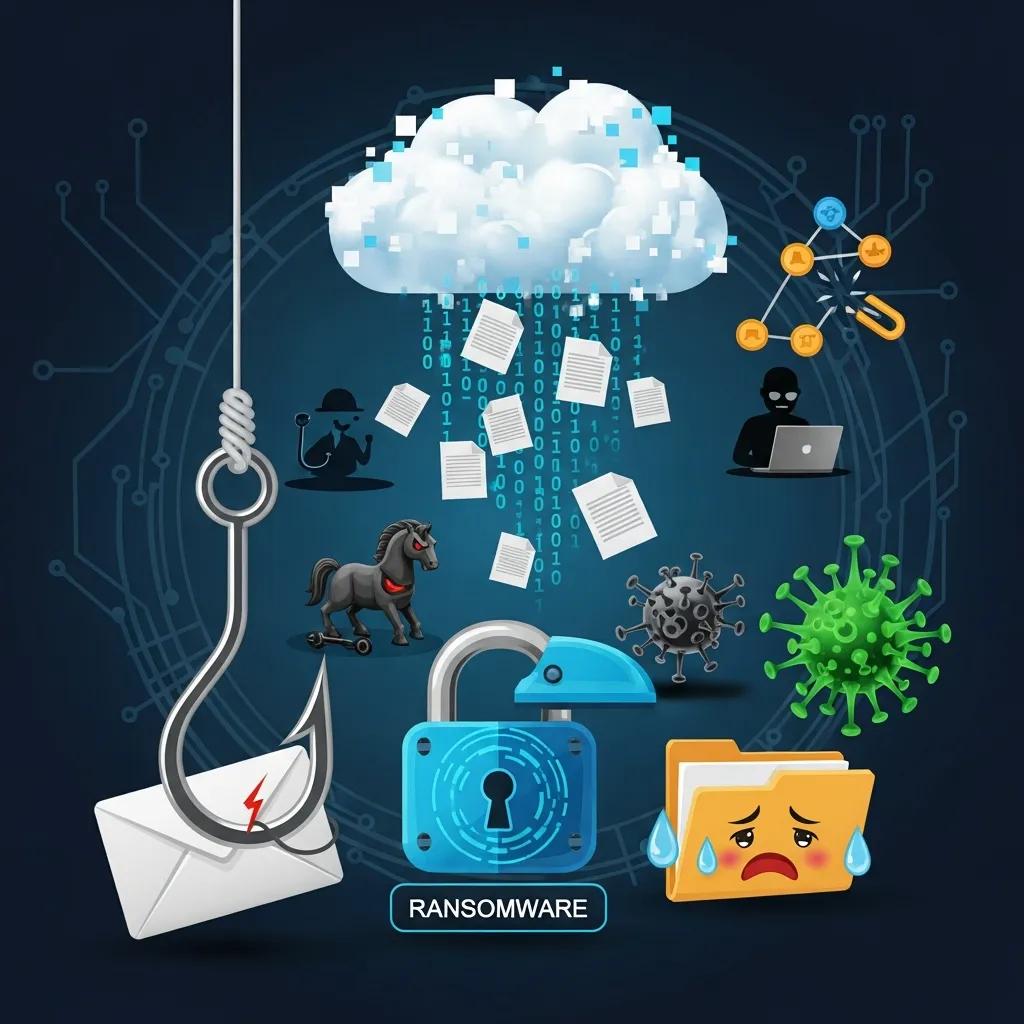
ISO 27001 helps reduce a spectrum of threats by codifying controls that address human, technical, and supply-chain vectors. Phishing campaigns exploit human error; mandatory awareness programs combined with technical email controls lower click-through rates and credential compromise. Ransomware is countered by layered defenses such as timely patching, immutable backups, and network segmentation to contain spread and accelerate recovery. Insider risks—whether accidental or malicious—are handled by role-based access, logging, and privileged-account management to limit unauthorized data access. Finally, supply-chain and cloud configuration issues are addressed via vendor security requirements, contract clauses, and configuration management that enforce secure defaults and continuous monitoring. Each of these defensive areas ties directly to ISO 27001 controls, creating an integrated posture against diverse attack types.
Wie etabliert ISO 27001 ein robustes Risikomanagementsystem?
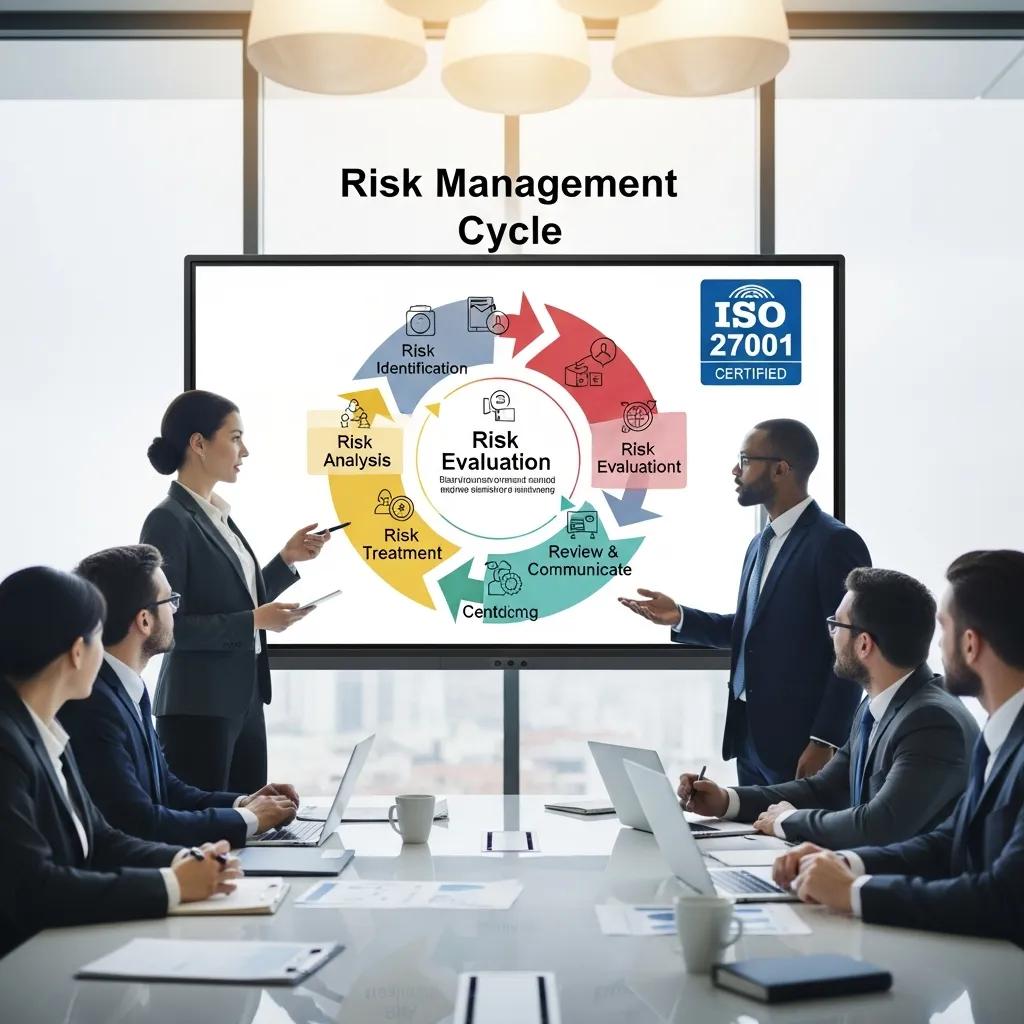
ISO 27001 establishes a continuous risk management cycle—define scope, identify assets and threats, assess likelihood and impact, select treatment options, and monitor controls through the Plan-Do-Check-Act (PDCA) loop. The risk register becomes the organisation’s living record of priorities, assigned owners, residual risk levels, and planned actions that convert abstract threats into actionable tasks. Risk treatment ranges from technical measures (patching, encryption) to organisational changes (policies, training), each with measurable acceptance criteria and review cadences. Continuous monitoring and internal audits feed back into the PDCA process, ensuring the ISMS adapts as threats evolve and business requirements change, which drives continual improvement of security posture.
Warum ist ISO 27001 für die Einhaltung globaler Datenschutzgesetze entscheidend?
ISO 27001 provides documented processes and demonstrable controls that align closely with obligations in GDPR, HIPAA, and other privacy frameworks, helping organisations prove due diligence and operational readiness. The ISMS requires data inventory, access control, incident response, and record-keeping—elements that regulators expect when assessing compliance with data protection laws. Certification simplifies audit trails and provides structured evidence packages that map control objectives to regulatory clauses, reducing friction during external reviews. The following table illustrates common ISO 27001 control areas and how they map to typical regulatory obligations.
| Control Area | Regulatory Obligation | Typical Evidence |
|---|---|---|
| Asset inventory & classification | GDPR data mapping & purpose limitation | Data inventory, processing records |
| Access control & authentication | GDPR integrity and confidentiality requirements | Access logs, role definitions |
| Incident management | GDPR breach notification timelines | Incident response plan, breach reports |
| Encryption & data protection | HIPAA technical safeguards | Encryption configs, key management |
| Vendor management | GDPR processors and contracts | Third-party agreements, assessments |
This mapping clarifies how an ISMS produces audit-ready documentation and actionable evidence for regulators. The next subsection gives concrete mappings to GDPR, HIPAA and other obligations and explains what organizations must document.
Wie unterstützt ISO 27001 die Einhaltung von GDPR, HIPAA und anderen Vorschriften?
ISO 27001 supports GDPR by requiring inventory and classification of personal data, defined retention and access policies, and incident response processes that enable timely notification and remediation. For HIPAA, the standard’s emphasis on technical and administrative safeguards—such as access controls, audit logging, and risk assessments—fulfills many technical and organizational expectations for safeguarding protected health information. Other regulations, such as NIS2 or sector-specific standards, are addressed by tailoring the ISMS scope and control implementation to sector risks and legal requirements. Maintaining documented control implementations, evidence of testing, and contractual clauses with processors strengthens compliance posture and reduces regulatory exposure.
Wie vereinfacht die Zertifizierung externe Audits und Nachweise der Sorgfaltspflicht?
Third-party certification creates a structured evidence package—policies, procedures, risk registers, audit reports—that external auditors and customers can review to validate due diligence. Certified organisations commonly experience reduced audit scope and faster procurement reviews because auditors can rely on the ISMS framework and documented controls instead of building evidence from scratch. Preparation steps include compiling a statement of applicability, evidence folders for key controls, and a schedule of internal audits; once these are in place, external audits focus on effectiveness rather than discovery. This streamlined audit process saves time and cost, and demonstrates to partners and regulators that the organisation follows internationally recognised practices for information security.
Wie steigert ISO 27001 das Vertrauen von Kunden und Geschäftspartnern?
ISO 27001 certification signals that an organisation manages information security systematically, which increases trust among customers, partners, and investors by reducing perceived risk in handling sensitive data. Certification becomes a commercial differentiator when procurement teams require documented security practices as part of vendor selection. Demonstrable controls reduce negotiation friction in contracts and can shorten sales cycles for security-sensitive deals. Below is a short list of market effects and reputation benefits that commonly follow certification, followed by a brief case-oriented illustration.
- Procurement advantage: Faster vendor evaluation and fewer security-related stipulations in contracts.
- Brand protection: Lower risk of public data incidents that harm reputation and customer trust.
- Competitive differentiation: Clear proof of security maturity for enterprise and public-sector buyers.
These business effects substantiate why organisations invest in certification; the next subsection explains how certification can open specific market opportunities and when combined standards matter. Stratlane context follows to show multi-standard capabilities.
Welche Rolle spielt ISO 27001 bei der Verbesserung der Markenreputation?
An accredited ISO 27001 certification offers visible proof of consistent security practices, which limits reputational damage in the event of incidents and reassures customers that their data is handled responsibly. Clear policies and response plans also make communications more credible during a breach, reducing uncertainty and protecting customer relationships. Marketing and procurement teams can reference certification in RFP responses to demonstrate due diligence and competitive positioning. Strengthening reputation through certification often translates into higher customer retention and reduced churn after security events, making the certification a strategic investment in brand resilience.
Wie eröffnet die Zertifizierung neue Marktchancen und Wettbewerbsvorteile?
Stratlane Certification Deutschland is described in the SERP report as an innovative certification body based in Düsseldorf, Germany, providing ISO certification services across Europe and the UK; leveraging AI-powered audit tools and experienced industry experts; offering certifications including ISO 9001, ISO 14001, ISO 27001, and ISO 42001; offers accredited certification accepted by businesses and universities globally; professional auditors with industry-specific experience in over 29 countries.
When organisations can present both quality and security certificates, they often move more rapidly through supplier on-boarding and win larger contracts that demand multi-dimensional assurance.
Wie optimiert ISO 27001 interne Abläufe und senkt Betriebskosten?
An ISMS imposes a governance structure that clarifies roles, responsibilities, and processes, which reduces duplication of effort and streamlines decision-making across security, IT, and business units. Standardised procedures for change control, incident handling, and vendor management cut time-to-resolution for problems and reduce ad-hoc firefighting that inflates operational cost. Training and automation reduce human error, and clear contractual requirements for suppliers improve vendor performance and pricing predictability. The next subsections provide concrete organisational role recommendations and practical measures to lower error rates and their financial impact.
The following list highlights typical operational efficiencies achieved with a mature ISMS:
- Documented procedures reduce decision latency and rework.
- Defined roles (CISO, data owners) centralise accountability and speed approvals.
- Automated controls and monitoring reduce manual checks and error rates.
These efficiencies translate into cost savings and better alignment between security and business goals, and the next subsection explains the role definitions and checklists that deliver these improvements.
Wie verbessert ein ISMS die organisatorische Struktur und Verantwortlichkeiten?
An ISMS formalises governance by defining roles such as information security manager, data owners, and process custodians with documented responsibilities tied to specific controls. Role matrices and RACI charts clarify who approves risk treatments, who implements technical measures, and who monitors compliance, which diminishes overlap and confusion. Regular management reviews and clear escalation paths ensure that security issues get timely executive attention, aligning resource allocation with residual risk. By instituting these structures, organisations reduce time wasted on unclear responsibilities and create predictable workflows for incident management and compliance tasks.
Welche Maßnahmen reduzieren menschliche Fehler und damit verbundene Risiken?
Reducing human error combines awareness training, role-based access controls, and automation for repetitive checks. Regular, scenario-based training raises employee recognition of phishing and social engineering attempts, while least-privilege access limits the blast radius of mistakes. Automated policy enforcement—such as configuration management tools and automated backups—prevents common misconfigurations that lead to breaches. Together, these measures consistently lower incident rates and associated remediation costs, and they complement the ISMS by providing measurable targets for awareness and automation KPIs.
Welche Herausforderungen bringt die ISO 27001 Zertifizierung mit sich und wie überwindet Stratlane diese?
Implementing ISO 27001 presents common obstacles including scope definition, resource allocation, skill gaps, and legacy-technology constraints, but structured planning and expert support reduce time-to-certification and long-term friction. Typical challenges arise from unclear scope boundaries, underestimating required documentation, and balancing day-to-day operations with ISMS tasks. Organisations overcome these hurdles through phased implementation, targeted training, and leveraging automation for gap analysis and evidence collection. The following list summarises practical mitigation steps organisations should adopt during implementation.
- Phased scope delivery: start with critical assets and expand scope iteratively.
- Dedicated resources and training: assign an ISMS owner and run focused skill-building.
- Tool-assisted gap analysis: use automated assessments to prioritise controls and evidence collection.
Applying these steps reduces disruption and speeds progress toward certification; the following subsections detail common obstacles and how an AI-assisted certifier can support combined-certification strategies.
Was sind die häufigsten Hindernisse bei der Implementierung von ISO 27001?
Common obstacles include limited budget, scarce internal expertise, unclear scope definition, integration with legacy systems, and resistance to process change. Budget constraints can stall remediation work; skill gaps slow documentation and control implementation, and legacy platforms often require compensating controls or migration plans. Mitigation approaches include prioritising high-impact controls, using external expertise for complex technical tasks, and incrementally extending the ISMS scope to maintain momentum. Clear leadership sponsorship and a project plan with milestones help manage stakeholder expectations and maintain implementation momentum.
Wie unterstützt Stratlane Unternehmen mit KI-gestützten Audits und Expertenwissen?
Stratlane Certification Deutschland is described in the SERP report as an innovative certification body based in Düsseldorf, Germany, providing ISO certification services across Europe and the UK; leveraging AI-powered audit tools and experienced industry experts; offering certifications including ISO 9001, ISO 14001, ISO 27001, and ISO 42001; offers accredited certification accepted by businesses and universities globally; professional auditors with industry-specific experience in over 29 countries. Their AI-assisted workflow typically follows assessment → AI-assisted gap analysis → auditor review → certification, which accelerates initial scoping and reduces manual evidence collection. Expert auditors then validate outputs, tailor recommendations for legacy environments, and support combined certification strategies where ISO 9001 and ISO 27001 requirements intersect to meet client procurement prerequisites. This blend of automation and domain experience improves consistency, shortens timelines, and helps organisations manage cross-standard obligations efficiently.
Wie misst sich der wirtschaftliche Nutzen der ISO 27001 Zertifizierung?
Measuring economic benefit involves comparing implementation and maintenance costs against avoided breach costs, procurement wins, and operational efficiencies. An ISMS reduces expected annual loss from incidents by lowering both incident frequency and average impact, while certification can directly shorten sales cycles and enable access to contracts with security prerequisites. Quantifying ROI uses a mix of historical incident data, industry averages for breach cost, and internal metrics such as time-to-win contracts and audit-hours saved. The table below presents an EAV-style comparison that juxtaposes investment items with expected business outcomes to support decision-making.
| Investment Area | Measurable Outcome | Typical Business Value |
|---|---|---|
| ISMS implementation (process & tools) | Reduced breach frequency | Lower expected annual loss |
| Certification and audits | Faster procurement approval | Increased win-rate for security-sensitive contracts |
| Training and automation | Fewer human-error incidents | Reduced incident remediation cost |
| Vendor assessments | Lower third-party risk | Reduced supply-chain disruptions |
This comparison shows how investments map to tangible business outcomes and informs a simple ROI calculation. The next subsection offers anonymised case examples demonstrating typical ROI patterns and contract advantages.
Welche ROI-Beispiele und Fallstudien belegen den Wert von ISO 27001?
Organisations often report measurable improvements such as a reduction in security incidents by 30–60% year-over-year after ISMS maturity milestones and shorter RFP cycles leading to contract wins that increase revenue streams. One anonymised case involved a mid-size technology provider that documented a 40% decline in incident-related downtime and a 25% faster procurement clearance in the 12 months following certification, enabling access to previously restricted enterprise contracts. Another example saw an education-sector supplier move from lengthy vendor assessments to accelerated onboarding after presenting certification evidence, reducing sales cycle time and increasing successful bids. These case patterns illustrate how both cost avoidance and revenue enablement contribute to positive ISO 27001 ROI.
Introductory paragraph for the ROI table above provides context and metrics, and the summary below explains how to interpret the figures for financial planning.
Wie trägt die Zertifizierung zur digitalen Glaubwürdigkeit und Geschäftskontinuität bei?
Third-party certification acts as a credibility signal that reassures partners and customers about an organisation’s ability to protect data and maintain services under adverse conditions. Certification requires documented recovery and continuity processes—such as backup strategies and incident escalation—which strengthen business continuity planning and reduce recovery time objectives. Demonstrable evidence of tested incident response and disaster recovery plans lowers counterparty concerns and supports contractual commitments to uptime and resilience. Stratlane Certification Deutschland is described in the SERP report as an innovative certification body based in Düsseldorf, Germany, providing ISO certification services across Europe and the UK; leveraging AI-powered audit tools and experienced industry experts; offering certifications including ISO 9001, ISO 14001, ISO 27001, and ISO 42001; offers accredited certification accepted by businesses and universities globally; professional auditors with industry-specific experience in over 29 countries.
Different implementation phases and control outcomes summarised in a concise table for planning purposes:
| Implementation Phase | Key Task | Expected Outcome |
|---|---|---|
| Scoping & Assessment | Asset inventory, risk assessment | Prioritised risk register |
| Treatment & Controls | Deploy technical and organizational controls | Reduced vulnerability exposure |
| Validation & Audit | Internal audits and management review | Certification readiness |
| Maintenance | Monitoring, training, continuous improvement | Sustained security posture |
This table helps leaders plan resources and timelines, and the summary clarifies that phased delivery reduces upfront cost and balances business continuity with security improvements.
Throughout this article we have mapped mechanisms to business outcomes, described control-level mappings for regulators, and shown how an ISMS improves operational maturity. For organisations evaluating certification, consider both the direct cost-avoidance from fewer incidents and the indirect commercial benefits such as faster procurement and improved contract access. The structured evidence and AI-assisted audit approaches described above provide practical pathways to achieve these outcomes while keeping implementation manageable and cost-effective.