

ISO 9001 Documentation Requirements: Comprehensive Guide to Quality Management System Documentation for Compliance and Efficiency
Effective ISO 9001 documentation centers on „documented information“—the records and documents an organization uses to demonstrate conformity to ISO 9001:2015 and to operate its Quality Management System (QMS) efficiently. This guide explains what documented information auditors expect, how to structure your QMS documents for clarity, and pragmatic controls that reduce risk and speed certification. Readers will learn which core documents and records are mandatory or practical to retain, how to design a maintainable documentation hierarchy, and how digital tools and AI can streamline evidence collection and version control. The article maps ISO clauses to everyday documents, gives retention and indexing recommendations, and provides industry-specific templates to accelerate implementation across IT, manufacturing, and service organizations. By following the organization and best practices below, teams can reduce audit friction, demonstrate continual improvement, and align documentation to client procurement expectations.
What Are the Mandatory Documents and Records for ISO 9001 Certification?
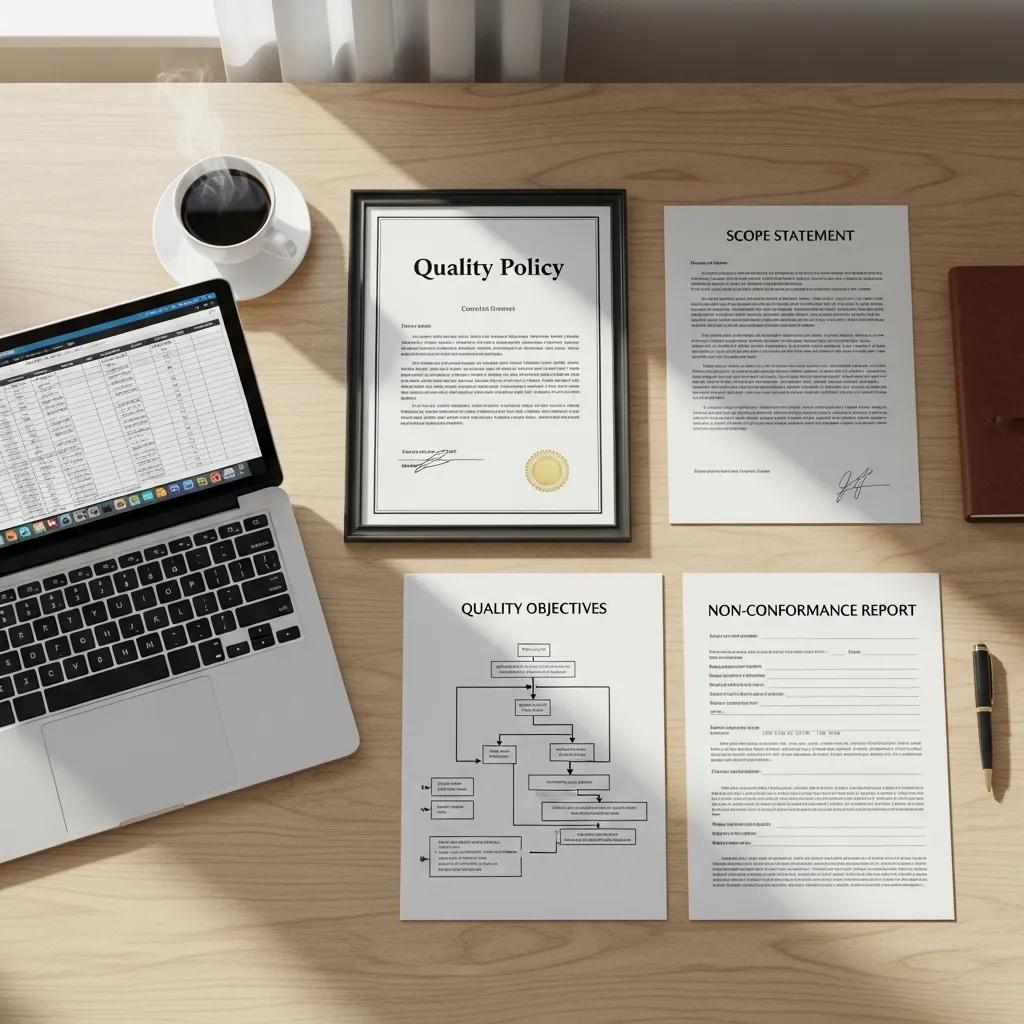
Documented information under ISO 9001:2015 includes both documents and records that demonstrate conformity, provide evidence of QMS operation, and support decision-making. Mandatory content is limited by the standard but organizations typically maintain a set of core documents to show conformity, define responsibilities, and evidence performance; these documents reduce ambiguity and speed audits. Clear documented information helps link the quality policy and objectives to operational controls and provides audit trails for internal audit findings and corrective actions. The next subsections list the essential documents and then the records you should retain to support certification and continual improvement.
Which Core Documents Must Your Quality Management System Include?
Core documents form the backbone of a QMS and clarify scope, intent, and governance. Typical core documents include a defined scope of the QMS, a quality policy, documented quality objectives, and process descriptions or a quality manual if the organization chooses to maintain one; these items explain what the QMS covers and who is responsible. A clear process map or high-level procedure that identifies interfaces and sequence of processes helps auditors see process ownership and control points, and short one-paragraph templates for policy and objectives speed authoring. Organizations often include supplier evaluation criteria and a documented change-control approach as supporting documents that tie into the core set. These core components provide auditors with immediate context about organizational boundaries and governance, which leads directly into the records you must retain as evidence.
What Records Are Essential to Retain for ISO 9001 Compliance?
Records provide objective evidence that processes operate as intended and that corrective actions close identified gaps; typical records include internal audit reports, management review minutes, competence and training records, nonconformity and corrective action records, and supplier evaluation outputs. Retention practices vary by risk and regulatory needs, but indexing records with metadata (date, owner, related clause) ensures quick retrieval during audits and supports trend analysis for continual improvement. Practical templates for audit checklists, nonconformity forms, and management review agendas reduce variability and improve audit-readiness. Keeping these records traceable enables timely root-cause analysis and links operational evidence to management decisions, which is key for verifying effectiveness in subsequent audits.
Different documented information items map directly to ISO clauses and everyday practice; the table below summarizes key documents and records with clause references and retention guidance.
Intro: The table below maps mandatory and commonly retained documented information to ISO 9001:2015 clauses and practical examples to guide implementation and audit preparation.
| Document / Record | Purpose / Clause reference | Example content / Retention guidance |
|---|---|---|
| Quality Policy | Clause 5.2 — sets overall intentions and direction | One-paragraph policy signed by top management; retain as current document |
| Scope of QMS | Clause 4.3 — defines boundaries and applicability | Scope statement with exclusions and justification; keep as published document |
| Quality Objectives | Clause 6.2 — measurable objectives aligned to policy | Objective table with targets, owners, review dates; retain 3 years |
| Internal Audit Records | Clause 9.2 — evidence of audit planning and results | Audit reports, findings, nonconformity actions; retain per retention matrix |
| Management Review Minutes | Clause 9.3 — evidence of top management review and decisions | Minutes with inputs/outputs and action items; retain 5 years |
How Should You Structure Your Quality Management System Documentation for Clarity?
A clear documentation structure groups information hierarchically so users find requirements and evidence quickly, reducing misinterpretation and nonconformities. Typical hierarchies progress from high-level governance (policy and scope) to process-level procedures, then to task-level work instructions and records that capture evidence; this layered approach supports both management oversight and operational execution. Naming conventions, version numbering, and cross-references ensure traceability and make it straightforward to demonstrate control during audits. The following subsections explain the optional quality manual and how procedures and work instructions differ in purpose and audience.
What Is the Role and Content of a Quality Manual in ISO 9001?
Under ISO 9001:2015 the quality manual is optional, but it remains a useful single-source overview that consolidates the scope, quality policy, process map, and references to documented procedures and records. A concise manual commonly includes a statement of scope, the quality policy, a high-level process map, roles and responsibilities, and pointers to main procedures and forms; this reduces auditor search time and helps new employees understand the QMS quickly. When maintained, the manual should link to controlled electronic documents rather than replicate details, and a stable versioning approach prevents conflicting information. Organizations that choose a manual should use it as a navigational tool that guides users to authoritative digital records and procedural steps, setting up a consistent documentation framework for the next level of procedures.
How Do Procedures and Work Instructions Fit into Your QMS Documentation?
Procedures describe what is done, who is responsible, and the interactions between functions, while work instructions describe how specific tasks are executed, often by role or job title; using both formats at the right granularity avoids either overburdening staff or leaving auditors without evidence. For example, a procedure for nonconformity management explains the sequence and responsibilities for identifying and handling nonconforming output, whereas a work instruction shows the exact steps to log a nonconformity in the EDMS. Linking instructions to procedures via cross-references and embedding version control metadata in each document ensures reviewers can verify current practices and follow the audit trail from policy to record.
What Are Best Practices for Effective ISO 9001 Document Control?

Document control ensures documents remain current, accessible to authorized users, and traceable across their lifecycle, preventing outdated instructions from being used and maintaining audit evidence integrity. Effective control implements a lifecycle: creation, structured review, formal approval, controlled publication, and eventual retirement, with clear responsibilities and timelines for each step. Versioning policies, access controls, and audit trails are critical metrics to monitor; these controls reduce nonconformities and improve operational consistency. The following H3 subsections cover efficient creation and the key steps for distribution and retention, and the table provides recommended control activities and responsibilities.
How to Manage Document Creation, Review, and Approval Efficiently?
Efficient document creation follows a template-driven model where authors use clause-mapped templates, reviewers check for alignment with process risks and controls, and approvers verify compliance before publication; establishing SLAs for each step prevents delays. Roles typically include an author, a subject-matter reviewer, and an approver from process ownership or quality; automated workflows in an EDMS send reminders and record approvals for traceability. Using checklists reduces rework and ensures documents reference required clauses and related records, while periodic review cycles (e.g., annually) keep content current. Standardizing templates and review criteria speeds onboarding of new documents and ensures consistency across processes, which leads into distribution and access management.
What Are the Key Steps for Document Distribution, Access, and Retention?
Controlled distribution requires defining who may view, edit, or approve a document and enforcing these rights through user groups and permissions; uncontrolled copies should be minimized by designating a single authoritative source. Access controls should be role-based and auditable, with read-only publication views for general staff and edit rights limited to document owners; retention schedules should be applied automatically where possible to archive or purge obsolete records according to risk and regulatory needs. Archival practices include indexing archived records with metadata for fast retrieval during audits and linking retained records to the processes and objectives they support. These controls complete the document lifecycle and enable reliable evidence for audits and continuous improvement.
Intro: The table below compares common document-control activities, recommended responsible parties, and practical tools or metrics to measure success.
| Control Activity | Who / When | Tool / Metric |
|---|---|---|
| Document creation & template use | Document owner / at initiation | Template library; # templates used |
| Review & approval workflow | Reviewer & approver / SLA (e.g., 7 days) | EDMS workflow times; approval audit trail |
| Publication & access control | QMS admin / on approval | Role-based permissions; access logs |
| Retention & archival | Records manager / per retention matrix | Retention compliance rate; retrieval time metric |
How Can AI and Digital Tools Enhance ISO 9001 Documentation Efficiency?
Digital QMS platforms and Electronic Document Management Systems (EDMS) improve accessibility, searchability, and version control, reducing time spent finding evidence and preparing for audits. AI-enabled features such as automated tagging, evidence aggregation, and pre-audit checks can highlight missing records, detect inconsistencies, and suggest corrective actions, increasing audit coverage and reducing manual effort. Governance is crucial when using AI: outputs should be validated, and traceability must be maintained so auditors can follow decisions back to source records. The next subsections outline concrete benefits of digital QMSs and a brief example of how an accredited certification body can use AI-powered auditing to speed certification-related documentation tasks.
What Are the Benefits of Digital QMS and Electronic Document Management Systems?
Digital QMS platforms centralize documents, automate version control, and provide full-text search, which reduces retrieval time and supports remote audits by presenting evidence quickly and securely. Integration with HR and training systems automates competence records and with internal audit modules to link findings to corrective actions, producing richer management-review inputs and measurable metrics. Expected operational improvements include shorter audit preparation cycles, fewer lost records, and faster corrective-action closure rates; metrics to monitor include document retrieval time, percent of documents with current approvals, and audit finding closure rate. These advantages make digital QMS an effective lever to improve both compliance and operational efficiency.
How Does Stratlane’s AI-Powered Auditing Improve Documentation Processes?
Stratlane Certification Deutschland combines AI-assisted auditing with experienced industry experts to increase the efficiency and coverage of audits while maintaining the rigour expected of an accredited certification body. AI-powered pre-checks can aggregate documented evidence, flag missing records, and identify inconsistencies ahead of the on-site review, allowing auditors to focus on judgment areas that need human expertise. This hybrid approach reduces documentation preparation time for clients and improves the speed of evidence collection without compromising audit quality, while the accreditation and expert oversight ensure decisions remain compliant and customer-centric. Using an accredited provider with AI tools can therefore shorten the certification timeline and reduce the administrative burden of maintaining documented information.
Why Is Robust ISO 9001 Documentation Essential for Meeting Key Client Requirements?
Clients and procurement teams often require suppliers to demonstrate consistent quality control and traceable processes; robust documentation and ISO 9001 certification are straightforward ways to meet these expectations and reduce vendor qualification time. Well-structured documented information allows quick responses to supplier questionnaires, faster onboarding, and fewer in-line client audits because evidence is readily available. Documentation also reduces commercial risk by showing process control and corrective-action effectiveness, which many clients interpret as lower operational risk in their supply chain. The following subsections explain how documentation builds trust and how it underpins certification and continual improvement, and include a brief client-focused integration using permitted business information.
How Does Quality Documentation Build Client Trust and Competitive Advantage?
Clear and accessible documentation demonstrates predictable delivery, process control, and a culture of continual improvement—attributes procurement teams prize when qualifying suppliers or evaluating bids. Suppliers that present mapped processes, up-to-date competence records, and recent internal audit results often receive faster approvals and less frequent on-site verification, shortening sales cycles and lowering entry barriers to tender processes. Documentation that aligns to clients’ contractual requirements (e.g., traceable inspection records, service-level procedures) provides tangible proof points that reduce perceived risk. Demonstrating this capability routinely transforms documentation into a commercial differentiator when competing for contracts.
What Role Does Documentation Play in Certification and Continuous Improvement?
During certification audits, documented information provides the evidence auditors need to verify conformity and effectiveness across planning, operation, performance evaluation, and improvement; management review records and trend analyses show that the organization uses data to steer improvement. Records of nonconformities, corrective actions, and monitoring outputs feed into PDCA cycles and prove that the system is not only implemented but actively improving. Over time, well-maintained documentation enables root-cause analytics and targeted training, reducing repeat findings and demonstrating to clients and auditors that the organization is maturing. Effective documentation thus directly supports both obtaining certification and sustaining continual improvement.
Integration: For organisations seeking certification and support across Europe and the UK, partnering with an accredited body that combines AI-driven auditing with industry expertise can accelerate achieving and demonstrating compliance. Stratlane Certification Deutschland positions itself as an accredited certification body that leverages AI-powered auditing alongside experienced industry experts to audit organisations, specialising in ISO 9001:2015 among other standards. This approach helps reduce documentation preparation time and increases audit coverage while maintaining a customer-centric focus to meet client procurement expectations.
How Can Industry-Specific ISO 9001 Documentation Examples Support Your QMS Implementation?
Industry context determines documentation emphasis: IT organizations prioritize configuration and release records, manufacturing emphasizes process controls and FMEAs, and service companies highlight service-level procedures and competence records. Tailoring templates and controls to sector-specific risks shortens implementation time and avoids unnecessary documentation while ensuring auditors see relevant controls. The following subsections provide prioritized document lists per industry and point to practical sources and vetting criteria for templates and toolkits.
What Are Typical Documentation Requirements in IT, Manufacturing, and Service Sectors?
Different sectors require different evidence to demonstrate control: IT focuses on change control, backup and release records, and supplier software validation; manufacturing prioritizes process control records, preventive maintenance logs, and inspection/traceability documents; service providers emphasize service agreements, competence matrices, and customer feedback records. Prioritizing the top 3–5 documents per sector ensures early audit readiness and focuses resources on high-impact evidence that auditors request most often. Understanding these priorities lets teams adapt template toolkits and EDMS structures to capture sector-relevant evidence efficiently, which leads to selecting vetted templates.
Intro: The table below summarizes typical industry document priorities and suggested template types to accelerate implementation.
| Industry | Typical required documents | Example templates / Special considerations |
|---|---|---|
| IT | Change control, release notes, access logs | Versioned release checklist; secure storage for logs |
| Manufacturing | Process control plans, inspection records, traceability | FMEA template; batch/lot traceability forms |
| Services | Service procedures, competence records, SLA evidence | SLA template; training matrix with evidence links |
Where Can You Find Practical ISO 9001 Documentation Templates and Toolkits?
Practical templates are available from free community sources, professional toolkits, and EDMS vendors; when selecting a toolkit look for clause mapping, update frequency, and clear ownership guidance so templates align with the version of ISO 9001 in use. Vet toolkits by checking that they include example procedures, record templates, a retention matrix, and a simple implementation plan; avoid one-size-fits-all packages that lack sector-specific examples. Integrate chosen templates into your EDMS and adapt them to your process map rather than adopting them verbatim, ensuring each template links to process owners and records. A disciplined vetting and tailoring process reduces rework and aligns templates to real operational practices.
For organizations preparing QMS documentation tailored to their industry, combining sector-focused templates with good document-control practices and digital tools yields faster audit-readiness and stronger evidential trails. The final paragraph provides a brief actionable prompt to consider certification support.
Stratlane Certification Deutschland offers ISO 9001:2015 certification services and positions its approach around AI-powered auditing and experienced industry experts, operating as an accredited certification body with a customer-centric approach. For organisations seeking to demonstrate compliance efficiently and meet key client procurement requirements, engaging a provider that streamlines evidence aggregation and applies sector knowledge can shorten the time to certification and reduce internal effort required to prepare documented information. Consider starting with a focused documentation gap analysis against the clauses and prioritized industry documents outlined above to create a targeted implementation plan that balances audit requirements with operational workload.