

Exportkontroll-Compliance: How ISO 9001 Certification Ensures Effective Export Control Management
Export control compliance means establishing policies, processes, and records that prevent unauthorized transfer of controlled goods, technology, or services across borders, and ISO 9001 provides a suitable quality management framework to operationalize those controls for repeatability and auditability. By applying ISO 9001’s process approach, risk-based thinking, documented information, and management review mechanisms, organizations turn export control obligations into measurable, auditable processes that reduce legal exposure and improve market access. This article explains the major export control regulations that affect businesses, the specific risks facing IT directors and business leaders, how ISO 9001 maps to export-control activities, a step-by-step blueprint for building an ISO 9001-certified export compliance program, the measurable business benefits of certification, and how Stratlane Certification Deutschland supports certification for export control. Readers will learn regulatory triggers, practical implementation steps, key performance indicators for continuous compliance, and concise governance templates that can be adopted by export-facing teams. The guidance integrates semantic best practices for classification, screening, and supplier due diligence while providing references to implementation patterns that facilitate certification and operational resilience.
What Are the Key Export Control Regulations Affecting Businesses?
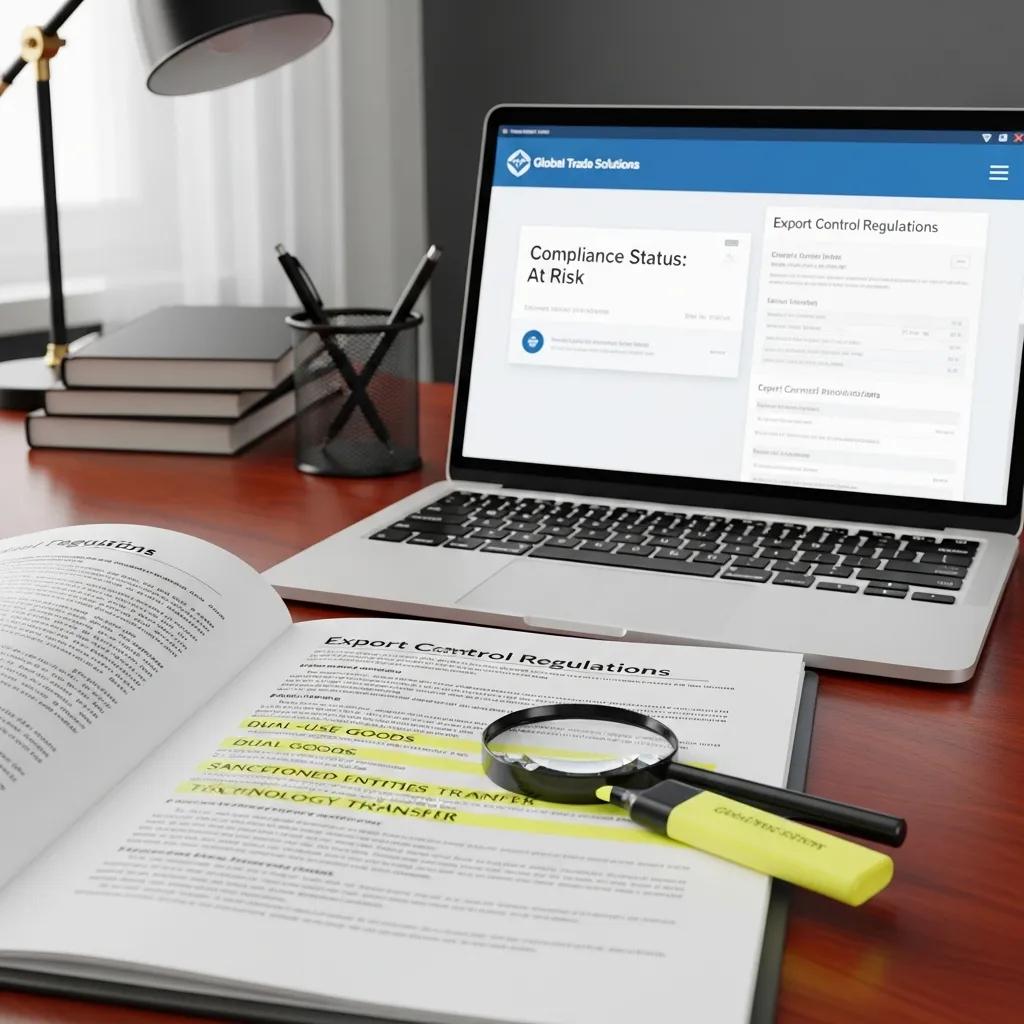
Export control regulations comprise national and multilateral rules that restrict transfers of goods, software, technology, and services for reasons of national security, non-proliferation, and foreign policy, and they establish licensing, classification, and denial mechanisms that companies must operationalize. These frameworks determine what needs a license, which transactions are blocked, and which parties are prohibited, so companies must translate legal obligations into process controls and documented evidence.
The critical importance of controlling dual-use items, particularly highlighted by European Union regulations, stems from their potential to contribute to weapons proliferation and compromise international security.
Export Control Compliance for Dual-Use Items
Exporting dual-use items and technology can endanger territorial or overall security, as well as contribute to the proliferation of WMDs resulting in serious violations of basic human rights and international humanitarian law. For reasons linked to the non-proliferation of weapon of mass destruction, the European Union has established many regulations to control the export, transfer, brokering, and transit of „dual-use items“.
Compliance as a response to export control, 2022
Below is a concise list of the principal regimes that commonly drive corporate export-control programs.
- EAR (Export Administration Regulations) governs dual-use and commercial items that have potential military applications and requires classification and licensing for specified exports.
- ITAR (International Traffic in Arms Regulations) restricts defense articles and related technical data, demanding strict control, registration, and licensing for transfers.
- OFAC sanctions administer financial and trade restrictions against designated countries, entities, and individuals and require transaction screening and blocking actions.
- EU and UK dual-use controls set regional licensing requirements and re-export controls that companies must follow for EU-origin goods and technology.
These regimes differ in scope and jurisdiction, and understanding their distinctions informs how classification, licensing, and screening controls are designed and enforced. Distinguishing which legal trigger applies leads naturally to examining how specifics such as EAR versus ITAR change operational compliance requirements.
How Do EAR and ITAR Regulations Impact Export Compliance?
EAR focuses on dual-use and commercial technologies whose misuse could raise national-security concerns, and compliance typically requires identifying the Export Control Classification Number (ECCN), assessing license exceptions, and documenting decision rationale. Organizations must implement classification workflows, a license determination process, and transactional records that show due diligence and reliance on exceptions, which helps demonstrate intent and care. EAR compliance often involves coordination with product engineering and legal teams to map technical specifications to ECCN criteria and to create standard operating procedures for license applications. Practical impacts include additional lead time for exports, mandatory technical reviews prior to shipment, and integration with denied-party screening to avoid unauthorized end-users. Understanding EAR’s scope prepares the organization for the contrasting controls under ITAR, which imposes tighter governance for defense-related items.
What Roles Do Sanctions and Embargoes Play in Global Trade Restrictions?
Sanctions and embargoes are targeted or broad restrictions imposed by governments or multilateral bodies to prevent trade with designated countries, entities, or persons, and they operate through lists, licensing rules, and transaction-blocking requirements. These measures require routine denied-party screening, real-time transaction controls, and financial compliance procedures to prevent prohibited transfers, and they often carry severe penalties for circumvention or negligent compliance. Operationally, sanctions demand integration between commercial, treasury, and compliance teams so that invoices, shipments, and payment channels are screened and blocked when necessary. Practical examples include list-based prohibitions that require rejecting orders, and jurisdictional embargoes that stop entire classes of transactions; these realities underscore the need for processes that can detect, escalate, and remediate potential violations promptly.
Why Is Export Control Compliance Critical for IT Directors and Business Leaders?
Export control compliance is critical because it transforms legal and operational risk into governance requirements that affect product development, IT architecture, sales, and supply-chain continuity, and failure to comply can produce fines, criminal exposure, loss of export privileges, and irreversible reputational harm. Leaders must prioritize compliance through governance, resourcing, and KPI-driven oversight so that technical teams can embed controls into systems and processes rather than relying on ad hoc manual checks. A focused compliance program aligns classification, licensing, screening, and recordkeeping with business objectives, ensuring that growth strategies do not create unexpected legal exposure. The next section details the concrete risks and penalties that make this governance imperative.
- Legal and financial penalties can include significant fines, sanctions, and administrative orders that impair operations.
- Criminal exposure or debarment can prevent companies and executives from participating in export markets.
- Operational disruption may result from withheld shipments, revoked licenses, or damaged supplier relationships.
These risks make export control policy a board-level concern and require measurable controls that IT and business leaders can monitor through dashboards and audit evidence. Understanding penalties and protections highlights why internal controls and supplier governance must be implemented next.
What Are the Risks and Penalties of Non-Compliance in Export Controls?
Non-compliance can trigger administrative fines, criminal prosecutions, civil penalties, and denial of export privileges, and enforcement agencies increasingly pursue both corporate and individual accountability for willful or negligent breaches. Recent enforcement trends show larger fines and cross-border cooperation among regulators, making robust documentation and proactive remediation essential mitigation factors. Organizations that maintain documented export-control programs and that make voluntary disclosures when issues arise often receive more favorable enforcement outcomes, emphasizing the value of an organized compliance posture. These enforcement realities inform program design: detailed transaction records, classification justifications, and documented training serve as tangible evidence during investigations.
How Does Export Control Compliance Protect Supply Chain Integrity?
Export control compliance protects supply chain integrity by enforcing supplier due diligence, contractual flow-downs, and traceability procedures that reduce the risk of inadvertent diversion or prohibited end-use. Effective supplier management includes periodic audits, screening of upstream parties, and contractual clauses that require compliance with applicable export regulations and record retention. Implementing traceability—from component sourcing to final shipment—creates auditable trails that expedite internal investigations and regulatory responses while preserving business continuity. These supplier controls naturally lead into how a quality management system like ISO 9001 can provide the procedural architecture to codify, measure, and continuously improve those supply-chain controls.
How Does ISO 9001 Quality Management System Support Export Control Compliance?
ISO 9001 is a quality management system (QMS) that creates standardized, auditable processes and documented information, and it supports export control compliance by formalizing responsibilities, recordkeeping, risk assessment, and continual improvement across export-related workflows. Applying ISO 9001 clauses helps organizations embed classification procedures, screening checkpoints, licensing decision gates, and management review of compliance metrics into routine operations. The table below maps key ISO 9001 clauses to typical export control requirements and operational controls that demonstrate how a QMS converts legal obligations into repeatable practices.
| ISO 9001 Clause Area | Export Control Requirement | Operational Control / Example |
|---|---|---|
| Context & Scope (4.x) | Define export-related process boundaries and stakeholders | Documented scope stating exports, re-exports, and responsible functions |
| Risk-based Thinking (6.1) | Identify and treat export control risks | Risk register with ECCN, sanctions, and supplier risk ratings |
| Documented Information (7.5) | Maintain records for classification and licensing | Controlled document repository for license applications and shipping records |
This mapping shows how ISO 9001 structures the organization’s approach to export controls and makes compliance demonstrable through records and processes. By turning export-control tasks into QMS processes, an organization can measure performance and evidence continuous compliance improvement.
Convince ISO 9001 certification is requirement for key clients
Which ISO 9001 Principles Align with Export Control Requirements?
ISO 9001 principles such as the process approach, leadership commitment, evidence-based decision making, and continual improvement align closely with export control needs because they enforce standardization, accountability, and measurable outcomes. The process approach ensures classification and licensing are embedded into workflows, leadership commitment secures resourcing and authority to enforce export policies, evidence-based decisions require documented classification and screening records, and continual improvement drives corrective actions and preventive measures after audits. Mapping these principles to export-control tasks reveals practical activities: documented procedures for ECCN determination, approved sign-off authorities for license submissions, retention of screening logs, and periodic management reviews. These activities become the operational foundation for both regulatory compliance and procurement or customer assurance requirements.
How Can Risk-Based Thinking and Process Control Enhance Trade Compliance?
Risk-based thinking requires organizations to assess likelihood and impact of export-related failures and to prioritize controls where residual risk is highest, producing scalable mitigation plans that reduce enforcement exposure while keeping operations efficient. Process controls such as automated denied-party screening, mandatory license-check gates, and multi-party approval workflows limit unauthorized transfers and create audit trails. Establishing KPIs—such as percent of shipments screened, time-to-license, and number of classification reworks—enables management review and targeted improvements. These measurable controls make compliance proactive and enable continuous improvement loops that feed corrective actions and training, thereby strengthening both trade compliance and overall quality performance.
How to Build an ISO 9001-Certified Export Compliance Program?
Building an ISO 9001-certified export compliance program (ECP) begins with scoping and gap analysis, followed by documented procedures, implementation of process controls, internal audits, corrective action cycles, and management reviews that demonstrate effectiveness and readiness for certification. A practical, stepwise checklist helps teams move from design to certification while ensuring export-specific controls—classification, licensing, screening, training, and recordkeeping—are auditable and integrated into the QMS. Below is a recommended step-by-step checklist for practitioners.
- Define program scope and responsibilities by mapping export activities and stakeholders across product, IT, sales, and logistics functions.
- Perform a gap analysis comparing current processes to ISO 9001 expectations and export-control obligations, and prioritize remediation.
- Document procedures for classification, licensing, denied-party screening, supplier due diligence, and record retention with clear owners.
- Implement process controls, training programs, and monitoring KPIs, then run internal audits and corrective actions before management review.
This checklist converts high-level requirements into actionable phases that produce evidence for certification and strengthen compliance maturity. The table below compares typical ECP elements with ISO 9001 mechanisms and example deliverables to help teams plan implementation.
| Export Compliance Element | ISO 9001 Mechanism | Example Deliverable |
|---|---|---|
| Classification & ECCN | Documented information | Classification log with technical rationale |
| Denied-party Screening | Process control & monitoring | Automated screening reports with exception handling |
| Licensing & Approvals | Roles & responsibilities | Approval matrix and licensing tracker |
The deliverables above are practical outputs that auditors will evaluate for conformity and effectiveness. After establishing these artifacts and processes, organizations should institutionalize internal audits and management review cycles to sustain certification readiness.
Convince ISO 9001 certification is requirement for key clients
What Are the Essential Elements of an Export Compliance Program with ISO 9001 Integration?
An effective ECP integrated with ISO 9001 includes a clear policy and governance structure, robust classification and licensing controls, routine denied-party screening, supplier due diligence, training programs, and disciplined recordkeeping that supports auditability. Minimum deliverables include a formal export control policy, a classification register, a licensing workflow with ownership, screening logs, supplier questionnaires, and training records that document employee competency. Quick implementation tips include prioritizing high-risk product lines, starting with automated screening, and embedding sign-off points into order-to-ship processes to avoid last-minute compliance failures. These essential elements create the documentary and procedural evidence auditors look for during certification and enforcement inquiries.
How Do Internal Audits and Management Reviews Ensure Continuous Compliance?
Internal audits assess process conformity and effectiveness, identify nonconformities related to classification, screening, and recordkeeping, and generate corrective actions that feed into management review for strategic decisions and resource allocation. A sample internal audit checklist might include verification of classification justifications, evidence of screening for all transactions, retention of license documentation, and proof of employee training completion. The corrective action lifecycle should capture root cause analysis, action owners, implementation dates, and verification steps. Management reviews then examine KPIs—such as audit findings, corrective action closure rates, and key risk indicators—to drive continual improvement and strategic alignment with business objectives.
What Are the Business Benefits of ISO 9001 Certification for Export Control?
ISO 9001 certification offers measurable business benefits for export control by demonstrating systematic governance, reducing legal and financial exposure, streamlining market access, and increasing partner and regulator confidence through independent validation of processes. Certification acts as third-party evidence that controls exist and are maintained, which can accelerate procurement approvals and contractual negotiations with international customers. Measurable attributes include fewer shipment delays due to better process adherence, reduced time-to-license from clearer workflows, and improved supplier reliability through enforced due diligence. The table below quantifies benefits in terms executives understand: attribute, measurable metric, and business impact.
| Benefit | Measurable Attribute | Business Impact |
|---|---|---|
| Reduced legal exposure | Number of compliance incidents per year | Lower fines and insurance costs |
| Improved market access | Percentage of tenders meeting procurement compliance | Increased win rate in regulated tenders |
| Operational efficiency | Average time-to-ship after order | Shorter lead times and higher customer satisfaction |
These measurable impacts help justify investment in certification and support procurement and sales efforts in regulated markets. Below are additional business-focused benefits presented as a concise list.
- Regulatory assurance: Certification provides evidence for regulators and counterparties that export processes are managed.
- Commercial differentiation: Certified processes are often required or preferred by large buyers and institutional customers.
- Operational resilience: Standardized workflows reduce errors and speed corrective actions.
These benefits explain why certification is increasingly viewed as strategic rather than merely procedural, and they lead naturally to the specific ways certification reduces legal and financial risks.
How Does Certification Reduce Legal and Financial Risks?
Certification reduces legal and financial risks by institutionalizing documented controls that regulators consider when assessing enforcement outcomes, and it supports stronger mitigation during voluntary disclosures and remediation. Auditable procedures and records minimize ambiguity about intent and demonstrate that the organization exercised appropriate care, which can result in reduced fines or settlements. In practical terms, certified processes shorten investigation timelines because documentation is structured and accessible, reducing legal costs and operational disruption. These risk reductions translate into lower total cost of compliance and a more predictable operating environment for international trade.
In What Ways Does ISO 9001 Improve Market Access and Reputation?
ISO 9001 improves market access and reputation by signaling to customers, partners, and public-sector buyers that the organization manages export-related risks with consistent, auditable systems, often meeting or exceeding procurement prerequisites. Certification can be a contractual requirement in tenders or preferred in supplier evaluations, simplifying bid qualification for regulated markets. Reputation benefits include enhanced confidence among multinational partners and academic or corporate clients who require third-party assurance of controls. The combination of certification and documented export controls thus becomes a competitive asset in regulated procurement processes.
How Does Stratlane Certification Deutschland Facilitate ISO 9001 Certification for Export Control?
Stratlane Certification Deutschland is an accredited certification body offering ISO certifications, including ISO 9001, and leverages AI-supported audit systems and experienced auditors to streamline certification for organizations with export-control needs. Their approach combines automated evidence capture with professional auditor judgment to accelerate audits while preserving rigor, which helps export-facing teams produce the records auditors need for conformity. Stratlane operates across Europe and the UK and issues certificates recognized in multiple countries, enabling multi-jurisdictional clients to demonstrate compliance consistently. Engagement typically begins with a gap analysis, moves through implementation verification, and culminates with certification audits supported by AI-powered reporting to document findings and nonconformity tracking.
What Is the AI-Powered Audit Process Offered by Stratlane?
Stratlane’s AI-powered audit process integrates automated evidence collection, consistency checks, and structured report generation to reduce audit time and improve the clarity of findings, while human auditors validate context and judgment-sensitive conclusions. The workflow includes pre-audit data ingestion, AI-assisted document analysis, on-site or remote verification by professional auditors, and final report and nonconformity tracking that teams can act on immediately. Benefits include faster audits, consistent evaluation criteria across sites, and clear, machine-assisted evidence trails that simplify internal corrective actions. These efficiencies make certification more predictable and reduce the resource burden on internal teams preparing for audits.
How Does Stratlane’s Expertise Support Export Control Compliance Across Europe and the UK?
Stratlane’s pan-European and UK coverage, together with auditors experienced in industry-specific export-control issues, supports multi-jurisdictional clients by providing localized regulatory insight and coordinated certification roadmaps. Their services include gap analyses tailored to export-control risks, certification roadmaps that align ISO 9001 processes with export requirements, and auditor teams familiar with denied-party screening, classification practices, and licensing documentation. Practical support options help organizations prioritize high-risk product lines and integrate compliance controls into existing QMS processes. For organizations seeking a pragmatic path to certification and demonstrable export-control governance, Stratlane offers a combination of accredited certification and AI-augmented efficiency.
Convince ISO 9001 certification is requirement for key clients