

ISO 9000 vs ISO 9001: Der Unterschied und warum ISO 9001 Zertifizierung für Unternehmen entscheidend ist
Quality-focused organizations must understand the distinction between ISO 9000 and ISO 9001 to align internal processes with market and client expectations. This article explains what ISO 9000 represents as a family of quality management guidance and how ISO 9001 functions as the certifiable standard that sets mandatory requirements for a Quality Management System (QMS). Readers will learn the seven quality management principles, the core clauses of ISO 9001, a clear comparative analysis of the two standards, and practical guidance on implementation and certification. Many companies face procurement barriers and customer demands that effectively require ISO 9001 certification; this guide offers step-by-step preparation, audit readiness tips, and measurable KPIs to demonstrate the business value of certification. We also show how modern certification partners use AI and expert auditors to streamline the process and reduce time to certificate. The article maps industry-specific client requirements to ISO 9001 outcomes and provides actionable checklists for executives and IT leaders seeking reliable QMS implementation.
Was ist ISO 9000? Grundlagen und Qualitätsmanagementprinzipien erklärt
ISO 9000 is the family of international standards that defines the vocabulary, fundamentals, and guiding principles of quality management, providing organizations with a common conceptual framework for QMS design and evaluation. It works by standardizing terms such as „nonconformity,“ „corrective action,“ and „documented information,“ which reduces ambiguity during contract negotiation, audits, and supplier management. The practical benefit is clearer communication across stakeholders and consistent interpretation of quality requirements, which in turn reduces audit disputes and procurement friction. Understanding ISO 9000 helps organizations apply ISO 9001 effectively because ISO 9000 sets the semantic foundation used by certifiable standards. The section below explains ISO 9000’s role in preventing misinterpretation and improving supplier-auditor interactions.
H3: Welche Rolle spielt ISO 9000 als Normfamilie im Qualitätsmanagement?
ISO 9000 establishes the conceptual framework and consistent terminology used across quality management standards, ensuring that auditors, suppliers, and managers interpret requirements the same way. By defining precise terms and concepts, ISO 9000 reduces the risk of misaligned expectations in procurement documents and audit findings, which accelerates dispute resolution and streamlines contract language. For example, clear definitions of „nonconformity“ and „corrective action“ help cross-functional teams implement consistent responses to process failures, improving corrective action cycles. This standardized vocabulary also aids interoperability when integrating multiple management system standards across the organization. The next section lists the seven quality management principles that underpin ISO 9000 and practical examples for IT and service providers.
H3: Was sind die sieben Qualitätsmanagementprinzipien nach ISO 9000?
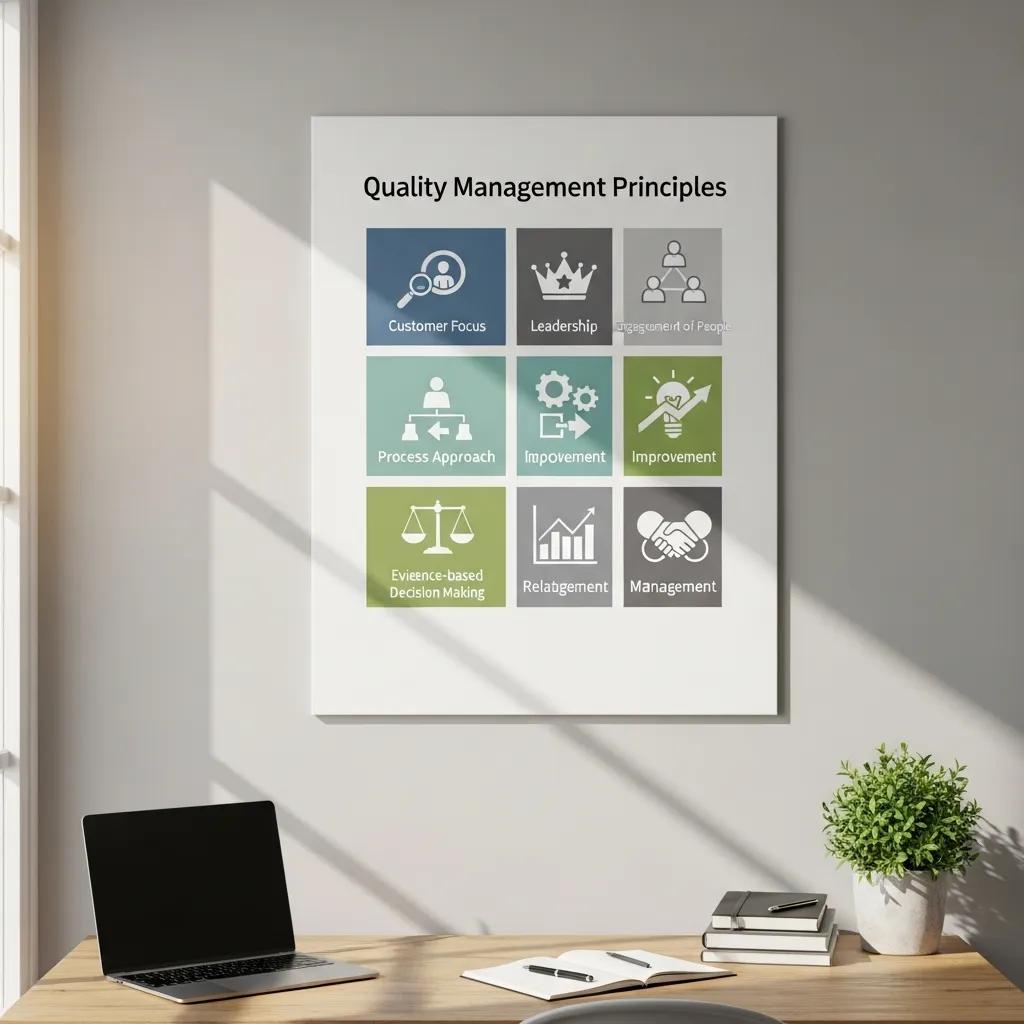
ISO 9000 identifies seven quality management principles that guide effective QMS design and operation and drive consistent value delivery to customers. These principles form the basis for ISO 9001 requirements and help leaders prioritize actions that improve performance and customer satisfaction. Each principle supports concrete outcomes: for example, customer focus improves requirement capture, while process approach reduces variability in service delivery. Below are the seven principles with short practical examples relevant to IT and business services.
- Customer focus: Understand and meet customer needs to improve satisfaction and retention.
- Leadership: Senior management sets direction and reinforces a culture of quality across teams.
- Engagement of people: Involving staff in improvement initiatives increases ownership and reduces defects.
- Process approach: Mapping service delivery processes clarifies inputs, controls, and expected outputs.
- Improvement: Continuous improvement cycles reduce incident rates and speed up incident resolution.
- Evidence-based decision making: Data-driven KPIs enable faster corrective actions and better resource allocation.
- Relationship management: Strong supplier relationships secure consistent inputs and stable service levels.
These principles form the philosophical backbone that prepares organizations to adopt the specific, certifiable requirements in ISO 9001.
ISO 9000 vs. ISO 9001: Unterschiede und Bedeutung der Zertifizierung
ISO 9001 is the certifiable standard within the ISO 9000 family that specifies mandatory requirements for establishing, maintaining, and continually improving a Quality Management System to demonstrate consistent product and service quality. It operates through a clause structure that requires organizations to understand their context, demonstrate leadership commitment, plan for risks and opportunities, ensure adequate support and operation, evaluate performance, and pursue continual improvement. The main benefit is a formal, auditable framework that provides customers and stakeholders with objective evidence of quality controls and process stability. The table below maps key ISO 9001 clauses to their practical meaning for leaders and IT managers, helping translate each clause into concrete responsibilities and evidence.
Intro: The following table translates core ISO 9001 clauses into actionable organizational responsibilities and examples of evidence that auditors seek.
| Clause | Requirement | Practical Meaning |
|---|---|---|
| Clause 4 – Context of the organization | Understand internal/external issues and interested parties | Identify market drivers, regulatory constraints, and stakeholder expectations that shape QMS scope and objectives |
| Clause 5 – Leadership | Top management commitment and quality policy | Evidence: documented quality policy, management review minutes, defined quality objectives tied to strategy |
| Clause 6 – Planning | Risk-based thinking and quality objectives | Practical step: risk register, opportunity plans, and measurable targets with owners |
| Clause 7 – Support | Resources, competence, documented information | Records: training logs, infrastructure inventories, controlled document lists |
| Clause 8 – Operation | Operational planning and control | Examples: process maps, work instructions, change control records |
| Clause 9 – Performance evaluation | Monitoring, internal audit, management review | Evidence: KPI dashboards, audit reports, corrective action records |
| Clause 10 – Improvement | Nonconformity handling and continual improvement | Outputs: corrective actions, improvement projects, lessons learned logs |
Summary: Mapping clauses to practical tasks helps executives and IT leaders convert ISO 9001 requirements into an implementation plan with named owners and observable records, which reduces audit friction and demonstrates operational control.
H3: Welche spezifischen Anforderungen definiert ISO 9001 für ein Qualitätsmanagementsystem?
ISO 9001 requires organizations to define their QMS scope, establish a quality policy and objectives, identify and manage risks and opportunities, ensure competent personnel, control documented information, and maintain operational controls that ensure product and service conformity. Practically, organizations must show evidence such as a documented scope statement, quality objectives with measurable targets, a risk register, training records, and process-level controls with performance metrics. Auditors look for how these pieces interrelate—how leadership reviews objectives, how internal audits feed corrective actions, and how change control preserves product conformity. For IT contexts, examples include documented incident handling workflows, SLA monitoring dashboards, and configuration management records that demonstrate consistent service delivery. The following EAV-style table highlights clause-to-responsibility mappings and helps teams allocate ownership.
H3: Wie unterstützt ISO 9001 die kontinuierliche Verbesserung und Kundenzufriedenheit?
ISO 9001 embeds mechanisms—internal audits, monitoring and measurement, management review, and corrective actions—that create structured feedback loops for continual improvement and demonstrate increasing customer confidence through objective evidence. These mechanisms operate by detecting deviations, assigning corrective actions, verifying effectiveness, and capturing lessons learned for process updates. Measurable outcomes often include reduced defect rates, faster incident resolution times, and improved SLA compliance that translate into higher customer satisfaction scores. For an IT organization, using post-incident reviews and trending data to implement preventive controls directly reduces repeat incidents and shortens mean time to repair. The next section compares ISO 9000 and ISO 9001 to clarify certifiability and practical use-cases.
Was sind die Hauptunterschiede zwischen ISO 9000 und ISO 9001? Vergleich der Normen
At its core: ISO 9000 is a family of guidance and terminology for quality management, while ISO 9001 is the single, certifiable standard that prescribes specific, auditable QMS requirements for organizations seeking formal certification. The practical difference matters for procurement, compliance, and auditability: organizations cannot be certified to ISO 9000, but they can obtain ISO 9001 certification to demonstrate compliance to customers. The table below compares scope, certifiability, purpose, and typical documentation between ISO 9000 and ISO 9001 to make these differences explicit for decision-makers.
Intro: The following comparison table summarizes the functional and certification differences organizations need to consider when referencing ISO 9000 versus pursuing ISO 9001 certification.
| Aspect | ISO 9000 (family) | ISO 9001 (standard) |
|---|---|---|
| Primary purpose | Vocabulary, principles, guidance | Certifiable QMS requirements |
| Certifiability | Not certifiable | Certifiable by accredited bodies |
| Typical audience | Educators, standard writers, implementers | Organizations seeking market assurance |
| Typical documentation | Guidance notes, definitions | Quality policy, procedures, records, audit evidence |
| Use in procurement | Reference for terminology | Often required as proof of capability |
Summary: The table clarifies why procurement teams specify ISO 9001 certification and why ISO 9000 remains essential as the conceptual baseline that prevents misinterpretation of requirements.
H3: Inwiefern unterscheidet sich die Zertifizierbarkeit von ISO 9000 und ISO 9001?
ISO 9001 is auditable and awardable by certification bodies because it contains explicit criteria and objective evidence requirements, whereas ISO 9000 provides explanatory guidance and terminology and is therefore not a target for certification. The implication for suppliers is clear: procurement clauses commonly require ISO 9001 certification as a gating factor for bids because it provides verifiable assurance about processes and controls. For example, a tender might demand „ISO 9001 certification for the supplier’s QMS“ to ensure consistent delivery and traceability. Recognizing this distinction lets organizations prioritize certification readiness activities rather than treating ISO 9000 as a certification goal.
H3: Wie unterscheiden sich Anwendungsbereiche und Zielsetzungen der beiden Normen?
ISO 9000 is best used for education, vocabulary alignment, and as a reference when designing QMS frameworks; ISO 9001 is used to implement, operate, and certify QMS processes that demonstrate consistent output quality. Target audiences differ: ISO 9000 benefits standard developers, trainers, and internal quality teams seeking common language, while ISO 9001 targets operations managers, compliance teams, and procurement stakeholders who need auditable evidence. Use-cases illustrate this: an organization may reference ISO 9000 when drafting internal guidance, then apply ISO 9001 clauses to build the procedures and records required for certification and customer contracts. The next section explains why ISO 9001 certification is often mandatory in supplier selection.
Warum ist die ISO 9001 Zertifizierung für Unternehmen und deren Kunden ein Muss?
ISO 9001 certification is frequently a commercial and regulatory requirement because it provides independent verification that an organization operates effective quality processes, which reduces buyer risk and simplifies supplier qualification. Clients and procurement bodies use ISO 9001 as a measurable signal that suppliers manage risks, maintain documentation, and pursue continual improvement—attributes that directly affect contract performance and supply chain reliability. Certification can influence market access, contract eligibility, and pricing negotiations by turning quality claims into auditable evidence. The table below maps common industry client requirements to how ISO 9001 satisfies those expectations, helping executives prioritize certification by market impact.
The complexities of compliance in highly regulated sectors, such as defense and aerospace, further underscore the critical need for robust ISO 9001-certified quality management systems.
Automating ISO 9001 Compliance in Regulated Manufacturing
The increasingly complicated nature of the regulated manufacturing environment demands strong data management architectures on the basis of international standards management. In particular, the defense and aerospace sectors, where the International Traffic in Arms Regulations (ITAR) and the ISO 9001 quality management standards apply, face big issues related to the provision of secure, traceable, and audit-ready data streams within the enterprise systems. The possibility of non-compliance, inefficiency, and slow audits exists with paper-based processes and system design fragmentation.
AUTOMATING COMPLIANCE-READY DATA FLOWS IN ITAR AND ISO 9001 CERTIFIED MANUFACTURING SYSTEMS, 2025
Intro: The following table links industry client requirements to the specific ways ISO 9001 meets those needs, clarifying why certification often becomes a contractual prerequisite.
| Industry | Client Requirement | Why ISO 9001 satisfies requirement |
|---|---|---|
| Automotive | Traceability and consistent component quality | Process controls, documented procedures, and corrective actions ensure traceability |
| IT & Services | Service continuity and SLA adherence | Operational controls, performance monitoring, and continual improvement improve SLAs |
| Healthcare | Risk management and compliance | Risk-based thinking, controlled documentation, and audit trails support compliance |
| Finance | Third-party controls and evidence of governance | Management review, internal audits, and documented policies demonstrate governance |
Summary: Mapping client needs to ISO 9001 outcomes shows why certification functions as a practical compliance tool that reduces procurement friction and demonstrates capability in regulated or tender-driven markets.
H3: Welche Vorteile bietet die ISO 9001 Zertifizierung für Geschäftsführung und IT-Leiter?
ISO 9001 delivers executive-level benefits—such as improved reputation, greater contract eligibility, and clearer governance—and operational advantages for IT leaders, including process stability, improved incident metrics, and better vendor management. For executives, certification reduces commercial risk and supports bids where certification is a requirement; for IT leaders, ISO 9001 fosters measurable KPIs like incident response time and defect rates that inform resource decisions. Typical metrics to track after certification include reduction in repeat incidents, improved SLA compliance percentage, and faster corrective action closure times. Capturing these improvements helps justify investment in QMS implementation and aligns technical teams with strategic business objectives.
H3: Wie beeinflusst ISO 9001 die Marktposition und Kundenanforderungen in verschiedenen Branchen?
ISO 9001 often serves as a gating factor in industry-specific tendering processes—buyers in sectors like automotive, healthcare, finance, and IT use certification to shortlist suppliers and reduce onboarding checks. In some sectors, clients treat ISO 9001 as evidence of maturity that reduces audit time and accelerates contract award; in others, certification can be a baseline expectation for participation in larger supply chains. For example, IT service buyers may require ISO 9001 to shorten vendor due diligence, while healthcare providers rely on documented processes for patient safety and regulatory compliance. Understanding sector-specific drivers helps organizations prioritize which certifications yield the most commercial benefit.
For organizations seeking external certification support, Stratlane Certification Deutschland operates as an innovative certification body offering auditing and certifying management systems to various ISO standards, including ISO 9001, and leverages AI plus experienced industry auditors to improve audit efficiency and quality while reducing time to certificate. This positioning makes Stratlane a natural partner for companies that want a streamlined, expert-led path to market-ready certification.
Wie läuft der ISO 9001 Zertifizierungsprozess ab? Schritt-für-Schritt Anleitung
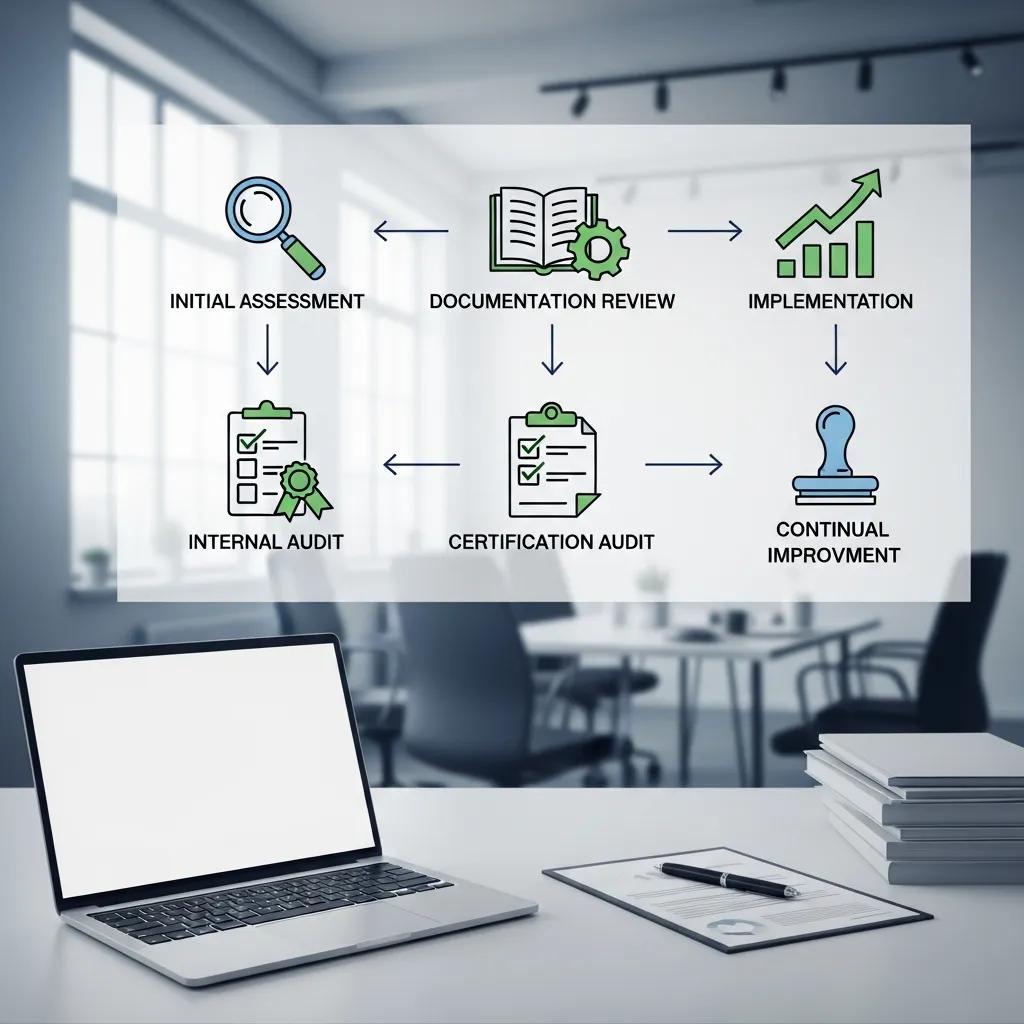
The certification process for ISO 9001 typically follows a clear sequence: gap analysis, documentation and implementation, internal audit and management review, external certification audit, and ongoing surveillance audits to maintain the certificate. This sequence ensures that organizations build evidence incrementally and address nonconformities before the external assessment. The main benefit of following a structured process is reduced risk of major audit findings and faster attainment of certificate status, which accelerates contract eligibility. Time estimates vary by organization size and maturity, but realistic planning and role assignment shorten lead times and avoid common delays such as incomplete evidence or insufficient internal audit coverage. The numbered list below summarizes the typical phases and deliverables.
- Gap analysis: Identify where current practices diverge from ISO 9001 clauses and create an implementation roadmap.
- Documentation and implementation: Define scope, quality policy, procedures, work instructions, and controls with assigned owners.
- Internal audit and management review: Validate effectiveness, capture nonconformities, and prioritize corrective actions.
- External certification audit: Stage 1 (readiness) and Stage 2 (full evaluation) performed by a certification body.
- Surveillance and recertification: Periodic audits to verify continued compliance and drive continual improvement.
This stepwise approach clarifies responsibilities and evidence requirements and sets realistic timelines for certification readiness.
H3: Was sind die wichtigsten Phasen von der Gap-Analyse bis zum externen Audit?
During a gap analysis, teams document current processes, identify missing records, and estimate resources needed to meet clause requirements; the output is a prioritized plan with owners and timelines. Implementation converts the plan into documented information, training, and process controls, while internal audits test conformance and feed corrective actions that management reviews. Preparing for the external audit requires compiling objective evidence such as process maps, KPI reports, and corrective action records to present during the certification assessment. Common delays include incomplete records, unassigned owners, and insufficient internal audit coverage; addressing these early reduces risk of major nonconformities. The next subsection explains how modern certification providers can reduce time and cost through AI-assisted auditing and experienced auditors.
H3: Wie unterstützt Stratlane Certification Deutschland Unternehmen effizient mit KI und Expertenwissen?
Stratlane Certification Deutschland combines AI-assisted audit techniques with experienced industry auditors to enhance efficiency, prioritize high-risk evidence, and reduce time spent on low-value checks during certification audits. AI can analyze documentation, spot risk patterns, and surface anomalies for auditor review, allowing human experts to focus on nuanced process assessments and contextual evaluation rather than repetitive verification. This hybrid approach speeds up readiness assessments and improves consistency across audit reports, which benefits organizations by shortening certification lead times and providing clearer remediation guidance. For clients seeking an efficient certification path, Stratlane’s model offers a practical balance between automated analysis and seasoned auditor judgment that supports faster, reliable certification outcomes.
Wie implementiert man ISO 9001 erfolgreich? Praktische Tipps und Leitfaden für Unternehmen
Successful ISO 9001 implementation begins with clear scope definition, leadership commitment, and a prioritized roll-out plan that assigns owners to clauses, processes, and records. Practical steps include mapping core processes, establishing measurable quality objectives, implementing risk-based controls, and scheduling internal audits that generate actionable corrective actions. Documentation should be concise, process-focused, and accessible so staff can comply without excessive bureaucracy; streamlined records improve auditability and daily usability. Training and competence tracking ensure staff can execute controlled processes, while KPIs and management review keep leadership informed and accountable. The checklist below provides a high-level implementation roadmap that translates requirements into tasks.
- Define QMS scope and quality policy with measurable objectives and assigned owners.
- Map critical processes and establish operational controls, work instructions, and evidence points.
- Implement documented information controls and maintain training and competence records.
- Run internal audits, manage corrective actions, and hold regular management reviews to close the loop.
- Monitor KPIs and use data-driven decision making to prioritize improvements.
These steps guide teams from planning to sustained improvement and prepare the organization for a successful external certification audit.
H3: Welche Dokumentations- und Audit-Anforderungen müssen Unternehmen erfüllen?
Organizations must maintain documented information that demonstrates compliance with ISO 9001 clauses: scope statement, quality policy, objectives, process descriptions or work instructions where needed, records of competence and training, internal audit reports, management review minutes, and corrective action logs. Audit evidence should clearly link to process outputs and show traceability from nonconformities to corrective actions and verification of effectiveness. For IT and service providers, examples of evidence include incident logs, change control records, SLA reports, and configuration baselines that prove consistent delivery. Streamlining documentation by using templates and controlled document management reduces auditor time and keeps the QMS usable for day-to-day teams.
H3: Wie fördert ein Qualitätsmanagementsystem nach ISO 9001 die nachhaltige Prozessverbesserung?
A QMS based on ISO 9001 fosters sustainable improvement through cyclical mechanisms: monitoring KPIs, conducting internal audits, implementing corrective and preventive actions, and engaging management review to allocate resources. Sample KPIs include defect rate, mean time to repair, customer complaint rate, and corrective action closure time; tracking these metrics over time demonstrates measurable gains. An example improvement cycle: internal audits identify recurring incident patterns, corrective actions are implemented, KPI trends show reduced incidents, and management review approves resource reinvestment to scale the improvement. Embedding these feedback loops ensures the QMS evolves with organizational needs and continually enhances customer satisfaction and operational resilience.
For organizations pursuing certification or audit support, the practical combination of AI-assisted analysis and experienced auditors—such as the approach offered by Stratlane Certification Deutschland—can shorten implementation cycles and deliver clearer audit remediation plans while preserving focus on core business operations.