

ISO 9001: Qualitätsmanagement für den internationalen Handel
ISO 9001 is an international quality management standard that defines requirements for a robust Quality Management System (QMS) to ensure consistent product and service delivery, and it acts as a practical mechanism to demonstrate reliability in international markets. This article explains how ISO 9001 and related ISO standards reduce trade friction, satisfy buyer prequalification, and support compliance with cross-border regulatory expectations so exporters and importers can win contracts and scale. Readers will learn why ISO 9001 functions as a buyer trust signal, which operational changes drive measurable export benefits, and the step-by-step process from gap analysis to certification audit in a global context. The guide also examines how AI-assisted auditing and multi-country accreditation affect certificate acceptance, and where to find real-world evidence and case studies that illustrate market access outcomes. Throughout, keywords such as ISO 9001 export benefits, global supply chain ISO certification requirements, and trade compliance ISO 9001 are integrated to support discoverability and practical application. The following sections cover why ISO 9001 matters for international trade, key business benefits, market access mechanisms, an implementation roadmap, how AI and accredited certification bodies support exporters/importers, and outcome-focused success stories.
Why is ISO 9001 Certification Crucial for International Trade?
ISO 9001 matters in international trade because it provides third-party verification that an organization’s processes produce consistent outcomes, and that traceability, corrective actions, and documented controls exist to manage cross-border risk. The mechanism—an audited QMS—creates confidence in procurement and reduces verification overhead for buyers, which directly shortens supplier onboarding timelines and lowers the administrative cost of cross-border transactions. For exporters and importers facing diverse regulatory regimes, ISO 9001 supplies standardized evidence that processes meet buyer and regulatory expectations, helping firms compete in tenders where certification is listed as a requirement or strong preference. Understanding these mechanisms clarifies how certification functions as both a quality framework and a commercial enabler for international trade and ISO trade strategies. The next subsection examines the concrete credibility signals ISO 9001 sends to overseas customers and procurement teams.
This perspective is echoed by research highlighting the fundamental role of ISO 9001 in navigating the competitive landscape of the global economy.
ISO 9001 QMS: Essential for Global Economic Competition
The fierce competition of global economy requires company to have a good Quality Management System (QMS). Efforts done by the company included applying standards of Quality Management System (QMS) ISO 9001. ISO 9001 is a standard that contains requirements of quality management system, published by theInternational Organization for Standarization (IOS).
Analysis of ISO 9001: 2015 certification readiness of
JP-Graha product of Jasaraharja Putera using gap analysis, B Purwanggono, 2015
ISO 9001 enhances credibility through documented controls, internal audit cycles, and external surveillance audits that collectively create verifiable assurance for buyers. Third-party certification differentiates audited systems from self-declared quality claims and supplies objective evidence during supplier prequalification, enabling faster contract approvals and fewer duplicate checks by multinational buyers. This trust signal is especially important when buyers demand traceability for components, consistent testing results, or documented corrective actions after nonconformances, and it directly supports dispute resolution in cross-border contexts. Evidence of consistent processes often leads buyers to reduce the frequency of their own audits, which in turn lowers transaction friction. That reduction in buyer oversight sets the stage for the next topic: how ISO 9001 maps to specific client requirements in tenders and contractual frameworks.
What role does ISO 9001 play in meeting key client requirements for exporters and importers?
ISO 9001 maps to typical buyer requirements by aligning clauses—such as control of externally provided processes, traceability, and nonconformity management—with common procurement evaluation criteria, making it easier for exporters to demonstrate compliance in tendering. In practical terms, ISO 9001 documentation (scope statements, process maps, and records) can be presented during supplier prequalification to show how quality risks are managed, reducing requests for ad hoc evidence from buyers. Many procurement teams list ISO 9001 or equivalent QMS certification as a pass/fail criterion or award-weighted attribute, which directly benefits certified suppliers in competitive bids. By reducing redundant vendor assessments and offering auditable records, ISO 9001 decreases administrative delays and helps exporters focus on value-added commercial negotiations, which naturally leads into how those commercial benefits translate into measurable operational gains.
What are the Key Benefits of ISO 9001 for Global Business Success?
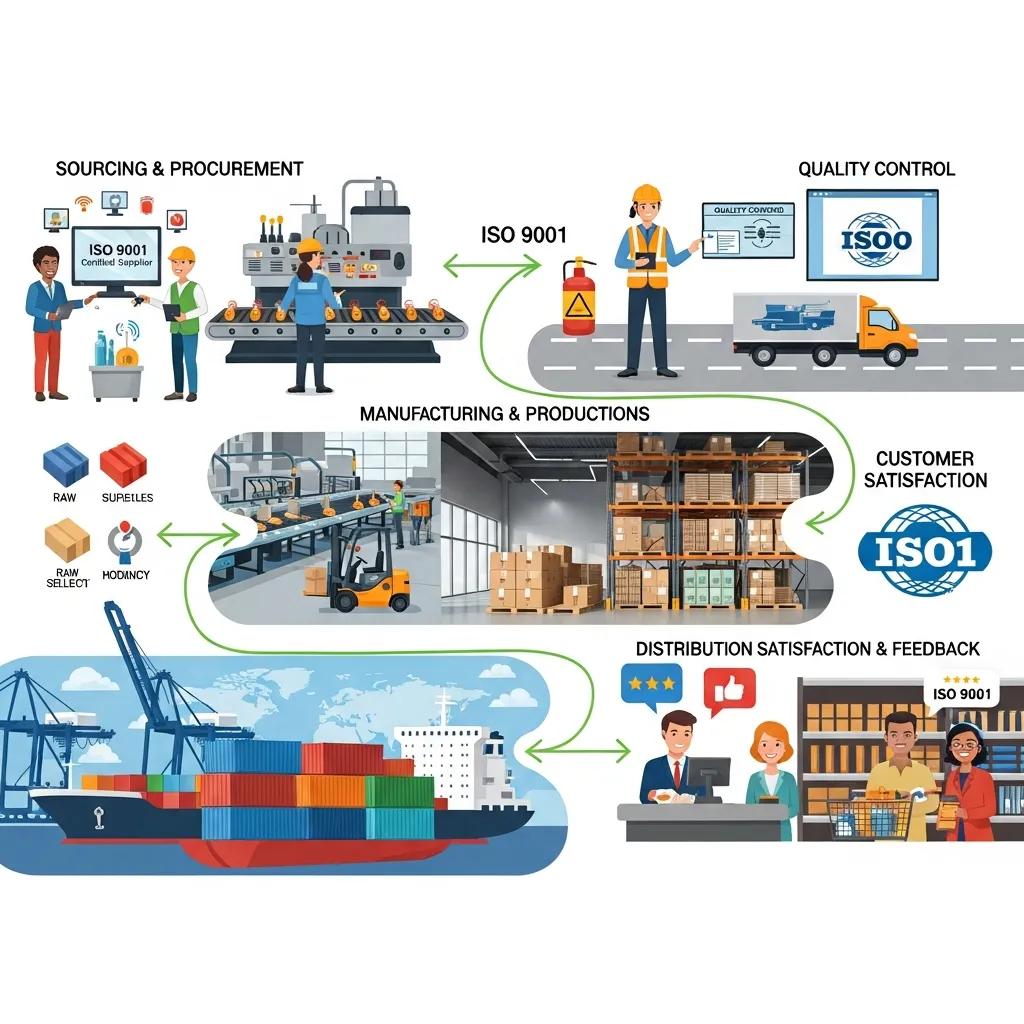
ISO 9001 delivers measurable operational, commercial, and compliance benefits that together improve competitiveness in international markets by reducing defects, shortening lead times, and strengthening buyer confidence. The standard drives standardized processes and KPIs that operational teams can use to lower variability and demonstrate improvement, which in turn supports price/quality positioning and contract-winning ability. Exporters and importers see benefit across supply chain coordination, regulatory documentation, and customer satisfaction metrics, all of which contribute to sustainable business growth in global trade contexts. The EAV table below summarizes how specific business areas experience operational impact from ISO 9001 adoption and why those impacts matter to decision-makers assessing export readiness.
ISO 9001 creates distinct operational impacts across core business areas:
| Business Area | Operational Impact | Typical Outcome |
|---|---|---|
| Supply Chain | Reduced defects and improved supplier controls | Lower rework rates and faster fulfillment |
| Production / Service Delivery | Standardized processes and defined KPIs | Consistent lead times and predictable capacity |
| Compliance & Documentation | Improved traceability and record retention | Easier customs inspections and regulatory checks |
| Commercial / Sales | Third-party verification for buyers | Higher tender win rates and faster onboarding |
How does ISO 9001 improve operational efficiency and supply chain management?
ISO 9001 improves efficiency by requiring defined processes, monitored KPIs, and supplier performance evaluation, which combined reduce variability and lead time in international supply chains. Implementing control plans, performance dashboards, and corrective action workflows helps teams identify root causes of defects and systematically reduce recurrence, thereby lowering cost of poor quality. Recommended KPIs include on-time delivery rate, first-pass yield, supplier defect rate, and corrective action closure time, all of which are useful for export-oriented reporting and buyer scorecards. Standardized supplier onboarding under ISO 9001 reduces duplicated checks by multinational customers and streamlines cross-border logistics, which naturally leads into how these same QMS elements simplify regulatory compliance for exports and imports.
In what ways does ISO 9001 certification facilitate compliance with international trade regulations?
ISO 9001 supports compliance by embedding documentation, traceability, and controlled records into daily operations, which align with customs inspections, product safety checks, and contract audit requirements across jurisdictions. The QMS requires retention of evidence—such as batch records, inspection results, and corrective action logs—which regulators or buyers can review during export clearance or supplier audits. By meeting these documentation expectations, certified companies typically experience fewer administrative holds at borders and can respond more quickly to regulatory inquiries. Clear overlap between ISO 9001 controls and regulatory needs reduces duplication of effort and helps exporters avoid shipment delays, leading into the next section that maps specific market-access barriers to ISO mitigations.
Further emphasizing the critical role of robust data management in regulated sectors, studies underscore how ISO 9001 helps automate compliance-ready data flows, particularly in complex manufacturing environments.
ISO 9001 & ITAR: Automating Compliance for Global Manufacturing
The increasingly complicated nature of the regulated manufacturing environment demands strong data management architectures on the basis of international standards management. In particular, the defense and aerospace sectors, where the International Traffic in Arms Regulations (ITAR) and the ISO 9001 quality management standards apply, face big issues related to the provision of secure, traceable, and audit-ready data streams within the enterprise systems. The possibility of non-compliance, inefficiency, and slow audits exists with paper-based processes and system design fragmentation.
AUTOMATING COMPLIANCE-READY DATA FLOWS IN ITAR AND ISO 9001 CERTIFIED MANUFACTURING SYSTEMS, 2025
How Does ISO 9001 Certification Enable Access to International Markets?
ISO 9001 enables market access by lowering buyer hesitation through third-party validation and by meeting many of the formal requirements used in supplier qualification and tender evaluation. The certification acts as a standardized credential that procurement teams and regulatory bodies recognize, simplifying initial vetting and enabling participation in supply chains that mandate certification for inclusion. For exporters targeting regulated sectors, ISO 9001’s emphasis on traceability, controlled documentation, and process consistency addresses common causes of cross-border rejection or rejection of bids. The EAV-style mapping below links common barriers to market entry with the specific ways ISO 9001 helps mitigate them.
Common market-access barriers and ISO 9001 mitigations:
| Barrier | Barrier Addressed | How ISO 9001 Helps |
|---|---|---|
| Buyer prequalification | Requirement for documented quality systems | Demonstrates audited QMS and reduces ad hoc evidence requests |
| Tender eligibility | Certification listed as mandatory or preferred | Provides a clear pass/score advantage in evaluations |
| Regulatory scrutiny | Need for traceability and records | Ensures retention of records required by customs and regulators |
| Supplier audits | Frequent buyer-led inspections | Reduces frequency of redundant audits through third-party assurance |
What barriers to global market entry does ISO 9001 help reduce?
ISO 9001 reduces several entry barriers including strict prequalification processes, region-specific documentation demands, and intensive buyer auditing by providing a common, auditable set of controls and records. For instance, when tenders require documented supplier controls, ISO 9001 evidence packages—process maps, inspection plans, and management review minutes—address those needs directly and prevent repeated requests for proof. Certification also helps with cross-border logistics by ensuring packaging and handling processes are standardized and traceable, which reduces customs queries. Reducing these barriers shortens time-to-contract and enables companies to allocate resources toward scaling operations rather than repeatedly proving compliance; the following subsection examines metrics that demonstrate this competitive advantage.
How does ISO 9001 support competitive advantage in export and import sectors?
ISO 9001 supports competitive advantage by shortening supplier onboarding, lowering buyer verification costs, and enabling clearer differentiation on quality rather than price alone, which can increase win rates in international tenders. Measurable levers include reduced onboarding time, fewer buyer-led corrective actions, and improved proposal scores when certification is a weighted criterion. Recommended metrics to track post-certification include tender success rate, average onboarding days, and number of buyer audits per year; tracking these KPIs demonstrates the ROI of certification to leadership. As the practical implementation steps underpinning these outcomes are often the most challenging, the next major section describes a clear roadmap from gap analysis to certification audit.
What is the Process for Implementing ISO 9001 in Global Trade Operations?
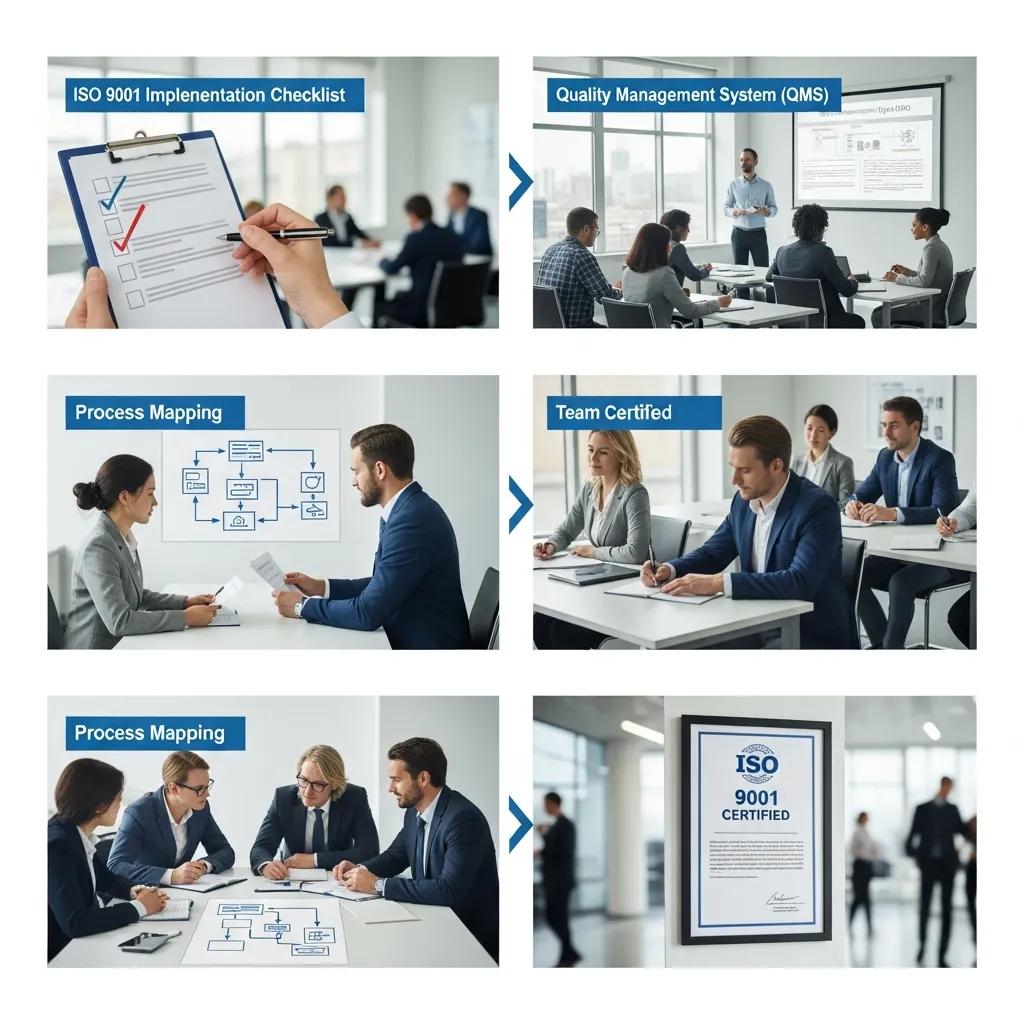
Implementing ISO 9001 for international trade starts with a targeted gap analysis and scoping exercise, followed by documentation, training, internal audits, and a certification audit; each phase produces deliverables that support export readiness. The mechanism is sequential: assess current state, define scope (including cross-border processes), close gaps with documented controls and training, validate through internal audit and management review, and then undergo external certification and surveillance. Timeframes vary by organization size and complexity, but a focused program for exporters can typically progress through the main phases within months when resources and leadership commitment are aligned. The numbered steps below target featured-snippet style clarity for teams planning implementation.
Key implementation steps for ISO 9001 certification in international contexts:
- Gap Analysis and Scoping: Identify deviations from ISO requirements and map export/import processes that fall within scope.
- Documentation & Training: Create required procedures, work instructions, and train staff on new controls.
- Internal Audit & Management Review: Validate the system internally and address findings before external assessment.
- Certification Audit & Surveillance: Undergo an accredited external audit and maintain continuous improvement through surveillance audits.
This numbered roadmap clarifies the sequence; the table below outlines typical deliverables and timeframe expectations to set realistic planning horizons.
| Phase | Deliverable | Typical timeframe / impact |
|---|---|---|
| Gap Analysis | Gap report and implementation plan | 2–4 weeks; clarifies priorities |
| Documentation & Training | Quality manual, procedures, trained personnel | 4–12 weeks; enables consistent practice |
| Internal Audit | Internal audit reports and corrective actions | 2–6 weeks; reduces risk before certification |
| Certification Audit | Certificate issuance and surveillance schedule | 4–8 weeks to audit; ongoing surveillance reduces long-term risk |
What are the key steps from gap analysis to certification audit?
The gap analysis identifies nonconformances and produces a prioritized implementation plan that defines required documents, training needs, and responsible owners, which primes the organization for documentation and process changes. During documentation and training, teams convert operational practice into auditable records and train staff on procedure execution and evidence collection, thereby building a stable evidence trail for internal and external audits. Internal audits and management reviews validate the system and close findings before certification, ensuring the external audit assesses a mature QMS; successful certification then leads into a surveillance cycle that sustains compliance. Clear deliverables and assignments during each step reduce rework and accelerate certification, and operational support examples clarify how organizations can expedite these phases.
How does continuous improvement and risk-based thinking apply in international contexts?
Continuous improvement and risk-based thinking extend ISO 9001 across borders by using risk registers, supplier risk assessments, and cross-border corrective action workflows to manage variability in international operations. Organizations should maintain a supplier risk register that scores vendors on delivery performance, compliance risk, and geopolitical exposure, and then use corrective actions and preventive measures to reduce high-risk items. Continuous improvement metrics—such as reduction in supplier defect rates, corrective action closure times, and improvements in on-time delivery—provide measurable evidence of system effectiveness to buyers and regulators. Embedding these risk-based controls into management review cycles ensures the QMS adapts to changing market conditions and trade requirements.
How Does Stratlane Certification Deutschland’s AI-Powered Auditing Enhance ISO 9001 Certification?
Stratlane Certification Deutschland brings AI-powered audit tools and multi-country accreditation to the certification process, which can accelerate evidence aggregation and improve consistency of findings for organizations pursuing ISO 9001, especially those engaged in international trade. AI-assisted auditing enables faster analysis of records and identification of anomalies, while Stratlane’s accreditation across 27+ countries and auditors with experience in 29+ countries increases the likelihood that certificates will be accepted by universities, corporations, and SMEs worldwide. For exporters and importers, this combination reduces time-to-certification and lowers friction during buyer verification because documentation and audit outcomes are more consistent and data-driven. The following subsections unpack AI advantages and accreditation benefits in practical terms while keeping the commercial mention concise and focused on how it supports the broader topic.
What advantages does AI bring to auditing for global businesses?
AI brings measurable advantages such as faster evidence aggregation, repeatable audit logic, and data-driven risk identification that reduce human variability and help audit teams spot systemic issues across multi-site operations. Automated analysis can flag missing records, inconsistent metrics, or supplier performance trends that merit corrective action, supporting continuous improvement with actionable analytics. For internationally operating companies, AI speeds cross-border audits by standardizing checklists and correlating evidence across regions, which lowers audit time and can reduce certification costs. These efficiencies translate into operational time savings and clearer audit trails that buyers can trust, which is why accreditation in multiple jurisdictions further multiplies the commercial value.
How does Stratlane’s accreditation across 27+ countries benefit exporters and importers?
Multi-country accreditation increases certificate acceptance in international tenders and buyer evaluations by reducing the need for local re-certification or redundant local audits. When a certification body is recognized across many jurisdictions, buyers and universities are more likely to accept the certificate as evidence of a verified QMS, decreasing requests for additional verification and accelerating contract awards. This broader acceptance reduces duplicated assessments and the administrative burden on exporters and importers, enabling faster entry into complex supply chains. For organizations engaged in cross-border trade, such accreditation combined with consistent AI-supported audit reports offers a practical path to lower trade friction and improved market access.
What Real-World Success Stories Demonstrate ISO 9001’s Impact on Global Trade?
Evidence from industry-level case studies shows that ISO 9001 often enables exporters to access new markets, satisfy tender requirements, and reduce buyer-led verification—outcomes that translate into improved contract win rates and faster onboarding. While specific client details are not disclosed here, there are case studies and resources published by accredited certification bodies that document these outcomes, and interested exporters can consult those resources to see anonymized examples of market access improvements. Metrics commonly associated with success post-certification include reductions in buyer audits, shorter supplier onboarding times, and improved customer satisfaction scores, all of which support business growth in international trade. The next subsections summarize sector-level observations from such case collections and outline the types of measurable benefits organizations typically record after certification.
How have German exporters improved market share through ISO 9001 certification?
German exporters across manufacturing and services sectors frequently report that ISO 9001 certification functions as a de facto entry ticket for certain international tenders where quality credentials are mandatory or highly weighted, enabling participation that would otherwise be closed. At an industry level, certified suppliers tend to experience higher selection rates in competitive bids because procurement teams can rely on an auditable QMS rather than extensive bespoke supplier checks. Certification also helps exporters demonstrate supply chain controls to global buyers, which assists in establishing new distribution or reseller agreements abroad. For specifics, review anonymized case studies available in certification resources that highlight these sector-level trends and typical paths from certification to contract awards.
What measurable benefits have businesses gained in customer trust and compliance?
Post-certification benefits commonly include fewer buyer-initiated audits, more rapid supplier onboarding, and measurable reductions in defect rates and corrective action recurrence—metrics that directly reflect increased customer trust and regulatory alignment. Typical KPIs to track these improvements include number of buyer audits per year, average onboarding days, and percentage reduction in nonconformances; organizations often see measurable movement in these indicators within the first 12 months post-certification. Tracking these KPIs and reporting them internally reinforces continuous improvement and demonstrates the ROI of ISO 9001 to stakeholders. For detailed examples and anonymized metrics, organizations should consult industry case studies and resource sections published by accredited certification bodies.
For exporters or importers considering certification, additional operational support—such as audit cadence planning and AI-assisted gap analysis—can accelerate readiness and reduce time-to-certification, and accredited bodies with international recognition can further smooth acceptance of certificates across jurisdictions.
- Reduced Buyer Audits: Fewer verification events decrease operational interruptions.
- Faster Onboarding: Shorter supplier qualification timelines improve cash flow and sales cycles.
- Lower Defect Rates: Systematic corrective actions reduce rework and returns.