

ISO 9001 Internal Auditor Training: Certification, Competence, and Business Benefits
ISO 9001 Internal Auditor Training prepares competent personnel to evaluate, verify, and strengthen a Quality Management System (QMS) so organisations can maintain certification and meet customer and regulatory expectations. This guide explains what the training covers, how the internal audit lifecycle is structured, the measurable business benefits of auditor competence, and who should attend to maximize organisational value. Many organisations struggle with inconsistent audit methods, unclear evidence collection, and slow corrective-action closure; targeted auditor education remedies these gaps by teaching risk-based auditing, objective evidence techniques, and effective reporting. Readers will learn practical steps for planning and conducting ISO 9001 audits, the core competencies developed during auditor qualification, role-specific returns on investment, and how training links to certification maintenance and procurement readiness. Where relevant, the article highlights provider-specific differentiators and enrollment steps while keeping the focus on developing audit capability that directly improves compliance, process performance, and customer confidence. The content weaves key terms such as Auditoren Qualifikation, Interne Auditoren Ausbildung, internal audit methodology ISO 9001, and risk-based auditing ISO 9001 to support discoverability and practical application.
What is ISO 9001 Internal Auditor Training and Why is it Essential?
ISO 9001 Internal Auditor Training is a structured program that teaches personnel to plan, perform, report and follow up on internal audits of a Quality Management System using the ISO 9001:2015 requirements and ISO 19011 guidance. The training works by developing auditor competence in interpreting clauses, applying risk-based thinking, and gathering objective evidence so findings drive corrective actions and continual improvement. Organisations that invest in auditor qualification reduce compliance risk, shorten non-conformity resolution cycles, and increase confidence during external certification assessments. A well-designed course emphasizes practical exercises, role-plays, and real-process audits so participants leave able to execute audits that reveal systemic causes rather than surface symptoms. This practical capability then naturally supports procurement and supplier requirements by demonstrating an auditable QMS that meets client expectations.
Stratlane Certification Deutschland is a certification body based in Düsseldorf, Germany, specializing in ISO certifications (ISO 9001, ISO 14001, ISO 27001, ISO 42001). The company leverages AI and experienced industry experts for auditing organizations and mentions ‚Training‘ under Resources, indicating an offering or facilitation of ISO 9001 Internal Auditor Training.
How Does Internal Auditor Training Support Quality Management Systems?
Internal auditor training strengthens a QMS by improving the reliability of audit findings and the effectiveness of corrective actions, which together elevate process stability and product/service conformity. Trained auditors apply risk-based sampling and focused evidence collection to detect root causes, leading to corrective actions that address systemic issues rather than superficial fixes. Practical training scenarios teach auditors to map processes, interview stakeholders, and validate objective evidence so non-conformities are classified accurately and resolved efficiently. Enhanced audit quality also supports management review inputs and continual improvement cycles, creating a measurable path from findings to performance gains and customer satisfaction. Understanding these mechanisms clarifies why investment in auditor competence is a strategic priority for any organisation seeking durable ISO 9001 conformance.
What Are the Key Competencies Developed in ISO 9001 Auditor Qualification?
ISO 9001 auditor qualification develops a set of competencies that combine standards knowledge, audit technique, communication, and analytical skills to produce reliable audit outcomes. Participants learn to interpret ISO 9001 clauses in context, design audit checklists aligned with process risks, and use interview techniques that elicit objective evidence rather than opinions. Reporting skills and non-conformity writing emphasize clarity, classification, and actionable corrective recommendations to ensure traceability and verification. Additionally, auditors acquire follow-up and verification techniques to confirm corrective actions are effective, which shortens closure times and reduces recurrent findings. These competencies translate directly into business impacts such as fewer repeat NCRs and faster corrective-action cycles.
How is the ISO 9001 Internal Audit Process Structured?
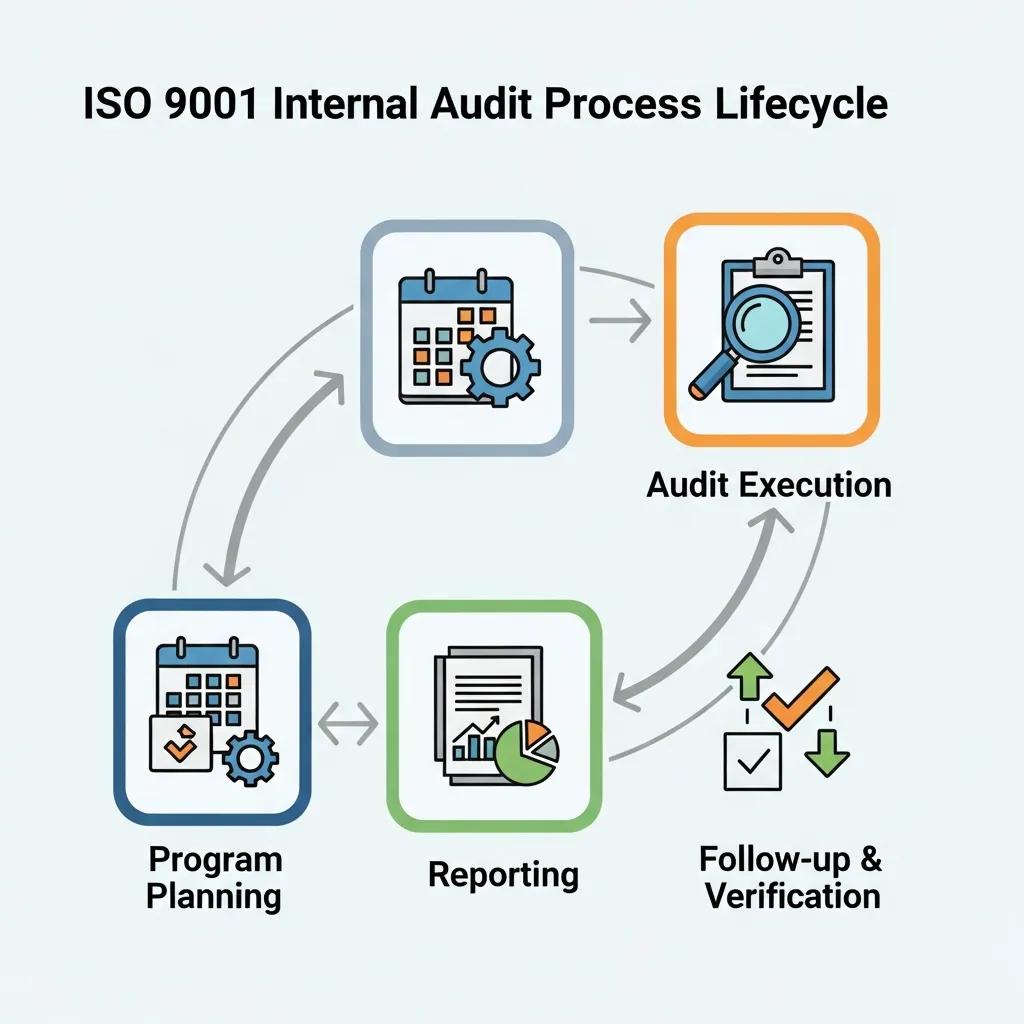
The ISO 9001 internal audit process follows a lifecycle of program planning, individual audit execution, reporting of findings, and follow-up verification to close corrective actions and feed continual improvement. This structure aligns with ISO 19011’s principles—objectivity, evidence-based approach, and risk-based planning—so audits focus on areas that present the highest business risk. Effective programmes include an annual audit schedule, competent auditors assigned by competence matrices, defined audit scopes, and documented sampling strategies that ensure representative coverage of processes. Integrating audit outputs into management review and corrective-action systems ensures findings are elevated appropriately and that improvements are tracked to measurable outcomes. The next sub-section offers a practical step-by-step checklist to implement each phase efficiently.
- Plan the audit programme, define scope and objectives, and allocate competent auditors based on process risk and frequency.
- Prepare checklists and sampling plans that map ISO 9001 clauses to process controls and performance indicators.
- Conduct onsite or remote audits using evidence-based techniques: interviews, observation, and document review.
- Report findings with clear classifications, root-cause suggestions, and recommended corrective actions.
- Track corrective actions, verify effectiveness, and integrate outcomes into management review and improvement cycles.
This step-by-step lifecycle ensures audits are purposeful and their outputs translate into tangible QMS improvements.
Introductory table describing course modules and expected competences before the EAV table.
| Module | Objective | Competence Outcome |
|---|---|---|
| Audit Planning & Programme Management | Teach risk-based programme design and scheduling | Ability to create an annual audit plan and allocate resources by risk |
| Audit Techniques & Evidence Collection | Develop interviewing, sampling, and observation skills | Accurate evidence gathering and objective finding formulation |
| Reporting, NCR Classification & Follow-up | Train on report writing, classification, and corrective action tracking | Clear NCR documentation and ability to verify corrective action effectiveness |
This module mapping shows how each course element converts directly into practical auditing skills that teams can use immediately to improve QMS reliability.
What Are the Steps of Planning, Conducting, and Reporting an Internal Audit?
Planning begins with a risk-informed audit programme and ends with documented evidence supporting conclusions; planning sets the tone for a focused, efficient audit cycle.
During planning, auditors define scope, objectives, criteria, and sampling methods while coordinating with process owners to minimize disruption. Conducting the audit follows with opening meetings, interviews, observation of activities, and validation of records against defined criteria; auditors prioritize objective evidence and avoid confirmation bias. Reporting requires concise statements of conformity or non-conformity, clear evidence references, and suggested corrective actions with assigned responsibility and due dates. A disciplined follow-up closes the loop by verifying corrective action effectiveness and updating the audit programme to address recurring risks.
How Are Non-Conformities Identified and Managed During Audits?
Non-conformities are identified through an evidence-based comparison of observed practices and records against ISO 9001 requirements and internal process criteria, then classified by severity to guide response priorities. Auditors distinguish observations from minor or major non-conformities, documenting objective evidence and immediate impact to operations or compliance. Managing findings involves a corrective-action workflow: root-cause analysis, defined corrective measures, responsible owners, and verification of effectiveness; this lifecycle reduces recurrence and supports continual improvement. Integrating findings into a central corrective-action register with clear metrics—closure time, recurrence rate, and effectiveness—enables management to track trends and allocate resources where systemic issues emerge. Effective management of non-conformities therefore converts audit findings into lasting quality gains.
Further emphasizing the critical role of internal audits and non-conformance management, research highlights their importance for achieving QMS certification and driving continuous improvement.
ISO 9001 Internal Audit: QMS, Certification, and Non-Conformance
This paper gives details of Internal Quality Audit and External Quality Audit of ISO9001 standard which help to achieve the Quality Management System (QMS). For ISO certification most of the organization /Institution should go for ISO implementation. Quality audits are the basic process of ISO done by the internal or external quality auditors or by the audit team. Quality Audits should be performed at regular time intervals and ensure that the institution has clearly done the external audit systems monitoring ISO procedures with effective action. This will enable the institution to grow faster with minimizing the errors and failures of ISO procedure executions. This paper explains about procedures of IQA and EQA and non-conformance report, which help for the better improvement. This brings higher customer satisfaction that intern brings new customers.
External Audit and Non Conformance, S Maidhili, 2017
What Are the Benefits of ISO 9001 Internal Auditor Certification for Businesses?

Certified internal auditors deliver measurable business benefits by improving compliance, reducing risk, increasing process efficiency, and strengthening customer confidence in product and service quality. Competent auditors help organisations detect systemic issues earlier, reduce the number of repeat non-conformities, and shorten corrective-action closure times—metrics that lower operational disruption and cost. Skilled internal auditing supports supplier and client assurance by producing traceable evidence of QMS performance, which often factors into procurement decisions and market access. Training also fosters a culture of continual improvement, using audit findings to prioritize process optimization and enhance customer satisfaction. These outcomes explain why many clients and procurement frameworks demand robust internal audit capability from their suppliers.
Indeed, the strategic value of internal audits extends beyond compliance, serving as a powerful managerial tool to achieve broader business objectives.
Internal Audit as a Managerial Tool: Business Benefits
in the business perspective of internal audit this paper aims to investigate the possibilities of using internal audit as a helpful managerial tool and describes the benefits of such use.
Managerial relevance of internal audit: Business benefits of using ISO 9000 internal audit as a managerial tool, 2011
Stratlane Certification Deutschland is a certification body based in Düsseldorf, Germany, specializing in ISO certifications (ISO 9001, ISO 14001, ISO 27001, ISO 42001). The company leverages AI and experienced industry experts for auditing organizations and mentions ‚Training‘ under Resources, indicating an offering or facilitation of ISO 9001 Internal Auditor Training.
Introductory EAV table mapping benefits to business impacts.
| Benefit | Business Impact | Metric / Example |
|---|---|---|
| Improved Compliance | Fewer external audit findings and reduced legal/regulatory exposure | 30% fewer repeat NCRs within one year (example improvement) |
| Risk Mitigation | Early detection of process failures reduces production downtime | Decreased downtime hours and incident frequency |
| Operational Efficiency | Streamlined processes lower waste and cycle time | Reduced process cycle time by measurable percentage |
| Customer Confidence | Better audit evidence supports procurement scoring | Higher supplier evaluation scores and retained contracts |
This table links auditor certification benefits to tangible business outcomes, showing how competence translates into measurable value.
How Does Certification Enhance Compliance and Risk Mitigation?
Certification of internal auditors enhances compliance by ensuring audits consistently apply ISO 9001 criteria and produce reliable evidence for both internal governance and external assessors. Trained auditors use systematic sampling and root-cause analysis to uncover latent conditions before they escalate into regulatory or customer-impacting failures. Efficient detection and correction of non-conformities reduce operational risk and the chance of external audit surprises that can jeopardize certification status. When audit outcomes are integrated into risk registers and management review, organisations can allocate resources proactively to controls that matter most. This proactive posture strengthens supplier credibility and reduces the likelihood of contract penalties or lost opportunities.
In What Ways Does Training Drive Continuous Improvement and Customer Satisfaction?
Auditor training fuels continuous improvement by turning audit findings into prioritized improvement projects that close performance gaps and enhance process capability. Audits highlight opportunities across process inputs, control points, and interactions—enabling targeted PDCA cycles that raise quality and reduce variability. As processes stabilize and defect rates decline, customer satisfaction improves through more consistent products and fewer service failures, which in turn strengthens market reputation. Reporting metrics such as reduced complaint rates, faster corrective-action closure, and increased on-time delivery quantify the customer-impact of internal audit-driven improvements. Over time, this continuous loop of assessment and improvement becomes a competitive advantage.
Who Should Enroll in ISO 9001 Internal Auditor Training?
ISO 9001 Internal Auditor Training is appropriate for a broad range of roles that influence, implement, or evaluate quality processes including quality managers, process owners, production supervisors, and compliance officers. The course is also valuable for IT managers where QMS intersects with service delivery, procurement staff responsible for supplier oversight, and team leaders tasked with local process control. Enrolling role-specific personnel ensures audits probe the right controls and that corrective actions are owned by those who can implement change. Training multiple staff levels builds internal audit capacity and resilience so the organisation can sustain certification requirements even when personnel change.
| Role | Why it’s Relevant | Primary Gain |
|---|---|---|
| Quality Manager | Oversees QMS performance and audit programme | Improved programme oversight and actionable audit outputs |
| Process Owner | Responsible for specific process controls | Faster root-cause resolution and reduced process variability |
| IT Director | Manages IT services that support QMS processes | Better control of IT-related non-conformities and service continuity |
| Department Head | Ensures departmental compliance and performance | Greater accountability and measurable process improvements |
This role mapping helps potential participants self-identify and understand the immediate returns their organisation can expect from training.
What Roles Benefit Most from Internal Auditor Qualification?
Several roles gain clear advantages from internal auditor qualification because they interact directly with processes and controls that audits evaluate, improving both compliance and operational outcomes. Quality managers who qualify as auditors can design more effective programmes and interpret audit trends to prioritize improvements. Process owners who attend can better understand what auditors look for and thus pre-emptively strengthen control points, shortening NCR closure times. IT directors gain insight into how service-level controls affect product conformity and can mitigate risks that cross functional boundaries. Department heads and supervisors who complete the training become local champions for quality, improving day-to-day adherence to procedures and evidence retention. These role-specific benefits justify targeted training investments.
How Does Training Support Career Advancement and Professional Recognition?
Auditor qualification contributes to career development by equipping individuals with transferable skills in systematic evaluation, root-cause analysis, and corrective-action verification that are valued across industries. Certified internal auditors often become candidates for roles in compliance, quality leadership, or supplier assessment functions because they demonstrate both technical knowledge and process improvement capability. Employers recognize these credentials as evidence of competency that supports internal promotion and role expansion into cross-functional quality initiatives. Additionally, the practical audit experience gained during training strengthens participants’ professional profiles, making them better positioned for responsibilities such as leading external auditor interfaces or supplier audits.
What Makes Stratlane Certification Deutschland’s Internal Auditor Training Unique?
Stratlane’s training approach combines practical auditor mentorship with AI-supported tools that simulate audit scenarios and analyse audit data to accelerate learning and competency development. Trainers who are experienced auditors translate theory into practice through live exercises, process mapping tasks, and real-case debriefs while AI-driven analytics offer pattern detection in audit findings and simulated risk scenarios for trainees to practice response strategies. Courses are tailored to industry contexts—manufacturing, IT services, and regulated sectors—so participants work on scenarios closely aligned with their operational realities. This combination of seasoned human insight and AI augmentation shortens the learning curve and increases the likelihood that audits will produce actionable, business-relevant findings.
Stratlane Certification Deutschland is a certification body based in Düsseldorf, Germany, specializing in ISO certifications (ISO 9001, ISO 14001, ISO 27001, ISO 42001). The company leverages AI and experienced industry experts for auditing organizations and mentions ‚Training‘ under Resources, indicating an offering or facilitation of ISO 9001 Internal Auditor Training.
How Does Stratlane Leverage AI and Experienced Auditors in Training?
Stratlane uses AI to create realistic audit datasets, highlight common finding patterns, and support scenario simulations that challenge trainees to interpret evidence under time constraints and uncertainty. Experienced auditors mentor participants through debriefs, demonstrating interview techniques, evidence validation, and report writing while AI outputs provide objective reflections on sampling choices and finding patterns. This blended model allows learners to practice high-impact skills—such as root-cause analysis and non-conformity classification—while receiving immediate, data-driven feedback that reinforces best practices. The result is auditors who can apply both judgement and analytics to produce robust, verifiable audit conclusions.
What Industry-Specific Insights and Practical Applications Are Included?
Courses include tailored modules and practical exercises that reflect the regulatory and process realities of sectors such as IT services, manufacturing, and regulated industries, focusing on risk areas typical for each sector. Examples include service continuity and change control for IT, production control and traceability for manufacturing, and compliance documentation for regulated environments. Hands-on exercises use process documentation and simulated records from those industries so trainees learn to recognise sector-specific indicators of conformity and risk. By practicing in realistic contexts, participants develop immediately applicable skills that reduce time-to-value when they return to their workplace and begin conducting internal audits.
How Can You Enroll and Prepare for ISO 9001 Internal Auditor Certification?
Enrolling in an ISO 9001 internal auditor course typically involves selecting a format (in-person, online, or hybrid), confirming prerequisites such as basic ISO 9001 familiarity, and scheduling around organisational audit cycles so learning can be applied promptly. Courses often range from one to three days for foundational internal auditor training, with assessment methods that include written tests, practical audit exercises, and observed reporting tasks to verify competence. Preparation tips include reviewing ISO 9001:2015 clauses, studying process documentation, and preparing examples of process controls from your workplace to use in practical exercises. Because internal audit skills are best learned by doing, participants should plan to apply concepts immediately through supervised internal audits or simulated assessments.
Stratlane Certification Deutschland is a certification body based in Düsseldorf, Germany, specializing in ISO certifications (ISO 9001, ISO 14001, ISO 27001, ISO 42001). The company leverages AI and experienced industry experts for auditing organizations and mentions ‚Training‘ under Resources, indicating an offering or facilitation of ISO 9001 Internal Auditor Training.
What Are the Course Duration, Format, and Certification Requirements?
Typical course formats include concise one-day introductions, two-day practical auditor courses, or three-day combined auditor-plus-lead modules depending on depth required; assessment commonly combines knowledge checks and practical audit exercises. Certification requirements often mandate attendance, successful completion of assessments, and demonstration of applied audit activities—such as participation in a supervised internal audit—so course planners should confirm evaluation criteria in advance. Accredited pathways may align with industry accreditation bodies’ expectations, and employers frequently require documented evidence of course completion in personnel competence records. Planning a follow-up internal audit soon after training consolidates learning and provides evidence for competence records.
Where Can You Find Additional Resources and Support for Internal Auditor Training?
Key resources for ongoing learning include the ISO 9001:2015 standard text and ISO 19011 guidance on auditing management systems, which provide authoritative frameworks for requirements and audit principles. Practical tools such as audit checklists, corrective-action registers, and sample audit reports support application of learned techniques; organisations should maintain templates adapted to their processes to ensure consistency. Many providers and accreditation bodies publish guidance notes and case studies that illustrate how audits surface systemic issues and drive improvement; reviewing these materials before and after training enhances practical understanding. Finally, participating in practice audits and peer reviews within your organisation helps embed auditor skills into daily operations.
Recommended preparatory activities:
- Read ISO 9001:2015 and ISO 19011 guidance to familiarise yourself with clauses and audit principles.
- Gather process documentation and records to use in practical exercises during the course.
- Plan a supervised internal audit soon after training to apply skills and collect competence evidence.
These preparatory steps increase the value of training and ensure participants can demonstrate competence through real audit activities.
Stratlane Certification Deutschland is a certification body based in Düsseldorf, Germany, specializing in ISO certifications (ISO 9001, ISO 14001, ISO 27001, ISO 42001). The company leverages AI and experienced industry experts for auditing organizations and mentions ‚Training‘ under Resources, indicating an offering or facilitation of ISO 9001 Internal Auditor Training.
- Contact your internal quality lead to align course timing with audit cycles and nominate participants.
- Select course format that matches operational needs—short practical sessions for upskilling or longer modules for deep competence.
- Ensure post-course application by scheduling supervised audits and documenting competence evidence in personnel records.
Enrolling qualified staff promptly is a strategic priority because ISO 9001 is required by key clients and procurement frameworks; building internal audit capability protects certification status and strengthens supplier credibility.