
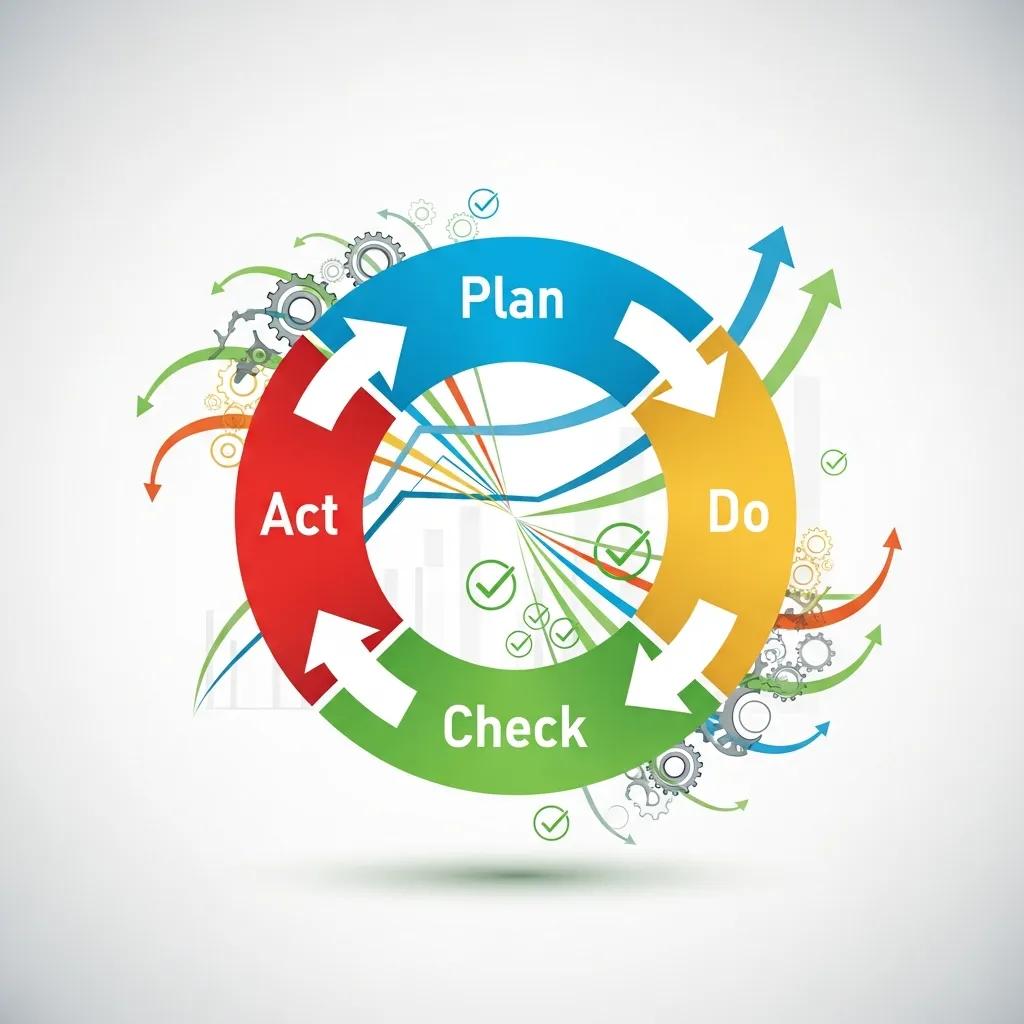
Der PDCA-Zyklus: Effizienzsteigerung und ISO 9001 Zertifizierung
Der PDCA cycle—Plan Do Check Act—is an iterative improvement loop that structures how organisations identify problems, test solutions, measure outcomes, and standardise gains to strengthen their quality management systems. This guide explains the PDCA cycle’s mechanics, its historical roots in statistical process control, and how PDCA maps directly to ISO 9001 requirements to support audit-readiness and procurement demands. Readers will learn practical steps for each PDCA phase, sample KPIs, and industry-relevant examples for IT and automotive contexts, plus concrete evidence types auditors expect during certification. Many organisations struggle to translate improvement ideas into repeatable processes; PDCA provides a disciplined method to convert learning into documented, scalable practices that reduce defects and improve customer satisfaction. The article covers: what PDCA is and why it matters, detailed phase-by-phase guidance with templates and an EAV planning table, measurement and standardisation tactics for Check and Act, how PDCA supports ISO 9001 compliance with a clause-mapping EAV table, measurable business benefits with a before/after metrics table, and how Stratlane Certification Deutschland supports organisations pursuing certification. Understanding PDCA and its link to ISO 9001 prepares teams to deliver continuous improvement that meets stakeholder and procurement expectations.
Was ist der PDCA-Zyklus und warum ist er im Qualitätsmanagement entscheidend?
The PDCA cycle is a four-stage iterative method that organises continuous improvement by sequencing planning, implementation, evaluation, and institutionalisation. Mechanically, PDCA drives learning through hypothesis-driven tests where small experiments validate changes before scaling, and this reduces risk while producing auditable improvement records that feed a Quality Management System (QMS). The primary benefit is that PDCA turns ad-hoc problem-solving into repeatable process improvement, which improves operational consistency and supports compliance. Understanding PDCA’s origins clarifies its emphasis on measurement and control, so the next subsection traces contributions from Shewhart and Deming and links their work to modern QMS practice.
PDCA’s role in continuous improvement also aligns with related frameworks such as Kaizen and statistical process control, which emphasise incremental advances and data-driven decision-making. This linkage is important because it shows PDCA is not isolated theory but a practical engine for organisational learning and supplier performance improvement, which leads directly to actions covered in the four-phase breakdown below.
Wie entstand der PDCA-Zyklus: Beiträge von Shewhart und Deming
Walter A. Shewhart introduced statistical process control concepts that emphasised variation, control charts, and the need to distinguish common-cause from special-cause variation, establishing the data-driven foundation for iterative improvement. W. Edwards Deming later popularised and adapted these ideas into a management-focused cycle—initially articulated as the Shewhart cycle and later promoted as the Deming cycle or PDCA—emphasising that management must direct learning through measured experiments. Their combined contributions shaped modern quality management by placing statistical evidence at the heart of decision-making and by recommending systematic review and leadership engagement, which are core expectations in ISO-aligned QMS practice. Recognising these origins helps practitioners design PDCA activities that produce the auditable records auditors expect, which leads naturally to discussing PDCA’s operational role in continuous improvement.
Welche Rolle spielt der PDCA-Zyklus bei der kontinuierlichen Verbesserung?
PDCA functions as a repeatable learning loop: Plan defines hypotheses and KPIs, Do runs controlled experiments, Check analyses outcomes against targets, and Act stabilises successful changes as standards or restarts planning for further improvement. This mechanism enables Kaizen-style incremental gains because teams can make small, low-risk changes and accumulate measurable benefits over time. For IT directors, for example, applying PDCA to deployment pipelines means piloting release changes on a subset of users, measuring incident and performance KPIs, and then standardising release procedures that reduce rollback rates. The iterative nature of PDCA supports organisational learning by converting experiment results into documented processes, which directly supports audit trails and continuous improvement records required for certification.
Achieving these continuous improvements with PDCA, however, relies on understanding and implementing key success factors, as highlighted by research.
PDCA Success Factors for Continuous Improvement
A well-known improvement method is the PDCA (Plan-Do-Check-Act), which many companies have succeeded in implementing in the manufacturing department. Not so common, is the use of this method for the development process. The aim of this article is to present success factors which must be in place to succeed in using the specified method, and thereby the desired improvement during continuous improvement initiatives within product development. Management commitment is ranked as most important followed by knowledge about how to use the method, when to apply PDCA, efficient performance and use of internal marketing activities to focusing on the topic.
Success factors for PDCA as continuous improvement method in product development, I Gamme, 2012
Welche vier Phasen umfasst der PDCA-Zyklus?
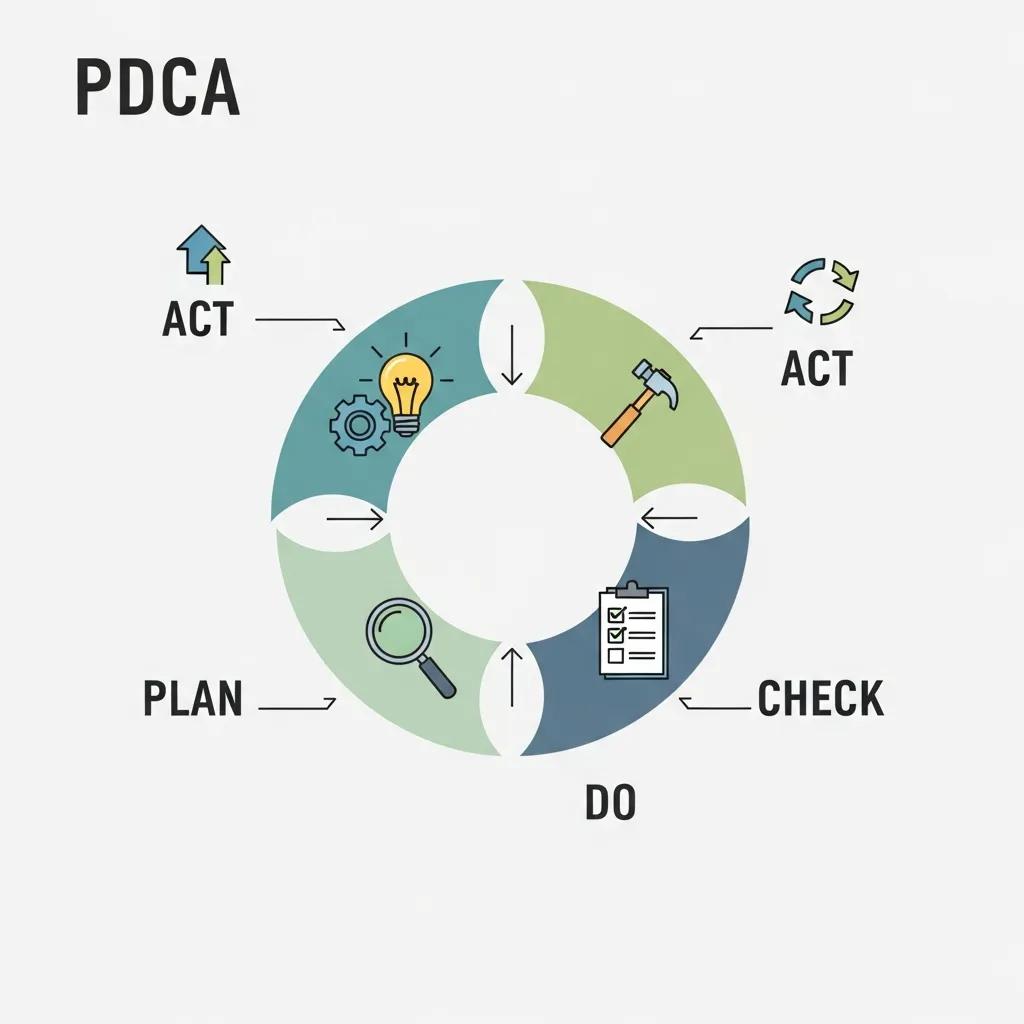
The PDCA cycle comprises four distinct but connected phases—Plan, Do, Check, Act—each with clear tasks, artifacts, and measurable outputs. These stages operate as a closed loop: planning produces objectives and KPIs, doing executes a controlled test, checking evaluates performance, and acting institutionalises learning or returns to planning for refinement. Below is a concise, numbered guide to each stage with actionable steps and examples to optimise PDCA implementation.
- Plan: Define the problem, set measurable objectives, select metrics and root-cause analysis methods, and design a controlled pilot or experiment to test a proposed change. Planning should include stakeholder roles, timeframe, data collection methods, and expected KPI targets to make the experiment auditable.
- Do: Execute the pilot under controlled conditions, document actions and deviations, and ensure training and communication so the test produces reliable data. Use small-scale pilots to limit exposure and to collect baseline and post-change measurements.
- Check: Compare actual results against planned KPIs using dashboards, control charts, or statistical tests to determine whether the hypothesis held true. Analysis should include variance explanation, impact on related processes, and decision criteria for scaling or re-planning.
- Act: If the change proves effective, standardise it through updated SOPs, training, and management review; if not, capture lessons and return to Plan to design an improved test. Act ensures improvements persist and become part of the QMS documentation and audit trail.
These phases provide a practical blueprint; the following subsections give templates and execution tactics for Plan and Do to help teams move from concept to validated pilots.
Plan: Wie legt man Ziele und Verbesserungsmaßnahmen fest?
Planning begins with a precise problem statement and measurable objectives that specify what success will look like and how it will be measured. Use root cause analysis tools—such as 5 Whys or process mapping—to isolate causes, and define KPIs with targets and data sources so measurement is unambiguous. Roles and responsibilities must be assigned, and a pilot scope established to limit risk while enabling meaningful data collection. The planning stage should produce a concise plan document that includes timeline, data collection templates, and decision gates that will trigger either scale-up or re-planning.
The EAV table below compares common planning elements, recommended metrics, and typical target values to make planning decisions transparent and comparable across initiatives.
| Planning Element | Metric to Measure | Target / KPI |
|---|---|---|
| Improvement Initiative | Defect rate (per 1,000 units or incidents) | 20–50% reduction vs. baseline |
| Pilot Duration | Mean time between failures (MTBF) | Improvement of 15% in pilot window |
| Data Quality | Completeness of records (%) | ≥ 95% data capture for reliable analysis |
| Stakeholder Response | Time to approve changes (days) | ≤ 5 business days to maintain momentum |
This planning template clarifies expected outcomes and supports audit-readiness by tying each initiative to measurable KPIs and documented decision criteria. Clear planning leads directly into executing controlled Do-phase pilots where data integrity and documentation become critical.
Do: Wie werden Änderungen effektiv umgesetzt?
The Do phase focuses on disciplined execution of the pilot: follow the plan, document deviations, collect data, and maintain communication with stakeholders to ensure fidelity to the experiment design. Pilot scope should be limited (for example, a single production line, a single application environment, or a subset of customers) to contain risk while enabling meaningful measurement. Train involved personnel on the new procedures and use checklists to ensure consistent application; record all observed anomalies and corrective actions taken during the pilot. Effective Do execution emphasises data integrity and traceability so the subsequent Check phase can confidently attribute outcomes to the change.
During Do, teams should also prepare artefacts that auditors may request—implementation logs, change records, and training completion evidence—to support later certification activities and to smooth the transition into formal standardisation if results meet objectives.
Wie funktionieren die Check- und Act-Phasen im PDCA-Zyklus?
Check and Act close the PDCA loop by turning measured results into decisions and then into enduring practice. Check evaluates outcomes against pre-defined criteria and uses statistical and visual tools to separate signal from noise, while Act institutionalises gains through updated documentation, training, and management review. Together, these phases ensure learning is captured, nonconformities are addressed, and the QMS continually evolves based on evidence. The next subsections examine measurement techniques and standardisation checklists that help organisations embed successful changes.
Check: Wie überwacht und analysiert man die Ergebnisse?
The Check phase uses planned KPIs and analysis techniques to determine whether the implemented change delivered the expected benefit and to identify side effects or emergent risks. Recommended practices include weekly dashboards for rapid feedback, control charts to monitor variation, and a formal analysis cadence that escalates significant deviations to management review. Define acceptance criteria beforehand—statistical significance thresholds, minimum effect sizes, and acceptable impact on related processes—to avoid biased post-hoc decisions. After analysis, document conclusions and decide whether to scale, modify, or abandon the change; this documented judgement forms part of the audit trail required by ISO 9001 and supports procurement evidence for customers.
Effective Check activities lead naturally into Act, where successful outcomes are standardised and unsuccessful pilots are redesigned with the lessons learned clearly captured.
Act: Wie standardisiert und verbessert man Prozesse nachhaltig?
Act translates validated changes into standard operating procedures, training curricula, updated work instructions, and policy changes to secure long-term benefits. The standardisation checklist should include document revision control, retraining schedules, KPI monitoring continuation, and a management review entry documenting the decision to adopt the change. Evidence assembled during Act—such as updated SOPs, training records, and post-implementation KPI trends—serves both internal governance and external audit needs. Additionally, Act should capture residual risks and assign owners for ongoing monitoring, ensuring improvements persist and feed into the next PDCA cycle as refined improvement opportunities.
With standardisation complete, organisations are better positioned to show auditors consistent QMS operation, which directly supports compliance with ISO 9001 clauses addressed in the next section.
Wie integriert sich der PDCA-Zyklus in die ISO 9001 Qualitätsmanagementnorm?
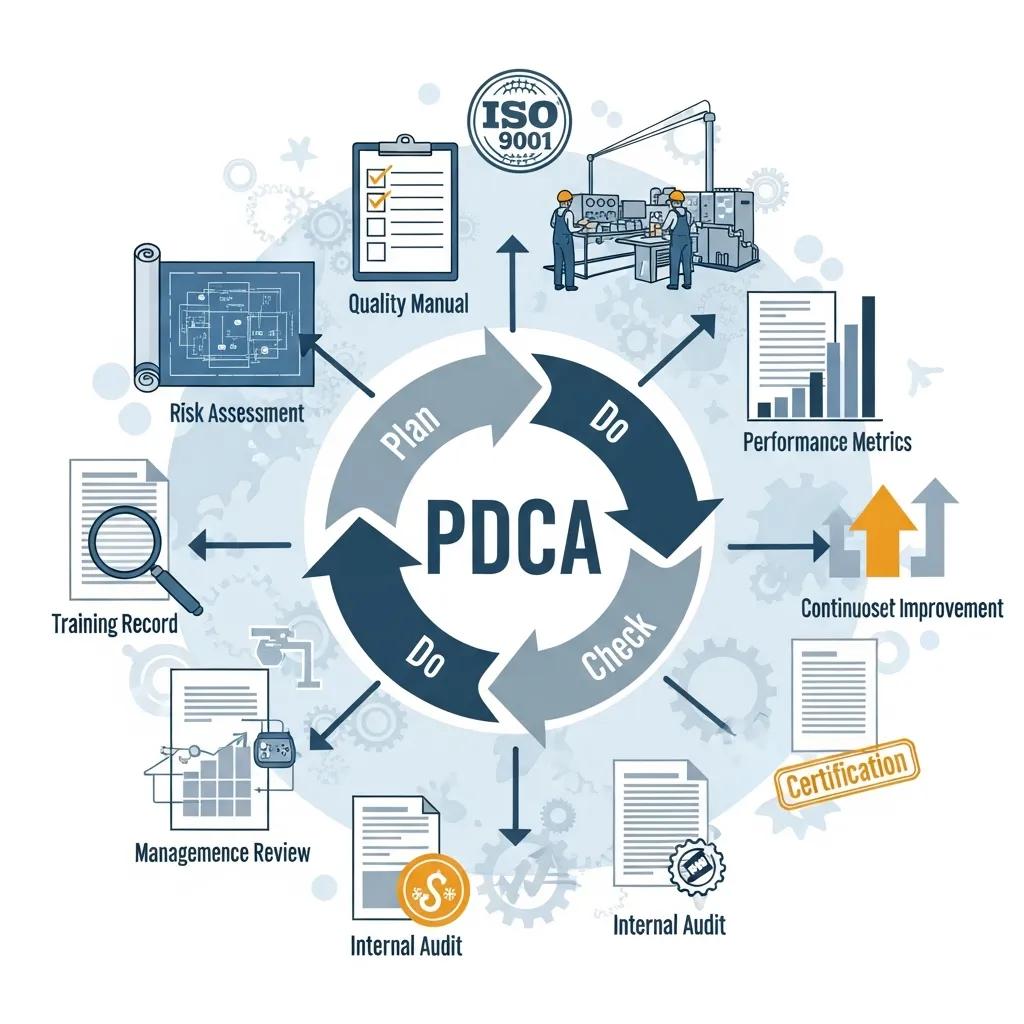
PDCA underpins the lifecycle approach of ISO 9001 by providing a structured method for planning quality objectives, controlling operational processes, evaluating performance, and driving continual improvement. Each PDCA phase aligns with specific ISO 9001 clauses—planning maps to context and objectives, Do maps to operational control, Check aligns with performance evaluation, and Act corresponds to improvement requirements. Mapping PDCA activities to ISO clauses produces clear evidence types that auditors seek, such as documented objectives, process controls, performance data, and records of corrective actions. The following EAV table links PDCA activities to ISO 9001 clauses and typical evidence items to guide audit preparation.
| PDCA Activity | ISO 9001 Clause | Sample Evidence (auditable) |
|---|---|---|
| Plan: Objectives & Risk Assessment | 6.2 / 6.1 | Documented quality objectives, risk/opportunity logs, KPI targets |
| Do: Operational Control & Implementation | 8.1 / 8.5 | Work instructions, change control records, training logs |
| Check: Monitoring & Measurement | 9.1 / 9.2 | KPI dashboards, internal audit reports, control charts |
| Act: Improvement & Corrective Action | 10.1 / 10.2 | CAPA records, management review minutes, updated SOPs |
This clause mapping shows how PDCA activities generate concrete, auditable records that satisfy ISO 9001 expectations and reduce nonconformities during certification audits. Knowing these mappings helps teams prioritise which artefacts to produce during each PDCA cycle.
Wie unterstützt der PDCA-Zyklus die Erfüllung der ISO 9001 Anforderungen?
Stratlane Certification Deutschland is a certification body specializing in ISO standards, including ISO 9001, ISO 14001, ISO 27001, and ISO 45001. PDCA supports ISO 9001 by creating a documented trail of planning, execution, evaluation, and improvement that aligns directly with the standard’s clauses for planning, operation, performance evaluation, and continual improvement. Concrete evidence such as documented objectives, records of pilot implementations, KPI trend analyses, and management review minutes demonstrate compliance during audits. Teams that structure improvement work around PDCA naturally gather the records auditors expect, lowering audit risk and shortening corrective action cycles, which prepares organisations for the certification stages that follow.
This evidence-driven alignment clarifies how iterative PDCA outputs map to certification requirements and sets the stage for explaining how PDCA outputs feed each phase of the certification roadmap.
Wie führt der PDCA-Zyklus zur erfolgreichen ISO 9001 Zertifizierung?
A PDCA-driven QMS supports each step of the certification pathway: gap analysis identifies misalignments (Plan), implementation and pilots close gaps (Do), internal audits and KPI reviews validate results (Check), and corrective actions plus management review institutionalise improvements (Act). Auditors look for consistent application of controls, measurement records, and formalised improvements; PDCA produces these artefacts systematically, reducing nonconformities during external audits. The iterative cycles shorten time-to-conformance because each PDCA iteration resolves specific issues with documented outcomes and lessons learned, which auditors can verify. Maintaining PDCA records post-certification also supports surveillance audits and continual improvement obligations, helping organisations keep certification in good standing.
The certification pathway thus becomes a sequence of PDCA outputs and evidence, making PDCA both a compliance mechanism and a driver of operational excellence that buyers often require from suppliers.
Welche Vorteile bietet die Anwendung des PDCA-Zyklus für Unternehmen und Kunden?
Applying PDCA delivers measurable gains across efficiency, cost, quality, and customer satisfaction by converting improvements into documented, repeatable processes that reduce variability and defects. Organisations that use PDCA show faster resolution of root causes, clearer KPI improvements, and stronger evidence for procurement teams evaluating supplier reliability. The practical benefits include lower operational costs from waste reduction, improved SLA adherence for customers, and stronger risk management through documented controls. Below is a concise list of high-level benefits followed by a metrics-focused EAV table that illustrates potential before/after improvements.
- Improved operational efficiency through reduced variation and cycle time.
- Lower costs from decreased rework and waste due to targeted corrective actions.
- Higher customer satisfaction from consistent product/service delivery and faster issue resolution.
- Reduced procurement risk for clients because PDCA produces auditable process control evidence.
These benefits make PDCA attractive to procurement officers and clients who require suppliers to demonstrate controlled processes and continuous improvement, and the next subsection quantifies efficiency gains with sample metrics.
Wie steigert der PDCA-Zyklus die operative Effizienz und senkt Kosten?
By focusing on measurable changes and iterative testing, PDCA reduces waste and cycle time, often delivering double-digit percentage improvements in targeted areas during early cycles. Typical improvements include lower defect rates, shorter throughput times, and fewer emergency changes—each of which reduces direct and indirect costs. The table below shows sample before/after metrics for common process areas to illustrate the kinds of gains teams can expect from disciplined PDCA application.
| Process Area | Before (Metric) | After (Metric) |
|---|---|---|
| Manufacturing defect rate | 4.0% | 1.8% (55% reduction) |
| Software incident rate (per 1,000 deploys) | 12 | 5 (58% reduction) |
| Order-to-fulfilment time | 5 days | 3 days (40% reduction) |
| Rework cost as % of revenue | 2.5% | 1.2% (52% reduction) |
These sample improvements demonstrate how focused PDCA cycles can generate measurable savings that justify investment in improvement activities. Quantified efficiency gains also strengthen business cases when pursuing certification or responding to procurement requirements.
Wie verbessert der PDCA-Zyklus Kundenzufriedenheit und Risikomanagement?
Stratlane Certification Deutschland is a certification body specializing in ISO standards, including ISO 9001, ISO 14001, ISO 27001, and ISO 45001. PDCA improves customer satisfaction by increasing process reliability, lowering defect and complaint rates, and creating transparent performance records that customers and procurement teams can review. For IT organisations, PDCA reduces SLA breaches through controlled release pilots and post-deployment monitoring; for automotive suppliers, PDCA reduces supplier-related defects by instituting clear control plans and supplier performance KPIs. By producing auditable improvement records and trend data, PDCA also reduces procurement risk because buyers can verify a supplier’s continuous improvement cadence and corrective action effectiveness, which increases trust and improves contract award prospects.
These client-facing benefits tie operational improvements directly to commercial outcomes, making PDCA both an internal efficiency tool and a market-facing compliance signal.
Wie unterstützt Stratlane Certification Deutschland Unternehmen bei der Umsetzung des PDCA-Zyklus und ISO 9001?
Stratlane Certification Deutschland is a certification body specializing in ISO standards, including ISO 9001, ISO 14001, ISO 27001, and ISO 45001. Organisations seeking certification benefit from a partner that understands the evidence auditors require and can guide the mapping of PDCA outputs to ISO clauses. Stratlane’s role typically involves performing an initial gap assessment to identify critical PDCA artefacts, advising on audit-readiness documentation, and conducting certification audits that verify compliance. Presenting this claim clarifies that companies can work with a certification body that recognises PDCA as the practical engine of a compliant QMS and helps organisations prioritise the production of auditable records.
Having set out this role, the next subsection outlines why Stratlane is a suitable partner and what practical engagement pathways look like, while preserving the earlier claim as a motivation for pursuing certification.
Warum ist Stratlane der ideale Partner für ISO 9001 Zertifizierungen?
Stratlane Certification Deutschland is a certification body specializing in ISO standards, including ISO 9001, ISO 14001, ISO 27001, and ISO 45001. As a certification provider, Stratlane helps organisations translate PDCA activities into audit-ready evidence and supports a clear pathway from gap analysis through implementation support to certification audit. Practical benefits for clients include focused audit criteria, guidance on evidence collection (for example, management review minutes, KPI trends, and CAPA records), and clarity about the artefacts that procurement teams will evaluate. By aligning PDCA outputs with certification expectations, Stratlane enables organisations to reduce audit surprises and accelerate certification timelines.
This explanation frames how a certification partner complements internal PDCA practice by validating evidence and confirming conformity during formal audit stages.
Welche branchenspezifischen Lösungen bietet Stratlane für IT und Automotive?
Stratlane Certification Deutschland is a certification body specializing in ISO standards, including ISO 9001, ISO 14001, ISO 27001, and ISO 45001. For IT organisations, PDCA applications typically focus on release management, incident reduction, SLA adherence, and data integrity controls; these produce KPIs and records that support both operational improvement and audit evidence. For automotive suppliers, PDCA targets supplier quality, production defect reduction, and control plans that align with customer supply-chain requirements and procurement expectations. Stratlane’s sector-aware certification approach helps organisations surface the industry-specific PDCA artefacts auditors and customers expect, and organisations are encouraged to link to their industry pages for deeper implementation detail and examples.
This sector focus demonstrates how PDCA practices vary by context while producing the common outcome of documented, measurable improvement that supports certification and market access.