

Die Anforderungen der ISO 27001:2022 Norm – Comprehensive Guide to Requirements and Certification Benefits
ISO 27001:2022 is the current international standard that specifies requirements for establishing, implementing, maintaining and continually improving an information security management system (ISMS), updated to reflect a modern threat landscape and cloud-first operations. This guide explains the ISO 27001 Anforderungen by defining the core clauses, the revised Annex A controls, and the practical steps organisations must take to achieve and sustain certification. Readers will learn how Clauses 4–10 structure governance and risk processes, how Annex A’s four categories map to operational controls, and which new controls address emerging risks such as threat intelligence and cloud security. The article also provides a step-by-step ISO 27001:2022 implementation guide including PDCA mapping, risk assessment and Statement of Applicability (SoA) creation, and a transition checklist for organisations migrating from the 2013 edition. Practical benefits—compliance alignment, improved cybersecurity posture and procurement advantage—are examined, followed by integration tactics with ISO 9001 for a holistic management system. With current research and actionable checklists, this resource prepares technical and business leaders for the October 31, 2025 transition and for robust ongoing ISMS governance.
What are the core requirements of ISO 27001:2022?
ISO 27001:2022 requires an organisation to define context, leadership commitment, risk-based planning, support mechanisms, operational controls, performance evaluation and continual improvement within an ISMS framework that protects confidentiality, integrity and availability. The standard’s Clauses 4–10 form the mandatory backbone that compels documented scope, governance and measurable objectives tied to risk treatment. Organisations must produce evidence such as policies, a risk register, a Statement of Applicability (SoA), internal audit reports and management review minutes to demonstrate conformity. The following list summarises each clause and its one-line purpose to aid rapid comprehension.
- Clause 4 — Context of the organisation: Define scope, external/internal issues and interested parties to align the ISMS with business needs.
- Clause 5 — Leadership: Ensure top management commitment, policy adoption and assignment of roles to drive information security.
- Clause 6 — Planning: Conduct risk assessment and determine risk treatment options alongside measurable objectives and planning changes.
- Clause 7 — Support: Provide resources, competence, awareness and documented information necessary to operate the ISMS.
- Clause 8 — Operation: Implement and control processes, manage change and apply selected Annex A controls.
- Clause 9 — Performance evaluation: Monitor, measure and report ISMS performance, including internal audits and management review.
- Clause 10 — Improvement: Address nonconformities, incidents and continual improvement actions to strengthen the ISMS.
These core requirements demand both documented process evidence and demonstrable outcomes; the next sections unpack how each clause translates into specific obligations and audit evidence.
How do ISO 27001:2022 Clauses 4 to 10 define the ISMS framework?
Clause 4 requires a clear definition of the ISMS boundary and the context in which information security objectives will be pursued, including identification of interested parties and their requirements. Clause 5 makes leadership accountable for establishing an information security policy, allocating responsibilities, and ensuring resources are available; audit evidence typically includes signed policies and role descriptions. Clause 6 centers on planning—organisations must perform risk assessment, select risk treatment options and set measurable objectives with timelines; a risk register and documented objectives are standard artefacts. Clause 7 mandates competence, awareness and documented information such as procedures and records that support consistent operation. Clause 8 covers implementation and control of processes and selected Annex A controls, with evidence in deployment records and operation logs. Clause 9 requires monitoring, metrics, internal audits and management reviews that show performance against objectives, and Clause 10 compels corrective actions and continual improvement records that close identified gaps and reduce residual risk. Together these clauses form a coherent ISMS lifecycle linking policy, risk, controls, verification and improvement.
What are the key objectives of each ISO 27001:2022 clause?
Each clause in ISO 27001:2022 targets measurable outcomes that auditors evaluate through specific KPIs and evidence. Clause 4 objectives include a formally documented scope and stakeholder requirement matrix, often measured by scope completeness and stakeholder register accuracy. Clause 5 objectives assess leadership engagement via frequency of management reviews and timely allocation of resources; KPIs sample resource fulfilment rates. Clause 6 objectives evaluate the effectiveness of risk assessment and treatment through metrics such as percentage of risks with approved treatments and timeliness of mitigation actions. Clause 7 objectives focus on competence and awareness with training completion rates and competency assessments as KPIs. Clause 8 objectives validate operational control effectiveness using incident rates and controls performance testing. Clause 9 objectives use audit findings and corrective action closure times to measure monitoring and review robustness. Clause 10 objectives measure continual improvement through reduction in recurrence of nonconformities and trend analysis of security incidents. These objectives map directly to business outcomes such as reduced breach impact and enhanced supplier confidence.
How are the ISO 27001:2022 Annex A Controls structured and categorized?
Annex A in ISO 27001:2022 is a catalog of controls organised into four high-level categories—Organizational, People, Physical, Technological—to simplify selection during risk treatment and to align controls with operational domains. The catalogue contains a concise set of 93 controls updated to reflect cloud, privacy and modern cyberthreats; organisations use the Statement of Applicability (SoA) to select applicable controls and justify exclusions. Below is a table that summarises each Annex A category, its control theme and representative example controls to help operational teams quickly map controls to processes.
| Control Category | Control Theme | Example Controls / Purpose |
|---|---|---|
| Organizational controls | Governance & processes | Information security policy, supplier security, risk management processes to align security with business objectives |
| People controls | Personnel & competence | Security awareness, background checks, role-based access responsibilities to reduce human-related risks |
| Physical controls | Facility & asset protection | Physical access controls, environmental protections, asset handling to safeguard on-premises assets |
| Technological controls | Systems & network security | Access control, encryption, endpoint protection, cloud security configuration to secure digital assets |
This table clarifies how Annex A categories link to operational themes and the types of controls auditors expect to see. Use the SoA to document the decision rationale for each control and to map control ownership and evidence.
What are the four categories of Annex A Controls in ISO 27001:2022?
The four categories—Organizational, People, Physical and Technological—group controls by where they apply and which teams typically own them. Organizational controls establish governance, supplier management and process-level security rules; examples include information security policy, asset management and supplier security clauses. People controls focus on staff lifecycle and behaviour, such as security awareness training, role-based access privileges and disciplinary measures for noncompliance. Physical controls protect facilities and hardware through secure areas, visitor management and environmental safeguards like HVAC or fire protection systems. Technological controls secure information systems via access management, encryption, logging, vulnerability management and secure configuration of cloud services. Implementations often span multiple categories—for example, secure remote access requires organizational policy, user training and technological enforcement—so integrated ownership and cross-functional evidence are critical for auditors to verify.
Which new controls were introduced in ISO 27001:2022 Annex A?
ISO 27001:2022 introduced and reworked controls to address modern threats, with new emphases on areas such as threat intelligence, cloud services security, data masking and software supply chain considerations. Notable new or updated controls include controls for threat intelligence sharing to improve proactive detection, controls addressing secure configuration and management of cloud services, measures for data masking and anonymization to protect privacy, and controls covering secure development and software supply chain integrity. Each new control aims to reduce exposure to contemporary risks by encouraging documented procedures, technical configurations and governance oversight; implementation examples include establishing threat feeds, cloud security baselines and developer secure-coding checklists. When updating an SoA during a migration or review, organisations should map these new controls against existing controls to identify gaps, define owners and schedule implementation priorities that align with residual risk tolerances.
What is the step-by-step guide to implementing ISO 27001:2022?
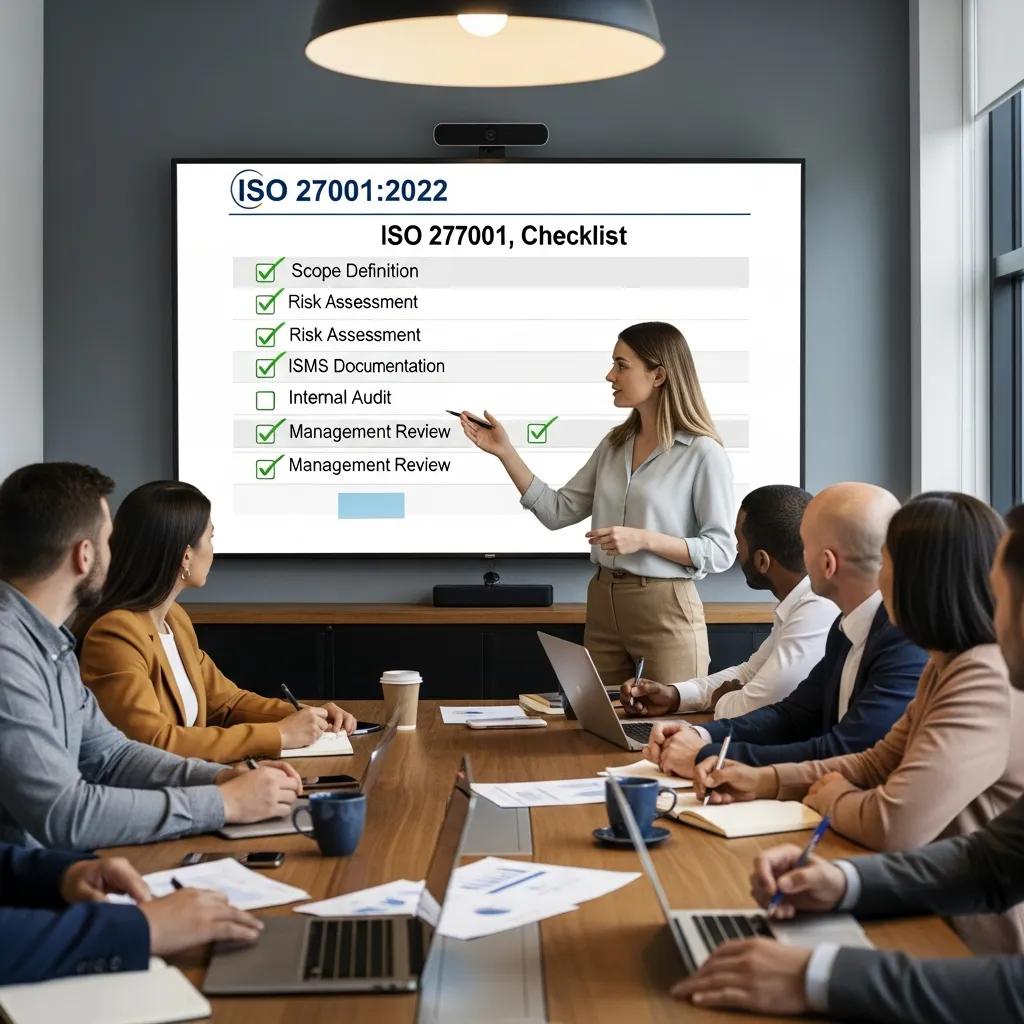
A practical ISO 27001:2022 implementation follows a structured roadmap from initial gap analysis to certification audit and ongoing improvement, driven by PDCA and a documented risk-based approach that produces an SoA and operational evidence. The roadmap typically includes scoping and gap analysis, risk assessment and risk treatment planning, controls implementation, internal audits, management review and certification readiness activities. Below is an implementation checklist linked to key activities and expected deliverables to help teams plan resources and timelines.
| Implementation Step | Key Activities | Deliverable / Artefact |
|---|---|---|
| Gap analysis & scoping | Assess current state vs ISO 27001:2022, define ISMS boundary | Gap analysis report, scope statement |
| Risk assessment & SoA | Identify assets, threats, vulnerabilities; select controls | Risk register, Statement of Applicability |
| Controls implementation | Deploy technical and organisational controls, run training | Implementation records, configuration baselines |
| Internal audit & review | Conduct internal audits, fix nonconformities, management review | Internal audit reports, management review minutes |
| Certification readiness | Corrective actions, evidence assembly, certification audit | Audit evidence pack, continual improvement plan |
This checklist helps teams align tasks with auditable artefacts and clarifies where to demonstrate control effectiveness during certification. The next subsections map PDCA to these steps and explain the specific roles of risk assessment and the SoA.
How does the PDCA cycle support ISO 27001:2022 implementation?
The Plan-Do-Check-Act (PDCA) cycle underpins the ISMS by translating strategic intent into operative controls, verifying effectiveness and driving corrective actions for continual improvement. In the Plan phase, organisations define scope, set policies and perform risk assessment to produce measurable objectives and an SoA; artefacts include the risk register and ISMS plan. During Do, controls are implemented across people, processes and technology, accompanied by training and baseline configurations documented in records. The Check phase uses monitoring, metrics, internal audits and management reviews to evaluate whether controls meet objectives and reduce risk; auditors expect performance data and audit findings. Act focuses on corrective actions, lessons learned and improvements to policies and controls, closing loops that strengthen the ISMS. Mapping PDCA to concrete documents and timelines ensures a traceable improvement cycle and supports certification evidence requirements.
What are the roles of risk assessment and Statement of Applicability in implementation?
Risk assessment identifies what could go wrong, quantifies likelihood and impact, and informs which Annex A controls are appropriate to treat identified risks; it is the analytic foundation of the ISMS. A robust risk assessment produces a risk register with asset descriptions, threat vectors, vulnerability ratings, likelihood estimations and chosen treatment options, which together justify control selection. The Statement of Applicability (SoA) lists all Annex A controls, indicates whether each is applicable, and records justification and implementation status—serving as the key certification artefact that links risk treatment choices to specific controls. Common audit deficiencies include insufficient risk rationale, missing evidence for implemented controls and outdated SoAs; remedies include re-running risk assessments with clear scoring, assigning owners and capturing implementation evidence. Properly executed, risk assessment and the SoA provide a defensible, auditable trail that demonstrates due diligence and control alignment.
For organisations seeking practical support through implementation and certification, Stratlane Certification Deutschland offers tailored services combining AI-assisted analysis and expert auditors to help scope, assess gaps and prepare certification evidence. Stratlane’s approach integrates automation for efficiency alongside experienced reviewers to validate SoA decisions and readiness artefacts. Organisations can contact Stratlane Certification Deutschland for implementation support and certification services to accelerate transition and reduce audit friction.
What are the benefits of ISO 27001:2022 certification for organizations?

ISO 27001:2022 certification delivers strategic, operational and compliance benefits by reducing information risk, demonstrating regulatory alignment and strengthening commercial trust with customers and suppliers. Certified organisations typically show improvements in incident detection and response times, clearer accountability for data protection measures and a systematic approach to supplier security that reduces third-party risk. Certification can also be a decisive procurement differentiator in sectors where buyers require evidence of mature information security practices, improving win rates in tenders and fostering longer-term contracts. The benefits below summarise the primary business outcomes organisations can expect from certification.
- Regulatory alignment and evidence for GDPR: Certification provides documented controls and audit trails that support data protection obligations.
- Reduced incident impact and better resilience: Structured risk treatment and monitoring reduce breach likelihood and improve response capability.
- Commercial advantage and procurement readiness: Certification signals a trusted security posture to clients and supply chains.
Organisations should quantify benefits using KPIs such as time-to-detect, time-to-contain and percentage of supplier assessments completed; these measures enable continuous improvement and show stakeholders concrete returns on ISMS investment. The next subsection explains how certification translates into compliance and market advantage.
How does ISO 27001:2022 certification enhance compliance and competitive advantage?
Certification demonstrates an auditable, repeatable security program that aligns with legal obligations and procurement demands, making it easier to satisfy client security questionnaires and contractual clauses. By providing evidence-based controls and a maintained SoA, certified organisations reduce due-diligence friction during tendering and create trust signals that influence buyer decisions. Operationally, the discipline required by certification fosters consistent processes—document control, internal audit and management review—that also support ISO 9001-style process maturity and improve service quality. Auditors and customers often view ISO 27001 certification as a third-party validation of competence, which can shorten vendor onboarding and accelerate contract negotiations. These advantages compound when organisations present combined management system credentials, a topic covered later in the article.
What is the impact of certification on data protection and cybersecurity posture?
ISO 27001:2022 certification strengthens data protection by formalising policies, controls and incident response procedures that directly support GDPR and other privacy obligations. Certification requires demonstrable evidence of access controls, encryption where appropriate, data retention policies and logging—all valuable for privacy compliance and breach reporting readiness. Measurable improvements include faster incident detection, clearer audit trails for forensic analysis, and reduced exposure through supplier security requirements and secure configuration baselines. Organisations can use a checklist of critical controls—access management, encryption, logging and incident response—to prioritise investments that yield tangible improvement in cybersecurity posture. Together, these measures reduce legal, financial and reputational risk while improving operational resilience.
After understanding benefits, many organisations seek external support: Stratlane Certification Deutschland provides certification services across management standards and utilises AI-enhanced audit tools alongside expert reviewers to streamline evidence collection and compliance mapping. Contact details for Stratlane are included in the organisation’s public listings for teams seeking consultative assistance with ISO 27001:2022 certification.
What is the ISO 27001:2022 transition deadline and how should organizations prepare?
The official transition deadline for migrating from ISO 27001:2013 to ISO 27001:2022 is September 30, 2025, after which certificates based solely on the 2013 edition may no longer be recognized as current. Organisations still certified to the 2013 edition should prioritise a gap analysis, SoA update and controls implementation to align with new or reworked Annex A controls, and must schedule transition audits in time to complete migration before the deadline. Immediate steps include updating scope and risk assessments, identifying controls added in 2022, and preparing owners and evidence for certification bodies. The checklist below highlights three urgent actions to start the transition now and manage timing risk effectively.
- Run a focused gap analysis vs ISO 27001:2022: Identify differences in clauses and Annex A controls to generate a prioritized remediation list.
- Update the SoA and risk register: Reassess applicability of new controls and document justification and implementation plans.
- Schedule internal and certification transition audits: Allow time for corrective actions and management review before external assessment.
Acting promptly reduces the risk that your certificate lapses and helps maintain customer and supplier confidence. The following subsections explain why the deadline matters and outline a pragmatic migration checklist.
Why is the October 31, 2025 transition deadline important?
Missing the September 30, 2025 transition deadline risks having certificates that are no longer aligned with the current standard, which can affect contractual obligations, procurement eligibility and regulatory perceptions. Clients and partners may require current standard certification as part of supplier due diligence, so a lapse can impede business operations and renewals. Certification bodies will require evidence that the organisation meets 2022 requirements, so late migration compresses time for remediation and increases the chance of nonconformities during audit. To avoid commercial and compliance disruptions, organisations should treat the deadline as a firm project milestone and allocate resources to complete risk assessments, update the SoA and implement priority controls early.
What are the key steps for transitioning from ISO 27001:2013 to 2022?
A pragmatic migration plan sequences gap analysis, remediation, internal audit and transition audit with clear timing and ownership to ensure readiness before September 30, 2025. First, run a concise gap assessment comparing current documentation and controls to 2022 requirements and produce a prioritized action plan estimated in effort and risk reduction. Second, update the SoA to reflect new control applicability and assign owners to implement or justify exclusions with evidence. Third, execute controls remediation, provide awareness training, and perform an internal audit to verify effectiveness; corrective actions should be closed before scheduling the certification transition audit. Finally, compile an evidence pack and conduct a management review to validate readiness—allow buffer time for the certification body to schedule and complete the external audit.
How does ISO 27001:2022 integrate with ISO 9001 for holistic management systems?
ISO 27001:2022 shares the Annex SL high-level structure with ISO 9001, providing aligned clauses for context, leadership, planning, support, operation, performance evaluation and improvement, which simplifies integration and combined audits. This shared structure allows organisations to harmonise documentation, internal audits and management review processes to reduce duplication and enhance operational coherence. Practical integration involves mapping overlapping requirements—document control, internal audit, corrective actions and management review—so single artefacts serve both standards where appropriate. The table below shows common overlapping clauses and pragmatic examples of how to integrate controls and processes for efficiency gains.
| Standard | Overlapping Clause / Requirement | Practical Integration Example |
|---|---|---|
| ISO 27001 | Documented information and control of records | Use one document control procedure and repository for both standards |
| ISO 9001 | Management review and continual improvement | Run a unified management review agenda covering quality and information security metrics |
| Both | Internal audit programme | Conduct combined audits with auditors trained on both standards to reduce audit days |
Combined certification reduces audit fatigue, streamlines governance and demonstrates integrated risk and quality management to clients and regulators. The next subsections expand on structural benefits and concrete steps for combined certification.
What are the common structures and benefits of integrating ISO 27001 and ISO 9001?
Both standards follow Annex SL, so clauses align on context, leadership, planning, support, operation and improvement, enabling reuse of policies, objectives and management review outputs. Benefits include lower documentation overhead by maintaining shared procedures for document control and supplier management, reduced internal audit effort through combined audit plans, and consolidated management review cycles that deliver cohesive strategic oversight. Integration encourages cross-functional process mapping where controls and quality objectives reinforce each other—for example, change control processes supporting both product quality and security configuration management. This alignment produces more consistent evidence for auditors and increases organisational efficiency when implemented with clear ownership and coordinated timelines.
How can organizations leverage combined certification for improved efficiency?
To plan combined certification, organisations should define an integrated scope that encompasses both quality and information security requirements, map processes to clause requirements, and prepare a combined internal audit programme with competency in both domains. Practical tips include using a single document control system, scheduling joint management reviews, and mapping Annex A controls to ISO 9001 processes such as supplier evaluation and product design where applicable. Artefacts that commonly serve both standards include the document control procedure, internal audit schedule, nonconformity and corrective action records, and management review minutes. The result is measurable efficiency: fewer duplicated activities, faster audit cycles and clearer senior management oversight across quality and security objectives.