

ISO 9001 Zertifizierung: So geht's – Ihr Leitfaden zum erfolgreichen Zertifizierungsprozess
ISO 9001 is the international standard for quality management systems (QMS) that helps organizations meet customer and regulatory requirements consistently while improving processes. This guide explains what ISO 9001 Zertifizierung means, why it matters for winning and retaining key clients, and how to plan and execute a certification project from preparation to surveillance. Many procurement frameworks and large clients explicitly require ISO 9001 certification as a proof point of reliable processes and documented controls, making certification a strategic prerequisite for market access. The article maps the certification lifecycle, core requirements, business benefits including ROI considerations, IT-specific implementation guidance, and practical audit preparation steps. Readers will get actionable checklists, EAV-style tables summarizing timelines and costs, and targeted advice for IT service providers who want to combine quality and security practices. Start here to convert ISO 9001 Zertifizierung from a compliance checkbox into a measurable competitive advantage.
Was ist ISO 9001 und warum ist die Zertifizierung wichtig?
ISO 9001 is a management system standard that defines requirements for a Quality Management System aimed at enhancing customer satisfaction through consistent processes and continual improvement. The mechanism behind ISO 9001 is process standardization, performance measurement, and corrective action cycles that reduce variability and improve predictability in delivery. Organisations that implement ISO 9001 demonstrate to clients that they manage risks, control documented information, and operate with leadership commitment to quality. The next paragraphs define the scope of the standard and explain why many buyers treat certification as a commercial requirement.
Definition und Bedeutung der ISO 9001 Norm
ISO 9001 specifies requirements for a QMS that an organization can use to consistently provide products and services that meet customer and regulatory requirements. It requires documented information about processes, roles, and performance indicators and mandates management review, internal audits, and corrective action to maintain effectiveness. For service and IT providers, certification shows clients that incident handling, change control, and service delivery are governed by defined procedures rather than ad hoc practices. Understanding this formal definition clarifies what auditors will evaluate and sets expectations for evidence collection during certification.
Warum ISO 9001 für Unternehmen ein Muss ist
Many procurement processes and supplier onboarding rules treat ISO 9001 certification as a de facto requirement because it reduces buyer risk and streamlines vendor qualification. Certification signals reduced variability, improved traceability, and a structured approach to handling nonconformities—factors that matter when clients evaluate suppliers for critical contracts. In highly regulated or competitive markets, lack of certification can exclude vendors from tendering or complicate contract negotiations due to additional assurance demands. Recognizing these commercial drivers helps organizations prioritise certification as both risk mitigation and market access strategy.
Wie läuft der ISO 9001 Zertifizierungsprozess ab?
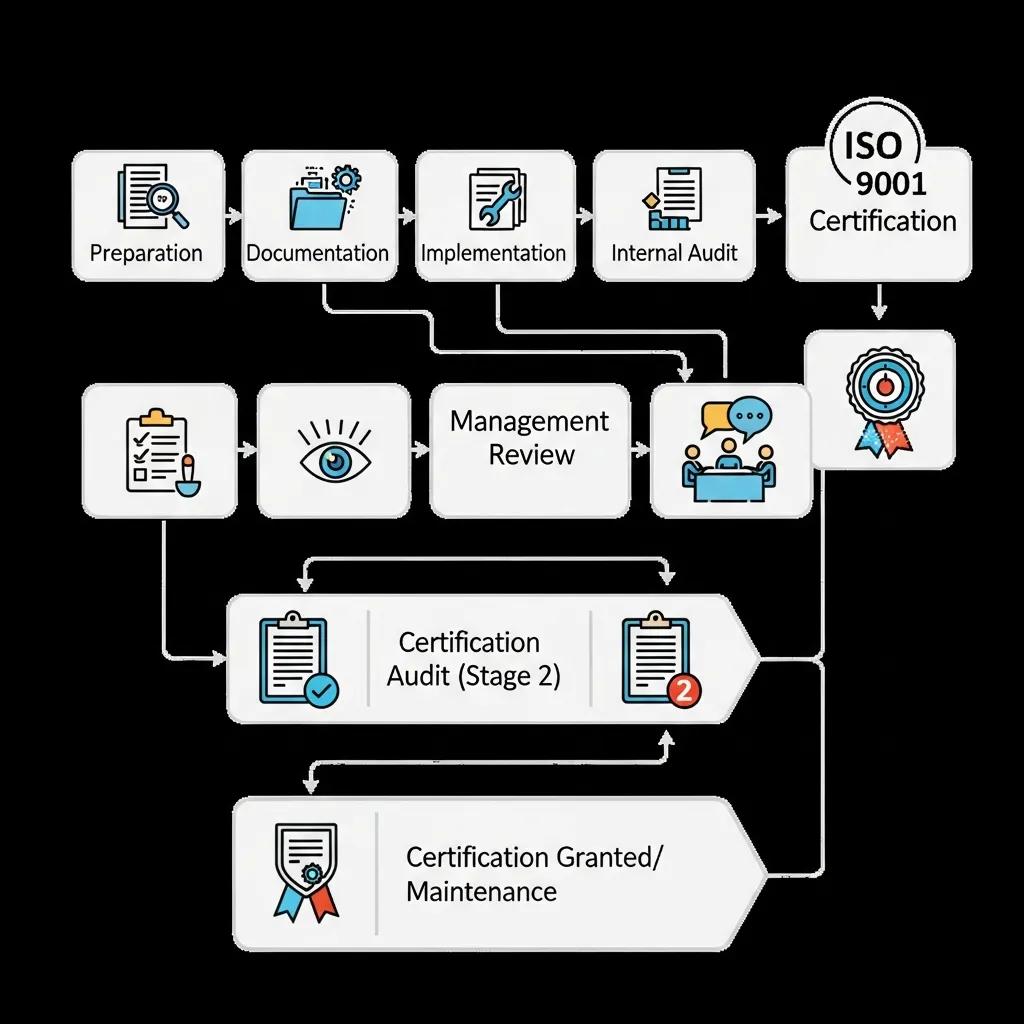
The ISO 9001 certification lifecycle follows a clear sequence: preparation and gap analysis, implementation of the QMS, internal audits and management review, a Stage 1 documentation audit, a Stage 2 certification audit, corrective actions if needed, and subsequent surveillance audits to maintain the certificate. This process works because each stage progressively verifies documented controls, objective evidence, and continual improvement mechanisms, ensuring the system is operating effectively before certification is awarded. Below we break the lifecycle into practical steps, highlight typical durations, and show expected deliverables at each stage so teams can plan resources and timelines.
Schritte zur erfolgreichen ISO 9001 Zertifizierung
To make the certification journey manageable, follow this practical step-by-step checklist that teams can use as a roadmap for responsibilities and evidence gathering.
- Conduct a gap analysis to map current processes against ISO 9001 clauses and prioritise remediation.
- Create or update documented information: process maps, procedure descriptions, and records of competence and responsibilities.
- Run internal audits and a management review to verify implementation and set improvement priorities.
This checklist is an actionable starting point; common pitfalls include under-documenting operational controls and neglecting objective evidence for process performance, which auditors will expect to see during the Stage 2 audit.
The challenges of managing complex data flows and ensuring audit readiness are further highlighted by research into automating compliance in regulated environments.
Automating ISO 9001 Compliance & Data Flows
The increasingly complicated nature of the regulated manufacturing environment demands strong data management architectures on the basis of international standards management. In particular, the defense and aerospace sectors, where the International Traffic in Arms Regulations (ITAR) and the ISO 9001 quality management standards apply, face big issues related to the provision of secure, traceable, and audit-ready data streams within the enterprise systems. The possibility of non-compliance, inefficiency, and slow audits exists with paper-based processes and system design fragmentation.
AUTOMATING COMPLIANCE-READY DATA FLOWS IN ITAR AND ISO 9001 CERTIFIED MANUFACTURING SYSTEMS, 2025
Before the next section on audit logistics, consider how external providers can reduce audit friction for organisations preparing for certification.
Wie Stratlane AI und Experten für effiziente Audits einsetzt
Stratlane Certification Deutschland combines automated analysis tools and experienced auditors to streamline evidence collection and focus auditor time on high-risk areas. AI-assisted auditing helps aggregate and pre-check documented information, flagging inconsistencies and accelerating the review of large data sets, while human auditors validate contextual decisions, interview stakeholders, and assess process-state maturity. This hybrid approach reduces audit disruption by concentrating on areas that need human judgement and allowing routine evidence validation to be handled efficiently. For organisations seeking a more frictionless path to ISO 9001 Zertifizierung, Stratlane Certification Deutschland’s model demonstrates how technology and expert oversight can shorten audit cycles and improve consistency.
Further research supports the growing role of artificial intelligence in transforming traditional audit processes, particularly for quality management systems.
AI-Powered Audits for Quality Management Systems
Many organizations still face significant challenges in document audits, such as contract reviews, accounting audits, and compliance checks, which require substantial manpower and time. Current Artificial Intelligence solutions struggle with ambiguous requirements, unclear standards, and complex documents, limiting their scalability and effectiveness. To address these challenges, we propose a novel architecture, LLMES, designed to generate a concise and independent audit checklist. This approach allows Large Language Models to perform audits and produce results without prior fine-tuning.
LLMES: an LLMs-based expert system for quality management system audits, M Yang, 2025
Below is a compact timeline mapping typical stages, durations, and deliverables to help teams set expectations and allocate resources.
| Stage | Typical Duration | Deliverables |
|---|---|---|
| Preparation & Gap Analysis | 2–6 weeks | Gap report, project plan, prioritized remediation list |
| Implementation & Documentation | 4–12 weeks | Process maps, documented procedures, training records |
| Internal Audit & Management Review | 2–4 weeks | Internal audit reports, management review minutes |
| Stage 1 Audit (Documentation) | 1 day–1 week | Stage 1 report, scope confirmation |
| Stage 2 Audit (On-site or remote) | 1–5 days | Certification decision, nonconformity reports if any |
| Surveillance Audits (annual) | 1 day each year | Surveillance reports, corrective action follow-ups |
Welche Anforderungen stellt ISO 9001 an Ihr Qualitätsmanagementsystem?
ISO 9001 requires organisations to define the scope of their QMS, identify relevant processes, maintain documented information, assign leadership responsibilities, monitor performance through KPIs, and establish continual improvement mechanisms. The standard is structured around core clauses such as context of the organisation, leadership, planning, support, operation, performance evaluation, and improvement, each translating into practical controls that teams must implement. The following subsections summarise key clauses and the emphasis on risk-based thinking that underpins ISO 9001’s approach to quality assurance.
Kernanforderungen und Prinzipien der ISO 9001
Core clauses in ISO 9001 translate to distinct practical requirements: Clause 4 requires understanding organisational context and interested parties; Clause 5 focuses on leadership and quality policy; Clauses 6–10 cover planning, support, operation, performance evaluation, and improvement. Implementing these clauses means establishing process owners, defined inputs and outputs, documented controls, monitoring points, and criteria for acceptance. For service and IT contexts, this often maps to change management, incident response, configuration control, and service level monitoring. Mapping each clause to an operational control helps teams demonstrate compliance with objective evidence during audits.
Risikobasiertes Denken und kontinuierliche Verbesserung
Risk-based thinking in ISO 9001 encourages organisations to identify process-level risks, assess their potential impact, and implement proportionate controls to reduce likelihood or severity. A simple risk register row might include process, identified risk, likelihood, impact, mitigation, and owner—linking directly to controls and objectives. Continuous improvement is implemented via Plan-Do-Check-Act cycles where KPIs inform corrective actions and management review drives systemic changes. This combination of risk focus and iterative improvement ensures the QMS remains responsive to changing client requirements and operational realities.
Welche Vorteile bringt die ISO 9001 Zertifizierung für Ihr Unternehmen?

ISO 9001 Zertifizierung delivers tangible business value by enabling access to procurement opportunities, improving customer satisfaction through consistent service delivery, reducing defects and rework, and providing a structured approach to measuring and improving performance. The mechanism is straightforward: a documented QMS aligns processes, clarifies responsibilities, and creates measurable KPIs that drive operational improvements and customer trust. The EAV table below compares typical certified vs non-certified outcomes to make benefits easier to quantify for decision-makers.
| Outcome Area | Measurable Attribute | Certified vs Non-Certified |
|---|---|---|
| Customer Satisfaction | Complaint rate / TTR | Certified: lower complaints, faster TTR |
| Operational Efficiency | Defect/rework percentage | Certified: reduced rework, higher throughput |
| Contract Eligibility | Procurement score | Certified: meets mandatory supplier criteria |
| Risk Exposure | Frequency of major incidents | Certified: improved controls, fewer incidents |
Wettbewerbsvorteile und Kundenzufriedenheit durch ISO 9001
Certification functions as a trust signal in procurement and vendor selection, often shortening vendor approval time and enabling participation in tenders that require certified suppliers. Operationally, consistent processes reduce variability and improve on-time delivery and service quality, which in turn raises client satisfaction metrics like Net Promoter Score or complaint reduction. For sales teams, certification can be referenced in proposals to demonstrate control over key processes and to reassure clients about escalation and corrective action mechanisms. These advantages make ISO 9001 primarily a competitive differentiator as well as a quality assurance foundation.
ROI und Effizienzsteigerung durch zertifiziertes Qualitätsmanagement
Modelling ROI for ISO 9001 typically includes upfront costs (consulting, documentation, audit fees) and recurring costs (surveillance audits, internal audit effort) balanced against benefits such as reduced rework, higher client retention, and new contract wins. A simple ROI framework compares annualised savings from defect reduction and retention improvements against certification costs to estimate payback period. Organisations often see positive ROI within 12–36 months, depending on scope and starting maturity. This financial perspective helps decision-makers prioritise certification projects where the business case aligns with strategic growth or procurement requirements.
Empirical studies further underscore the tangible financial advantages that ISO 9001 certification can bring to businesses.
Financial Benefits of ISO 9001 Certification
The result of this research is that there is a significant positive difference between ISO 9001 certified companies in Iceland and companies without certification. The certified companies had a significant higher gross profit margins and return on sales ratio. There was also a difference in financial health of the certified companies from the non-certified companies where certified companies had lower debt ratio than companies that were not certified.
Financial benefits of an ISO 9001 certification, 2008
Wie erhalten IT-Unternehmen mit ISO 9001 einen Qualitätsvorsprung?
IT organisations can map ISO 9001 requirements to software development lifecycle (SDLC) activities, incident and change management, and third-party supplier controls to improve delivery predictability and client confidence. The practical mapping transforms abstract clause requirements into concrete artefacts such as release checklists, change approvals, test evidence, and service performance dashboards. Below we examine common IT challenges and how ISO 9001 provides structured mitigations, and then explain how aligning quality and security standards delivers combined benefits.
Spezifische Herausforderungen und Lösungen für IT-Branchen
Common IT challenges include variability in release quality, inadequate vendor oversight, and insufficient evidence of process execution; ISO 9001 addresses these by requiring defined inputs and outputs, documented responsibilities, and records demonstrating conformity. Practical mitigations include integrating release gating into the QMS, enforcing vendor contracts with defined deliverables, and tracking software quality metrics like defect density and mean time to repair. These controls reduce incidents in production and provide tangible evidence during audits, which helps IT teams move from reactive firefighting to predictable delivery. Implementing these measures also prepares teams for integrated approaches with related standards.
Integration von ISO 9001 mit IT-Sicherheitsstandards wie ISO 27001
ISO 9001 and ISO 27001 share several overlapping controls—such as document control, supplier assessment, and incident response—that organisations can align to reduce duplication and audit overhead. Joint documentation practices, combined internal audits, and harmonised management review agendas allow organisations to demonstrate both quality and security maturity more efficiently. Integrated audits focusing on shared controls can shorten certification timelines and present a unified risk posture to clients concerned with both service quality and information security. For organisations seeking both quality and security assurance, aligning ISO 9001 and ISO 27001 creates compounded trust signals for demanding clients.
Wie bereiten Sie sich optimal auf die ISO 9001 Zertifizierung vor?
Preparation for certification focuses on documentation, internal validation, training, timeline and budget planning, and prioritising fixes to address high-risk gaps before the certification audit. Effective preparation emphasises collecting objective evidence that processes operate as claimed, scheduling internal audits to exercise controls, and ensuring leadership engagement through management review. The checklist below outlines immediate actions teams should take to be audit-ready and how to sequence activities to maintain momentum while controlling costs.
Tipps zur Auditvorbereitung und Dokumentation
A focused audit-preparation checklist reduces last-minute surprises by ensuring key evidence and process controls are in place and auditable.
- Document process maps and clearly assign process owners and responsibilities.
- Maintain records of competence, training, and internal audit findings with corrective action closure.
- Prepare objective evidence for performance monitoring such as KPI dashboards, incident logs, and change records.
Following this checklist helps organisations show consistent operation of the QMS during both Stage 1 and Stage 2 audits and reduces the risk of nonconformities that would delay certification decisions.
Before budgeting, organisations should review typical cost drivers and expected timelines to set realistic expectations for certification investments.
Kosten, Zeitrahmen und ROI der ISO 9001 Zertifizierung
Cost drivers for certification include the scope of activities, number of sites, complexity of processes, and whether external consulting support is engaged; timelines range from a few months for focused teams to longer for organisations requiring substantial process redesign. The EAV table below outlines typical company-size scenarios, indicative cost ranges, and expected ROI timelines to guide budgeting decisions.
| Company Size | Typical Cost Range | Expected ROI / Timeline |
|---|---|---|
| Small IT team (local scope) | Low–Moderate | ROI 12–24 months |
| Mid-size service org (multiple processes) | Moderate | ROI 18–30 months |
| Larger or multi-site organisations | Higher | ROI 24–36 months |
This table provides scenario-based guidance so decision-makers can estimate investment and payback more accurately, and prepare a phased approach if needed.
For organisations ready to engage a certification body, consider providers that combine automated analysis with experienced auditors to reduce audit time and administrative burden. Stratlane Certification Deutschland offers an AI-assisted audit model and domain experts to support efficient certification workflows, enabling many organisations to progress through Stage 1 and Stage 2 audits with less operational disruption. If you want a consultative conversation about timelines, costs, and integrated certification strategies, request a consultation to align scope, expectations, and resource plans.
This article has presented a structured roadmap to ISO 9001 Zertifizierung, defined core requirements, supplied practical checklists and tables for timelines and costs, and explained IT-specific mappings and integration with ISO 27001. Use these steps to prioritise actions, align leadership, and create measurable KPIs that convert certification effort into sustainable business value.