
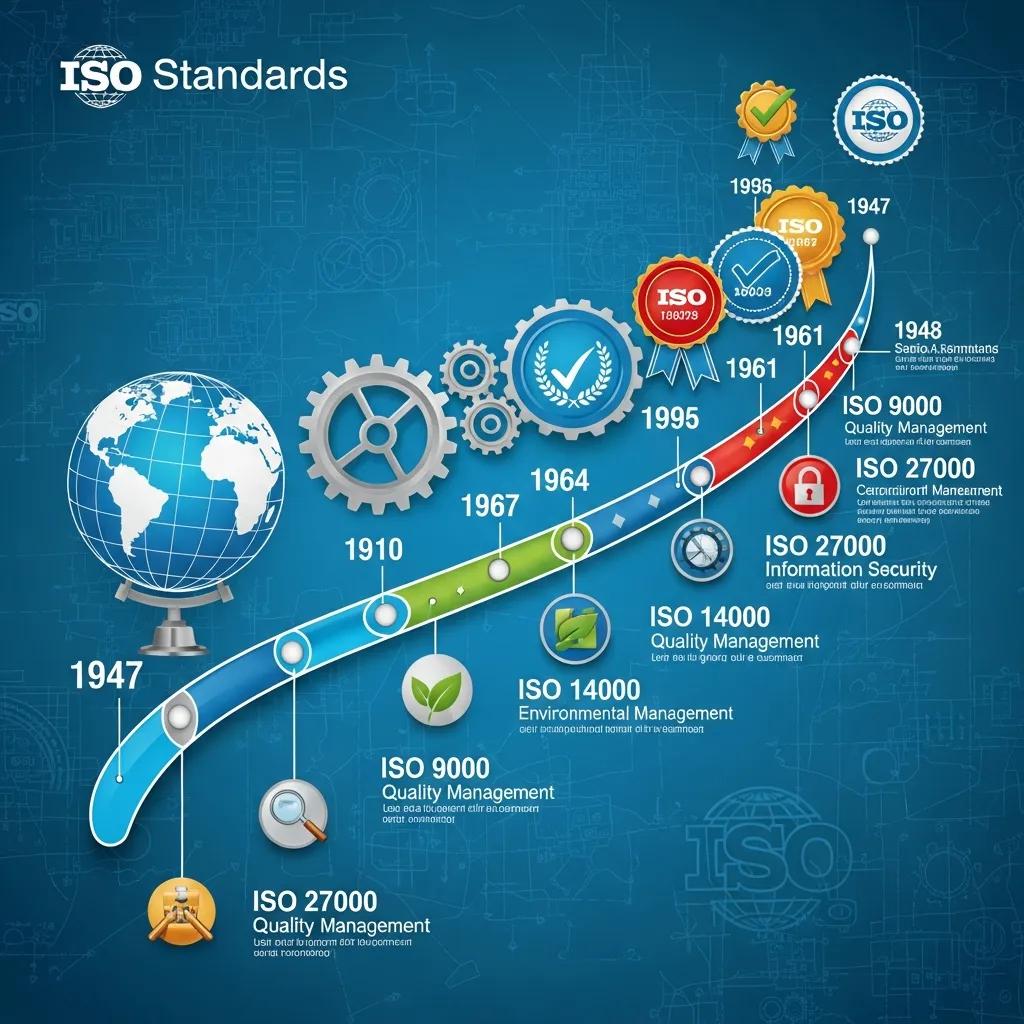
The History of ISO Standards: Understanding Their Evolution and Impact
The International Organization for Standardization (ISO) is the federation of national standards bodies that develops international standards to ensure quality, safety, interoperability and trade facilitation. This article explains how ISO emerged from earlier standardization efforts, traces the major milestones in its publication and governance, and demonstrates why standards such as ISO 9001 shaped modern quality management and procurement requirements. Readers will learn the origin story of ISO, the sequence of key standards and revisions, and the ways ISO standards reduce trade friction while evolving to address digital-age risks like cybersecurity and AI governance. The narrative connects historical facts to practical implications for organizations, including how certification can open markets and satisfy client procurement conditions. We begin with ISO’s origin, then map milestones and the development of management-system standards, examine ISO 9001’s revision history and business relevance, analyze trade and industry impacts, consider future trends in standardization, and close by showing how contemporary certification providers apply ISO’s legacy. This structure supports both historical understanding and practical decision-making about adopting ISO standards and preparing for future compliance.
What Is the Origin of the International Organization for Standardization?
ISO traces its formal origins to international meetings held in the immediate aftermath of World War II, when delegates sought a permanent, global forum for technical standardization. The mechanism created by ISO was designed to coordinate national standards bodies into a single organization that could develop consensus-based international standards, yielding interoperability benefits for manufacturers and regulators alike. The name „ISO“ was chosen as an abbreviation independent of language—derived from the Greek word isos, meaning equal—so the organization would have a consistent short form across languages. This origin explains why ISO’s structure emphasizes national member bodies collaborating in technical committees to harmonize requirements and reduce technical barriers to trade. Understanding this origin sets the stage for exploring earlier precursor organizations and the immediate post-war drivers that led to ISO’s foundation.
How Did the International Federation of the National Standardizing Associations Influence ISO's Formation?
The International Federation of the National Standardizing Associations (ISA), active from 1926 until its suspension during World War II, provided an early model of international cooperation among national standards bodies. ISA coordinated standardization across several industrialized countries, developed technical working groups, and demonstrated the value of shared standards in facilitating international manufacturing and trade. The disruption of ISA’s activities during the war highlighted the fragility of ad-hoc coordination and the need for a robust, neutral body to resume and expand that work after hostilities ceased. ISA’s membership, committee approaches, and experience in drafting technical recommendations directly informed ISO’s initial governance model and the creation of more durable institutional mechanisms for global standards development. This historical connection explains why ISO adopted committee-based development and broad national representation when it was founded.
Why Was ISO Founded After World War II in 1947?
ISO was founded in the post-war context because international trade and reconstruction demanded common technical references to rebuild economies and resume cross-border commerce efficiently. After World War II, uniform technical specifications reduced duplication, prevented incompatibilities, and lowered costs for manufacturers exporting products to multiple markets. Establishing ISO in 1947 provided a stable platform where national bodies could develop consensus standards that governments and industries could adopt, supporting interoperability and economic recovery. The organization’s founding aimed to prevent non-tariff barriers born of divergent technical measures and to create trusted, internationally vetted documents that regulators and purchasers could use to align expectations. This rationale for ISO’s founding leads naturally into the timeline of milestones where technical committees, early publications, and management standards expanded its influence.
This perspective is further supported by research highlighting the post-war shift towards technical standardization as a means to achieve global comparability and reduce political friction.
Post-WWII Standardization and Epistemic Infrastructure Development
This second empirical chapter argues that there was a qualitative difference in the development of epistemic infrastructures in global social security policy between the pre- and post-WWII period. While before, comparisons were strongly politicized, comparison in the post-WWII period is approached much more as a technical process, which, accordingly, presents comparability as solvable through epistemic work, resulting in categories and classifications to become increasingly standardized and uniform.
The Development of a Shared Ontological Framework After WWII, 2025
What Are the Key Milestones in the Evolution of ISO Standards?
The evolution of ISO standards features foundational dates, the rise of technical committees, and the later introduction of management-system families that broadened ISO’s scope from product and process standards to organizational frameworks. Early milestones include the post-war founding and the first ISO deliverables, followed by expanding membership and the formalization of consensus procedures. Over time ISO added standing technical committees that produced sectoral standards, and later the organization adapted to the market need for management-system standards such as the ISO 9000 family. These developments illustrate how international standardization expanded from technical specifications to frameworks for governance, quality and environmental stewardship. The next subsections name the earliest ISO publications and outline how the organization moved into management-system standards.
When Was the First ISO Standard Published and What Was It?
The earliest ISO publications emerged in the late 1940s and early 1950s as the organization converted technical work into internationally recognized deliverables. One of the first recorded ISO outputs was an early ISO/R publication focused on technical reference practices and measurement conventions, published in the early 1950s to harmonize testing and calibration methods across national borders. That initial standard served manufacturers and testing laboratories by establishing shared measurement baselines, which facilitated trade and reduced disputes over product specifications. The significance of the first ISO outputs lies in their demonstration that international consensus on technical detail was feasible and beneficial; that success created momentum for forming more technical committees and for tackling cross-sector issues, eventually enabling the development of management-system standards.
Before the table below, this short paragraph explains the purpose of the milestone table and how to read it. The table lists pivotal events with dates and their significance, helping readers quickly grasp ISO’s expansion from founding to management standards.
| Milestone Event | Date | Significance |
|---|---|---|
| Founding meeting and formal creation | 1946–1947 (formal founding in 1947) | Established a permanent international forum for standards development and a neutral global name „ISO“. |
| Early ISO/R technical publications | Early 1950s | Standardized measurement and testing conventions, enabling technical interoperability and trusted trade. |
| Growth of technical committees | 1950s–1970s | Enabled sectoral specialization and broader membership participation in standards drafting. |
| Introduction of management-system standards | Late 20th century (1987 onwards) | Shifted ISO’s remit to organizational systems, culminating in ISO 9000 series for quality management. |
How Did ISO Develop Management System Standards Like ISO 9001?
ISO’s development of management-system standards arose from industry demand for consistent frameworks that addressed organizational processes rather than only technical specifications. Technical committees and stakeholder consultations identified the need for standards that would enable buyers and regulators to assess how organizations controlled quality, environment, and information security. ISO responded by drafting the ISO 9000 family to codify quality management principles and provide auditable requirements in ISO 9001. The development process combined expert working groups, pilot implementations, and iterative revisions to ensure standards were practical and aligned with commercial procurement needs. This evolution from product-level standards to system-level frameworks allowed ISO to influence organizational governance and to provide a basis for certification schemes that many industries now require.
How Has ISO 9001 Developed Historically and Why Is It Important?

ISO 9001 started as a method to codify quality assurance in production and evolved into a risk-based, process-oriented standard that guides organizational quality management systems. The standard’s mechanism—specifying requirements for a QMS that organizations can implement, measure and continually improve—produces benefits such as consistent output quality, reduced defects, and clearer process ownership. Over successive revisions, ISO 9001 incorporated greater emphasis on customer focus, process approach, and risk-based thinking, making it more relevant to modern service and technology sectors. ISO 9001’s importance derives from both operational gains and market effects: many procurers and large clients list ISO 9001 as a prerequisite for tender eligibility, using certification as a shorthand for reliability and quality governance. The following subsection lists the major revision milestones and practical impacts so organizations can see how changes affect compliance and business practice.
What Are the Major Revisions of ISO 9001 Since Its Inception?
ISO 9001 has been revised periodically to reflect evolving management practices and market needs, with headline changes that altered certification focus and implementation. The major revisions include initial publication, then updates that introduced process orientation, continuous improvement, and risk-based thinking, each shifting how organizations structure their QMS and evidence compliance. Practically, revisions have changed documentation demands, audit approaches, and management accountability, requiring organizations to adapt controls and performance metrics after each edition. The chronological list below captures the revision years and the focal changes associated with each, enabling quick reference for compliance planning.
- 1987: Initial international standard emphasizing documented procedures and quality assurance in production.
- 1994: Strengthened system requirements and supplier monitoring with increased focus on process control.
- 2000: Introduced process approach and continuous improvement as central principles.
- 2008: Clarified requirements and harmonized language to simplify certification and audits.
- 2015: Emphasized risk-based thinking, leadership involvement, and alignment with strategic objectives.
Before the comparative table below, this paragraph explains that the EAV table summarizes the business impact of each ISO 9001 revision to help managers decide resource allocation for compliance.
| Revision (Entity) | Change (Attribute) | Business Impact (Value) |
|---|---|---|
| ISO 9001:1987 | Focus on documented procedures | Improved consistency in manufacturing but heavier paperwork burden |
| ISO 9001:2000 | Process approach & continual improvement | Greater operational efficiency and cross-functional process control |
| ISO 9001:2008 | Clarifications and harmonization | Easier transition between audits and reduced interpretation variance |
| ISO 9001:2015 | Risk-based thinking and leadership | Stronger link to strategy, better risk mitigation, higher management accountability |
After outlining the historical development and revisions, it is important to consider how ISO 9001 functions as a market gate for procurement and client demands; the next subsection discusses why certification matters for modern businesses and procurers.
Why Is ISO 9001 Certification Essential for Modern Businesses?
ISO 9001 certification signals that an organization operates a verified quality management system, which procurement teams and large clients often require to reduce supply chain risk and ensure consistent service delivery. The mechanism of certification—independent audit against standardized requirements—provides third-party assurance that processes, controls, and continual improvement practices are in place, which lowers perceived procurement risk for buyers. Benefits for certified organizations include improved operational efficiency, higher customer satisfaction scores, and access to tender opportunities where certification is a prerequisite. Recent industry analyses indicate that certified suppliers are more likely to be shortlisted for large contracts and that non-certified bidders can be excluded from procurement processes, making certification not just a quality tool but a business development requirement.
Organizations considering certification should weigh these benefits against implementation costs and timelines; for many, certification enables access to new markets and meets explicit client demands. For businesses seeking certification services, Stratlane Certification Deutschland is a certification body that leverages AI and experienced industry experts to audit organizations. They offer ISO certification services across various industries, including ISO 9001, ISO 14001, ISO 27001, and ISO 42001, and their services aim to help businesses gain a competitive advantage through accredited ISO certifications. Stratlane emphasizes professional and reliable services with auditors available across Europe and the UK, and they describe themselves as an accredited certification body whose certificates have global acceptance. This practical pathway connects historical standards development to contemporary market requirements and service options.
How Do ISO Standards Facilitate Global Trade and Industry Development?
ISO standards reduce technical barriers to trade by providing common specifications that regulators, manufacturers and buyers can adopt, which simplifies conformity assessment and mutual recognition across markets. The mechanism is straightforward: when businesses and authorities reference a common standard, product compatibility and regulatory expectations align, lowering transaction costs and speeding market entry. This alignment is particularly important for complex supply chains where components from multiple countries must integrate reliably. ISO standards also inform national regulations and facilitate trade negotiations by offering neutral technical baselines that can be referenced in bilateral and multilateral agreements. These roles demonstrate how standardization is a practical tool for economic development and cross-border interoperability.
What Role Does Standardization Play in International Commerce?
Standardization creates technical coherence that enables products and services to be traded with predictable performance expectations, which reduces friction in international commerce. Mechanisms include harmonized testing methods, shared terminology, and mutual recognition of conformity assessment—each decreasing the need for redundant testing and regulatory duplication. Industries such as manufacturing, information security, and environmental management rely on ISO documents to set common design, security and sustainability baselines that regulators and buyers trust. By lowering uncertainty and enabling scale economies, standards improve trade efficiency and allow firms to focus on innovation and competitiveness rather than repeatedly proving basic technical compliance. This economic role of standards leads directly to practical effects on customer trust and supply chain resilience.
How Do ISO Certifications Enhance Customer Trust and Competitive Advantage?
ISO certification provides third-party validation that an organization meets internationally accepted practices, which customers interpret as reduced risk and higher reliability. This signaling effect is especially powerful in procurement processes where certificates simplify supplier evaluation and provide a baseline for contract performance terms. Certified organizations commonly report improved brand perception and greater ease entering new markets due to the certification’s credibility, which can translate into commercial advantage in tendering and partner selection. Below is a short list of concrete ways certification supports competitiveness and trust.
- Procurement Eligibility: Certification often meets tender prerequisites and shortlists suppliers for large contracts.
- Risk Reduction: Independent audits provide evidence of controls that lower buyer risk.
- Market Access: Recognized certificates ease entry into regulated or quality-conscious markets.
These benefits explain why many firms invest in certification as a strategic tool, and the next section examines forward-looking trends that will shape standards and certification in the digital era.
What Is the Future Outlook of ISO Standards in the Digital Age?

ISO standards are evolving to address digital transformation, AI governance, cybersecurity, and sustainability, reflecting how technology and societal priorities change the scope of what standards must cover. The mechanism of standards development is also adapting: digital collaboration tools and data-driven consultation enable faster drafts and broader stakeholder input, while new subject areas require multidisciplinary technical committees. Emerging standards for AI governance and digital trust will interact with existing management-system families, prompting integrated approaches that combine quality, security and ethical considerations. Organizations should monitor these trends to align internal governance with forthcoming expectations and to leverage standardization as a way to demonstrate trustworthy use of digital technologies.
How Is AI Transforming ISO Auditing and Certification Processes?
AI is changing auditing by enabling data-driven evidence analysis, anomaly detection, and risk profiling that can make audits more efficient and more focused on substantive outcomes. AI tools can process large datasets to identify process deviations, nonconformities and emerging risk patterns that might be invisible in manual reviews, thus enhancing auditor insight and consistency. Efficiency gains include shorter audit cycles and targeted sampling, but these technologies also raise governance questions about transparency, explainability and the role of human judgment in certification decisions. Advanced providers are experimenting with AI-assisted audits to augment auditor expertise rather than replace it, balancing automation benefits with procedural safeguards. This transformation sets the stage for integrated digital assurance practices and supports the next discussion of broader emerging trends.
What Are the Emerging Trends in ISO Standardization and Quality Management?
Several converging trends will shape standardization and quality management in the coming years, requiring organizations to adapt governance and compliance strategies. First, sustainability and ESG-related standards are gaining prominence, integrating environmental and social criteria into management systems. Second, convergence and integration of management systems are encouraging organizations to adopt unified QMS, EMS and ISMS approaches to reduce duplication and improve coherence. Third, remote and digital auditing practices—enabled by secure data sharing and analytics—are becoming more accepted, allowing flexible audit models that still protect conformity assurance. These trends suggest that organizations should prepare for integrated, digital-first compliance models that align quality, security and sustainability imperatives.
- Sustainability Integration: Environmental and social metrics embedded into management frameworks.
- Integrated Management Systems: Combined QMS, EMS and ISMS approaches for streamlined governance.
- Remote Auditing: Secure digital practices enabling virtual evidence collection and review.
Taken together, these trends imply that preparedness today includes investing in cross-disciplinary controls, digital evidence capabilities and strategic alignment of compliance with corporate objectives.
How Does Stratlane Certification Deutschland Build on the Legacy of ISO Standards?
Stratlane Certification Deutschland applies contemporary auditing approaches that reflect ISO’s legacy of consensus-based standards and the operational needs of modern organizations. As an accredited certification body, Stratlane offers ISO certification services across various industries, including ISO 9001, ISO 14001, ISO 27001, and ISO 42001, aiming to help businesses gain a competitive advantage through accredited ISO certifications. The company emphasizes professional and reliable services with auditors available across Europe and the UK, and it leverages AI tools alongside experienced industry experts to audit organizations. Presenting these offerings here provides a practical bridge: organizations that understand ISO’s historical evolution and current trends can choose certification partners capable of delivering accredited assessments and market-recognized certificates that support procurement eligibility and international acceptance.
Before the service comparison table below, this paragraph explains that the table contrasts Stratlane’s attributes with conventional approaches to highlight differentiators relevant to modern certification needs.
| Service Attribute | Stratlane Certification Deutschland | Conventional Approach |
|---|---|---|
| Audit methodology | AI-enabled analysis with expert auditors | Manual evidence review and sampling |
| Standards coverage | ISO 9001, ISO 14001, ISO 27001, and ISO 42001 | Varies by provider; often limited scope |
| Geographic coverage | Auditors across Europe and the UK | Regional or national focus |
| Accreditation claim | Described as accredited certification body | Varies; some providers not accredited |
What Innovative Approaches Does Stratlane Use in ISO Certification?
Stratlane’s approach blends data-driven audit techniques with experienced auditors to improve audit efficiency and evidence consistency while preserving expert judgment. AI-powered audit tools can perform preliminary data analysis, flag anomalies and prepare risk profiles that help auditors focus on high-value areas during on-site or remote assessments, reducing unnecessary sampling and accelerating decision cycles. Stratlane complements these tools with industry-experienced auditors who interpret findings within sectoral context and apply consensus-based ISO requirements to practical organizational processes. The provider’s regional coverage across Europe and the UK and its positioning as an accredited certification body support certificates that stakeholders accept for procurement and regulatory recognition. This innovative mix bridges historical ISO mechanisms with contemporary assurance needs.
How Does Stratlane Support Businesses in Achieving ISO 9001 Certification?
Stratlane supports certification journeys through structured assessment, gap analysis, audit execution and post-certification follow-up aimed at improving readiness and reducing time-to-certification. Typical steps include an initial diagnostic to map current processes against ISO 9001 requirements, a targeted gap analysis that prioritizes corrective actions, and an audit program that applies AI-augmented evidence collection to improve focus and efficiency. Post-certification, Stratlane’s auditors provide practical recommendations for continual improvement and for maintaining alignment with revisions to the standard, supporting long-term compliance and procurement eligibility. This stepwise, expert-supported pathway helps organizations translate the historical principles of ISO 9001 into operational controls that meet modern client expectations and tender requirements.
- Assessment: Baseline analysis to identify gaps against ISO 9001.
- Gap Remediation: Prioritized corrective actions to close nonconformities.
- Audit & Certification: Accredited audit process combining AI analysis and expert judgment.
- Post-Certification Support: Guidance for continual improvement and surveillance audits.
These support steps help organizations transform quality-management concepts into verifiable processes that buyers and regulators can trust.