

ISO Zertifizierung für den Dienstleistungssektor: Wie Serviceunternehmen mit ISO 9001 und verwandten Standards Vertrauen und Effizienz gewinnen
Service companies face increasing pressure from clients and procurement processes to demonstrate consistent quality and measurable performance, and ISO certification provides a structured route to meet those expectations. This article explains what ISO certification means for service providers, how ISO 9001 organizes a quality management system (QMS) around customer focus and the Plan-Do-Check-Act cycle, and how complementary standards such as ISO 27001 and ISO 14001 target information security and environmental management for specific service subsectors. Readers will learn practical steps for preparing for certification, realistic timelines and cost drivers, and how to decide which standards to pursue together to maximize trust, efficiency and tender eligibility. The guide then breaks down sector-specific benefits for IT, consulting, healthcare and logistics, and closes with focused guidance on working with a certification body to streamline audits. Throughout, the article integrates semantic context and practical examples so service leaders can translate ISO requirements into operational improvements and procurement advantages.
Warum ist ISO 9001 für Dienstleistungsunternehmen unverzichtbar?
ISO 9001 defines a quality management system focused on consistent processes, customer satisfaction and continual improvement, and it matters for service companies because it converts tacit practices into auditable, repeatable processes that reduce variability in service delivery. The standard works by requiring documented processes, internal audits, management review and a PDCA approach so organizations can identify root causes, reduce errors and improve SLA performance. For many buyers and public tenders, ISO 9001 is either a formal requirement or a strong selection signal because certification proves third-party validation of process controls. Service teams that translate ISO 9001 into concrete process maps, incident workflows and customer feedback loops typically see measurable improvements in SLA compliance, lower complaint rates and faster onboarding of new clients.
Indeed, the motivation for certification often stems directly from external pressures, as highlighted by research on ISO 9000.
ISO 9000 Certification: Meeting Regulatory & Customer Demands
Compliancerelated motivations arise in the presence of regulatory or procurement requirements for goods and services. The opportunity to circumvent regulatory or customer requirements is a strong incentive for firms to seek ISO 9000 certification.
Why firms seek ISO 9000 certification: regulatory compliance or competitive advantage?, SW Anderson, 1999
Below is a compact mapping of key benefits to how they deliver value and measurable outcomes to help procurement and operations teams assess ROI.
| Benefit | How it delivers value | Measurable outcome |
|---|---|---|
| Operational consistency | Standardized processes and documented procedures | Reduced process variance; percentage drop in incident rates |
| Customer confidence | Third-party certification and evidence of improvement cycles | Improved NPS or customer satisfaction scores |
| Risk reduction | Formal risk assessment and control measures | Fewer service disruptions; SLA attainment increase |
| Procurement eligibility | Recognized proof of capability for tenders | More bid shortlists and contract wins |
This EAV-style table shows how ISO 9001 links capabilities to measurable outcomes, and the next section examines the standard’s core concepts and how they map to common service activities.
Was bedeutet ISO 9001 und wie definiert es Qualitätsmanagement im Dienstleistungssektor?
ISO 9001 is a management system standard that requires organizations to establish a Quality Management System (QMS) centered on customer needs, process orientation and continual improvement using PDCA. In a service context that means mapping service delivery processes such as onboarding, incident handling and service transitions, and using documented criteria to manage handoffs, response times and escalation procedures. Service-specific QMS components include SLA definitions, customer feedback loops, measurable KPIs and internal audit routines that validate process performance. Translating ISO 9001 into operational practice helps teams turn subjective expectations into objective checks that drive consistent delivery and continuous improvement.
Understanding these mechanisms leads naturally to the specific benefits organizations can expect when they implement ISO 9001 tailored to services.
Welche Vorteile bietet ISO 9001 für Serviceunternehmen und deren Kunden?
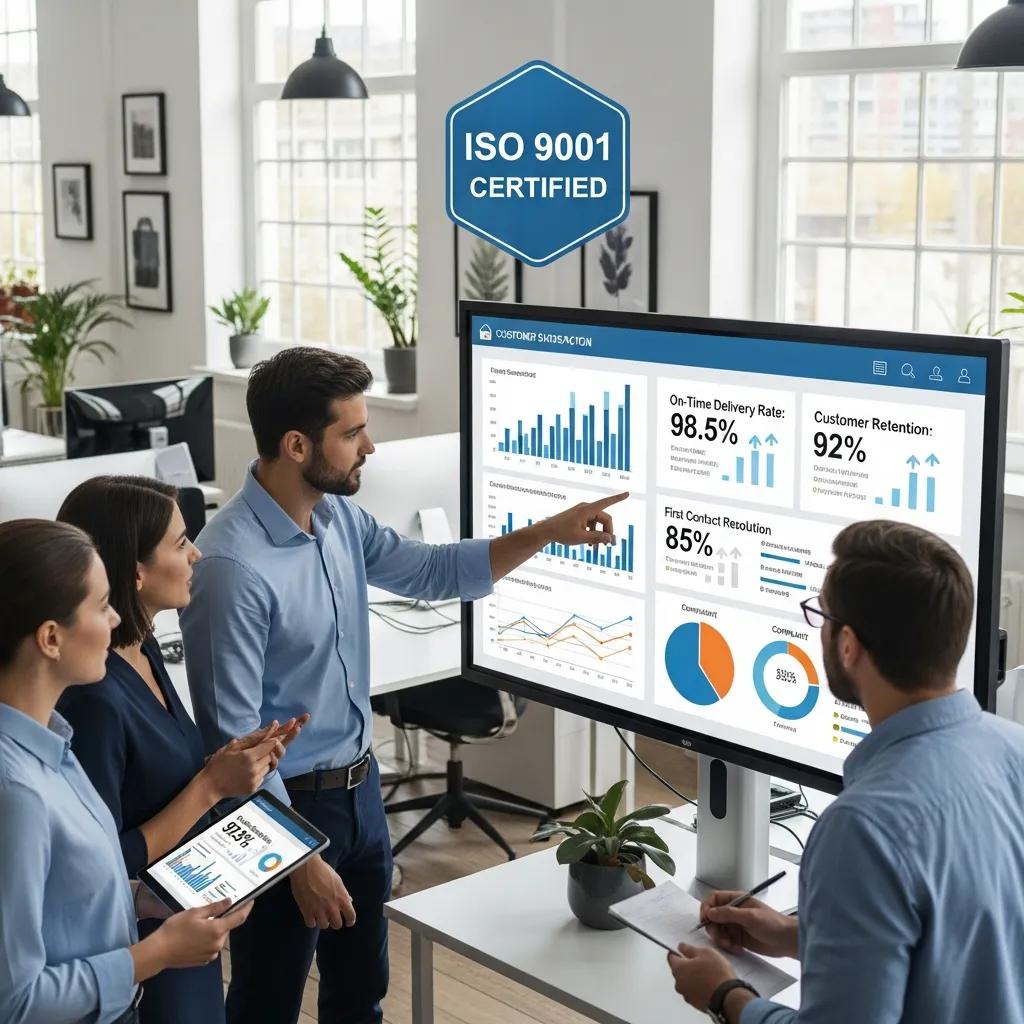
ISO 9001 provides service firms with clearer process ownership, predictable delivery and a framework for reducing errors and rework, which directly benefits both providers and clients. For clients, the standard signals reliable vendor selection and documented procedures for complaints and corrective actions; for providers, it reduces operational waste and improves onboarding speed for new contracts. Typical KPIs that improve after certification include SLA compliance rates, mean time to resolve incidents, and customer satisfaction scores. These measurable benefits support stronger proposals in procurement processes and create a basis for continuous improvement that feeds back into better service design.
These advantages also influence how the certification process is planned and executed, which is the focus of the next major section.
Wie funktioniert der Zertifizierungsprozess für Dienstleistungsunternehmen?

The certification process for service organizations follows a predictable journey: prepare the scope and QMS, run internal audits and management review, and then undergo a certification audit followed by periodic surveillance. Each phase has a clear purpose: gap analysis to identify missing controls, implementation to close gaps, internal verification to test controls, and third-party validation to certify the system’s effectiveness. Time and cost vary by scope, complexity and organizational maturity, but transparency in timelines and costs helps procurement and leadership plan resources. The next subsection lists the typical steps in sequence to aid project planning and stakeholder alignment.
- Gap analysis and scope definition: Identify current practices versus ISO requirements and set the certification scope.
- QMS development and implementation: Document processes, assign responsibilities and integrate KPIs and SLAs.
- Internal audit and management review: Verify controls, identify nonconformities, and prioritize corrective actions.
- Certification audit (Stage 1 & Stage 2): Independent auditor assesses readiness and system effectiveness.
- Surveillance audits: Periodic checks to ensure continuous compliance and improvement.
This numbered sequence gives a clear roadmap; the following table summarizes typical durations and cost ranges to set realistic expectations for planning.
| Phase | Typical duration | Typical cost / range |
|---|---|---|
| Gap analysis | 1–4 weeks | Internal effort; external consult optional |
| Implementation & documentation | 4–20 weeks | Varies by scope; internal resource cost is primary |
| Internal audit & management review | 1–3 weeks | Internal resource cost; basic external support optional |
| Certification audit (external) | 1–2 weeks | Audit fees depend on scope and auditor rates |
| Surveillance (annual) | 1 day per year | Annual audit fees and ongoing internal costs |
This process table clarifies where time is spent and which cost categories matter; the next subsection expands on responsibilities and practical examples for services.
Welche Schritte umfasst die ISO 9001 Zertifizierung für Servicefirmen?
Certification begins with a gap analysis that examines existing processes against ISO 9001 clauses to define the scope and priorities, and this step identifies quick wins and deeper workstreams. The implementation phase requires documenting core processes such as service intake, incident management and change control, and assigning process owners who will operate and measure each activity. Internal audits test those documented controls, drive corrective actions and feed into a formal management review where leadership confirms readiness for external assessment. Finally, accredited auditors perform a two-stage certification audit: a readiness review followed by an effectiveness assessment, after which certification may be granted and surveillance cycles begin.
These practical steps show how certification translates into concrete tasks for operations teams, and the following subsection explains realistic timelines and cost drivers.
Wie lange dauert die Zertifizierung und welche Kosten sind zu erwarten?
Typical timelines vary: organizations with mature processes may prepare in 8–12 weeks, while those building a QMS from scratch often require 4–6 months before external audit readiness, and complexity of services and number of sites increase duration. Cost drivers include internal staff time, any external consultancy engagement, and the certification body’s audit fees which scale with scope; optional pre-assessment services add cost but reduce audit risk. Smaller service providers often invest primarily in internal effort and minimal external support, while larger firms budget for consulting plus multi-day audits. Planning realistic timelines and transparent cost estimates reduces surprises and ensures stakeholder alignment during the certification project.
Understanding the choices among related standards helps leaders decide which additional certifications will best amplify quality, security or environmental performance.
Welche ISO-Standards sind neben ISO 9001 für den Dienstleistungssektor relevant?
Alongside ISO 9001, ISO 27001 and ISO 14001 are frequently relevant to service providers: ISO 27001 secures information assets and supports data-integrity-driven service quality, while ISO 14001 addresses environmental aspects that matter for some service models. Choosing additional standards depends on sector risks, client expectations and regulatory drivers; combining certifications can create synergies where shared controls reduce duplicated effort and improve overall governance. Decision-makers should assess which standards affect procurement eligibility and operational resilience, and create a prioritized roadmap for combined implementation. The short comparison table below helps clarify when each standard is appropriate.
| Standard | Primary focus | When to choose |
|---|---|---|
| ISO 9001 | Quality management and process consistency | When consistent service delivery and tender eligibility are priorities |
| ISO 27001 | Information security and data protection | For IT services, cloud providers or when handling sensitive client data |
| ISO 14001 | Environmental management and impact reduction | When environmental footprint influences procurement or brand positioning |
This comparison highlights where each standard adds value and suggests combined strategies; the next subsections examine ISO 27001 and ISO 14001 in service contexts.
Wie unterstützt ISO 27001 die Informationssicherheit in IT-Serviceunternehmen?
ISO 27001 establishes an Information Security Management System (ISMS) that formalizes risk assessment, controls and incident response to protect confidentiality, integrity and availability of information assets. For IT service providers, ISO 27001 maps directly to obligations around access control, change management and secure service delivery, and it complements ISO 9001 by ensuring data integrity that underpins service quality. Controls such as asset inventories, access policies and incident handling procedures help teams demonstrate to clients that security is managed systematically rather than ad hoc. When combined with ISO 9001, the two standards strengthen proposals for security-sensitive contracts and reduce the operational risk of data-related service failures.
The practical impact of ISO 27001 lies in its ability to proactively manage and mitigate information security risks, as further explored in academic studies.
ISO 27001: Information Security, Risk Prevention & Stakeholder Assurance
The effectiveness of ISO 27001 is in preventing or minimizing the exposure to information security incidents in the real world. In a scenario where there has been so much investment in adopting the framework and subsequent certification resulting in high levels of stakeholder assurance, the focus is to identifying the areas where it is effective. But more importantly, it also focus on the areas where there are gaps, leading to information security risks and/or an incident even in a situation where the framework is adhered to and certification against it exists. Companies that have ISO 27001 certification and audit
Effectiveness of ISO 27001, as an information security management system: an analytical study of financial aspects, NK Sharma, 2012
This security foundation naturally leads to consideration of environmental impacts where relevant, which ISO 14001 addresses next.
Welche Rolle spielt ISO 14001 für Umweltmanagement in Dienstleistungsbetrieben?
ISO 14001 provides a framework to identify and control environmental aspects of service operations—such as energy use in data centers, travel-related emissions for consulting teams, or supplier impacts in logistics services—and to set improvement targets. Even when direct environmental footprint is small, many clients and public tenders now evaluate supplier sustainability, so ISO 14001 can influence procurement outcomes and brand perception. Implementing ISO 14001 encourages supplier screening, resource-efficiency measures and documentation of environmental performance that can be reported to stakeholders. For service firms aiming to differentiate on sustainability, integrating environmental objectives into the management system creates credible evidence for clients and reduces regulatory and reputation risks.
Having compared relevant standards, it helps to view how different service sectors gain concrete advantages from certification.
Wie profitieren spezifische Dienstleistungsbranchen von ISO Zertifizierungen?
ISO certifications translate into sector-specific outcomes: IT firms gain improved security posture and SLA delivery, consulting firms secure repeatability and trust for complex engagements, healthcare providers strengthen patient-safety processes, and logistics operators increase traceability and on-time performance. The value proposition varies by subsector, but common benefits include easier qualification for large contracts, clearer evidence for procurement, and operational efficiencies that lower cost-per-service. Decision-makers should map standards to the most critical client requirements and measure improvements with KPIs such as SLA attainment, incident volumes, and contract win rates. The following list highlights concrete advantages across representative service subsectors.
- IT services: Improved data integrity and SLA consistency that support large enterprise contracts.
- Consulting firms: Repeatable methodology and documented quality that ease scale and client trust.
- Healthcare services: Process standardization that supports safety-critical operations and regulatory expectations.
- Logistics and transport: Enhanced traceability and reduced service disruptions through standardized procedures.
These sector-focused benefits illustrate how certification choices align with tender needs and operational goals, and the next subsections dive deeper into IT/consulting and healthcare/logistics examples.
Welche Vorteile bietet ISO 9001 für IT-Dienstleister und Beratungsfirmen?
For IT providers and consultants, ISO 9001 enforces process design and measurement that improve project delivery predictability, change-control practices and incident resolution workflows, which directly reduce downtime and client escalations. Documented methodologies and metrics make resource planning and staffing more consistent, enabling reliable responses to RFPs that request evidence of quality controls. KPIs that typically improve include on-time delivery, first-time-right implementation rates and customer satisfaction, and ISO 9001 combined with ISO 27001 strengthens proposals where data security is critical. Demonstrating both quality and security through certification increases eligibility for larger, higher-value contracts and shortlists in competitive procurement.
These improvements in delivery and evidence lead naturally to safety and reliability gains in other service domains like healthcare and logistics.
Wie verbessert ISO 9001 die Qualität und Sicherheit im Gesundheits- und Logistiksektor?
In healthcare and logistics, ISO 9001 enforces standardized procedures for safety-critical operations—such as medication administration workflows or shipment handling protocols—reducing variability that can cause patient harm or shipment errors. The standard’s emphasis on process controls, traceability and corrective action supports better incident investigation and preventive measures, leading to measurable reductions in adverse events and lost shipments. Traceability and documentation practices also support regulatory compliance and client reporting, while continuous improvement cycles drive incremental gains in reliability. These operational benefits combine to improve overall service safety and client confidence in high-stakes sectors.
With sector needs clarified, the next section explains how a certification body can help service companies navigate the audit journey efficiently.
Wie unterstützt Stratlane Certification Deutschland Dienstleistungsunternehmen bei der ISO Zertifizierung?
Stratlane Certification Deutschland offers certification services tailored to organizations seeking ISO 9001 and related standards, using AI-assisted processes together with experienced industry auditors to conduct audits and validate management systems. This approach aims to speed preparatory analysis and documentation review through data-driven pre-assessment while preserving human judgment for contextual audit decisions, reducing time-to-audit readiness and focusing auditor effort on high-risk areas. Stratlane’s service model positions the company to support service providers in preparing for certification and in aligning scope to client procurement needs for tenders. For firms planning certification projects, a factual next step is to request a quote or consultation to understand a tailored timeline and scope from a certification partner.
Welche Rolle spielt KI in Stratlanes innovativem Zertifizierungsprozess?
AI is used to accelerate pre-audit activities such as gap analysis, document scanning and pattern detection, enabling auditors to identify common nonconformities and focus on the most impactful controls during the onsite assessment. In practice, automated analysis can surface inconsistencies in documentation, highlight missing process flows and suggest areas where objective evidence may be lacking, which reduces time spent on routine checks. However, human auditors perform contextual interpretation, stakeholder interviews and judgment-based assessments that AI cannot replace; the AI output augments, rather than supersedes, auditor expertise. This hybrid model improves audit efficiency and helps service clients reach readiness faster while retaining the credibility of experienced assessor oversight.
Having described AI’s support role, the next subsection explains how auditor experience improves audit reliability and reduces disruption.
Wie gewährleisten erfahrene Auditoren eine effiziente und vertrauenswürdige Zertifizierung?
Experienced auditors bring sector knowledge and practical judgement that streamlines evidence collection and targets audit inquiries to the most relevant processes, reducing unnecessary disruption to day-to-day operations. Sector expertise enables auditors to evaluate whether controls are operating effectively in real service contexts, and to provide pragmatic recommendations that operations teams can implement quickly. Auditors also ensure impartiality and traceability in findings, which strengthens the credibility of the certification decision for clients and procurement teams. Combining experienced auditors with AI-driven pre-analysis creates a balanced approach that saves time and maintains the rigorous validation required by accredited certification processes.
Next, readers often have concise, procurement-focused questions about ISO certification; the following section addresses those common queries.
Welche häufigen Fragen stellen Dienstleistungsunternehmen zur ISO Zertifizierung?
Service organizations commonly ask whether ISO 9001 is required by clients, how long certification takes and how to use certification as a sales advantage; clear, succinct answers help guide procurement and sales planning. The FAQ-style responses below are designed to be direct and actionable for teams preparing RFP responses or internal project plans. Short, authoritative answers help purchasing teams and business leaders decide whether to pursue certification now or to stage it alongside other initiatives like ISO 27001. Each answer is intentionally concise to support quick decision-making and to serve as ready references for stakeholder discussions.
Welche Anforderungen stellen Schlüsselklienten an ISO 9001 zertifizierte Dienstleister?
Key clients typically require proof of current certification, alignment of the certification scope with contracted services, and evidence of relevant KPIs such as SLA performance and corrective action records. Procurement teams often ask for the certificate, the scope statement, and internal audit summaries or management review outputs that demonstrate ongoing compliance. Additionally, clients may request evidence of related controls (for example, data protection measures) when services involve sensitive information. Preparing a procurement pack with certificate evidence, scope alignment statements and recent KPI snapshots helps streamline vendor qualification and reduces bid friction.
These procurement requirements naturally feed into practical tactics for leveraging certification as a competitive advantage, as explained next.
Wie kann ein Serviceunternehmen die ISO Zertifizierung als Wettbewerbsvorteil nutzen?
Service firms can leverage certification in sales and procurement by explicitly referencing certification in RFP responses, including the certificate in credentials, and using audit-validated KPIs to demonstrate performance improvements and risk controls. Tactical uses include creating a concise one-page certification summary for proposals, highlighting measurable improvements (such as SLA attainment rate increases), and using certification to meet mandatory tender requirements. Marketing and sales teams should translate audit findings into client-facing proof points—such as reduced incident rates and faster resolution times—that resonate with procurement evaluators. These practical tactics turn certification from a compliance checkbox into a documented sales differentiator that supports higher win rates and better contract terms.