

Was ist ISO 14001? Comprehensive Guide to Environmental Management System Certification
ISO 14001 is the international standard for Environmental Management Systems (EMS) that helps organisations manage environmental responsibilities and improve environmental performance through a structured management approach. This guide explains what ISO 14001 requires, how an EMS is designed around the PDCA cycle, and why certification matters for compliance, risk reduction, and commercial access. Many organisations struggle to translate environmental obligations into measurable actions; ISO 14001 provides a consistent framework to identify environmental aspects, set objectives, control operations and demonstrate continual improvement. Readers will learn the standard’s core principles, the high-level structure (Clauses 4–10), mandatory documentation, audit expectations, and practical steps to achieve certification. The article also maps benefits such as reduced waste and energy use to KPIs and procurement advantages, explains the step-by-step certification pathway, and outlines how ISO 14001 and ISO 9001 align for integrated management systems. Throughout, we reference current research and practice trends relevant in 06/2025, including life-cycle thinking, climate focus, and digital EMS integration, so organisations can prepare for upcoming revisions and audit expectations.
What is ISO 14001 and How Does It Define Environmental Management Systems?
ISO 14001 defines an Environmental Management System (EMS) as a systematic framework enabling organisations to identify, control and reduce environmental impacts while meeting compliance obligations and improving performance. The standard uses risk-based thinking and a life-cycle perspective to require organisations to assess environmental aspects, set measurable objectives and put operational controls in place so that impacts on air, water, land, resources and biodiversity are managed. Implementing an EMS under ISO 14001 creates a repeatable mechanism to monitor performance, run audits and enact corrective actions that drive continual improvement and meet stakeholder expectations. The following subsections explain the standard’s core principles and how the PDCA cycle operates as the EMS backbone, providing the operational logic for planning, implementing, evaluating and improving environmental outcomes.
What Are the Core Principles and Scope of ISO 14001?
ISO 14001 is built on a set of core principles that translate environmental intent into operational practice: risk-based thinking, leadership commitment, life-cycle perspective, continual improvement and compliance with obligations. Organisations define the EMS scope by identifying sites, activities, products or services that influence environmental aspects; scope boundaries should be defensible and reflect interested parties such as regulators, customers and the community. Typical examples of scope boundaries include a manufacturing site, distribution operations, or a service delivery footprint where processes cause emissions, waste or resource consumption. By framing the EMS scope clearly, organisations link Clause 4 (context) to planning and operational controls, which supports measurable environmental objectives and effective stakeholder engagement.
How Does the PDCA Cycle Support Continual Improvement in EMS?
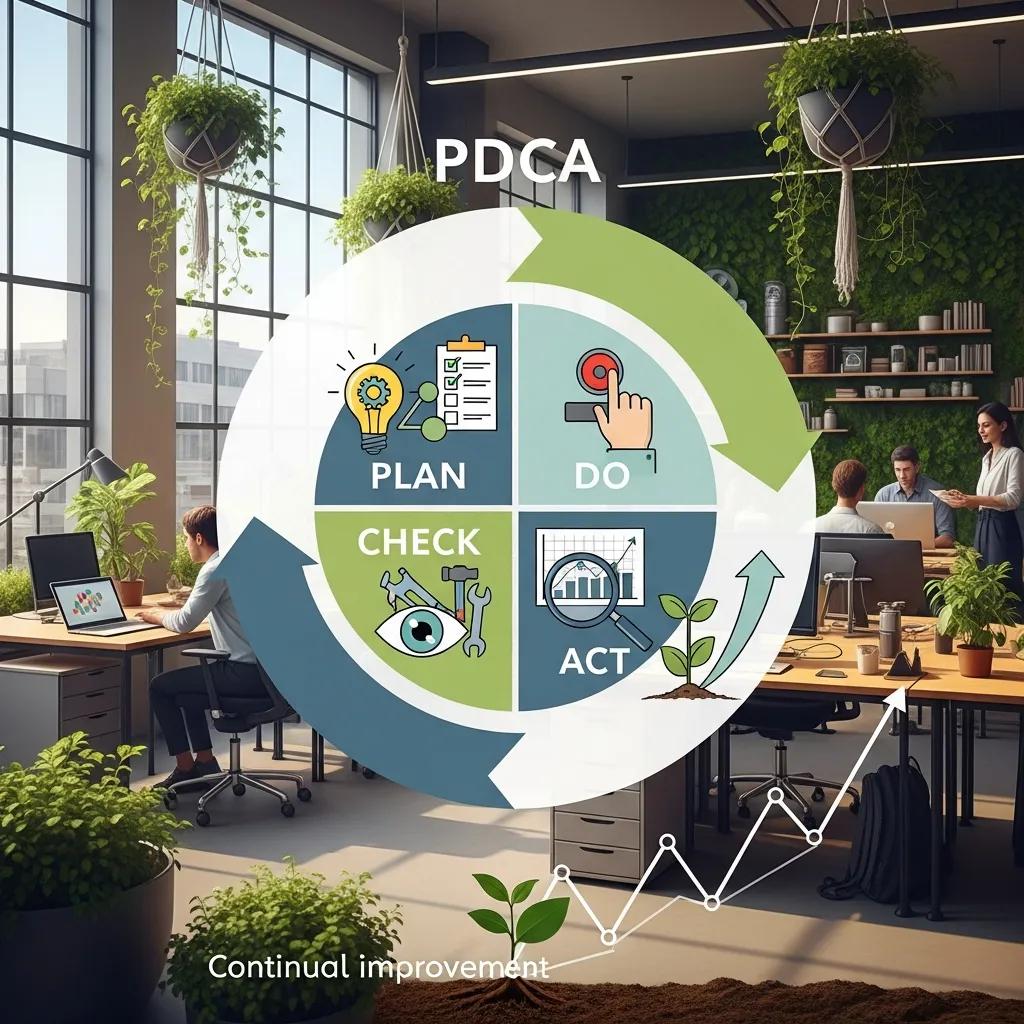
The Plan-Do-Check-Act (PDCA) cycle is the operational backbone of ISO 14001 that turns strategic intent into measurable results through iterative improvement. In the Plan phase organisations identify environmental aspects, assess risks and compliance obligations, and set objectives with targets and indicators; in Do they implement controls, training and operational procedures to meet those targets. Check involves monitoring, measurement, internal audits and performance evaluation to detect deviations, while Act requires corrective actions and management review to adjust policy and objectives based on evidence. Applying PDCA ensures environmental performance is data-driven and that management review closes the loop by prioritising resources and strategic changes for continual improvement.
Research further underscores the global adoption of ISO 14000 and its foundation in the PDCA model for continuous improvement.
ISO 14000 EMS: Global Standard & PDCA Cycle
For EMS, ISO 14000 is a standard adopted by 171 countries which is based on plan-do-check-act (PDCA) model of improvements.
Environmental Management System (EMS), 2024
What Are the Key Requirements of ISO 14001 for Certification?
ISO 14001 follows the High-Level Structure (HLS) used by other ISO management standards, which organises requirements into Clauses 4–10 covering context, leadership, planning, support, operation, performance evaluation and improvement. Certification requires organisations to demonstrate systematic compliance across these clauses: understanding external/internal context, top management leadership and commitment, documented planning for aspects and compliance obligations, adequate support and competence, operational controls, monitoring and evaluation mechanisms, and processes for corrective action and continual improvement. Auditors will look for evidence that objectives are measurable, operational controls are effective, monitoring and internal audits are performed, and management review drives improvement.
Introductory table mapping clauses to actions and evidence:
| Clause (HLS) | Required Action | Typical Audit Evidence |
|---|---|---|
| Clause 4: Context | Define organisational context and scope | Scope statement, stakeholder analysis |
| Clause 5: Leadership | Demonstrate top management commitment | Policy signed by leadership, objectives in strategy |
| Clause 6: Planning | Identify aspects, risks, compliance obligations | Aspect register, risk assessments, objectives |
| Clause 7: Support | Ensure competence and documented information | Training records, document control logs |
| Clause 8: Operation | Implement operational controls | Procedures, permits, operational checks |
| Clause 9: Performance eval. | Monitor and audit performance | Monitoring logs, audit reports, management metrics |
| Clause 10: Improvement | Manage nonconformities and continual improvement | Corrective action records, improvement plans |
This clause mapping makes it easier to connect each high-level requirement to specific deliverables auditors expect and to prioritise remediation during pre-certification gap analysis.
Which Clauses Constitute the High-Level Structure of ISO 14001?
Clauses 4 through 10 form the standard’s structure and cover: context of the organisation; leadership; planning; support; operation; performance evaluation; and improvement. Each clause requires specific outcomes: Clause 4 requires documented context and scope; Clause 5 requires visible leadership and an environmental policy; Clause 6 mandates planning for aspects and compliance obligations with measurable objectives; Clause 7 requires resources and competence; Clause 8 covers operational control and emergency preparedness; Clause 9 specifies monitoring, measurement and internal audit; and Clause 10 demands corrective actions and continual improvement. Understanding these clause outcomes helps organisations create evidence-based documentation and connects planning to day-to-day operations, ensuring the EMS is auditable and effective.
What Mandatory Documentation and Records Are Needed for Compliance?
ISO 14001 does not require extensive prescriptive documents but expects documented information sufficient to demonstrate conformity and effective EMS operation. Core documented items typically include an environmental policy, scope statement, aspect and impact register, objectives and targets, documented operational controls for significant aspects, competence and training records, monitoring data, internal audit reports and management review records. Practical evidence for auditors often includes sampling of records such as calibration logs, waste removal manifests, training matrices and corrective action records; lightweight digital records are acceptable if they are traceable and controlled. Organizations employing digital EMS tools should ensure document control mechanisms are robust so auditors can verify authenticity and traceability during certification audits.
What Are the Benefits of ISO 14001 Certification for Businesses?

ISO 14001 certification delivers multiple operational and commercial benefits by formalising environmental risk management, improving resource efficiency and supporting regulatory compliance. Certified organisations typically see improvements in energy use, waste reduction and emissions tracking because the EMS forces systematic identification of improvement opportunities and accountable objectives. Commercially, certification can open procurement channels, reduce supply-chain friction and improve brand reputation; certifications provide independent evidence that the organisation manages environmental risk and can meet client and regulator expectations. The next subsections detail performance and compliance mechanisms and quantify cost savings and competitive advantages with typical KPIs to help build a business case for certification.
Studies confirm that implementing such management systems significantly enhances business performance, market access, and overall organizational image.
ISO 14001 Implementation: Business Performance & Market Access
The results of the analyses showed that the implementation of IMAS has significantly influenced the business performance of the selected companies. Interestingly, it is also found that IMAS has contributed to the increase of employee awareness, improvement of the company’s image, improvement of quality and safety of the food products, the enlargement of new customers pool and facilitate access to new markets. Moreover, IMAS also has proven an important system that managed to increased customer satisfaction, contributed to the improvement of internal organizational, improve communication culture in the co
The effect of implementation integrated management system ISO 9001, ISO 14001, ISO 22000 and ISO 45001 on
Indonesian food industries performance, P Agus, 2015
ISO 14001-aligned benefits and typical outcomes:
| Benefit Area | Mechanism | Typical KPI / Outcome |
|---|---|---|
| Energy efficiency | Objective-based energy management | 5–15% energy reduction (typical range) |
| Waste reduction | Process controls and segregation | 10–30% reduction in landfill waste |
| Compliance & risk | Registering obligations and controls | Fewer compliance incidents; faster corrective actions |
| Market access | Independent certification evidence | Eligibility for tenders requiring EMS certification |
This benefits table shows measurable outcomes that organisations can track post-certification to verify return on investment and continuous performance gains.
How Does ISO 14001 Improve Environmental Performance and Compliance?
ISO 14001 drives environmental performance through structured identification of significant aspects, objective-setting, operational controls and monitoring that provide the data needed to reduce impacts. Organisations implement aspect registers to prioritise actions, set SMART objectives with KPIs, and apply operational controls such as process modifications, substitution or containment to reduce emissions or resource use. Compliance is strengthened by maintaining an up-to-date compliance obligations register and conducting internal audits and inspections that detect deviations early and trigger corrective actions. Regular monitoring and management review ensure performance trends are tracked and that resources are allocated to high-impact improvements.
What Cost Savings and Competitive Advantages Result from Certification?
Certification can produce tangible cost savings via reduced energy consumption, lower waste disposal costs, and improved materials efficiency, while also delivering competitive procurement advantages in supplier selection and tendering. Typical savings observed in practice include reductions in utility bills, decreased waste management fees and fewer regulatory fines due to better compliance; these savings are often measurable within the first 12–24 months after implementation. Beyond direct savings, certification strengthens market positioning by signalling responsible stewardship to customers and partners, which can translate into contract wins and reduced supplier scrutiny. Presenting these quantifiable outcomes alongside process KPIs helps make a clear financial case for investment in EMS measures.
A brief provider note: Stratlane Certification Deutschland offers ISO 14001 certification services and supports organisations seeking integrated management system certification for ISO 9001 and ISO 14001. Their approach combines industry expertise with AI-enabled auditing techniques to help organisations reduce audit burden and align documentation for combined certification pathways, supporting faster certification and clearer evidence for procurement-driven client requirements.
How Does the ISO 14001 Certification Process Work Step-by-Step?
The ISO 14001 certification pathway follows a logical sequence from initial assessment to surveillance and recertification audits: gap analysis; EMS design and planning; implementation; internal audit and management review; certification audit (Stage 1 and Stage 2); and ongoing surveillance. Each stage produces deliverables such as gap reports, documented procedures, training records, internal audit reports and corrective action logs. Typical timelines vary by organisation size and complexity but a pragmatic plan includes a 2–6 month implementation phase followed by internal audit cycles to validate readiness before the certification audit. The ordered steps below summarise the core phases organisations should expect when preparing for certification.
- Gap analysis and planning to identify requirements and create an implementation roadmap.
- EMS design and documentation, including objectives, controls and training plans.
- Implementation of controls, operational changes and data-collection systems.
- Internal audits and management review to confirm readiness and close nonconformities.
- Certification audit (initial assessment and on-site Stage 2 audit) leading to certification.
- Surveillance audits and recertification cycles to maintain conformity and continual improvement.
These steps ensure a structured transition from planning to certified operation and prepare organisations for common audit findings such as incomplete aspect registers or insufficient operational controls.
Introductory table summarising stages, activities and deliverables:
| Stage | Activities | Deliverables |
|---|---|---|
| Gap Analysis | Review current systems and legal obligations | Gap report, remediation plan |
| Design & Planning | Develop policy, objectives, controls | EMS documentation, training plan |
| Implementation | Apply controls, train staff, collect data | Records, operational procedures |
| Internal Audit | Verify conformity and effectiveness | Internal audit report, corrective actions |
| Certification Audit | External audit in two stages | Audit report, certification decision |
| Surveillance/Recert. | Ongoing audits and improvement | Surveillance reports, updated objectives |
This process map clarifies responsibilities at each stage and the evidential deliverables auditors expect when assessing conformity to ISO 14001.
What Are the Stages from Gap Analysis to Final Audit?
A detailed staging approach begins with a gap analysis that assesses current practices against Clauses 4–10 and produces a prioritised remediation plan; next, organisations document the EMS scope, policy and objectives aligned with identified aspects. Implementation focuses on operational controls, training and measurement systems to generate the records needed for audits, followed by internal audits and management review to verify effectiveness. The final certification audit typically comprises a Stage 1 document review and a Stage 2 site audit; successful Stage 2 results in certification, after which surveillance audits maintain conformity. Realistic timelines and clear deliverables at each stage reduce the risk of nonconformities during the external audit.
How Does Stratlane Support Organizations Through Certification?
Stratlane Certification Deutschland provides certification services tailored to ISO management systems, including ISO 14001 and integrated ISO 9001 + ISO 14001 certifications, leveraging experienced auditors and AI-assisted audit insights. Their services commonly include gap analysis, on-site and remote auditing, support for integrated audits to reduce duplication, and clear audit reports that highlight corrective actions and improvement opportunities. Stratlane’s blended approach aims to minimise audit disruption by aligning documentation and audit scopes, enabling organisations to pursue combined certification pathways that reduce total audit time and administrative burden. Organisations seeking an external certification partner can engage such services to streamline readiness, clarify evidence expectations and accelerate the path to accredited certification.
What Is the Relationship Between ISO 14001 and ISO 9001?
ISO 14001 and ISO 9001 share the same High-Level Structure, which makes them inherently compatible and simplifies the creation of an integrated management system (IMS) that addresses environmental and quality processes together. The two standards overlap in areas such as context, leadership, risk-based thinking, document control, internal audit and management review; integrating them reduces duplication of procedures, aligns objectives and enables combined audits that save time. Integration delivers operational synergies including consolidated documentation, unified internal audits and aligned performance indicators, which streamline management oversight and can improve both quality and environmental outcomes. The following subsections explain integration tactics and why many clients still require ISO 9001 as a baseline in procurement.
How Do Environmental and Quality Management Systems Integrate?
Integration focuses on consolidating shared processes—document control, training, change management, corrective actions and internal audits—so one procedure can satisfy both ISO 9001 and ISO 14001 requirements. Organisations typically map processes to both standards, create combined objectives where feasible (for example, quality defect reduction that also reduces waste), and run joint internal audits to verify conformity across both domains. Benefits include fewer procedures to maintain, aligned KPIs and reduced audit fatigue for operational teams. To implement an IMS, start by harmonising the scope statements, aligning policy language and merging registers (e.g., combining aspect registers with process risk assessments) so the system functions cohesively.
Why Is ISO 9001 Certification Often Required by Key Clients?
ISO 9001 is commonly seen by buyers as a baseline assurance of consistent quality processes and supply-chain reliability, which is why many key clients include it in procurement criteria and tenders. Procurement teams use ISO 9001 as an objective signal that suppliers have documented processes for meeting customer requirements, controlling nonconformities and driving continual improvement—factors that reduce supplier risk. For organisations pursuing ISO 14001, adding ISO 9001 or obtaining an integrated ISO 9001 + ISO 14001 certification often satisfies client RFPs and shortens vendor qualification times. Combining quality and environmental certification provides a single compliance package that addresses both operational reliability and sustainability expectations from customers.
A short integration note: pursuing combined ISO 9001 and ISO 14001 audits reduces total audit workload and aligns documentation, and Stratlane Certification Deutschland supports integrated certification pathways that help organisations meet procurement-driven client requirements while minimising audit duplication.
How Is ISO 14001 Evolving with the 2025/2026 Revisions?
The ISO 14001 revision cycle in 2025/2026 emphasises strengthened requirements on climate-related impacts, enhanced life-cycle thinking and greater attention to digital EMS capabilities and stakeholder expectations. Anticipated changes push organisations to consider upstream and downstream impacts across the product or service life cycle, to embed climate-related objectives such as GHG reduction targets, and to demonstrate that digital monitoring and data integrity are integral to EMS evidence. These changes increase the expectation that organisations can show measurable performance against broader environmental outcomes and that EMSs are resilient to climate-related risks. The following subsections summarise new focus areas and practical steps organisations can take to prepare.
What New Focus Areas Are Introduced in the Upcoming Standard?
Key focus areas in the revision include explicit life-cycle thinking, stronger emphasis on climate and emissions, enhanced stakeholder engagement requirements, and recognition of digital EMS tools for real-time monitoring and data integrity. Life-cycle thinking requires organisations to assess impacts from raw material sourcing through end-of-life and to take proportionate controls; climate focus asks for consideration of GHG emissions and resilience to climate risks. Digital EMS features encourage use of sensors, IoT and data analytics to provide timely performance evidence. For auditors, these shifts mean stronger scrutiny of life-cycle assessments, emissions inventorying, data quality and the robustness of stakeholder engagement processes.
The evolution of ISO 14001, particularly its 2015 update, solidified the importance of life cycle thinking and its global impact on eco-design practices.
ISO 14001: Global Diffusion & Life Cycle Thinking
ISO 140001 is the environmental management standard that has had the greatest diffusion worldwide. In its last update in 2015, it included product life cycle thinking, so that by 2018 all certified companies should include product life cycle thinking management in their management systems. The results show that certified companies have a higher propensity to include eco-design practices in their management.
Effects of the Inclusion of Life Cycle Thinking in the ISO 14001, B Landeta-Manzano, 2014
How Can Organizations Prepare for Climate Change and Digital EMS Integration?
Organisations should start with a targeted gap analysis against the revised focus areas to identify shortcomings in life-cycle assessments, emissions accounting and digital data capture. Quick wins include establishing baseline GHG inventory processes, piloting digital monitoring for critical parameters, and aligning EMS objectives with broader climate strategy and ESG reporting frameworks. Prioritise data governance—ensuring measurement accuracy, traceability and access controls—so monitoring systems provide reliable audit evidence. By piloting digital tools and integrating life-cycle perspectives into planning now, organisations reduce transition risk and will be better positioned for audit expectations under the revised ISO 14001 standard.
- Run a gap analysis focused on life-cycle, climate and digital requirements.
- Pilot digital monitoring for high-impact processes to collect verifiable data.
- Align EMS objectives with corporate climate and ESG targets to create coherence.
These preparatory steps help organisations demonstrate readiness for upcoming revisions and ensure EMS practices remain robust and auditable under evolving expectations.