

Was ist ISO 22000? Comprehensive Guide to the Food Safety Management Standard and Its Strategic Importance
ISO 22000 defines a Food Safety Management System (FSMS) that organisations use to control food safety hazards across the entire food chain, from farm to fork. ISO 9001 is often a requirement for key clients. This article explains what ISO 22000 requires, how it integrates HACCP and Prerequisite Programs, and why organisations should treat the standard as a strategic tool for risk reduction and market access. Readers will learn the core principles, the practical implementation steps, the role of the PDCA cycle, measurable benefits for buyers and regulators, and how ISO 22000 relates to ISO 9001. The guide also summarises 2025 trends such as ISO 22002 updates and sustainability intersections, and it explains how Stratlane Certification Deutschland’s blended auditor-and-AI approach supports integrated ISO 22000 and ISO 9001 certification. Throughout, the focus is on actionable guidance, clear checklists, and comparative tables to help food businesses plan a compliant and efficient FSMS.
What is ISO 22000 and How Does It Define Food Safety Management?
ISO 22000 is an international management system standard specifying requirements for a Food Safety Management System to ensure food is safe at the time of human consumption. The standard combines prerequisite programs (PRPs), HACCP-based hazard control and management-system elements such as leadership, planning and continual improvement to create a coherent FSMS. Organisations use ISO 22000 to identify hazards, implement operational controls, and demonstrate to customers and regulators that food safety risks are managed systematically. The standard applies across the food chain — including manufacturers, processors, distributors, retailers and service providers — and frames food safety as an organisational responsibility rather than a set of isolated activities.
The 2018 revision of ISO 22000 further refined its methodology, integrating key components like HACCP and PRPs more explicitly and emphasizing the PDCA cycle for continuous improvement.
ISO 22000:2018 Methodology, HACCP, PRPs, and PDCA Integration
The high-level structural management of ISO 22000:2018 can be integrated with other management systems. The risk which was assessed through the severity and possibilities could be converted into an opportunity according to the new method of risk evaluation of ISO 22000:2018 based on the CODEX HACCP. In addition, the key terms and definitions of ISO 22000:2018 such as critical control points, prerequisite programs, and operation prerequisite programs are more clearly defined and consistent with the standard operating procedures of effective food safety management systems. ISO 22000:2018 also pays greater attention to the two “plan, do, check, action” (PDCA) cycles including food safety management system and food safety level.
Food safety management systems based on ISO 22000: 2018 methodology of hazard analysis compared to ISO 22000: 2005, 2018
ISO 22000’s structure emphasises risk-based thinking and documented evidence of controls, which helps businesses prioritise resources where hazards present the greatest threat. The next subsections explain the core principles that set the standard’s scope and how HACCP and PRPs are embedded into the FSMS to produce operational results.
H3: What Are the Core Principles and Scope of ISO 22000?
ISO 22000 rests on three core principles: risk-based thinking, prevention through control of hazards, and leadership-driven accountability. Risk-based thinking ensures organisations identify biological, chemical and physical hazards and prioritise controls by severity and likelihood. Prevention is implemented through PRPs and HACCP plans that create operational controls for critical points in production and distribution. Leadership and top management commitment align food safety objectives with business strategy, ensuring resources, roles and documented information support consistent safe outputs.
These principles make ISO 22000 applicable to any organisation in the food chain because they translate technical hazard control into management practices that reduce recalls, regulatory action and reputational damage. The following subsection describes how HACCP and PRPs interlock inside ISO 22000 to deliver those controls.
H3: How Does ISO 22000 Integrate HACCP and Prerequisite Programs?
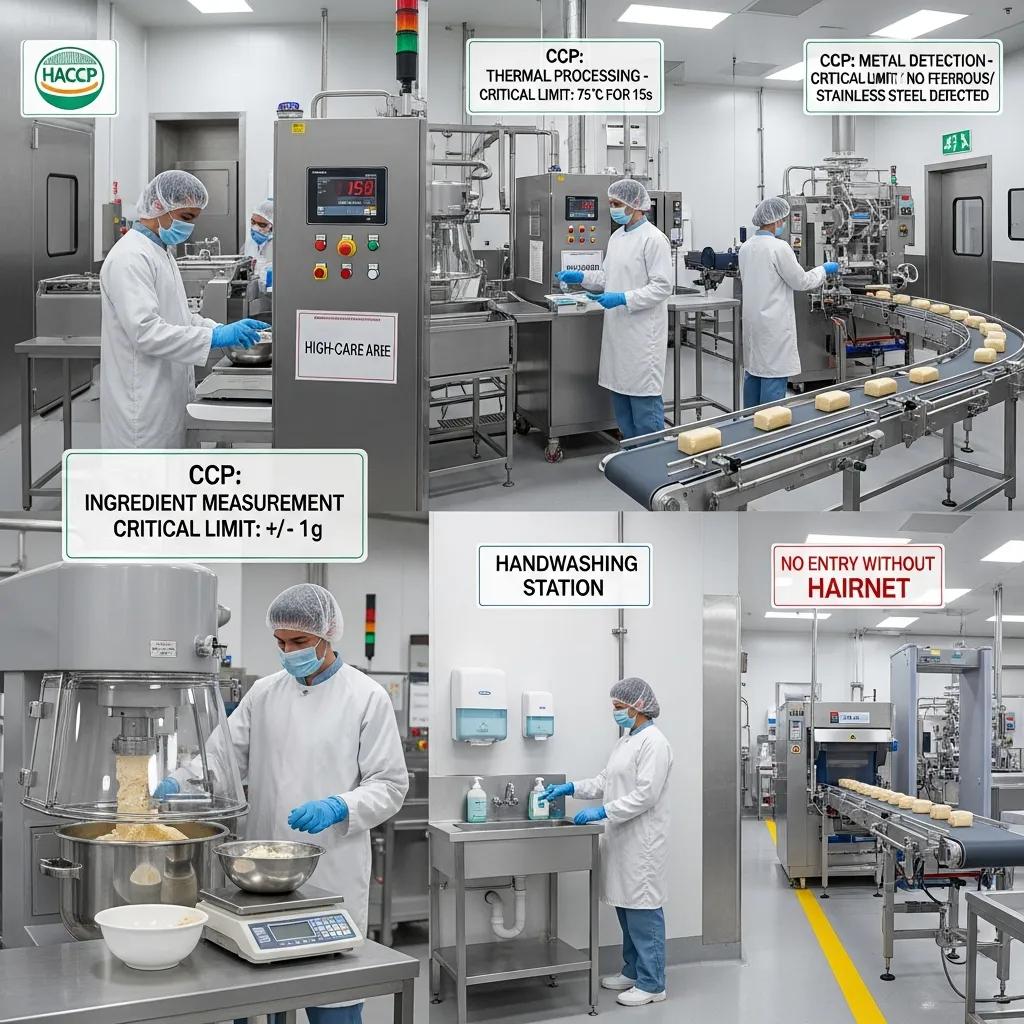
ISO 22000 integrates HACCP as a systematic method for hazard analysis and critical control point determination, while PRPs provide the foundational environmental and operational conditions necessary for safe production. PRPs cover activities such as cleaning and sanitation, pest control, maintenance, and supplier management which reduce background risk and enable HACCP measures to be effective. The ISO 22002 series offers detailed guidance on PRPs, and recent 2024 updates refine requirements for general and sector-specific PRPs to improve consistency across operations.
Combining PRPs and HACCP within the FSMS means organisations validate controls, monitor performance, and use verification steps to confirm that hazard reduction is working in practice. This layered approach results in traceable records and defensible audit evidence, which the next section explains in implementation terms.
What Are the Key Requirements and Implementation Steps of ISO 22000?
ISO 22000 requires organisations to document context, leadership commitment, hazard analysis, operational planning, performance evaluation and continual improvement across the FSMS. Implementation follows a sequence: establish scope and context, perform hazard analysis and determine HACCP control points, implement PRPs, document controls and verification activities, conduct internal audits and management reviews, and continually improve based on monitoring and corrective actions. These phases translate the clauses of ISO 22000 into practical tasks that create demonstrable food safety performance and audit evidence.
A clear, stepwise approach helps teams allocate responsibilities, set measurable objectives and prepare for certification assessments. The table below maps key clauses/processes to their purpose and a practical implementation tip for audit readiness.
Different ISO 22000 clauses and processes map directly to operational actions and audit evidence.
| Clause / Process | Purpose | Practical implementation tip |
|---|---|---|
| Context of the organisation | Define scope and interested parties | Document scope with process maps and stakeholder list |
| Leadership & commitment | Ensure top management responsibility | Record management review minutes and assigned roles |
| Hazard analysis & HACCP | Identify and control food safety hazards | Maintain hazard analysis worksheets and CCP records |
| Operational PRPs | Create baseline operational conditions | Use checklists for cleaning, supplier controls, and maintenance |
| Performance evaluation | Monitor FSMS effectiveness | Implement KPIs, internal audits and verification records |
This EAV-style mapping clarifies how clauses translate into day-to-day practices that auditors expect to see during certification. The following subtopics unpack clause-level actions and how PDCA supports continual improvement.
H3: Which Clauses and Processes Must Food Businesses Follow?
Key clauses require documented context, leadership, planning, support, operation, performance evaluation and improvement. Organisations must maintain documented information on hazard analyses, operational PRPs, control measures, validation/verification evidence and monitoring records. Practically, this means keeping accessible records for cleaning schedules, supplier approvals, CCP logs, corrective actions and management review outputs. Auditors will request routine evidence that controls are implemented as described, so aligning documented procedures with what staff actually do is essential.
Documented information should be concise and audit-focused, aiding traceability during inspections and customer requests. The next subsection explains how PDCA brings these requirements into a cycle of measurable improvement.
H3: How Does the PDCA Cycle Support ISO 22000 Compliance?
The PDCA (Plan-Do-Check-Act) cycle provides a framework to plan hazard controls, implement PRPs and CCPs, monitor effectiveness and act on nonconformities to improve the FSMS. In practice, Plan covers hazard analysis and objectives; Do implements PRPs and control measures; Check uses monitoring, verification and internal audits; Act involves corrective actions and management review to adjust the system. This cyclical approach ensures food safety performance is measurable and continually refined based on empirical evidence.
Using PDCA shifts the FSMS from reactive firefighting to proactive risk management, enabling faster corrective actions and reduced recurrence of issues. The next section describes the concrete benefits organisations gain from certification and how those benefits can be measured.
What Are the Benefits of ISO 22000 Certification for Food Industry Businesses?
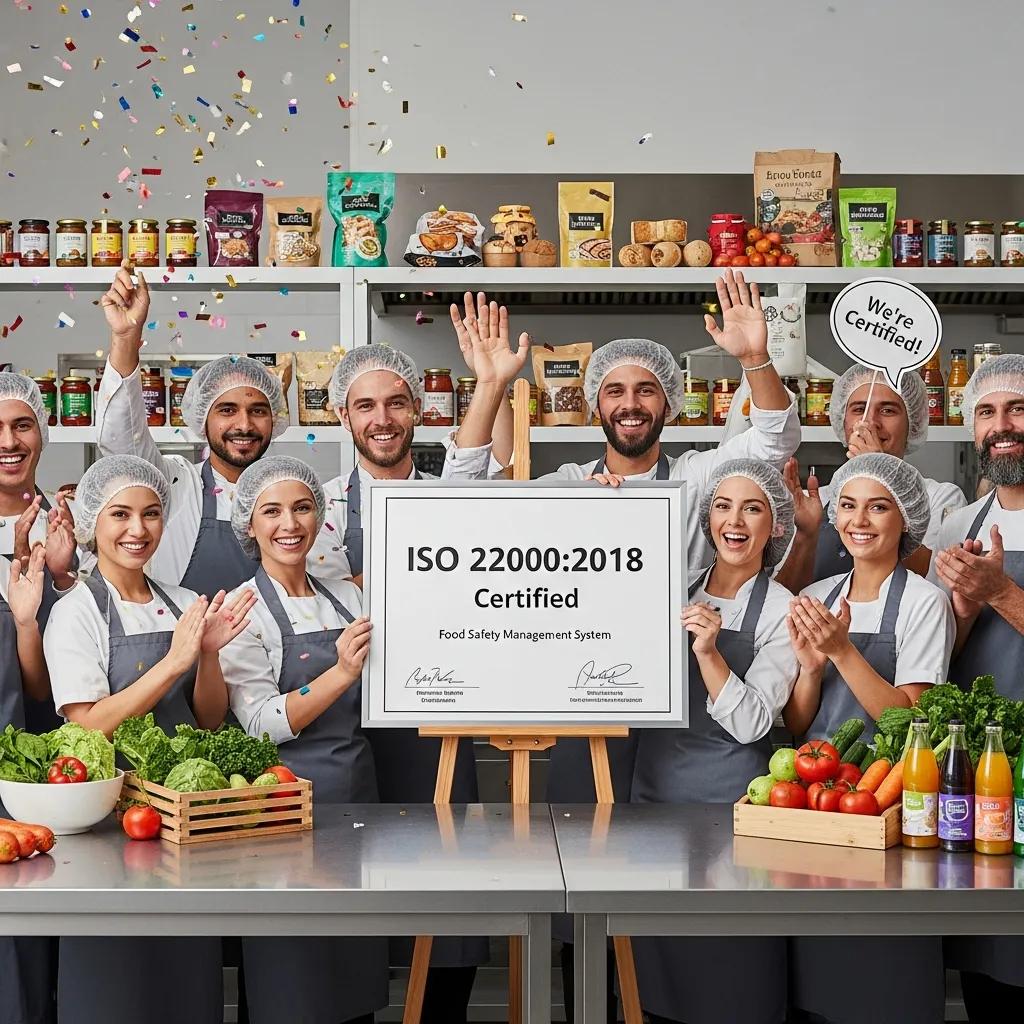
ISO 22000 certification delivers risk reduction, regulatory alignment, and market differentiation by demonstrating a structured FSMS and documented hazard control. Certified organisations typically experience fewer recalls, clearer supplier expectations and stronger buyer confidence, which in turn reduces commercial friction and cost exposure. Internally, the standard drives process discipline and measurable improvement through KPIs for nonconformities, audit findings, and verification results that management can track over time.
Stakeholders value specific, measurable outcomes from certification, so mapping benefits to who cares and how to measure them helps prioritise FSMS investments. The table below connects primary benefits with stakeholders and suggested KPIs to monitor.
| Benefit | Who cares | Metric / KPI to measure |
|---|---|---|
| Reduced recalls | Regulators, buyers | Number of recalls per year; recall cost |
| Improved buyer confidence | Retailers, B2B clients | Tender success rate; supplier scorecards |
| Operational consistency | Operations managers | Nonconformities per audit; on-time deliveries |
| Regulatory compliance | Legal/regulatory bodies | Number of non-compliances; inspection outcomes |
This mapping helps organisations translate certification into business value and governance metrics that buyers and regulators recognise. The following lists and subsections illustrate direct risk reductions and competitive advantages in practice.
ISO 22000 reduces risk and builds consumer trust through consistent controls, and it also creates procurement advantages when buyers assess supplier capability. The next subsection explores measurable trust signals and the competitive benefits certification brings.
H3: How Does ISO 22000 Reduce Risks and Enhance Consumer Trust?
ISO 22000 reduces risk by enforcing preventive controls and verification, which lowers the probability of contamination events and costly recalls. Operational measures such as validated cleaning procedures, supplier approvals and traceability systems reduce hazard exposure and provide documented evidence when incidents occur. Consumer trust increases when organisations demonstrate third-party certification, disclose audit results to customers, and use KPIs such as reduced complaint rates and faster corrective actions.
Measuring effects requires baseline data: track complaints, customer returns and near-miss incidents before and after FSMS changes to show improvement. These metrics make trust tangible and support marketing claims with objective performance indicators.
H3: What Competitive Advantages Does ISO 22000 Provide?
Certification can translate into preferred supplier status, stronger performance in tenders, and reduced insurance or recall liabilities that affect commercial competitiveness. Buyers often shortlist suppliers who can demonstrate robust FSMS records, which simplifies procurement risk assessments and can shorten negotiation cycles. Operational benefits such as fewer production stoppages and clarified supplier expectations also reduce total cost of ownership for customers, reinforcing competitive positioning.
Documenting these advantages through case-style KPIs and supplier scorecards supports commercial discussions and helps sales teams convert certification into measurable contract wins. The next major section compares ISO 22000 to ISO 9001 and explains why many clients expect both standards.
How Does ISO 22000 Compare to ISO 9001 and Why Is ISO 9001 Essential for Key Clients?
ISO 22000 focuses specifically on food safety — controlling hazards to ensure safe food — while ISO 9001 defines requirements for a Quality Management System that ensures consistent product/service quality and customer satisfaction. ISO 22000 and ISO 9001 overlap in management-system elements such as leadership, documented information and continual improvement, but their primary objectives differ: safety versus overall quality and customer focus. ISO 9001 is often requested by major buyers because it demonstrates systemic process reliability and customer-oriented performance monitoring beyond safety alone.
ISO 9001 is often a requirement for key clients. The table below compares both standards side-by-side to clarify focus, typical evidence and business benefits for procurement and compliance purposes.
| Standard | Primary focus | Business benefit / client expectation |
|---|---|---|
| ISO 22000 | Food safety and hazard control | Demonstrable hazard controls, PRPs, HACCP evidence |
| ISO 9001 | Quality management and customer satisfaction | Process stability, complaint handling, continuous improvement |
| Combined implementation | Integrated FSMS and QMS processes | Reduced audit burden, aligned KPIs, stronger buyer assurance |
This comparison shows why many organisations pursue dual certification: combined systems reduce duplication and present comprehensive assurance to customers. The next subsections map principal differences and show how ISO 9001 reinforces FSMS outcomes.
H3: What Are the Main Differences Between ISO 22000 and ISO 9001?
ISO 22000 requires hazard analysis, operational PRPs and HACCP controls targeted at preventing unsafe food reaching consumers, while ISO 9001 emphasises the process approach, product conformity and customer satisfaction metrics. Audit evidence for ISO 22000 focuses on control records, CCP monitoring and validation, whereas ISO 9001 audits target process performance indicators, change control and complaint resolution records. Organisations will therefore maintain different types of documented information and KPIs to satisfy each standard’s audit expectations.
Understanding these differences helps businesses design an integrated management system that satisfies both food safety and broader quality requirements without duplicative processes. The next subsection explains how ISO 9001 mechanisms strengthen FSMS delivery.
H3: How Does ISO 9001 Strengthen Food Safety Management and Client Trust?
ISO 9001 strengthens FSMS by formalising process ownership, defining performance indicators and embedding customer feedback loops that drive corrective actions and continual improvement. The process approach promotes stable inputs and controlled outputs, reducing variability that can lead to safety incidents. Customer-focused mechanisms — such as complaint handling, supplier performance monitoring and risk-based thinking — make organisational responses to safety issues faster and more structured, which increases client trust in supply reliability.
When buyers review supplier capabilities, combined evidence of ISO 22000 and ISO 9001 shows both safety competence and consistent delivery, meeting procurement expectations and often simplifying contractual approval. After explaining standards and market expectations, we turn to 2025 trends that affect FSMS design and certification priorities.
What Are the Latest Trends and Updates in Food Safety and ISO 22000 Standards for 2025?
In 2025, key trends shaping food safety include updates to the ISO 22002 PRP series, greater emphasis on supply chain traceability, and stronger links between sustainability practices and food safety outcomes. Organisations should prepare for ISO 22002:2025 clarifications that standardise PRP requirements and provide sector-specific guidance to ensure consistent baseline controls. Meanwhile, sustainability concerns — such as reduced chemical inputs, animal welfare and resource-efficient operations — are increasingly evaluated for their food safety implications, creating opportunities to align FSMS objectives with environmental goals.
These trends require companies to extend FSMS scope to include supplier sustainability performance and data-driven traceability systems that support both safety and ESG reporting. The next subsections detail the practical PRP changes and how sustainability links to food safety practices.
H3: What Are the Key Changes in the ISO 22002 Prerequisite Programs Series?
ISO 22002:2025 introduces clearer general requirements under new Part 100 and expands sector-specific guidance such as retail and wholesale in Part 7, clarifying expectations for supplier controls, equipment maintenance and environmental monitoring. Practical changes include more prescriptive requirements for documented PRPs, strengthened supplier verification obligations and explicit expectations for traceability mechanisms. Organisations must update PRP documents, verification schedules and supplier contracts to remain audit-ready under the revised guidance.
Adapting to these changes involves gap analysis, updated SOPs and targeted training to ensure operational practice aligns with the new PRP expectations. The next subsection explains how sustainability trends intersect with these operational shifts.
H3: How Do Sustainability and Food Safety Intersect in Current Industry Practices?
Sustainability and food safety intersect where practices that reduce environmental impact also lower safety risks — for example, improved animal welfare can reduce disease vectors, and decreased chemical residues limit contamination risks. Traceability systems used for recall efficiency also enable sustainability verification, creating synergistic data flows that serve both compliance and ESG reporting. Policy trends in antimicrobial stewardship and transparency incentivise suppliers to adopt practices that are both safer and more sustainable.
Aligning FSMS objectives with sustainability goals requires integrated KPIs that measure safety performance alongside resource efficiency and supplier sustainability metrics. Implementing these dual-purpose controls can streamline audits and meet rising stakeholder expectations.
How Can Stratlane Certification Deutschland Support Your ISO 22000 and ISO 9001 Certification Journey?
Stratlane Certification Deutschland combines experienced industry auditors with AI to audit organisations and offers ISO certification services across multiple industries; the site lists ISO 9001 among its certification services and includes a ‚Food‘ industry section emphasizing process-focused quality management. Their integrated approach is designed to support organisations seeking either single or dual certification by providing gap analyses, implementation guidance and certification audits tailored to food-sector needs. Combining human auditor judgement with AI-driven data analysis helps prioritise audit focus areas, identify recurring trends and speed up evidence collection and reporting.
This consultative model reduces client burden by aligning certification activities with business processes, cutting duplication and focusing corrective actions where they deliver the greatest risk reduction. The next subsections outline Stratlane’s dual-certification process and explain how auditors plus AI deliver practical audit advantages.
H3: What Is Stratlane’s Integrated Approach to Dual Certification?
Stratlane’s integrated approach begins with a combined gap analysis that maps ISO 22000 and ISO 9001 requirements to existing procedures, enabling a harmonised documentation set that supports both standards. The process then designs an integrated management system structure, aligns KPIs and schedules combined internal audits and management reviews to reduce audit frequency and administrative load. Clients benefit from a single evidence set and coordinated corrective action plans that demonstrate compliance to both food safety and quality requirements simultaneously.
This approach reduces duplication, clarifies responsibilities and shortens time-to-certification by ensuring that control measures and records satisfy both standards simultaneously. The final subsection describes how the auditor-plus-AI model enhances audit quality and efficiency.
H3: How Do Experienced Auditors and AI Enhance the Certification Process?
Pairing experienced auditors with AI tools enables data-driven audit prioritisation and pattern detection while retaining human contextual judgement for complex assessments. AI can analyse production, supplier and testing data to highlight anomalies, trending nonconformities and areas of emerging risk, allowing auditors to target verification efforts where they matter most. Experienced auditors then apply professional judgement to interpret AI findings, validate root causes and recommend actionable corrective measures that fit the client’s operational reality.
This hybrid model typically reduces time spent on routine evidence collection, increases the accuracy of risk focus during audits and supports predictive risk detection that improves long-term FSMS resilience. ISO 9001 is often a requirement for key clients.