

ISO Zertifizierung für die IT-Branche: Warum ISO 9001 und weitere Standards für IT-Unternehmen unverzichtbar sind
Introduction
ISO certification for IT companies defines formal management-system requirements that align processes, risk controls and stakeholder expectations to measurable outcomes. This article explains how ISO 9001, ISO 27001, ISO 42001 and related standards apply to software development, SaaS and IT support, and why achieving certification translates into procurement access, reduced delivery risk and operational clarity. Readers will learn the mechanics of each standard, pragmatic implementation steps, typical timelines, and how certification impacts KPIs such as defect rates, time-to-resolution and bid win rate. The guide also compares standard synergies, maps benefits to executive metrics, and outlines a practical certification pathway that leverages AI-assisted audits and expert validation where beneficial. Throughout, you’ll find concrete checklists, comparison tables and decision criteria tailored to IT leaders evaluating certification options and preparing their teams for audit readiness.
Warum ist ISO 9001 für IT-Unternehmen entscheidend?
ISO 9001 is a quality management system standard that requires organizations to define processes, measure outcomes and pursue continual improvement, which directly reduces defects and improves predictability for IT services and products. For IT companies, the mechanism is process standardization across development, release and support cycles, producing measurable gains in delivery stability and customer satisfaction. The specific benefit is procurement alignment: many enterprise clients evaluate suppliers on documented quality systems, and ISO 9001 provides objective evidence of process maturity. In practice this means fewer regressions, clearer change control and more reliable SLAs, all of which reduce vendor risk perception. The next section explains how those process improvements manifest in concrete IT quality practices and metrics.
Wie verbessert ISO 9001 das Qualitätsmanagement in der IT-Branche?

ISO 9001 improves IT quality management by formalizing processes such as requirements control, versioned documentation, change control and release gating to prevent regressions and manage technical debt. By requiring documented procedures and objective measures, teams introduce repeatable practices—test coverage criteria, deployment checklists and post-release reviews—that lower defect rates and shorten mean time to recovery. Organizations typically see improvements in defect density and fewer emergency patches when PDCA cycles are embedded into sprint retrospectives and incident handling. These structured changes also facilitate supplier management for third-party components and cloud services. Understanding these mechanisms leads naturally to how ISO 9001 affects customer perception and competitive positioning.
Welche Rolle spielt ISO 9001 bei der Kundenzufriedenheit und dem Wettbewerbsvorteil?
ISO 9001 strengthens customer satisfaction by making delivery performance and complaint handling transparent, auditable and measurable, which reduces perceived procurement risk and speeds contract approvals. The standard’s emphasis on customer requirements and feedback loops helps IT teams prioritize fixes and product enhancements that drive retention and Net Promoter Score improvements. For sales and bids, a certified QMS often improves evaluation scores in RFPs and shortlists, increasing win rates in competitive procurements. Quantitatively, vendors with mature quality systems tend to report reduced rework and higher on-time delivery—metrics that directly influence client confidence and commercial outcomes. The following section contrasts ISO 9001 with other standards IT teams commonly consider.
Welche ISO-Standards sind für IT-Unternehmen relevant?
IT organizations commonly pursue a portfolio of ISO standards that address complementary domains: quality (ISO 9001), information security (ISO 27001), AI governance (ISO 42001) and service management (ISO 20000). Each standard targets a different risk surface—process reliability, confidentiality/integrity/availability, responsible AI practices and service delivery respectively—so combined certification creates layered assurance for clients and regulators. Selecting which standards to prioritize depends on business model: SaaS providers handling sensitive data often start with ISO 27001, product teams selling into regulated industries may lead with ISO 9001, and AI product owners should consider ISO 42001 when models affect safety or fairness. Below is a concise comparison to help IT leaders evaluate priorities before committing resources to implementation.
Different standards provide distinct advantages for IT organizations and can be stacked based on risk and market demand.
| Standard | Primary objective / scope | Key benefits for IT companies |
|---|---|---|
| ISO 9001 | Quality Management System for consistent delivery | Improves process discipline, reduces defects, strengthens procurement position |
| ISO 27001 | Information Security Management System (ISMS) | Protects sensitive data, reduces breach risk, meets client security requirements |
| ISO 42001 | AI Management System for trustworthy AI | Governs model lifecycle, mitigates ethical and compliance risks, enables responsible AI claims |
| ISO 20000 | IT Service Management System (ITSM) | Standardizes incident/change processes, improves SLA performance, supports managed services contracts |
This table clarifies when each standard is most relevant and how stacking them increases client assurance and operational resilience.
Was sind die Vorteile von ISO 27001 für Informationssicherheit in der Softwareentwicklung?
ISO 27001 provides a structured ISMS that applies risk-based controls to software development lifecycles, data handling practices and operational infrastructure, reducing likelihood and impact of breaches. The mechanism involves formal risk assessment, control selection (access management, encryption, logging) and continuous monitoring, which together raise the security baseline for code repositories, CI/CD pipelines and production environments. For software teams, implementing the standard clarifies responsibilities for secrets management, third-party dependencies and incident response, which in turn lowers potential compliance costs and customer churn after security incidents. Improved evidence of secure practices also shortens procurement cycles with security-conscious clients. The next subsection explores AI-specific governance where emerging standards address additional risks.
Further research highlights the specific considerations and impacts of implementing ISO 27001 within a software development context.
ISO 27001 Implementation in Software Development
ABSTRACT: ISO 27001 information security management standard provides guidelines to organizations to evaluate and document their information security processes. However, information security management standards have been criticized to focus on the existence of the process but not its actual content. This Master’s Thesis aims to assess ISO 27001’s suitability to software development environment and its impact on employees’ practices and experiences in secure soft-ware development.
ISO 27001 information security management standard’s implementation in software development environment: A case study, 2020
Wie unterstützt ISO 42001 das verantwortungsvolle Management von KI-Systemen in der IT?
ISO 42001 defines governance and lifecycle controls tailored to AI systems, focusing on risk assessments, validation, monitoring and transparency to ensure models behave as intended and do not introduce unacceptable harms. IT teams can apply the standard to model development, dataset management and post-deployment monitoring, establishing roles for data owners, model validators and oversight committees that reduce bias, drift and compliance gaps. Integrating ISO 42001 with ISO 27001 and ISO 9001 closes governance loops: security protects data, quality controls enforce development rigor, and AI governance ensures ethical outcomes. Practical adoption includes documented evaluation criteria for model performance and an incident playbook for model-related failures, which improves stakeholder trust and procurement readiness.
The integration of AI management systems like ISO 42001 with established quality management systems such as ISO 9001 is crucial for comprehensive governance.
Integrating AI with ISO 9001 Quality Management Systems
Discussion” gives a summary of the key elements that need specific attention when creating a roadmap forwards an integrated ISO 9001 – ISO/IEC 42001 management system (MS).
An approach to integrate Artificial Intelligence in ISO 9001-based quality management systems, T Gueorguiev, 2025
Wie verläuft der Zertifizierungsprozess für IT-Unternehmen bei Stratlane?
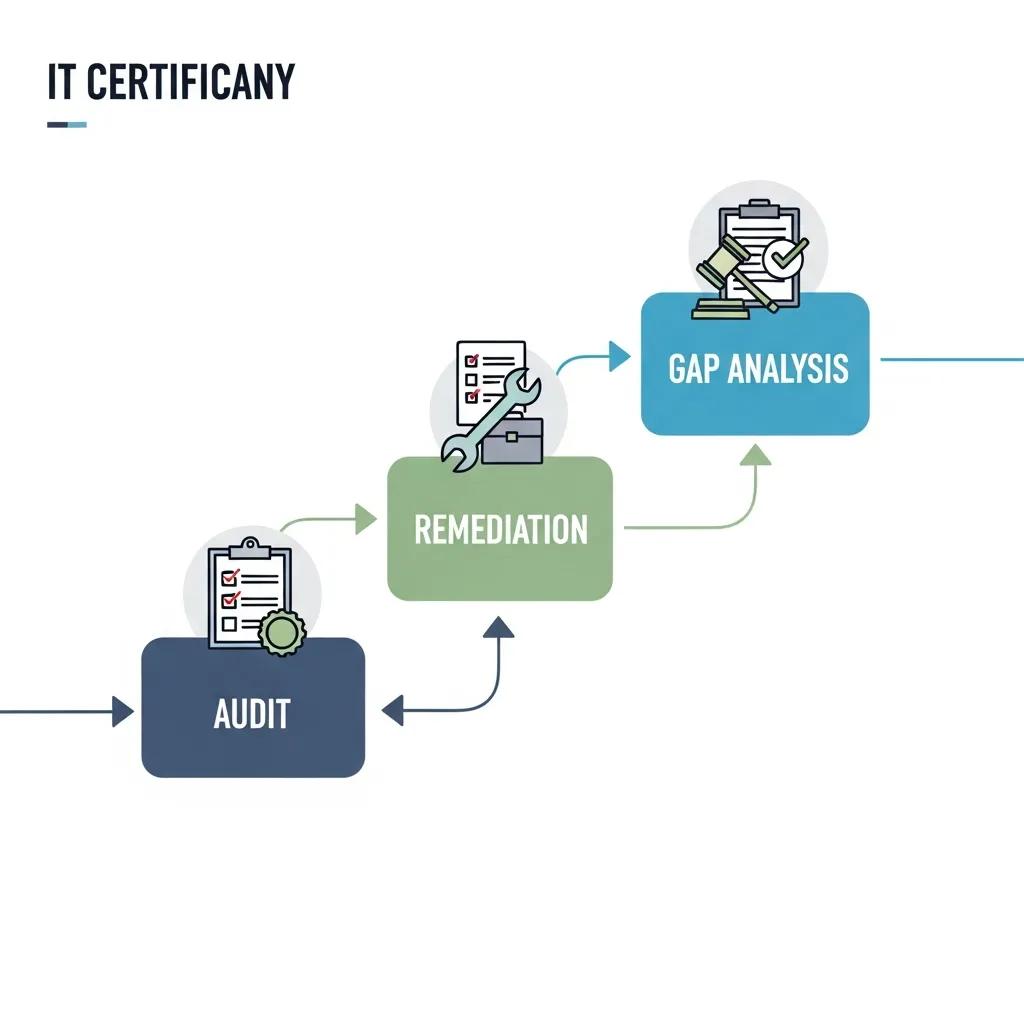
The certification pathway for IT firms generally follows phases—gap analysis, remediation, audit and surveillance—with clear responsibilities, deliverables and timelines at each stage to move from readiness to certified status. Stratlane Certification Deutschland combines AI-driven evidence aggregation with expert-led audits to accelerate evidence collection and focus expert review on contextual judgment rather than repetitive sampling, reducing client hours while preserving audit rigor. The overall effect is faster gap identification and targeted remediation plans that align with business priorities and procurement timelines. Below is a process table that clarifies steps, expected inputs and outcomes so IT teams can plan resources and milestones before engaging a certification partner.
The standard certification phases, responsibilities and outcomes are summarized for IT companies.
| Phase | Duration / input required | Outcome |
|---|---|---|
| Gap analysis | 1–3 weeks; existing documentation and key stakeholder interviews | Prioritized list of nonconformities and remediation roadmap |
| Remediation & implementation | 4–12 weeks; process updates, controls, training | Documented QMS/ISMS and evidence artifacts ready for audit |
| Certification audit | 1–5 days onsite/remote; evidence sampling and interviews | Certification decision and initial certificate issuance |
| Surveillance & continuous improvement | Annual surveillance audits; ongoing metrics | Maintains certification and drives incremental improvement |
This timeline clarifies where client effort is required and what deliverables result from each step, helping teams plan internal resources and risk mitigation.
Welche Schritte umfasst der AI-gestützte und expertengeführte Auditprozess?
An AI-assisted audit begins with automated evidence aggregation—indexing policies, configurations and logs—followed by risk-prioritization algorithms that surface high-impact nonconformities for expert scrutiny and targeted interviews. Experts then validate context, probe complex processes and assess effectiveness where AI cannot interpret nuance, such as organizational intent or leadership engagement. This hybrid model concentrates human effort on decision points while automating repetitive evidence checks, shortening audit windows and reducing disruption to engineering teams. Example artifacts commonly sampled include change logs, access control lists, incident records and release checklists, which AI can pre-map into an audit-ready dossier. The next section outlines typical overall durations and common requirements IT organizations must prepare.
Wie lange dauert die ISO-Zertifizierung und welche Anforderungen sind zu erfüllen?
Certification timelines vary by organization size and maturity: a small IT shop with documented practices may complete remediation and audit within 2–4 months, while larger or heavily regulated enterprises typically require 4–12 months for full implementation. Core requirements include a documented management system (QMS or ISMS), defined processes for risk assessment and incident handling, evidence of management review and internal audits, and personnel trained on relevant procedures. Factors that extend timelines include fragmented processes, legacy technical debt, and unresolved third-party supplier risks; conversely, pre-existing process discipline and centralized documentation accelerate readiness. Preparing standard artifacts—policy documents, risk registers, change logs and performance metrics—early reduces back-and-forth during audit and shortens the certification path.
Welche konkreten Vorteile bietet die ISO-Zertifizierung für IT-Leiter und Geschäftsführung?
ISO certification converts technical controls into executive-level business outcomes: measurable reductions in incident impact, improved contract conversion rates and clearer operational KPIs that support strategic decision-making. For leadership, the mechanism is alignment—management commitment and documented processes that translate into reliable service delivery and predictable commercial performance. The concrete advantages include fewer customer escalations، improved SLA compliance und stronger leverage in procurement negotiations where certification scores favor vendors. Below is a benefits-to-KPI mapping that helps IT managers quantify expected improvements and present a business case to stakeholders.
Executives can map certification outcomes to core KPIs to justify investment and measure results.
| Benefit area | KPI / Metric impacted | Expected improvement or example |
|---|---|---|
| Procurement access | RFP win rate | Higher shortlisting probability due to reduced vendor risk |
| Operational efficiency | Mean time to resolution (MTTR) | Shorter resolution times through standardized incident processes |
| Customer satisfaction | Number of customer complaints | Reduction in repeat complaints through root-cause controls |
| Security posture | Time to detect and remediate breaches | Faster detection and response driven by ISMS controls |
This mapping enables leaders to forecast ROI and prioritize certification components that deliver the highest commercial value.
Wie steigert ISO 9001 die operative Effizienz und das Risikomanagement?
ISO 9001 drives operational efficiency by enforcing documented workflows, defined acceptance criteria and regular review mechanisms that reduce variability in development and operations. Process controls—such as standardized ticket triage, release gating and defined rollback procedures—lower rework and stabilize release cycles, which improves MTTR and throughput. Risk-based thinking mandated by the standard forces teams to identify failure modes and implement preventive controls, shifting effort from firefighting to proactive mitigation. When these practices are combined with measurable KPIs, management gains visibility and can reallocate resources more effectively to strategic initiatives, improving both efficiency and resilience.
Welche ROI-Erfolge und Kundengewinnungen zeigen Fallstudien aus der IT-Branche?
Industry evidence and anonymized case summaries commonly show that certification contributes to tangible commercial outcomes: faster procurement cycles, higher contract values and measurable reductions in operational incidents after implementation. Companies report improved bid success in regulated sectors where certification is a vendor requirement and documentable process improvements that reduce rework and support scalability. While results vary by context, typical ROI drivers include reduced incident remediation costs, less customer churn after major incidents and improved margins from fewer emergency fixes. These outcomes illustrate why decision-makers treat certification as both a risk-management investment and a commercial enabler.
Wie vergleicht sich ISO 9001 mit ISO 27001 und ISO 42001 für IT-Unternehmen?
ISO 9001 focuses on quality and process consistency, ISO 27001 secures information assets and ISO 42001 governs AI lifecycle and ethical use; together they form a complementary risk-management stack for modern IT organizations. The main differences lie in control targets—process outputs for quality, confidentiality/integrity/availability for security, and model governance for AI—yet all share common management-system elements like leadership commitment, risk assessment and continuous improvement. Integrating multiple standards reduces audit duplication by aligning documentation, risk registers and internal audit programs across frameworks. The decision to pursue one or more standards should depend on client expectations, data sensitivity and product exposure to AI risks.
Welche Synergien und Unterschiede bestehen zwischen den ISO-Standards?
Synergies arise because all three standards require documented context, leadership involvement and risk-based processes, allowing shared artifacts such as risk registers, incident procedures and management review outputs to serve multiple audits. Differences appear in control specifics: ISO 27001 mandates technical controls for access and encryption, ISO 9001 emphasizes process performance metrics and customer focus, and ISO 42001 requires model validation, bias monitoring and explainability measures. By mapping overlapping requirements, organizations can create integrated management systems that reduce duplication and audit effort while meeting the distinct objectives of each standard. This integrated approach supports scalable compliance across product lines.
Wie wählen IT-Unternehmen die passenden Zertifizierungen für ihre Bedürfnisse aus?
Choosing the right certifications requires assessing procurement requirements, the sensitivity of processed data, product exposure to AI risks and strategic market targets; this decision framework helps prioritize effort and budget. Start with client and regulator demands: if customers require security assurances, ISO 27001 should lead; if process maturity and bid competitiveness are primary, ISO 9001 is the logical starting point; if AI models materially affect outcomes, ISO 42001 becomes necessary. A checklist approach—evaluate stakeholder requirements, map internal risks, estimate remediation effort and forecast commercial upside—produces a prioritized roadmap that balances risk reduction and market access. The following list offers practical decision criteria to guide selection.
Key criteria IT leaders should use when prioritizing ISO certifications:
- Client requirements: Prioritize standards explicitly requested in RFPs or contracts.
- Data sensitivity: Choose ISO 27001 when handling personal or regulated data.
- Product risk: Select ISO 42001 when AI-driven decisions affect safety or fairness.
Applying these criteria produces a clear sequencing strategy that aligns compliance investment with commercial priorities.
Welche häufigen Fragen stellen IT-Unternehmen zur ISO-Zertifizierung?
IT companies commonly ask whether ISO 9001 is necessary for clients, how much certification costs, and how implementation impacts day-to-day operations; concise answers help procurement and engineering teams plan realistically. Below are focused responses aimed at purchasing and technical stakeholders to clear common misconceptions and set expectations for timelines, costs and ongoing maintenance. The final paragraph in this section also outlines how specialized certification providers can reduce internal burden through efficient audit models and expert guidance.
Warum ist ISO 9001 für IT-Kunden ein Muss?
ISO 9001 is often a de facto requirement because it provides verifiable evidence of process maturity and consistent delivery, which reduces vendor selection risk for large clients and public-sector purchasers. The standard formalizes customer-focused processes and feedback mechanisms, which improves predictability and complaint resolution—traits buyers prioritize during procurement. Many evaluation frameworks explicitly score quality management evidence, so lacking ISO 9001 can be a competitive disadvantage even when technical capability is strong. Given this procurement reality, organizations justify certification as a commercial necessity rather than purely an internal quality exercise.
Wie hoch sind die Kosten und wie gestaltet sich die Implementierung?
Implementation costs depend on company size, existing process maturity and the number of standards pursued; major cost components include internal person-hours for remediation, possible consultancy support, and external audit fees. Rather than fixed prices, leaders should estimate effort in person-months and categorize costs into planning, remediation and audit phases; staged implementation and leveraging existing documentation can significantly reduce expense. Many organizations reduce cost by prioritizing high-impact controls first and aligning audits to cover multiple standards simultaneously. Early scoping and a realistic resource plan are the most effective levers for controlling total implementation cost.
For IT teams ready to begin certification, partnering with a provider that uses automated evidence aggregation and expert-led audits can reduce internal disruption and shorten timelines. Stratlane Certification Deutschland offers AI-driven audit workflows combined with expert validation tailored to IT contexts—helping software, SaaS and support providers accelerate readiness for ISO 9001, ISO 27001 and ISO 42001 while focusing internal effort on remediation and value-adding improvements. If your procurement pipeline requires certification evidence or you need a pragmatic roadmap to compliance, engaging a specialized partner can convert certification from a technical burden into a strategic advantage.